Military Factory
Military Pay Chart
Global Firepower
Military Industrial Complex
Second World War
Home
Military Pay Scale
Military Ranks
Small Arms
Aircraft
Land Systems
Navy
Education
Military Factory Facebook Logo
flag of United States

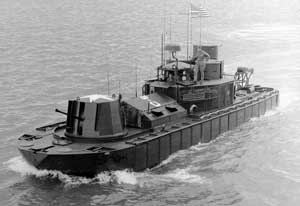
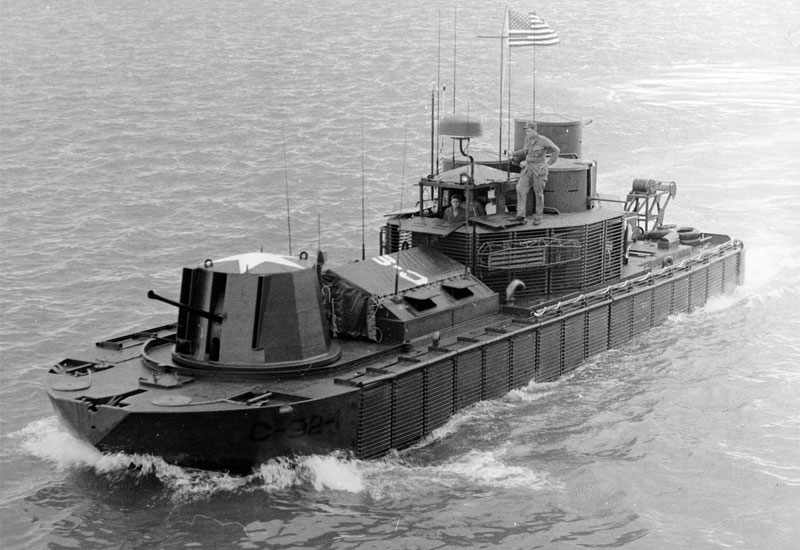
Command and Communications Boat (CCB) Riverine Warfare Command and Communications Platform (1964)

Authored By JR Potts, AUS 173d AB | Last Updated: 4/18/2011

CCBs were all-important to the tactical scope of American riverine operations in the Vietnam War.

Find a School Near You
Follow Military Factory on Facebook:
Trending on Military Factory:
Recent Articles:
Not since the Civil War of 1861 had America found a need for a "brown water navy" - that is, a naval force charged with combat in rivers. In 1966, the United States had committed more than 385,000 troops to the war effort against North Viet Nam in the Vietnam War. The key region of the Mekong Delta totaled an area of 15,000 square miles and, thusly, had fewer troops assigned to police her due to geographic reasons. The Delta was located at the southernmost tip of South Viet Nam, far from the North and, having few roads, was dominated by rivers and canals. To interdict enemy resupply lines utilizing waterways and move IV Corps elements quickly from one area to the next required new methods of transport. To accomplish this, the United States Army and Navy created the "Mobile Riverine Force" (MRF) and these groups were given new boats to accomplish a variety of missions ranging from armed patrol to dedicated assault. To allow vital command and communications with the rest of the flotilla, an information boat was needed and, thusly, the "Command and Communications Boat" (CCB) was devised. The MRF was designed to support an army infantry brigade and an artillery battalion from the 9th Army Infantry Division. Additional support ships made the MRF a self-contained amphibious assault force with the CCB boats acting as the information mission center.

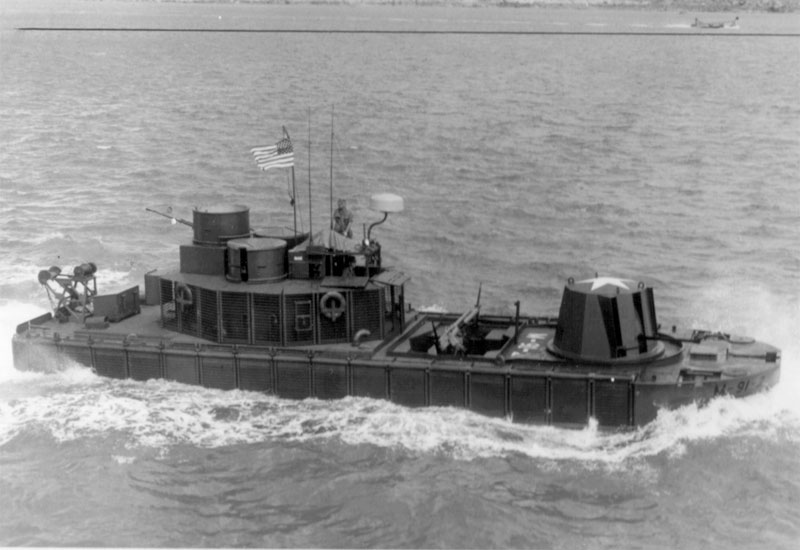
MRF squadrons were each comprised of two divisions consisting of thirteen "Armored Troop Carrier" (ATC) boats each, eight "Assault Support Patrol Boats" (ASPBs), five Monitors between the two divisions and one Refueler boat. To each division was assigned a single CCB command Monitor. The design of a basic CCB boat was essentially a Monitor-class vessel with a command superstructure built between the forward turret and the wheelhouse. The hull was nothing more than a World War 2-era Landing Craft Mechanized (LCM) and she was made of steel, measuring some 60 feet long after her conversion (up from the original's 56 feet length). She was 17 feet wide with a draft of 3 feet, 6 inches, suitable for traversing river waterways with relative ease. The deck, gun turrets, wheelhouse and "Combat Information Center" "CIC" shelter were fitted with up to 10 tons of armor for protection. Quarter-inch armor plate was used as was "bar" armor that surrounded vital areas. Bar armor reduced armor weight and served to detonate rocket grenades fired from the shore before they hit critical crew areas of the boat. Air conditioning was installed for crew comfort in the jungle setting.

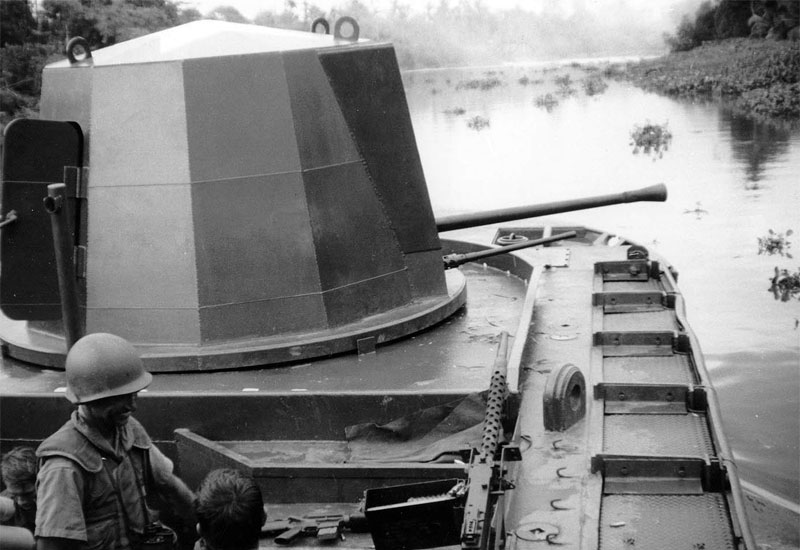
The Monitor, when fitted as a CCB boat, was still used as the "battleship" of the riverine fleet for she could be fielded with heavy armament to suit mission requirements. One such variation fitted a 105mm howitzer system (with 40mm autocannon) while another utilized a 81mm mortar. Specialized versions fitting 2 x 200mm Napalm flame throwers were known collectively as "Zippos". Additional weapons were standard across all later versions and included use of 20mm cannons, 2 x 12.7mm Browning air-cooled heavy machine guns and 7.62 M60 general purpose air-cooled machine guns. The single shot 40mm M79 grenade launcher was another common sight on such river vessels as were 40mm Mk 18 belt-fed automatic grenade launchers. These armaments were further backed by any personal arms carried by the crew such as pistols, rifles and automatic rifles. Such an armament load could help the crew bring "rain" against a target or target area.

The CIC on the CCB boat was used by a commander to communicate with other boats in the convoy, in essence acting as a hub for tactical information mission control. Each CCB boat was fitted with a Pathfinder 1900N radar, 6 x AN/VSC 46 radio, 2 x GRA-39 Prog V, 2 x AN/GRC 106 radio, 1 x AN/PRC 27 radio, 1 x AN/PRC 25 radio. The boat, also being in contact with elements of IV Corps, was able to receive up-to-the-minute mission information and convey it to all the MRF squadron boats while also receiving terrain and combat conditions from the flotilla itself. This network of communication inevitably increased the success rate of a given mission.

Despite the loss of South Vietnam to the North, the Brown Water Navy served a critical role during actions in the Vietnam War. Her operations also included use of the valuable Patrol Boat, Riverine (PBR) crafts as featured in the Hollywood motion picture "Apocalypse Now" and the fabled "Swift Boats". Deadly and hectic firefights were common during operations in this sector of the war where an enemy could easily wait concealed along shores in ambush and many Army and Navy personnel lost their lives in service against such an enemy. Towards the end of American involvement in the Vietnam War, CCBs and many other pieces of US equipment were transferred over to the forces of South Vietnam to continue the fight. These ultimately fell to the North.
Text ©2003-2013 www.MilitaryFactory.com • All Rights Reserved • No Reproduction Permitted
MilitaryFactory.com does NOT sell equipment/weaponry. Material presented throughout this website is for historical and entertainment value and should not to be construed as usable for hardware restoration, maintenance or general operation. Please consult manufacturers for such information. Our disclaimer. Email corrections / Comments to MilitaryFactory at Gmail dot com.
Picture of Command and Communications Boat (CCB)
Pic of the Command and Communications Boat (CCB)
Image of the Command and Communications Boat (CCB)
View All Images (3)

Specifications for the
Command and Communications Boat (CCB)
Riverine Warfare Command and Communications Platform


Country of Origin: United States
Initial Year of Service: 1964
Operators: North Vietnam; South Vietnam; United States


Crew: 11


Length: 61ft (18.59m)
Beam: 17.5ft (5.33m)
Draught: 3.4ft (1.04m)
Displacement: 83tons


Machinery: 2 x 64HN9 diesel engines developing 220 horsepower at 2,100rpm to 2 x shafts.


Surface Speed: 8.5kts (10mph)
Range: 150miles (241km)


Armament:
Type 1:
1 x 81mm mortar
1 x 40mm autocannon
1 x 20mm cannon
3 x 40mm M79 grenade launchers
2 x Mk 18 automatic grenade launchers
2 x 12.7mm Browning heavy machine guns
4 x 7.62mm M60 general purpose machine guns

Type 2 - Flame (Zippo):
2 x 20mm cannons
2 x 200mm Flamethrowers
3 x 40mm M79 grenade launchers
2 x 12.7mm Browning heavy machine guns

Type 2 - Howitzer:
1 x 105mm howitzer
2 x 20mm cannons
3 x 40mm M79 grenade launchers
2 x 12.7mm Browning heavy machine guns
1 x 7.62mm M60 general purpose machine guns


Ship Class: Modified Monitor
Number-in-Class: 25
Ships-in-Class: Not Applicable.

ALL NAVY SHIP CATEGORIES
Site Disclaimer | Privacy Policy | Site Map | MF Origins


©2013 www.MilitaryFactory.com • Content ©2003-2013 MilitaryFactory.com • All Rights Reserved • Site Contact Email: militaryfactory at gmail dot com. The "Military Factory" name and MilitaryFactory.com logo are registered ® trademarks and protected by all applicable domestic and international intellectual property laws.


Top MF Stuff: 2013 Military Pay Scale | Military Ranks | WW2 Weapons | Sniper Rifles | Kts to Mph | WW1 Aircraft | Automatic Rifles | Aircraft Cockpits | Vietnam War Weapons | Main Battle Tanks | Submachine Guns | Shotguns | French Military Victories


Most photographic images appearing on this site are courtesy of the United States Department of Defense and are approved for public use. Other images acquired through the public domain. Digital art work courtesy of Dan Alex. Business Consulting by Kyle Williams. Material presented throughout this website is for historical and entertainment value and should not to be construed as usable for hardware restoration, maintenance or general operation. Please consult manufacturers for such information.


eXTReMe Tracker