Leading up to the Islamic Revolution, Iran received its military support from Western players such as the United States. After the revolution, such support ended and a relationship evolved with the Soviet Union to which the Iranian Army was the receiver of various Russian weapons, aircraft and vehicles. However, combat actions in the long, drawn-out affair that was the Iran-Iraq War of the 1980s clearly showed the obsolete nature of the Russian systems and support for Western originated weapons was clearly a disadvantage for the acting regime. It was, therefore, decided to begin a new Iranian initiative in which the nation would no longer have to depend on foreign help to flex its military might in the region. To that end, the Boragh, a tracked armored construct, was engineered to become the Iranian Army's primary indigenously designed and produced Armored Personnel Carrier (APC). Production of the Boragh APC is believed to have begun in 1997 under the Defense Industries Organization banner of Iran.
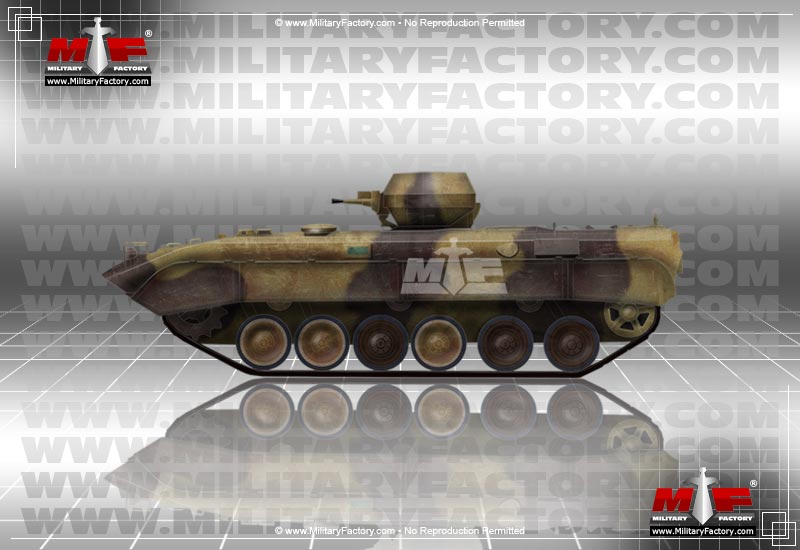
The Boragh bears a strong resemblance to the original Soviet-era BMP-1 armored personnel carrier but is believed to be derived from the Chinese copy - the Type 86. The vehicle promotes a low profile with a nearly flat glacis plate. The chassis is straddled by a six-wheeled track arrangement featuring the drive sprocket at front and the track idler at rear. The hull roof is flat saw for any armament installations. The rear of the vehicle is squared off and holds the fighting compartment entry/exit doors for the passengers. The Boragh is crewed by three primary personnel that includes the driver, vehicle commander. and dedicated gunner to manage the turret. There is room for eight passengers in the rear fighting compartment, seated in rows of four personnel, each group back-to-back along the vehicle's centerline. The vehicle is protected by an integrated NBC (Nuclear, Biological, Chemical) system. All primary crew positions are given infrared night-vision sighting devices to aid in night operations.
While principally an armored personnel carrier, the Boragh is armed with a point defense system consisting of a heavy caliber 12.7mm Soviet DShK 1938/46 series machine gun for anti-aircraft and personnel suppression duty. This weapon system is afforded up to 1,000 rounds of ammunition. Some versions have been seen with a shield protecting the open-air gun emplacement. In other Boragh variants, the vehicle is armed for a more offensive battlefield role and armament is broadened to include a 30mm automatic cannon with coaxial 7.62mm PKT machine gun (infantry fighting vehicle variant), a 120mm caliber field mortar (mortar carrier variant) or the Toophan anti-tank guided missile launcher with reloads. At any rate, the base chassis can be utilized for a variety of battlefield needs as the Iranian Army requires.
The Boragh is powered by a single diesel-fueled V8 engine delivering up to 330 horsepower fitted to the front of the vehicle. This supplies the vehicle with a top road speed of 65 km per hour and an off road speed of 45 km per hour. Operational range is listed at 550 km. The chassis sits atop a torsion bar suspension system for improved performance qualities. The fuel provides the vehicle with an impromptu smoke screen system by injecting raw fuel into the powerplant to produce the needed smoke. The Boragh - like the BMP-1 before it - is thought to be fully amphibious, propelled in the water by its own tracks.
The Boragh APC entered frontline service in 1997 and has seen inception in the armies of Iran, Kazakhstan and Sudan. The Iranian and Kazakhstan armies both maintain inventory levels of about 40 vehicles apiece while Sudan, who manufactures the type locally to an extent, has seen at least ten vehicles delivered as of this writing. In Sudanese service, the Boragh is designated as the "Khatim 1" and is produced by the MIC concern.
Additional Iranian Boragh variants include a field munitions resupply vehicle and self-propelled howitzer platform. The SPG version has been developed in two distinct forms known as the "Raad-1" and "Raad-2" ("Thunder-1" and "Thunder-2)". The main difference between the two developments is the turret - the former utilizing that of the 2S1 Gvozdika with the latter utilizing an M109A1-style box structure.
The advanced armament APC, 120mm mortar carrier and self-propelled howitzer forms were unveiled in 2002. The Raad-1 ("Thunder-1") Self-Propelled Howitzer features the chassis of the Boragh - complete with hull superstructure, running gear, and track system - while sporting a 122mm howitzer in a powered 2S1 turret.
Power & Performance Those special qualities that separate one land system design from another. Performance specifications presented assume optimal operating conditions for the DIO Boragh Armored Personnel Carrier (APC).
1 x V8 air-cooled diesel engine developing 330 horsepower. Installed Power
40 mph 65 kph Road Speed
342 miles 550 km Range
Structure The physical qualities of the DIO Boragh Armored Personnel Carrier (APC).
3 (MANNED) Crew
22.0 ft 6.72 meters O/A Length
10.2 ft 3.1 meters O/A Width
5.4 ft 1.66 meters O/A Height
28,219 lb 12,800 kg | 14.1 tons Weight
Armament & Ammunition Available supported armament, ammunition, and special-mission equipment featured in the design of the DIO Boragh Armored Personnel Carrier (APC).
Armored Personnel Carrier:
1 x 12.7mm DShK 1938/46 heavy machine gun
Infantry Fighting Vehicle:
1 x 30mm 2A42 autocannon in turret
1 x 7.62mm PKT coaxial machine gun
Mortar Carrier:
1 x 120mm mortar
Self-Propelled Howitzer:
1 x 155 main gun
Anti-Tank Missile Carrier:
4 x Toophan anti-tank guided missiles
AMMUNITION: Dependent upon production version; 1,000 x 12.7mm ammunition for standard APC form.
Variants Notable series variants as part of the DIO Boragh family line.
Boragh APC - Standard Armored Personnel Carrier; 1 x 12.7mm heavy machine gun; seating for eight combat-ready personnel.
Boragh IFV - Infantry Fighting Vehicle; fitted with turret mounting 30mm autocannon and 7.62mm coaxial machine gun.
Boragh 120mm - Mortar Carrier; fitted with 120mm field mortar.
Boragh ATGM - Guided Missile Launcher Carrier; fitted with Toophan anti-tank missiles.
Boragh Resupply - Ammunition Resupply Vehicle
Raad-1 (Thunder-1) - Self-Propelled 122mm Howitzer; turret based on Soviet 2S1 Gvozdika SPG.
Raad-2 (Thunder-2) - Self-Propelled 155mm Howitzer; turret based on American M109A1 SPG.
Operators Global customers who have evaluated and/or operated the DIO Boragh. Nations are displayed by flag, each linked to their respective national land systems listing.
Total Production: 100 Units Contractor(s): Defense Industries Organization - Iran / MIC - Sudan
[ Kazakhstan; Iran; Sudan ]
1 / 1
Image copyright www.MilitaryFactory.com; No Reproduction Permitted.
Going Further... The DIO Boragh Armored Personnel Carrier (APC) appears in the following collections:
The "Military Factory" name and MilitaryFactory.com logo are registered ® U.S. trademarks protected by all applicable domestic and international intellectual property laws. All written content, illustrations, and photography are unique to this website (unless where indicated) and not for reuse/reproduction in any form. Material presented throughout this website is for historical and entertainment value only and should not to be construed as usable for hardware restoration, maintenance, or general operation. We do not sell any of the items showcased on this site. Please direct all other inquiries to militaryfactory AT gmail.com. No A.I. was used in the generation of this content.