Military Factory
Military Pay Chart
Global Firepower
Military Industrial Complex
Second World War
Home
Military Pay Scale
Military Ranks
Small Arms
Aircraft
Land Systems
Navy
Education
Military Factory Facebook Logo
flag of United Kingdom

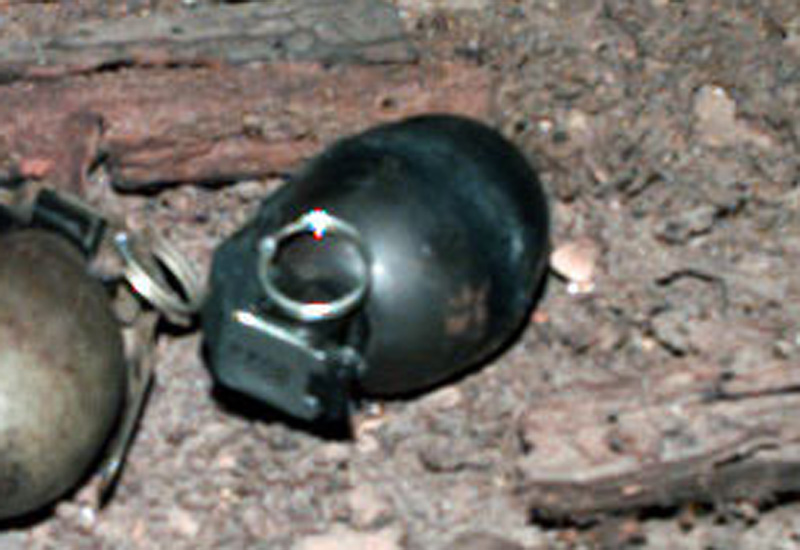
L2 (Grenade) Anti-Personnel Fragmentation Hand Grenade (1950)

Authored By Staff Writer | Last Updated: 4/7/2013

The L2A2 was the British military designation of the American M26 series.

Find a School Near You
Follow Military Factory on Facebook:
Trending on Military Factory:
Recent Articles:
L2 marked the British military version of the American M26 fragmentation hand grenade that appeared in the early 1950s. The M26 was developed in the post-World War 2 market to replace the wartime Mk II series which gave solid, if unspectacular, service throughout the conflict. The M26 was of a smooth-bodied design, consisting of upper and lower metal sections joined at a horizontally-running seam. The safety device was attached to its top in the usual way while squared-off bottom allowed for resting the grenade on surfaces. Due to its distinct shape - a vast departure from the wartime "pineapple" types - the M26 garnered the nickname of "lemon grenade". All British production was handled by Royal Ordnance Factories and differed primarily in its fuse assembly design. L2 grenades replaced No. 36M grenades in British military service.

The M26 (and therefore the British L2 series) improved upon its fragmentation principles through use of a pre-notched coil added between the filling and out shell casing layers. The filling was of Composition B and weighed 5.75 ounces. Detonation was through the L25A6 fuse which allowed a delay of up to 4.4 seconds before detonation. Overall weight of the weapon was 454 grams with a diameter of 57mm and a height of 99mm.

The M26 was operated in typical hand grenade fashion, the operator managing a ring that held the safety in check. Once removed, the operator then could throw the grenade in the direction of the enemy, an internal timer ticking down and then the grenade detonating. When detonating, the explosion reduced the outer shell casing to fragments, causing the needed metal fragmentation to be strewn about a blast radius - maiming or killing enemy personnel in the process. In this fashion, the M26 could be used to remove enemy elements from key positions without endangering allied forces directly. Of course the operator would have to make sure his distance from the blast radius was acceptable prior to usage.

The M26 entered service with US military forces during the Korean War (1950-1953) though widespread circulation of the preceding Mk II series ensured its own existence well into the 1960s. By the time of the Vietnam War (1955-1975), the M26 had stabilized in the American inventory, becoming the standard-issue hand grenade of American forces in the conflict. British military elements made extensive use of the M26 throughout its engagements of the Cold War decades. In particular, the type served as the standard-issue mark during the Falklands War (1982), Argentina's ultimately failed invasion of the neighboring Falklands Islands. The M26 also saw use with other US allies including Australia, Brazil, Canada, Israel, Pakistan, Portugal, South Africa and South Vietnam.

The British L2 series was ultimately produced in two distinct operational variants as the "L2A1" and the "L2A2". The only difference between the two marks was the fuse holder of the latter, intended to ease serial production. L3 marked training grenades (clearly colored a gaudy light blue) and appeared as the L3A1, L3A2 and L3A3 marks. The L4 was a drill grenade (dark blue body) recognized under the marks of L4A1 and L4A2.

The L2 has itself since been replaced by the modernized L109 series, this nothing more than a local adoption of the Swiss HG85 of 1985. For the Americans, the M26 was replaced by the M67 series, the current standard-issue fragmentation grenade of US forces (2013).
Text ©2003-2013 www.MilitaryFactory.com • All Rights Reserved • No Reproduction Permitted
MilitaryFactory.com does NOT sell equipment/weaponry. Material presented throughout this website is for historical and entertainment value and should not to be construed as usable for hardware restoration, maintenance or general operation. Please consult manufacturers for such information. Our disclaimer. Email corrections / Comments to MilitaryFactory at Gmail dot com.
Picture of L2 (Grenade)
View All Images (1)

Specifications for the
L2 (Grenade)
Anti-Personnel Fragmentation Hand Grenade


Country of Origin: United Kingdom
Manufacturer: Royal Ordnance Factories - UK
Initial Year of Service: 1950


Overall Length: 84mm (3.31in)
Barrel Length: 0.00mm (0.00in)
Weight (Empty): 0.87lbs (0.40kg)


Cartridge: Not Applicable
Action: Timed Friction Fuse
Feed: Single Use
Rate-of-Fire: 1 rounds per minute
Range: 33ft (10m; 11yds)
Sights: Not Applicable


Variants:
L2 - Base Series Designation


L2A1 - Original production models of the 1950s

L2A2 - Revised fuse holder for ease of production

L3 - Training grenades with light blue bodies; inert.

L3A1 - Training Grenade; inert

L3A2 - Training Grenade; inert

L3A3 - Training Grenade; inert

L4 - Drill grenades with dark blue bodies.

L4A1 - Drill Grenade

L4A2 - Drill Grenade


Operators: United Kingdom

ALL SMALL ARMS CATEGORIES

BY YEAR:


1700 to 1799
1800 to 1899
1900 to 1909
1910 to 1919
1920 to 1929
1930 to 1939
1940 to 1949
1950 to 1959
1960 to 1969
1970 to 1979
1980 to 1989
1990 to 1999
2000 to 2009
2010 to 2019
VIEW ALL
Compare Guns


BY TYPE:


Anti-Aircraft Weapons
Anti-Material Rifles
Anti-Tank Weapons
Automatic Rifles
Bolt-Action Rifles
Carbine Guns
Flamethrowers
Flintlock Guns
Grenade Launchers
Hand Grenades
Lever-Action Rifles
Machine Guns
Mortars
Musket Guns
Pistols / Handguns
Recoilless Rifles
Revolvers
Rocket Launchers
Shotguns
Silenced Guns
Sniper Rifles
Special Weapon Systems
Submachine Guns
VIEW ALL


SPECIAL:


18th Century Warfare
3 Soldiers Statue
Battle of Mogadishu
Chainmail Armor
Firearm Types Defined
French Military Victories
Medieval Crossbow
Medieval Longbow
Vietnam War Casualties
Vietnam War Memorial

WORLD WAR 2:


British Guns
French Guns
German Guns (ALL)
German Rifles
Italian Guns
Japanese Guns
Soviet Guns
US Guns
US Infantry Regiment-Level Guns
Machine Guns
Pistols
Submachine Guns
Sniper Rifles
VIEW ALL


WORLD WAR 1:

Pistols
Rifles
Machine Guns
Mortars
US Guns
VIEW ALL


KOREAN WAR:

Machine Guns
VIEW ALL


VIETNAM WAR:

Mortars
VIEW ALL


COLLECTIONS:


Ancient Weapons
British SAS Weapons
Civil War Guns
Colt Guns
Glock Guns
GROM Polish Special Forces
Guns of Libya
Guns of North Korea
Guns of Syria
Guns of WW1 & WW2
Heckler & Koch Guns
Kalashnikov Guns
Modern Russian Guns
Navy SEAL Weapons
Spetsnaz Weapons
Weapons of Desert Storm
Wild West Guns
Winchester Guns


HOLLYWOOD/GAMES:


Guns of the Walking Dead

Site Disclaimer | Privacy Policy | Site Map | MF Origins


©2013 www.MilitaryFactory.com • Content ©2003-2013 MilitaryFactory.com • All Rights Reserved • Site Contact Email: militaryfactory at gmail dot com. The "Military Factory" name and MilitaryFactory.com logo are registered ® trademarks and protected by all applicable domestic and international intellectual property laws.


Top MF Stuff: 2013 Military Pay Scale | Military Ranks | WW2 Weapons | Sniper Rifles | Kts to Mph | WW1 Aircraft | Automatic Rifles | Aircraft Cockpits | Vietnam War Weapons | Main Battle Tanks | Submachine Guns | Shotguns | French Military Victories


Most photographic images appearing on this site are courtesy of the United States Department of Defense and are approved for public use. Other images acquired through the public domain. Digital art work courtesy of Dan Alex. Business Consulting by Kyle Williams. Material presented throughout this website is for historical and entertainment value and should not to be construed as usable for hardware restoration, maintenance or general operation. Please consult manufacturers for such information.


eXTReMe Tracker