Military Factory
Military Pay Chart
Global Firepower
Military Industrial Complex
Second World War
Home
Military Pay Scale
Military Ranks
Small Arms
Aircraft
Land Systems
Navy
Education
Military Factory Facebook Logo
flag of Netherlands

Blunderbuss Short-Ranged Musket (1720)

Authored By Staff Writer | Last Updated: 8/3/2012

The Blunderbuss proved a popular weapon for obvious from the 17th Century into the 19th Century.

Find a School Near You
Follow Military Factory on Facebook:
Trending on Military Factory:
Recent Articles:
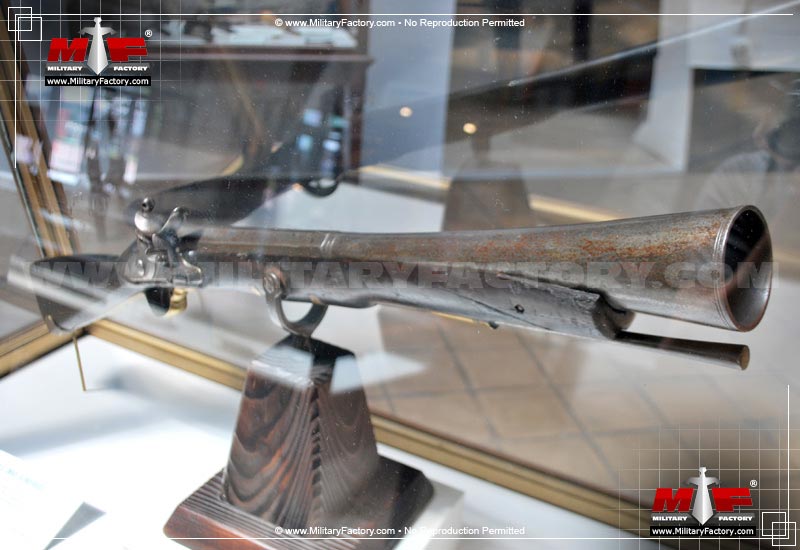
The Blunderbuss (born of the Dutch word "Donderbus", appropriately meaning "Thunder Pipe" or "Thunder Gun") came to prominence in the early part of the 18th Century (1701-1800) and was more akin to the modern day shotgun than a "long gun" musket or heavy pistol of the time. As such, she excelled in close-in fighting, be it within the confines of naval warfare or walled nature of the urban environment, where her spread of shot could inflict maximum damage to targets at close ranges. Its manageable size, coupled with its spread shot, ensured some level of accuracy for even the novice user and its appearance was rather intimidating to those unfortunate enough to be staring down the business end. As with modern shotgun firearms, the Blunderbuss also made for an excellent security-minded weapon and soon found popularity amongst all matter of operators - military, civilian and, of course, criminal parties - by the middle of the 1700s. Even George Washington championed the Blunderbuss for Continental Army "Dragoon" units of the burgeoning American military as opposed to the carbine musket - a "carbine" this being nothing more than a full-featured long gun of lesser overall length, proving suitable for horse-mounted handling. In fact, the short-form version of the Blunderbuss came to be known as the "Dragon", giving rise to the term "Dragoon" for such gun-wielding cavalrymen. Dragoons went on to form specialized units of mounted infantrymen within their respective armies during the end of the 17th Century and into the middle of the 18th Century - in a way, becoming an evolutionary step of the fabled mounted knight of the Middle Ages. Their use of Dragons soon gave way to the widely-accepted carbine musket. The Blunderbuss was also known as the "Blunderbess".

The Blunderbuss existed in two distinctly notable forms - a short, pistol-like form (the aforementioned "Dragon") and the more identifiable medium-sized, shotgun-like version. Both versions were muzzle-loading firearms - that is, loaded from the barrel end as opposed to an open breech at the rear of the gun body. Blunderbuss operation was actuated by a flintlock arrangement requiring use of a swiveling "cock" that held a piece of flint stone. Loading involved filling the barrel with an appropriate level of gunpowder, forcing cotton wadding down the barrel and adding shot (lead balls) before finally stamping the contents down with the supplied ramrod. Shot could be made up of lead balls or any sort of projectile that easily fit the caliber of the barrel. Gunpowder was then supplied to the open pan along the side of the gun body and the weapon was "cocked" for firing. With a pull of the trigger, the cock-containing flint was scrapped against a metal fixture to generate sparks, these sparks falling into the pan of gunpowder and igniting the contents within. The force of the internal explosion would send the projectiles out of the flared end of the barrel in a "spread" fashion.

Construction of Blunderbusses, of course, varied throughout its decades of use and each were based on regional construction methods, user requirements and field usage. Some were completed with brass barrels while others were finished with steel versions and, still others, particularly navalized versions, were covered over in heavy protective finishes to help combat the corrosive effects of the salty sea against the temperamental wood and metal construction of these guns.

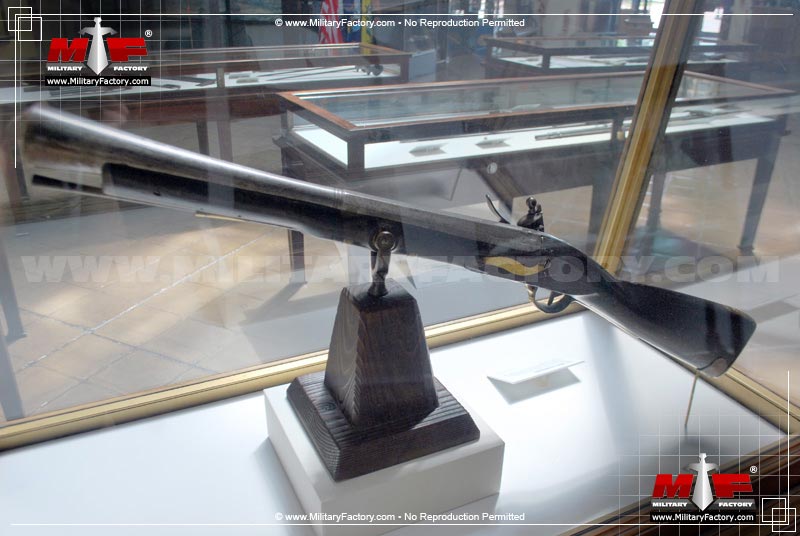
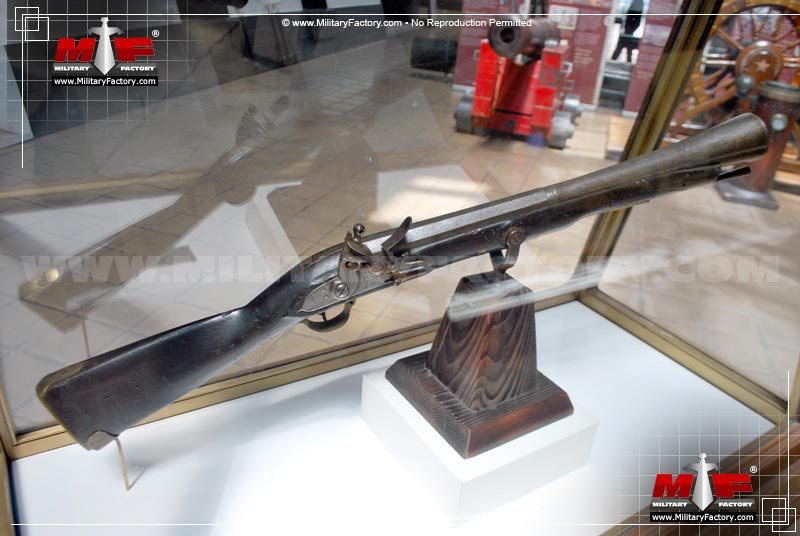
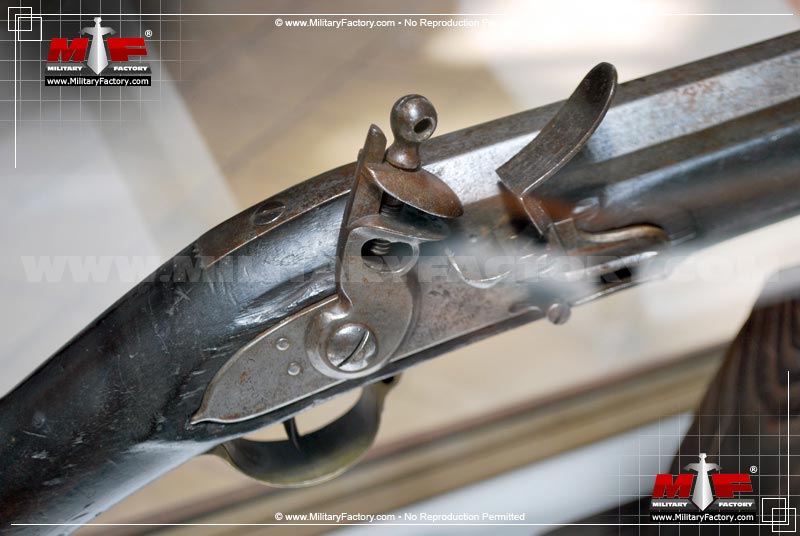
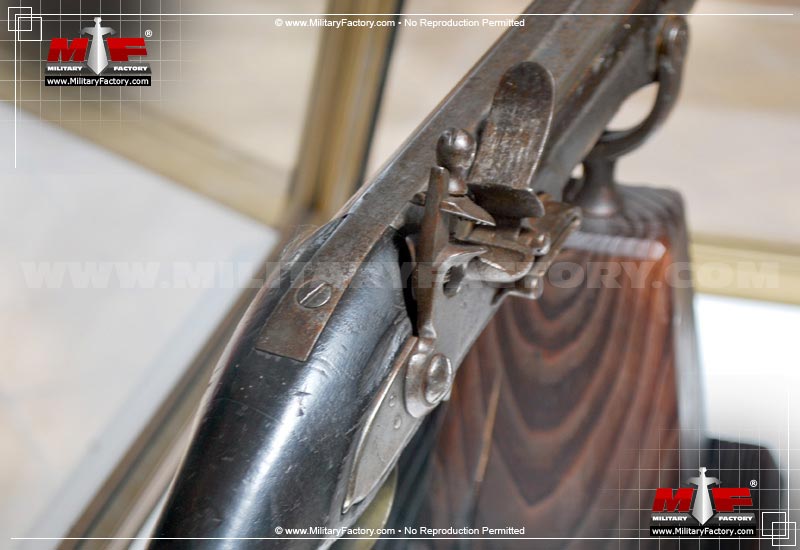
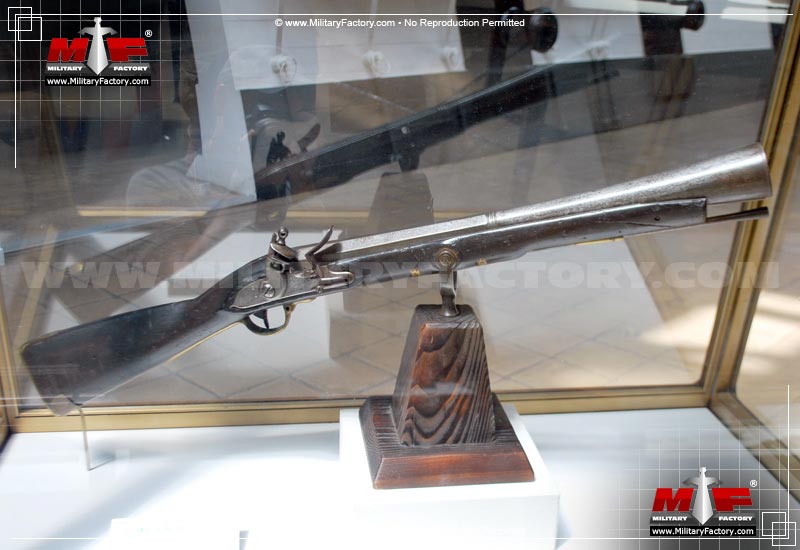
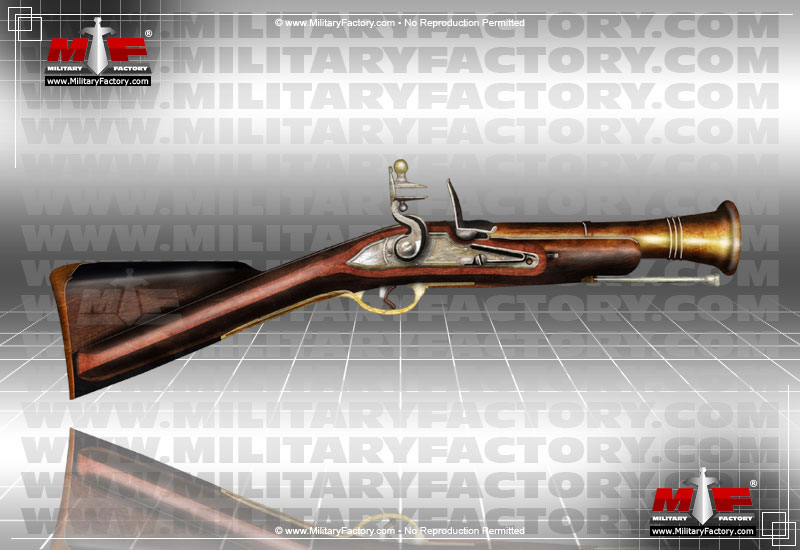
Traditionally, the image of the Blunderbuss featured a bell-shaped (or "flared") muzzle for the spreading of shot with the barrel set within a solid wooden frame. The frame contained the working components including a compressed spring, the cock with flint stone and gun powder pan (also known as the "flash pan" or "frizzen"). The cock was set to the right hand side as was the open pan. The trigger was set underneath the body of the gun and protected by an oblong trigger ring. A shoulder stock assisted in containing the inherently violent recoil of such a short, powerful weapon and also served to provide a rifle-type hand grip. A ramrod was fitted underneath the barrel for ramming shot contents down the barrel when loading/reloading. Overall length was shorter than any available musket of the time which lent itself well to rising use worldwide - some examples measuring between 14 and 30 inches long with a variable-length barrels to boot. Pistol forms, of course, were shorter than their full-length Blunderbuss counterparts. Caliber was equally variable as well with some Blunderbusses fielding a 2.5 inch flared muzzle opening. Military Blunderbusses additionally sported fittings for the use of a bayonet.

Despite its military applications, the Blunderbuss will forever be associated with its use by privateers and pirates of the high seas. Understanding the form and function of the Blunderbuss in such a role and the reader immediately understands the ideal nature of the weapon in the close-fighting environment involved with a boarding action between rival ships. Even the British Royal Navy found value in such a weapon that it issued Blunderbuss-type weaponry to its sailors for that very role. The spread shot could be put to lethal use in such quarters as could its portability, particularly in fighting below decks. Once the gun was fired, the user could then close in on his enemy by way of blade (or bayonet if equipped as such) or use the butt-end of the Blunderbuss as an effective club of sorts. Since reloading of flintlock weapons was generally time consuming, it made sense to provide the soldier with both firearm and blade at this point in history. British use of the Blunderbuss even extended into land-based protection of convoys and mail service for her coachmen operating between destinations where bandits roamed. As a proven weapon worldwide, it was not surprising that colonists in the Americas also kept Blunderbusses for protection against all matter of target - needless to say, use of Blunderbuss-type weapons was quite global, particularly noted for its use in European Armies.

The tenure of Blunderbuss survived into the 19th Century to which by this time the carbine had staked its claim on the modern battlefields. Regardless, many still held their Blunderbusses in higher regard due to her inherently excellent man-stopping qualities and in-the-field ruggedness. Nevertheless, the Blunderbuss - the imposing weapon with the funny name - would still go down as one of the most recognizable firearms in history and live a long healthy life in the romanticized pirate tales to follow.
Text ©2003-2013 www.MilitaryFactory.com • All Rights Reserved • No Reproduction Permitted
MilitaryFactory.com does NOT sell equipment/weaponry. Material presented throughout this website is for historical and entertainment value and should not to be construed as usable for hardware restoration, maintenance or general operation. Please consult manufacturers for such information. Our disclaimer. Email corrections / Comments to MilitaryFactory at Gmail dot com.
Picture of Blunderbuss
View All Images (1)

Specifications for the
Blunderbuss
Short-Ranged Musket


Country of Origin: Netherlands
Manufacturer: Various Worldwide
Initial Year of Service: 1720


Overall Length: 775mm (30.51in)
Barrel Length: 370.00mm (14.57in)
Weight (Empty): 4.63lbs (2.10kg)


Cartridge: Various
Action: Flintlock
Feed: Single-Shot Spread
Rate-of-Fire: 1 rounds per minute
Range: 50ft (15m; 17yds)
Sights: None


Variants:
Blunderbuss - Base Series Designation; full-length version.


Dragon - Pistol Form; shortened overall design.


Operators: Austria; Belgium; Denmark; France; Germany; India; Italy; Mexico; Netherlands; Ottoman Empire; Poland; Portugal; Russia; Sardinia; Spain; United Kingdom; United States

ALL SMALL ARMS CATEGORIES

BY YEAR:


1700 to 1799
1800 to 1899
1900 to 1909
1910 to 1919
1920 to 1929
1930 to 1939
1940 to 1949
1950 to 1959
1960 to 1969
1970 to 1979
1980 to 1989
1990 to 1999
2000 to 2009
2010 to 2019
VIEW ALL
Compare Guns


BY TYPE:


Anti-Aircraft Weapons
Anti-Material Rifles
Anti-Tank Weapons
Automatic Rifles
Bolt-Action Rifles
Carbine Guns
Flamethrowers
Flintlock Guns
Grenade Launchers
Hand Grenades
Lever-Action Rifles
Machine Guns
Mortars
Musket Guns
Pistols / Handguns
Recoilless Rifles
Revolvers
Rocket Launchers
Shotguns
Silenced Guns
Sniper Rifles
Special Weapon Systems
Submachine Guns
VIEW ALL


SPECIAL:


18th Century Warfare
3 Soldiers Statue
Battle of Mogadishu
Chainmail Armor
Firearm Types Defined
French Military Victories
Medieval Crossbow
Medieval Longbow
Vietnam War Casualties
Vietnam War Memorial

WORLD WAR 2:


British Guns
French Guns
German Guns (ALL)
German Rifles
Italian Guns
Japanese Guns
Soviet Guns
US Guns
US Infantry Regiment-Level Guns
Machine Guns
Pistols
Rifles
Submachine Guns
Sniper Rifles
VIEW ALL


WORLD WAR 1:

Pistols
Rifles
Machine Guns
Mortars
US Guns
VIEW ALL


KOREAN WAR:

Machine Guns
VIEW ALL


VIETNAM WAR:

Mortars
VIEW ALL


COLLECTIONS:


Ancient Weapons
British SAS Weapons
Civil War Guns
Colt Guns
Glock Guns
GROM Polish Special Forces
Guns of Libya
Guns of North Korea
Guns of Syria
Guns of WW1 & WW2
Heckler & Koch Guns
Kalashnikov Guns
Modern Russian Guns
Navy SEAL Weapons
Spetsnaz Weapons
Weapons of Desert Storm
Wild West Guns
Winchester Guns


HOLLYWOOD/GAMES:


Guns of the Walking Dead

Site Disclaimer | Privacy Policy | Site Map | MF Origins


©2013 www.MilitaryFactory.com • Content ©2003-2013 MilitaryFactory.com • All Rights Reserved • Site Contact Email: militaryfactory at gmail dot com. The "Military Factory" name and MilitaryFactory.com logo are registered ® trademarks and protected by all applicable domestic and international intellectual property laws.


Top MF Stuff: 2013 Military Pay Scale | Military Ranks | WW2 Weapons | Sniper Rifles | Kts to Mph | WW1 Aircraft | Automatic Rifles | Aircraft Cockpits | Vietnam War Weapons | Main Battle Tanks | Submachine Guns | Shotguns | French Military Victories


Most photographic images appearing on this site are courtesy of the United States Department of Defense and are approved for public use. Other images acquired through the public domain. Digital art work courtesy of Dan Alex. Business Consulting by Kyle Williams. Material presented throughout this website is for historical and entertainment value and should not to be construed as usable for hardware restoration, maintenance or general operation. Please consult manufacturers for such information.


eXTReMe Tracker