Global Firepower | Military Industrial Complex | Second World War History
Home | Military Pay Scale Chart | Aircraft | Infantry Weapons | Military Vehicles | Navy Ships | Military Education | French Military Victories | Military Ranks | WW2 Weapons
Military Factory Latest from Military Factory
Thumbnail picture of the Dardo infantry fighting vehicle
Dardo IFV
Thumbnail picture of the Supermarine Scimitar fighter
Supermarine Scimitar
Thumbnail picture of the Centauro B1 8x8 tank killer
Centauro 8x8
Thumbnail picture of the Novi Avion fighter
Novi Avion
Thumbnail picture of the FR F2 bolt-action sniper rifle
FR F2
Thumbnail picture of the Lebel Model 1886 bolt-action rifle
Lebel Model 1886
2009 Military Pay Scale Chart - for Army, Navy, Air Force and Marines
  By Type
    · Age of Sail
    · Aircraft Carriers
    · Escort Carriers
    · Amphibious
    · Amphibious Assault
    · Battleships
    · 2nd Class Bttlshps
    · Cargo Ships
    · Cruisers
    · Destroyers
    · Dreadnoughts
    · Pre-Dreadnoughts
    · Frigates
    · Ironclads
    · Midget Submarines
    · Mine Sweepers
    · Patrol Craft
    · Pocket Battleships
    · Special Forces
    · View All Ships
  Submarines
    · Full List
    · Diesel-Electric
    · Ballistic Missile
    · Nuclear Attack
  World War 2
    · Full List
    · Aircraft Carriers
    · Battleships
    · Destroyers
    · Submarines
    · US Warships
  Vietnam War
    · Full List

MilitaryFactory > Navy Ships > USS Bainbridge (DD-1)
 
 
More Pictures CompareX2 Conversions Dictionary Acronyms

USS Bainbridge (DD-1)

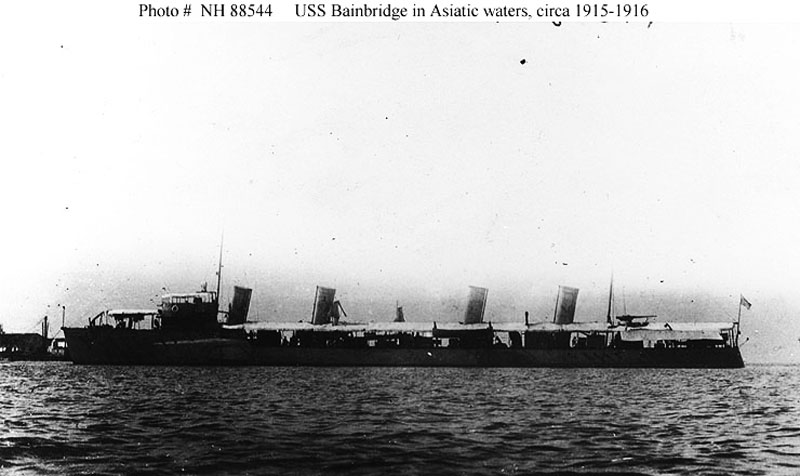
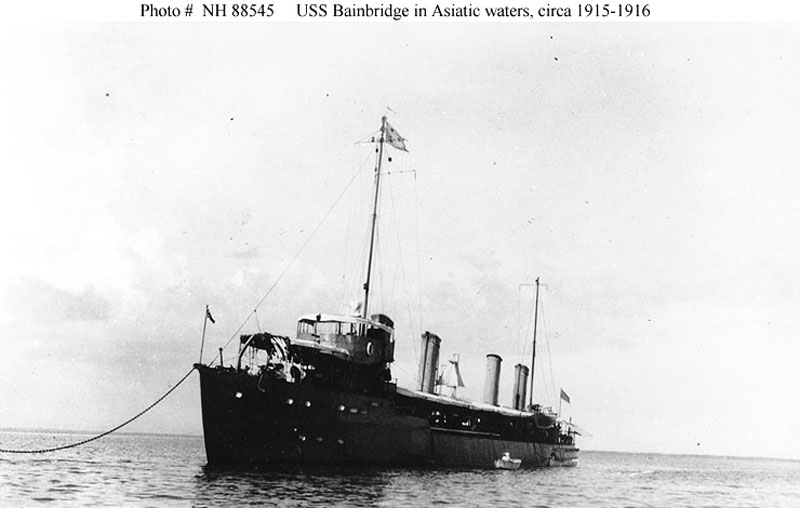
The USS Bainbridge was the first destroyer type warship to see service with the United States Navy.
By JR Potts, AUS 173d AB

Bookmark and Share

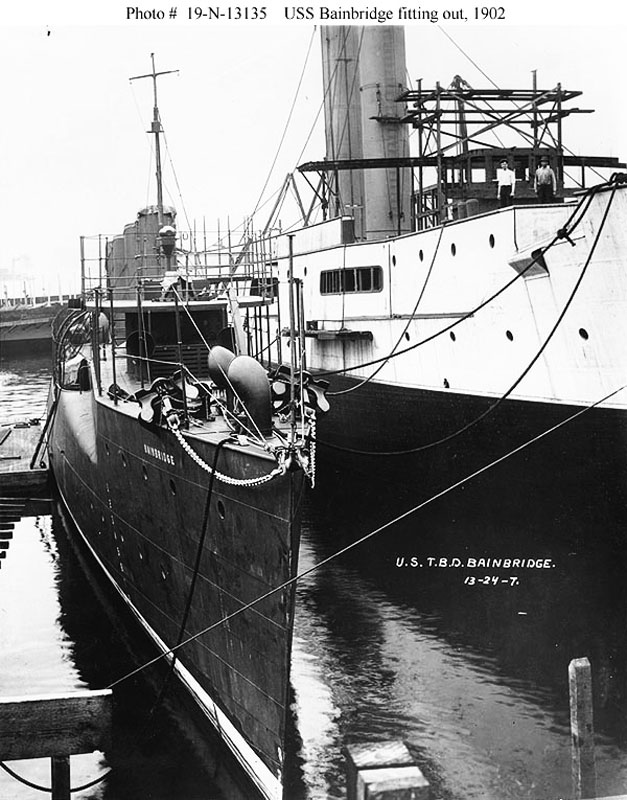
This destroyer ship class was named USS Bainbridge (DD-1), commonly called a torpedo boat destroyer, and was the first destroyer in service with the United States Navy also becoming and the lead ship of her class. She was named after William Bainbridge, a Commodore who himself appropriately served in the United States Navy, and proved victorious over the HMS Java during the War of 1812. The ship was built in August of 1901 by Neafie and Levy Ship & Engine Building Company of Philadelphia, Pennsylvania and placed in reserve commission at the Philadelphia ship yards in November of 1902. On February 12th, 1903, the vessel then under the command of Lieutenant G. W. Williams, she was towed to Norfolk, Virginia and entered service on the active duty roster.

An evolution had begun with the torpedo boat, originally a steam-launched system with a long spar torpedo - essentially a long pole with a charge at the end and attached to the bow of the boat. This seemingly archaic arrangement itself had evolved over the use of fortified bow rams used through centuries before. The invention in the 1880s of the self-propelled torpedo had eliminated the need for the torpedo "pole boat" approach. This new "launched" torpedo needed an equally new designed craft that would be able to attack enemy ships at distance. Within a decade, the torpedo's success required the world's navies to also devise defenses for its capital ships when attacked by such implements. The answer to the need became the small gun ship, larger than the torpedo boats and capable of blue water operations with the fleet on the high seas. Appropriately, this new design was called the torpedo boat destroyer. By 1900, torpedo boats were already being decommissioned and replaced by larger heaver-armed destroyers that were also multi-mission capable. As such, Bainbridge and her class became the first such class of warships in service with the United States Navy.

The new generation of destroyers were called upon to accomplish their missions of attack and fleet protection through the use of speed. This was made possible by the use of new compound expansion engines. In a compound engine, high pressure steam from the boiler expanded in a high pressure cylinder and then entered lower pressure cylinders. The expansion of the steam in these multiple cylinders meant that less heat was being lost in the process thus increasing power and overall efficiency of the engine. These types of engines were used either in a three- or four-expansion stage, known simply as a "triple" or "quadruple" engine. A British engineer, Arthur Woolf, built a high pressure compound engine as early as 1805.

Bainbridge was assigned to the 1st Torpedo Flotilla and spent three months completing her sea trials. On June 1st, 1903, the flotilla steamed to Annapolis, Maryland where it joined the North Atlantic Fleet's Coastal Squadron. For the next few months, the Costal Squadron drilled and completed exercises in New England waters. Detached from the Coast Squadron in September of 1903, the 1st Torpedo Flotilla returned to Hampton Roads to refit for service on the Asiatic Station. After weeks of refurbishment, Bainbridge and others in her class left the docks at Chesapeake Bay and headed south with the rest of the 1st Torpedo Flotilla and Baltimore Cruiser No. 3, this occurring on December 12th, 1903. The Baltimore was a 4,413 tons ship and could make 21.5 knots while armed with 4 x 8-inch guns and 6 x 6-inch guns with additional rapid fire "pounders" of varying sizes. The convoy arrived at Key West, Florida on December 18th for final fueling and supplies.

The Cruiser Buffalo relieved the Baltimore for the cruise to the Far East on December 23rd. The journey was a long one, taking the vessels through the Canary Islands, Gibraltar, Algiers and Malta. In Malta, several weeks were needed to repair Barry DD2's damaged propellers. After repairs, Bainbridge and the flotilla passed thru the Suez Canal on February 26th, staying at Port Suez in Egypt. Soon after, the flotilla made the final leg of the voyage to the American port at Cavite in the Philippines. Concerned policy makers in the Navy Department were now convinced of the worth of the destroyers after the four month voyage from the US to the Philippines. The next test would be duty in the volatile China waters.

As they steamed out of Manila Bay to its first tour of duty in China with the Asiatic Fleet's Battleship Squadron, Bainbridge was flying the flotilla commander’s flag. Upon reporting to the fleet, Bainbridge and others in her class joined with the Asiatic Fleet's Battleship Squadron. This squadron was composed of the flagship Olympia, Baltimore, Raleigh, Petrel, Concord, Boston, and McCulloch. The fleet started developing new tactics with destroyers in attack and defending drills near the Chinese coast. The fleet also spent a lot of time showing the flag in Chinese ports. With the Boxer Rebellion history by 3 years it was relatively safe in these ports for sailors of foreign nations who looked forward to shore leave for a number of reasons. Bainbridge and her flotilla served to maintain Chinese sovereignty and to keep China open to American interests - otherwise known as "The Big Stick".

In Bainbridge’s first Far East tour the friction between Japan and Russia began to escalate. The Russian Navy needed a year-round warm-water port in the Pacific Ocean. The Russian Pacific seaport of Vladivostok was operational only during the summer months but Port Arthur, in Manchuria, could be operational all year long. The Russian fleet kept a number of ships at Port Arthur, both merchants for trade and warships. Japan felt the Russian warship presence was an intrusion and a threat into the Yellow Sea claimed by the Imperial Japanese Navy (IJN). On February 8th, 1904, a surprise night attack by a squadron of Japanese destroyers was made on the Russian fleet anchored at Port Arthur and a major surface engagement occurred the next day, beginning the Russo-Japanese War. The United States did not want to be lured into this conflict and recalled all battleships from Chinese waters back to the Philippines. The destroyer flotilla and some cruisers were left for costal duty in the area along with patrol boats for use in China’s rivers.

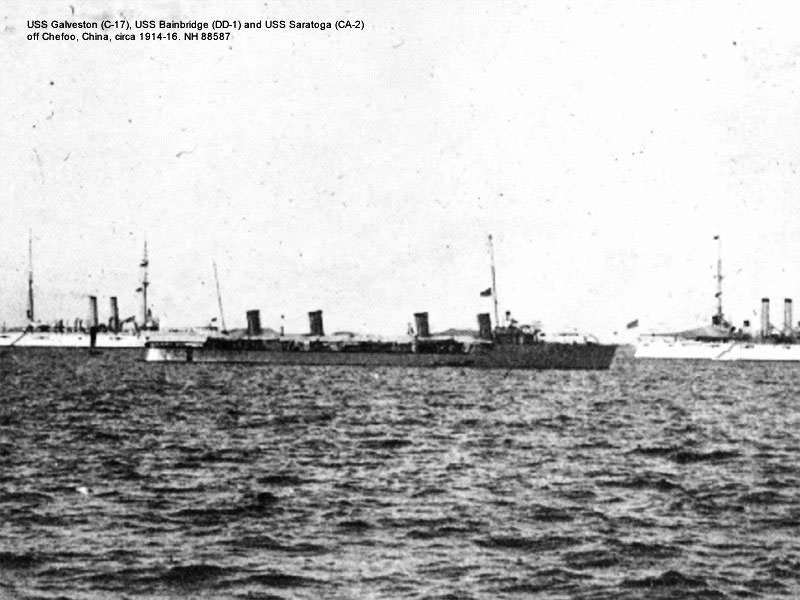
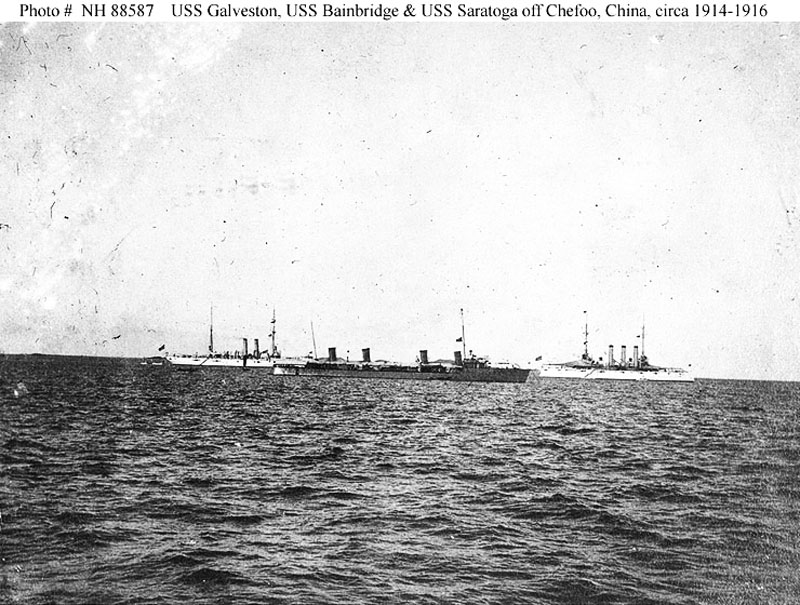
The Japanese forced the Russian squadron to attempt a run towards Vladivostok in August of 1904. Bainbridge was at Shanghai when Askold, a Russian-protected cruiser, sought sanctuary in the port. The Japanese sent a destroyer to seize Askold as they had already done to another Russian ship at Chefoo, this against international maritime law. Rear Admiral Stirling dispatched Bainbridge to deter the capture of an interned ship in a neutral port. Not wanting to fire upon an American warship the Japanese destroyer withdrew and the Russian ship Askold sought - and received - sanctuary from the Chinese.

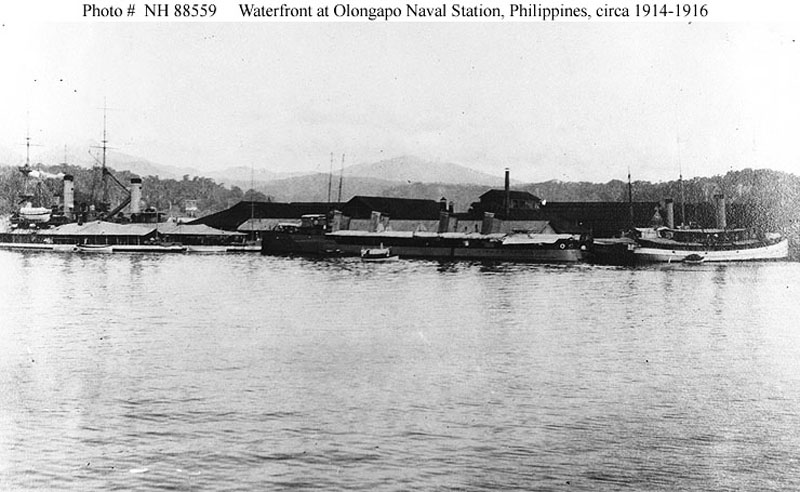
Following that incident, Bainbridge spent another two months in Chinese waters before departing Shanghai on October 4th. The destroyer reached Cavite in late October and spent the remainder of 1904 in local operations, mostly torpedo drills and gunnery practice. In 1905, Bainbridge and the destroyer flotilla with Battleship Squadron spent the next few months guarding the American Philippines against possible neutrality violations by the Russians and the Japanese. After the war was over, Bainbridge and Barry remained in Chinese waters and continued to "show the flag". In January of 1907, Bainbridge was put out of commission at the Cavite yard in the Philippines to undergo repairs to her boilers. She remained out of service for 14 months and was re-commissioned on April 2nd, 1908.

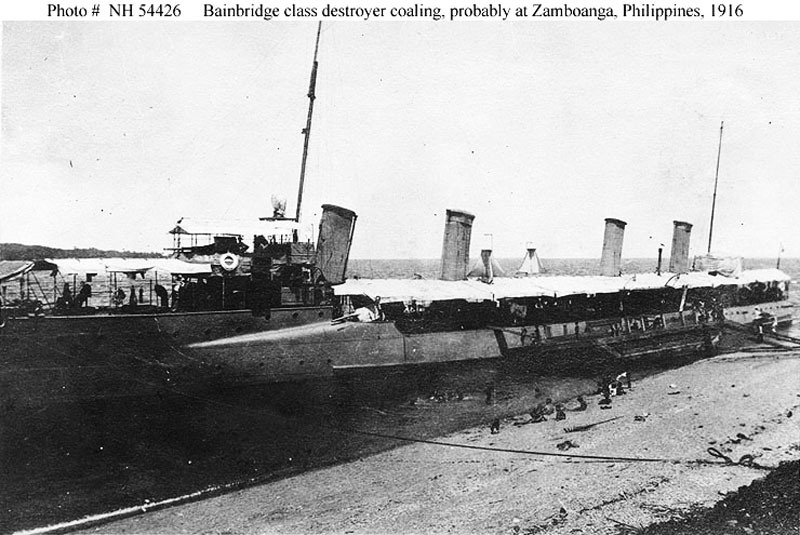
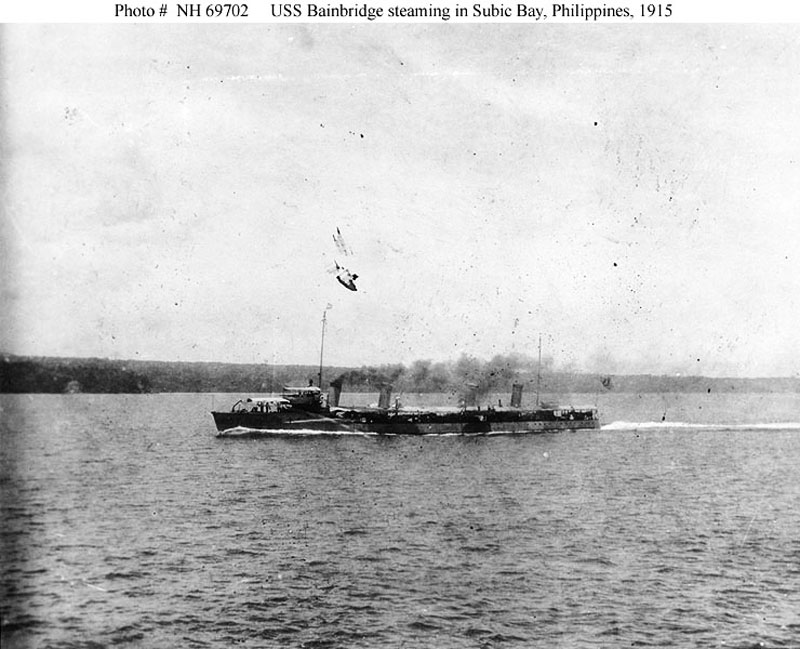
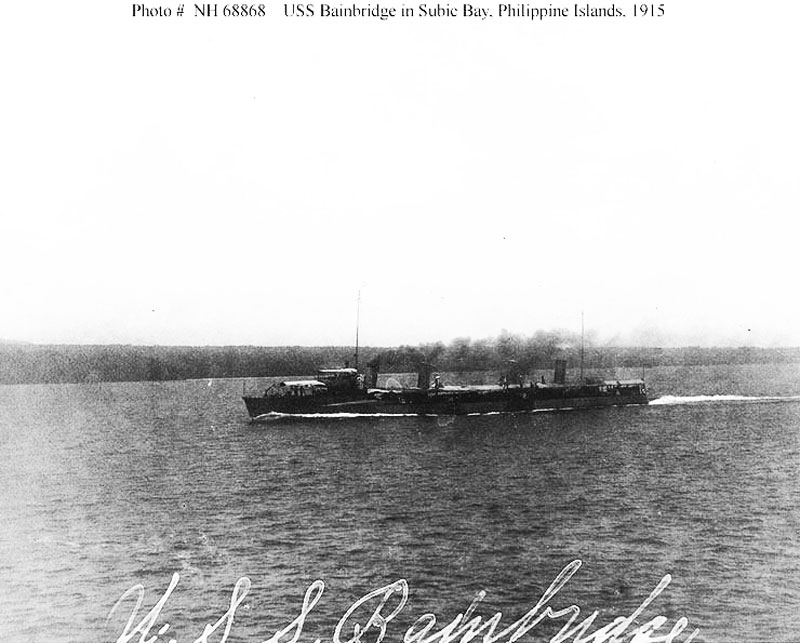
For three years after her return to active service, Bainbridge carried out a normal routine for Asiatic Fleet destroyers. Near the end of the 1911 summer cruise, disturbances in China requiring her to return to Chinese waters once again to maintain American interests. Upon her return from China, Bainbridge was placed in reserve on April 24th, 1912, and remained in this semi-active state for almost a year, resuming full active duty in April of 1913 with Lt. J.G. Raymond A. Spruance in command. For the next 4 years she patrolled the waters between the Philippines and China. She and the flotilla spent all of 1916 patrolling in the Philippines.

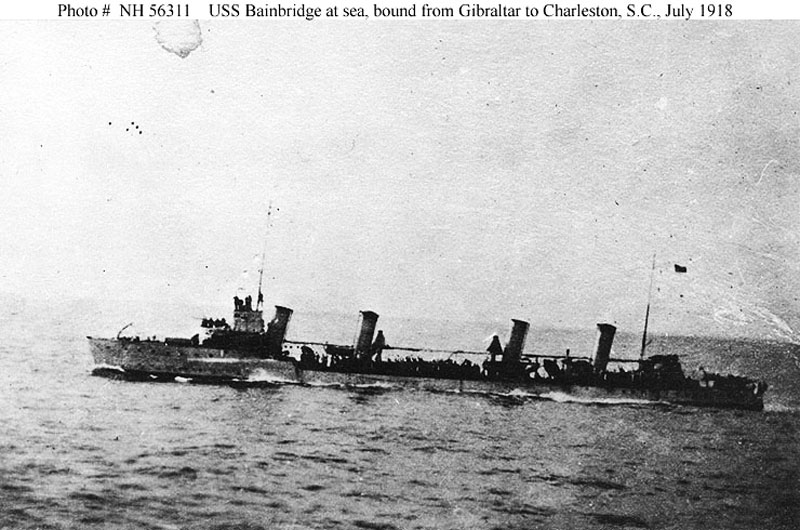
Even when war was declared in the spring of 1917, plunging the United States into World War 1, Bainbridge did not disrupt her schedule of Philippine operations until mid-summer. A few months later, orders came for the destroyer flotilla to leave for European waters. They left in August for the long voyage and started operations upon entering the Mediterranean Sea where German and Austro-Hungarian submarines were active. Bainbridge had steamed with the division to Malta escorting some ships to Naples. On October 8th, her lookouts saw a U-boat on the surface following the SS Camilla Rickmers. Bainbridge sounded battle stations. As she approached within gun range, the submarine submerged and escaped. The next day Bainbridge and the merchant ships steamed into Naples to safe harbor. The warship served nine months in the European war zone based at Gibraltar, escorting shipping into and out of the Mediterranean Sea. She returned to the United States and served along the east coast until 1919.

On July 3, 1919 Bainbridge, DD1, was officially decommissioned at the Philadelphia Navy Yard and her name was struck from the Naval Register on September 15 later that year. In 1920 she was sold to Joseph G. Hitner of Philadelphia, Pennsylvania, for conversion of the vessel into mercantile service as a fruit carrier - an unceremonious ending for a historical warship.

History text ©2003-2009 www.MilitaryFactory.com • All Rights Reserved
No Reproduction Without Permission • Corrections / Comments to MilitaryFactory at Gmail dot com

Last Updated: 7/5/2009


  Specifications for the USS Bainbridge (DD-1)
arrow downDimensions:
Length: 250ft (76.20m)
Beam: 23.1ft (7.04m)
Draught: 6.6ft (2.01m)

arrow downPerformance:
Surface Speed: 28kts (32mph)
Range: 0miles (0km)

arrow downStructure:
Complement: 75
Suface Displacement: 592tons
arrow downPower:
Engine(s): 2 x engines; 4 x boilers generating 8,000 shaft horsepower.
arrow downArmament Suite:
2 x Single-barrel 3-inch (76mm) cannons
5 x Single-barrel 6-pounder (2.7kg) cannons
2 x 18-inch (477mm) torpedo tube mountings

  Pictures of the USS Bainbridge (DD-1)
     
Picture of USS Bainbridge (DD-1)
Picture of the USS Bainbridge (DD-1)
Image of the USS Bainbridge (DD-1)
     
arrow upView All 10 Images

More Pictures CompareX2 Conversions Dictionary Acronyms

  Special Navy Ship Collections

Collections:
United States Navy Carriers
Modern Warships

World War 2:
Destroyers of World War 2
Navy Ships of World War 2
USN Warships of World War 2
Submarines of World War 2

Vietnam War:
Warhips of the Vietnam War

Miscellaneous:
Battle of Trafalgar
How Submarines Work
United States Navy Classification


  Recent Navy Ship Section Additions
Thumbnail picture of the USS New York LPD-21 amphibious support landing dock
USS New York (LPD-21)
Thumbnail picture of the Bell PACV/ACV hovercraft
Bell PACV/ACV
Thumbnail picture of the USS United States frigate of 1797
USS United States

  Contacting MilitaryFactory.com
We can only get better if you tell us how. You can contact MilitaryFactory.com at MilitaryFactory at gmail dot com (replace "at" with "@" and "dot with ".") with any questions, comments or corrections. We also accept related military imagery that you approve for us to use on our website. Keep in mind, however, that due to volume, we may not directly respond to your inquiry. Please add us to your list of non-blocked recipients!

Aircraft Carriers

  Navy Ship Profile:


Picture of the USS Bainbridge (DD-1).
Photo Courtesy of the United States Navy

flag of United States
1903
Designation: USS Bainbridge (DD-1)
Classification Type: Torpedo Boat Destroyer
Ship Class: Bainbridge-class

Country of Origin: United States
Number in Class: 13

Operators: United States


  Ships in Class
USS Bainbridge (DD-1); USS Barry (DD-2); USS Chauncey (DD-3); USS Dale (DD-4); USS Decanter (DD-5); USS Hopkins (DD-6); USS Hull (DD-7); USS Lawrence (DD-8); USS Macdonough (DD-9); USS Paul Jones (DD-10); USS Perry (DD-11); USS Preble (DD-12); USS Stewart (DD-13)

  Collections
  • Dreadnoughts - Bigger Ships, Bigger Guns
  • Pocket Battleships
  • Destroyers - Power of One
  • Tall Ships
  • Carriers of the United States Navy
  • Cruisers
  • Battleships of World War 2


Free GI Bill Guide

Top MF Stuff: Military Pay Scale Chart | Military Ranks | World War 2 Weapons | Sniper Rifles | Conversion Calculators


©2009 www.MilitaryFactory.com • Content ©2003-2009 MilitaryFactory.com • All Rights Reserved • Disclaimer Privacy Policy Site Map Origins
Most photographic images appearing on this site are courtesy of the United States Department of Defense and are approved for public use.
Other images acquired through the public domain. Digital art work courtesy of Dan Alex.
Business Consulting by Kyle Williams

Material presented throughout this website is for historical and entertainment value and should not to be construed as usable for
hardware restoration, maintenance or general operation. Please consult manufacturers for such information.

Site Contact: militaryfactory at gmail dot com (replace "at" with "@" and "dot" with ".") eXTReMe Tracker