Military Factory
Military Pay Chart
Global Firepower
Military Industrial Complex
Second World War
Home
Military Pay Scale
Military Ranks
Small Arms
Aircraft
Land Systems
Navy
Education
Military Factory Facebook Logo
flag of United States

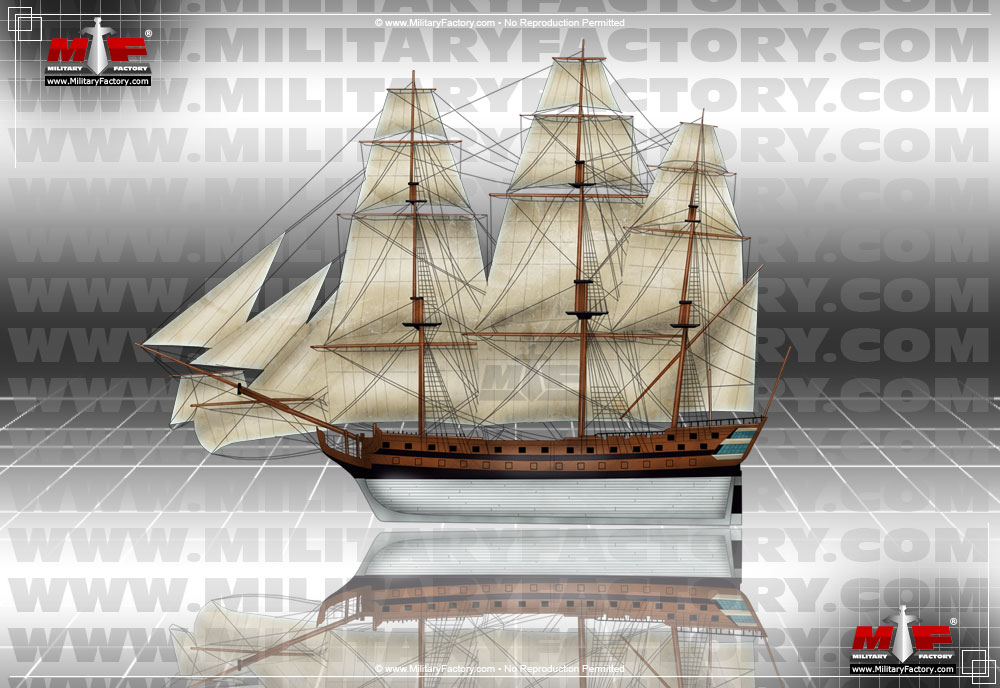
USS America (1782) 74-Gun Ship-of-the-Line (1782)

Authored By JR Potts, AUS 173d AB | Last Updated: 5/9/2013

Despite delays in her construction, the USS America eventually set sail, ultimately given away as a gift to the French.

Find a School Near You
Follow Military Factory on Facebook:
Trending on Military Factory:
Recent Articles:
On November 9th, 1776, the Continental Congress authorized the construction and purchase of three 74-gun ships. The first of these men-of-war built for the Continental Navy became the USS America. Her construction started in May 1777 in New Hampshire between Portsmouth and Kittery, Maine on Rising Castle Island in the Piscataqua River at the shipyard of one John Langdon. Langdon did not choose the location of his shipyard by chance. American shipbuilding businesses were established near trading ports and fishing towns. New Hampshire and Maine had dense forests of mature oak trees, providing a plethora of supply in raw materials with close proximity to the rivers. A ship like America needed two thousand such trees to build her and after cutting, transporting these trees was easiest along the waterways. Roads during this period of American history were almost non-existent past the limits of a few towns. The mill was built close to the river to reduce time and effort. Trees were reduced to planks in the mill and moved onto barges and ultimately to lumber yards close to the shipyards. New cut lumber needed to dry out and season for years before it was ready to be used in ship building. Merchants shipped New Hampshire boards and masts abroad and traded them along the Atlantic coast.

Her construction was delayed by an ever present shortage of funds from the Continental Congress and a shortage of skilled craftsmen. However the major factor was the lack of stock piles of well-seasoned timber. American timber was slow in coming, thus becoming a highly sought after commodity eventually being sold green on the world market. The keel was finally laid down but her actual construction dragged on for over two years under the master shipbuilder Colonel James Hackett and the supervision of John Langdon. In November of 1779, the Marine Committee (or Navy Department as it is known today) sent Captain John Barry to oversee the ships construction progress. His orders stipulated he was to press the project forward as quickly as his power would allow to have the ship finished. His presence was not making did not make much headway with the shipwrights and months continually passed without much progress. By March 1780, Barry could not see the end of this assignment and ultimately applied for a leave through the Marine Committee - a request eventually granted. To Barry's fortune, and perhaps not understood at the time, he was posted to command the best ship in the Continental Navy - the 36-gun frigate USS Alliance - which had recently returned home from Europe.

Congress became restless with the pace of the shipwrights building of America and paid the bill which pressured Langdon to finish forthwith. In late June of 1781 Capt. John Paul Jones was picked by the Maritime Board to become the commanding officer of the unfinished America. Jones was having the cannon placed when he received word that Congress decided to present the ship to King Louis XVI of France to replace the French ship of the line Magnifique which had run aground trying to enter Boston harbor and had been destroyed in August of 1782. This was a political decision to show gratitude to the French crown for her support for America in the independence war against Britain. Jones' disappointment was deep but he continued to press on and finish this first American ship-of-the-line. On November 5, 1782 she was completed and with ropes in place drifted into the Piscataqua river. Once fitted out with rigging and sail the French Captain of the lost frigate Magnifique, M.Ie Chevalier de Macarty Martinge, took command and departed Portsmouth on June 24, 1783, reaching France some 23 days later.

The America served under the flag of France for only a short time. Three years later a maritime French commission inspected her and sadly reported she was unfit. The inspection indicated that dry rot had progressed beyond a reasonably priced repair. In all probability the rot occurred due to her construction from green unseasoned timber. She was scrapped for her sail, cannon and all usable metal parts. A new French warship was built and named America.
Text ©2003-2013 www.MilitaryFactory.com • All Rights Reserved • No Reproduction Permitted
MilitaryFactory.com does NOT sell equipment/weaponry. Material presented throughout this website is for historical and entertainment value and should not to be construed as usable for hardware restoration, maintenance or general operation. Please consult manufacturers for such information. Our disclaimer. Email corrections / Comments to MilitaryFactory at Gmail dot com.

Specifications for the
USS America (1782)
74-Gun Ship-of-the-Line


Country of Origin: United States
Initial Year of Service: 1782
Operators: United States; France


Crew: 626


Length: 182.5ft (55.63m)
Beam: 50.5ft (15.39m)
Draught: 23ft (7.01m)
Displacement: 2,014tons


Machinery: Wind-Powered Sail.


Surface Speed: 12kts (14mph)
Range: Essentially Unlimited


Armament:
30 x 18-pounder guns
30 x 12-pounder (43 cwt) (159mm) guns
14 x 9-pounder guns


Ship Class: Frigate
Number-in-Class: 1
Ships-in-Class: USS America

ALL NAVY SHIP CATEGORIES
Site Disclaimer | Privacy Policy | Site Map | MF Origins


©2013 www.MilitaryFactory.com • Content ©2003-2013 MilitaryFactory.com • All Rights Reserved • Site Contact Email: militaryfactory at gmail dot com. The "Military Factory" name and MilitaryFactory.com logo are registered ® trademarks and protected by all applicable domestic and international intellectual property laws.


Top MF Stuff: 2013 Military Pay Scale | Military Ranks | WW2 Weapons | Sniper Rifles | Kts to Mph | WW1 Aircraft | Automatic Rifles | Aircraft Cockpits | Vietnam War Weapons | Main Battle Tanks | Submachine Guns | Shotguns | French Military Victories


Most photographic images appearing on this site are courtesy of the United States Department of Defense and are approved for public use. Other images acquired through the public domain. Digital art work courtesy of Dan Alex. Business Consulting by Kyle Williams. Material presented throughout this website is for historical and entertainment value and should not to be construed as usable for hardware restoration, maintenance or general operation. Please consult manufacturers for such information.


eXTReMe Tracker