Military Factory
Military Pay Chart
Global Firepower
Military Industrial Complex
Second World War
Home
Military Pay Scale
Military Ranks
Small Arms
Aircraft
Land Systems
Navy
Education
Military Factory Facebook Logo
flag of Imperial Japan

IJN I-58 Submarine (1944)

Authored By JR Potts, AUS 173d AB | Last Updated: 5/9/2013

The IJN I-58 was the last B-3 series type submarine to be produced though twenty-one such vessels were planned.

Find a School Near You
Follow Military Factory on Facebook:
Trending on Military Factory:
Recent Articles:
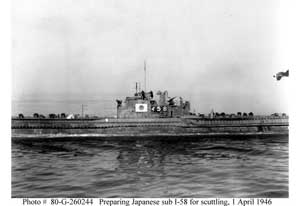
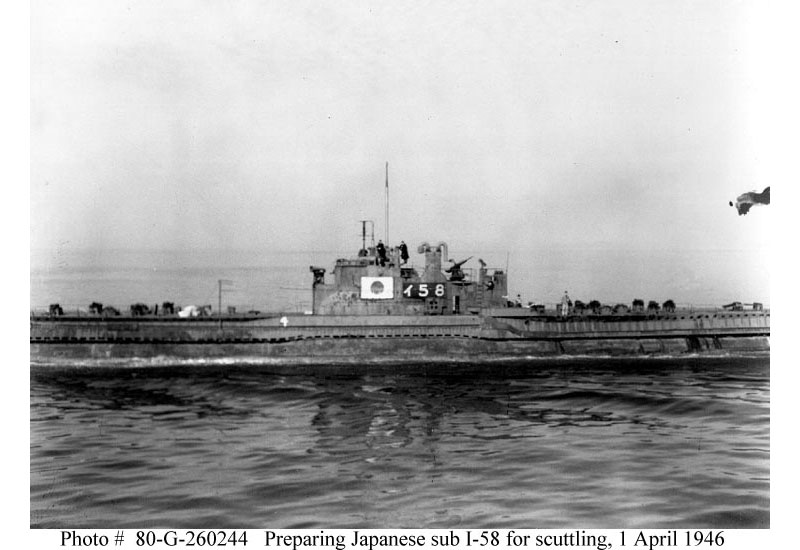
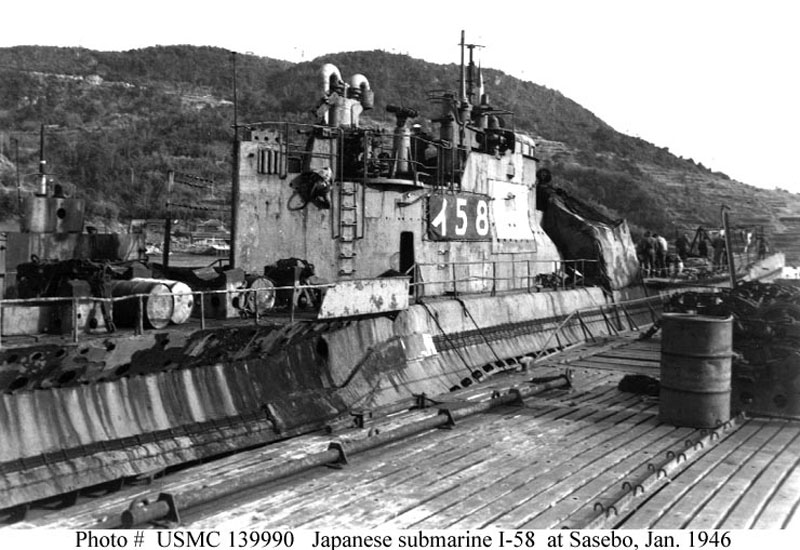
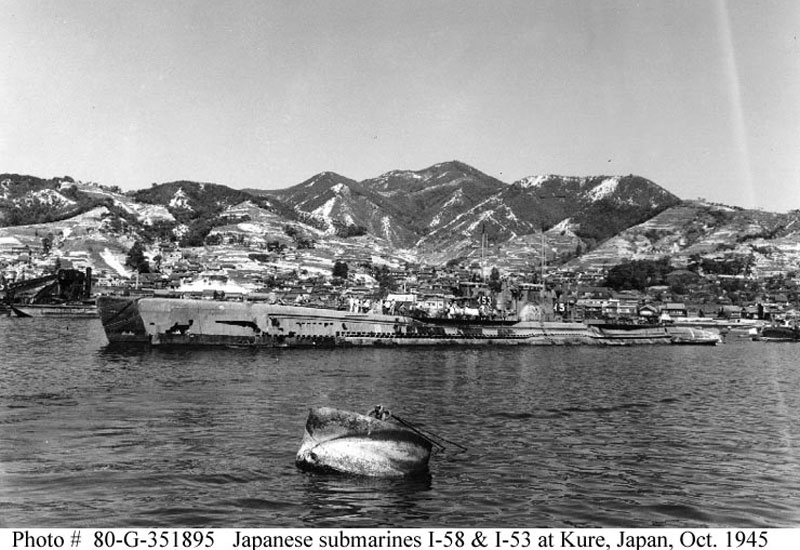
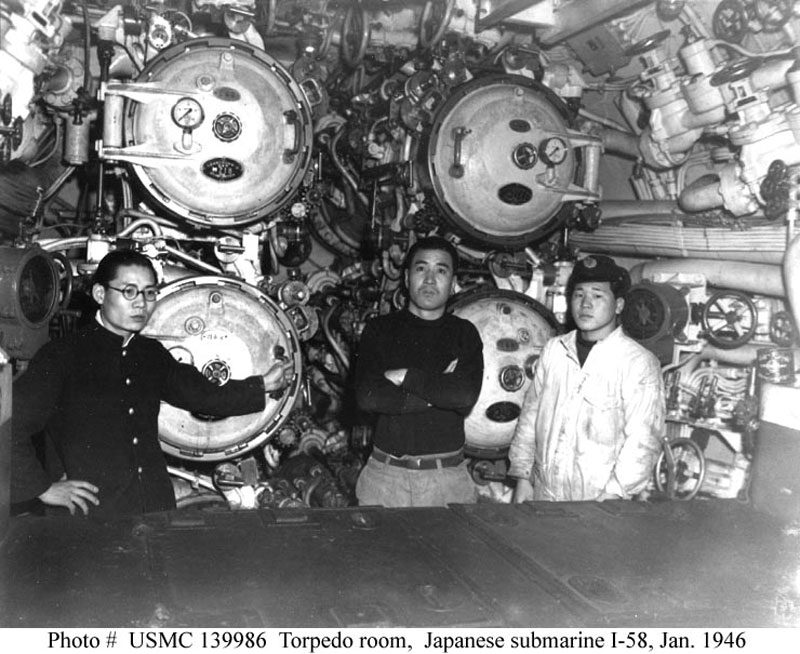
The last Japanese submarine built in the B-3 type series family became the I-58. She was laid down on December 26th, 1942, launched on June 30th, 1943, and completed on September 7th, 1944, at the naval yard in Yokosuka, Japan - the home port of the mighty Battleship Yamato. She was launched in early December 1944 and was assigned to the IJN 15th Submarine Section with Lt. Commander Mochitsura Hashimoto in command beginning in June of that year. The I-58 is best known for the sinking of the USS Indianapolis and served as a mother-ship to several Kaiten "suicide" manned torpedoes. She survived through to the end of World War 2 before being purposefully scuttled in 1946.

The B-Type Series

The previous B-1 and B-2 series boats had a range of 14,000 nautical miles. As such, the B-3 type series was designed as a long-range patrol boat able to operate deep within the vast Pacific Ocean - the largest ocean body on the planet. She carried 842.8 tons of fuel oil allowing her to range out to 21,000 nautical miles at 16 knots. The maximum diving depth of 100 meters (330 feet) remained the same throughout all the B-series boats including the B-3. The increased range, however, was a remarkable achievement in World War 2 submarines. This allowed the B-3 to patrol, target and sink any and all allied shipping within her increased operating range. The Imperial Japanese Navy (IJN) wanted more such submarines but with all of her military services competing for Japan's limited available resources to fight the war, the IJN decided to build fewer but larger boats with extended range.

Between September and December of 1944, I-58 had her 140mm deck gun removed to make the needed room for the Kaiten suicide torpedo compartments. Two compartments were initially fitted and these were joined by a Type 22 surface/air-search radar system fitted to the top of the aircraft hangar (the I-58 housed a Yokosuka floatplane). An E27/Type 3 radar system was fitted to the bridge. I-58 reported to the IJN Sixth Fleet's SubRon 11 Group for training in the Inland Sea.

Suicide Torpedoes

On December 2nd, 1944, a special conference was held at IJN Sixth Fleet to evaluate the battle results of the first Kaiten "manned torpedo" mission at Ulithi. In attendance were 200 staff officers and various other personnel and the meeting took place onboard the Sixth Fleet flagship IJN Tsukushi Maru. After review of the available reconnaissance photos and absorbing the after-action reports from the participating Japanese commanders, it was decided that the American Navy had lost three aircraft carriers and two battleships in the foray. In reality, however, no American carriers or battleships were ever sunk. These type of inaccurate or exaggerated claims covering enemy losses was common to both sides during the war, proving great for moral but horribly bad for war planning decisions.

Based on these reported successes, the Kaiten was viewed as a viable offensive weapon. These "kamikaze" torpedoes required a crew of two men and were 45 feet long with a 3,000 pound warhead.

On December 4th, 1944, the I-58 was reassigned to SubDiv 15 as part of Vice Admiral Miwa Shigeyoshi's Sixth Fleet. Four days later, the vessel was assigned to Kongo (Diamond) Group along with submarines I-36, I-47, I-48, I-53 and I-56. This group was charged with attacking the American Fleet across five anchorages with their Kaiten torpedoes. Specifically, the I-58 is given the assignment of targets at Apra Harbor in Guam, the attack to commence on January 11th, 1945.

The I-58 was transferred to Otsujima to undergo Kaiten launching training during the period from December 19th, 1944 to December 24th, 1944. She then departed from Sasebo towards Kure for resupply and rearmament. On December 29th, she headed out of Kure towards Otsujima. Two days later, the I-58 receives four Kaiten torpedoes and their applicable crew and then heads out to Kure with submarine I-36. The group arrived near Guam on January 6th, 1945. Soon enough, I-58 received word from a scout plane (Nakajima JC6N2 Saiun-Kai "Myrt") that several enemy vessels were at Apra harbor - an escort carrier, two destroyers, one submarine, 20 transports and four floating docks. The decision was to penetrate the harbor and launch the Kaiten torpedoes on January 11th, 1945.


Flawed Reporting Leads to Flawed Decisions

I-58 launched all four of her Kaitens and, as Lt. Commander Mochitsura Hashimoto left the area, he took note of two columns of smoke rising. His quick retreat was forced upon him as Kaiten Number 4 self-detonated immediately after its launching. On January 22nd, 1945, I-58 arrived at the Japanese base at Kure and Hashimoto learned that he had been credited with sinking an American aircraft carrier and a large merchant ship (an oiler). Unbeknownst to Hashimoto, this grand claimed sinking of the two ships would also prove to be an incorrect assessment of the action but it served to bolster the use of Kaitens in future assaults.

Operation TAN 2

I-58 returned to Japan to rearm with four new Kaiten suicide torpedoes and their respective crews. I-58 was then ordered to attack the American Fifth Fleet of 450 ships stationed near Iwo Jima as part of Operation Detachment. The Americans had captured the island and its all-important Motoyama airfields. I-58 and I-36 are grouped once again as part of the Shimbu attack group charged with targeting island communications at Iwo. I-58 leaves Hikari on February 28th, 1945, now fitted with a Type 13 air-search radar system.

On March 1st, 1945, I-58 left the port at Kure, fully armed and loaded and voyages through the Bungo Straight. Several close calls with American spotted planes forced the submarine under but limited her detection. On March 7th, I-58 surfaced as standard practice to recharge her depleted batteries (needed for submerged operations). Her original mission was to attack the anchored shipping vessels off of Iwo but this command was later repealed as the Combined IJN Fleet is called to cease operations around Iwo Jima and proceed to Okino Torishima (Douglas Reef) to participate in a new Operation named "TAN No. 2". Hashimoto decided to jettison two of the four Kaitens and proceeded at flank speed to Okino Torishima.

TAN 2 was a joint Japanese Army and Navy attack plan involving twenty four, twin engine Yokosuka bombers each carrying one 1,763 pound bomb on a kamikaze mission from Kanoya airfield to attack USN ships at Ulithi harbor. I-58's station was to be a radio beacon for the bombers to follow to Ulithi. Six bombers made it and hit the carrier USS Randolph CV-15 resulting in moderate damage to her structure. I-58 found no viable targets herself to fire on and returned to Hikari, debarking her two remaining Kaiten's and their crews. The I-58 then relocated to Kure and underwent more Kaiten training in the inland sea sometime in late March of 1945.
Continue to Page 2 (of 2) >>
Text ©2003-2013 www.MilitaryFactory.com • All Rights Reserved • No Reproduction Permitted
MilitaryFactory.com does NOT sell equipment/weaponry. Material presented throughout this website is for historical and entertainment value and should not to be construed as usable for hardware restoration, maintenance or general operation. Please consult manufacturers for such information. Our disclaimer. Email corrections / Comments to MilitaryFactory at Gmail dot com.
Picture of IJN I-58
Pic of the IJN I-58
Image of the IJN I-58
View All Images (4)

Specifications for the
IJN I-58
Submarine


Country of Origin: Imperial Japan
Initial Year of Service: 1944
Operators: Imperial Japan


Crew: 94


Length: 356.5ft (108.66m)
Beam: 3.5ft (1.07m)
Draught: 17ft (5.18m)
Displacement: 2,174tons
Displacement (Submerged): 3,747tons


Machinery: 2 x Kampton Mk 22 Model 10 diesel engines generating 4,700bhp; submerged electric motors producing 1,200 horsepower; 2 x shafts.


Surface Speed: 17.7kts (20mph)
Submerged Speed: 6.5kts (7mph)
Range: 24,166miles (38,891km)


Armament:
6 x 533mm (21-inch) torpedo tubes (all bow-facing); 19 x Type 95 torpedoes.
6 x Kaiten manned torpedoes (later)
1 x 140mm (5.5-inch) L/40 11th Year Type Naval deck gun.
2 x 25mm Type 96 anti-aircraft guns


Air Arm: 1 x Yokosuka E14Y2 "Glen" floatplane


Ship Class: Type-B Mod. 2
Number-in-Class: 3
Ships-in-Class: I-54; I-56; I-58

ALL NAVY SHIP CATEGORIES
Site Disclaimer | Privacy Policy | Site Map | MF Origins


©2013 www.MilitaryFactory.com • Content ©2003-2013 MilitaryFactory.com • All Rights Reserved • Site Contact Email: militaryfactory at gmail dot com. The "Military Factory" name and MilitaryFactory.com logo are registered ® trademarks and protected by all applicable domestic and international intellectual property laws.


Top MF Stuff: 2013 Military Pay Scale | Military Ranks | WW2 Weapons | Sniper Rifles | Kts to Mph | WW1 Aircraft | Automatic Rifles | Aircraft Cockpits | Vietnam War Weapons | Main Battle Tanks | Submachine Guns | Shotguns | French Military Victories


Most photographic images appearing on this site are courtesy of the United States Department of Defense and are approved for public use. Other images acquired through the public domain. Digital art work courtesy of Dan Alex. Business Consulting by Kyle Williams. Material presented throughout this website is for historical and entertainment value and should not to be construed as usable for hardware restoration, maintenance or general operation. Please consult manufacturers for such information.


eXTReMe Tracker