Military Factory
Military Pay Chart
Global Firepower
Military Industrial Complex
Second World War
Home
Military Pay Scale
Military Ranks
Small Arms
Aircraft
Land Systems
Navy
Education
Military Factory Facebook Logo
flag of Imperial Japan

IJN I-400 (STo / Sen-Toku) Submarine Aircraft Carrier (1944)

Authored By Staff Writer | Last Updated: 5/9/2013

Although 18 of the large I-400 aircraft-carrying submarines were planned, only three were ever produced before the end of the war.

Find a School Near You
Follow Military Factory on Facebook:
Trending on Military Factory:
Recent Articles:
At the time of their completion, the I-400 class of submarines serving the Imperial Japanese Navy were the largest submarines ever constructed in all of World War 2. Unique to their design was the ability to house, launch and recover three floatplane aircraft held in a pressurized hangar to be used for reconnaissance and limited bombing sorties. Beyond the utilization of these aircraft, the I-400 was designed with her attack submarine functions intact, meaning that after launching her aircraft the massive submarine could still go "on the hunt" for Allied surface ships. With some 18 vessels in the I-400 class planned from 1943 onwards, just 3 were ever completed and none of these saw operational service before the end of the war - each leading rather inglorious lives to say the least. The first I-400 submarine was commissioned in 1944 with the last in 1945. Construction lasted from January of 1943 to July of 1945. The war for the Empire of Japan was over by the end of August 1945 and her war-making capabilities were soon stripped to the fullest.

Frustrated with their inability to hit American targets on the American mainland. the Japanese were also faced with a shrinking operational reach due to Allied gains. IJN authorities (led by Admiral Yamamoto himself) gave rise to the idea of a "submarine aircraft carrier". The idea involved building a submarine large enough to house two floatplane aircraft which could then be transported underwater (and undetected) within easy reach of targets along the American coasts. These aircraft could then be unleashed and sent forth to bomb said targets or reconnoiter areas prior to other Japanese offensives. The vessel would have to be designed for long-term, rough seas operation travel and be able to reach any point in the world under its own power. The idea would bring the war directly to American cities and interests - a prospect seemingly out of reach since the bombing of Pearl Harbor in December of 1941. Japanese authorities envisioned direct strikes against American shipyards, refineries, cities and key interests such as the Panama Canal which fed the US Navy with new warships, submarines and supplies from her East shores. Vessels entered Pacific waters through the Canal before heading to ports along the American West Coast before reaching Hawaii and war beyond.

Design work on this new vessel class in 1942 with construction formally beginning in early 1943. The shipyards at Kure, Hiroshima shipyard and Sasebo was tabbed with manufacture of the large submarines. Originally, it was envisioned that 18 such vessels would be completed. However, this order dwindled to half that amidst mounting IJN losses (Yamamoto himself was killed during a trip to the Solomon Islands), shortages of wartime supplies and waning interest in the project itself. The nine-strong order then became five and, of these, only three ever reached a completed, usable form. These three were designated the I-400 (the lead ship of the class) and sisters I-401 and I-402.

The I-400 class was forged into a mammoth submarine designed for both the rigors of open ocean sailing and diving to depths of 328 feet. As such, the vessel was highly pressurized including the integrated hangar needed to house the floatplane aircraft. While original plans called for two such aircraft to be housed, the I-400 class was designed to fit three - these being the Aichi M6A1 "Seiran" series of floatplane aircraft. Outwardly, the submarine was rather conventional in her appearance with a smoothly contoured shape from bow to stern. It took on a traditional cylindrical form save for the top facing which was kept traditionally flat t serve as a suitable platform for when the vessel was surfaced. The propeller systems were held at the extreme rear section of the craft and driven by four diesel-fueled engines when surfaced and two powerful electric motors when submerged. The engines were tied to a gearbox which powered a pair of propeller shafts. A rudder was affixed at the extreme end of the boat for turning.

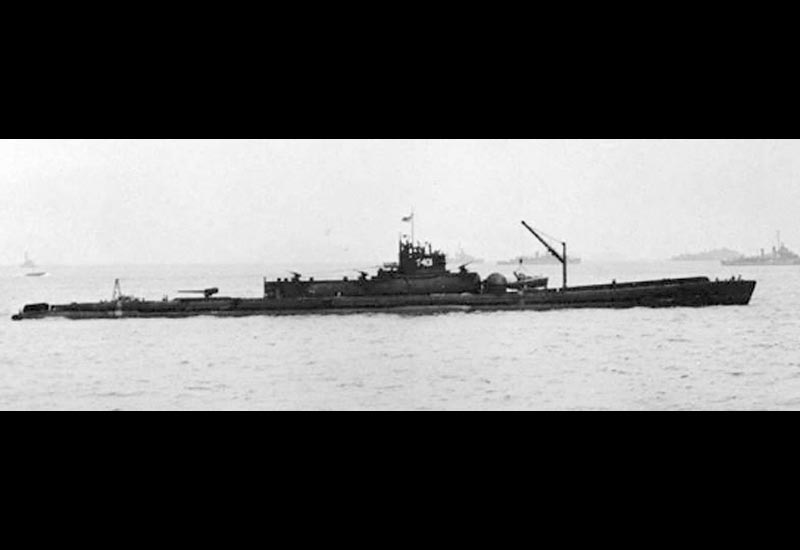
The design yielded a running length of nearly 400 feet with a beam wide enough for the required aircraft at just over 39 feet. The I-400 was given a draught 23 feet deep and yielded a displacement of 6,500 short tons. The pressurized hanger was fitted amidships which forced the bridge superstructure to be offset to the portside from centerline. The hangar was accessible from within the vessel itself or from outside along the deck. The foredeck was dominated by the catapult launching system running from bridge superstructure to bow and slightly angled upwards to promote short take-offs for the floatplanes. A collapsible crane arm was also fitted ahead of the bridge and to be used in recovering the floatplane aircraft as needed.

The I-400 was defensed by 1 x 140mm (5.5") deck gun and 4 x 25mm Type 96 anti-aircraft cannons. The deck gun was fitted aft of the bridge superstructure while a pair of the 25mm triple-mounted cannons were fitted aft of the tower proper, along the superstructure platform. The remaining 25mm triple-mounted cannon was mounted forward of the tower along the same platform. A single-mounted 25mm cannon was fitted to a pedestal mount aft of the bridge. This network was intended to fight off any low-flying aircraft. The floatplane aircraft allotted their own supply of ordnance in the form of conventional drop bombs and torpedoes. The I-400 maintained her attack submarine nature as well, being fitted with 8 x 533mm torpedo tubes, all facing towards the bow, with 20 torpedo reloads intended to counter Allied surface vessels.

Her uniqueness in design also required a different approach to her hull construction. Instead of a basic cylindrical cross section form, the I-400 class was completed with a horizontally-set "figure eight" cross section (when viewed in its forward profile) required of her broad structure and to withstand the pressure of her expected operating depths. The vessel also made use of typical submarine installations such as day and night periscopes (of German origin), radar warning receivers and aircraft / surface ship detecting radar facilities.

Performance specifications for the I-400 class included a top surfaced speed of 19 knots with a submerged speed equal to 7 knots. Japanese submarines always lacked in the latter category for they never matched the specifications exhibited of her contemporaries elsewhere. Surfaced range was an impressive 4,350 miles though this was substantially lessened when submerged to just 68 miles when on battery power. As with other diesel-electric submarines of the time, the I-400 needed to surface to recharge her batteries and oxygen supply - making this the most vulnerable time for the craft and crew. A fixed snorkel allowed the vessel to stay just under the waterline at periscope depth for stealth-minded coastal work while at the same time recharging the battery stores.

Despite the ambitiousness in her design, the I-400 class never amounted to much for the of the war soon found the Japanese Empire. The three completed vessels never saw operational service though two were commissioned.
Continue to Page 2 (of 2) >>
Text ©2003-2013 www.MilitaryFactory.com • All Rights Reserved • No Reproduction Permitted
MilitaryFactory.com does NOT sell equipment/weaponry. Material presented throughout this website is for historical and entertainment value and should not to be construed as usable for hardware restoration, maintenance or general operation. Please consult manufacturers for such information. Our disclaimer. Email corrections / Comments to MilitaryFactory at Gmail dot com.
Picture of IJN I-400 (STo / Sen-Toku)
View All Images (1)

Specifications for the
IJN I-400 (STo / Sen-Toku)
Submarine Aircraft Carrier


Country of Origin: Imperial Japan
Initial Year of Service: 1944
Operators: Imperial Japan


Crew: 144


Length: 400ft (121.92m)
Beam: 39.4ft (12.01m)
Draught: 23ft (7.01m)
Displacement: 6,670tons


Machinery: 4 x Diesel engines developing 2,250 horsepower eachl 2 x Electric motors developing 2,100 horsepower each.


Surface Speed: 18.7kts (22mph)
Submerged Speed: 12kts (14mph)
Range: 0miles (0km)


Armament:
8 x 533mm torpedo tubes (bow facing)
1 x 140mm /40 caliber deck gun
3 x 25mm anti-aircraft triple-mounted cannons
1 x 25mm anti-aircraft single-mounted cannon


Air Arm: 3 x Aichi M6A1 Seiran recoverable floatplane aircraft.


Ship Class: I-400 Class
Number-in-Class: 3
Ships-in-Class: I-400; I-401; I-402; I-403; I-404; I-405; I-406; I-407; I-408; I-409; Boat #5241; Boat #5248

ALL NAVY SHIP CATEGORIES
Site Disclaimer | Privacy Policy | Site Map | MF Origins


©2013 www.MilitaryFactory.com • Content ©2003-2013 MilitaryFactory.com • All Rights Reserved • Site Contact Email: militaryfactory at gmail dot com. The "Military Factory" name and MilitaryFactory.com logo are registered ® trademarks and protected by all applicable domestic and international intellectual property laws.


Top MF Stuff: 2013 Military Pay Scale | Military Ranks | WW2 Weapons | Sniper Rifles | Kts to Mph | WW1 Aircraft | Automatic Rifles | Aircraft Cockpits | Vietnam War Weapons | Main Battle Tanks | Submachine Guns | Shotguns | French Military Victories


Most photographic images appearing on this site are courtesy of the United States Department of Defense and are approved for public use. Other images acquired through the public domain. Digital art work courtesy of Dan Alex. Business Consulting by Kyle Williams. Material presented throughout this website is for historical and entertainment value and should not to be construed as usable for hardware restoration, maintenance or general operation. Please consult manufacturers for such information.


eXTReMe Tracker