Global Firepower | Military Industrial Complex | Second World War History
Home | Military Pay Scale Chart | Aircraft | Infantry Weapons | Military Vehicles | Navy Ships | Military Education | French Military Victories | Military Ranks | WW2 Weapons
Military Factory Latest from Military Factory
Thumbnail picture of the Dardo infantry fighting vehicle
Dardo IFV
Thumbnail picture of the Supermarine Scimitar fighter
Supermarine Scimitar
Thumbnail picture of the Centauro B1 8x8 tank killer
Centauro 8x8
Thumbnail picture of the Novi Avion fighter
Novi Avion
Thumbnail picture of the FR F2 bolt-action sniper rifle
FR F2
Thumbnail picture of the Lebel Model 1886 bolt-action rifle
Lebel Model 1886
2009 Military Pay Scale Chart - for Army, Navy, Air Force and Marines
  By Type
    · Age of Sail
    · Aircraft Carriers
    · Escort Carriers
    · Amphibious
    · Amphibious Assault
    · Battleships
    · 2nd Class Bttlshps
    · Cargo Ships
    · Cruisers
    · Destroyers
    · Dreadnoughts
    · Pre-Dreadnoughts
    · Frigates
    · Ironclads
    · Midget Submarines
    · Mine Sweepers
    · Patrol Craft
    · Pocket Battleships
    · Special Forces
    · View All Ships
  Submarines
    · Full List
    · Diesel-Electric
    · Ballistic Missile
    · Nuclear Attack
  World War 2
    · Full List
    · Aircraft Carriers
    · Battleships
    · Destroyers
    · Submarines
    · US Warships
  Vietnam War
    · Full List

MilitaryFactory > Navy Ships > HMS Dreadnought
 
 
More Pictures CompareX2 Conversions Dictionary Acronyms

HMS Dreadnought

Dreadnought originally appeared as a Devastation class warship before undergoing revisions to her armor and armament.
By JR Potts, AUS 173d AB

Bookmark and Share

The 1906 when she was commissioned, HMS Dreadnought was the predominant battleship class of her era. Dreadnought was anointed the revolutionary ship of the age even when in WW I, she did not sink another battleship or even participate in the battle of Jutland. The reason, revolutionary armament schemes, an electronic range finding system and increased speed technology that came together for the first time.

For some time many were planning a new type of battleship. In 1903 Vittorio Cuniberti an Italian naval engineer wrote of the concept of an all-big-gun ship design. British Admiral Jackie Fisher also formulated a like concept around 1900. However while others pondered the IJN, Imperial Japanese Navy, started building the first all-big-gun ship the Satsuma in 1904. Laid down five months before Dreadnought, she was intended to have mounted 12 of the Armstrong 12 inch (30 cm) guns and displace 19,700 tons. Conversely only 4 of the 12 big guns ordered were shipped to Japan due to the stock on hand at the Armstrong British factory and 10 inch guns were substituted. In Jane’s, Battleships of the 20th century,” “it was that future all-big gun battleships were to be called "Dreadnoughts", and not "Satsumas". All previous, and some same era steel battleships would then and for all time be classified as Pre-Dreadnought.

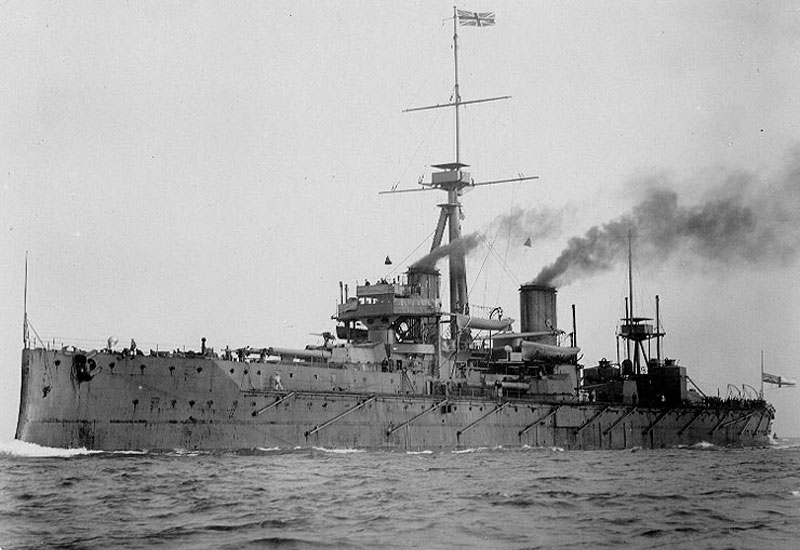
The armament improvements on Dreadnought focused the change of the current discipline of using many calibers guns for offence and defense in the armament scheme. Dreadnought had five 12 inch two gun turrets having a range of 14.2 miles / 25,000 yards. Three turrets were located conventionally along the center line of the ship for weight stabilization, with one turret forward and two aft. The torpedo control tower located on a small tripod mast was mounted between the aft turrets. This blocked any aft center line fire from the aft turret closest to the superstructure. Two other 12 inch turrets were located on both sides of the bridge superstructure, each able to fire forward oblique and port or starboard based on which side the turret was mounted on. Dreadnought could deliver a broadside of eight guns, and fire eight guns aft or six ahead, in most cases only within a narrow range. At the time Lord of the Admiralty Jackie Fisher insisted that end on fire was more important than broadside fire, in future battles this concept was proven to be less effective. Dreadnought had 24 x12 pounders (76 mm), ten mounted on the tops of the 12 inch turrets, with 14 placed on the sides of the super structure having a range of 5.3 miles / 9,300 yards. The 76 mm was used as a defense against torpedo boats and was a poor choice as they did not have the range and used a light round. Casements on pre dreadnought battleships in this era also used 12 pounders with a 3 inch shell and were side mounted to mostly fire port or starboard and did not have full movement forward and aft. The casements required holes in the sides of the ship below the main deck that allowed water to enter during heavy seas this scheme was not used on Dreadnought.

Having superior firepower was useless without enhanced ranging, aiming and fire control systems. Dreadnought was one of the first Royal Navy capital ships to be fitted with improved electronic range transmitting equipment. The old standard fire control system was the use of a voice pipe system where changes in range and deflection were yelled into a brass pipe from fire control to the turrets. This was found to be ineffective in combat situations with the noise level affecting the spoken order. Also in the transmitting station in the bowels of the ship was the Vickers variable range/speed clock that estimated and projected the changing range between the target vessel and the attacking ship. For greater accuracy of determining the distance Dreadnought was fitted with a new type electrical rangefinders by Barr and Stroud, a 9-foot (3 m) base length instead of the standard 4½-foot base used on every other naval vessel of the day.

The use of a uniform main battery without multiple caliber guns greatly simplified the task of adjusting fire in action. All the 12 inch guns had the same ballistic characteristics. If the shells splash was over the target, the range was shortened, and if called short the range was increased. If the target was bracketed, the next volley used the same settings, adjusted by the Vickers clock for the ship speeds and course changes. Powder loads were made in small adjustments for range elevation adjustments. This superior fire control was not possible when the big guns were of different calibers simply because observers could not tell which guns created which splashes by what caliber shell.

The British invention of the steam turbine propulsion engine in 1884 was important for its use in ships by exhausting the fresh water to a condenser that could be reclaimed to feed a boiler because seawater could not be used. HMS Dreadnought was the first capital warship to replace the proven technology of the triple-expansion engine with the experimental steam turbine making her the fastest battleship in the world at the time of her launch. The battle plan was with a speed of 21 knots (39 km/h) she could outrun any existing battleship with like firepower, and the ability to outgun a faster cruiser. Having said that prior to and during World War I & II, the triple expansion engine dominated marine vessels when high speed was not essential.

Dreadnought reversed the old sailing arrangement, housing officers forward closer to the bridge and enlisted men aft, so that both officers and most enlisted men were closer to their action stations. Another major improvement was the removal of longitudinal passageways between compartments below deck. Doors connecting compartments were always closed during combat, like in submarines. Connecting open compartments would allow water to run the length of the ship in a collision or if hit by a torpedo.

Dreadnought was commissioned for trials in December 1906, and in January 1907 she sailed for the Mediterranean Sea and then to Port of Spain, Trinidad. Her successful trials were observed by many navies from around the world and inspired a naval arms race, with all major fleets adding Dreadnought type battleships. At Dreadnought’s commissioning Britain possessed a lead of 25 first-class battleships over the fleets of foreign navies. With Dreadnought, Britain now possessed a lead of only one ship, all other British first class battleships became second class Pre-Deadnaught vessels.

At the outburst of World War I in 1914 she was the flagship of the Fourth Battle Squadron based at Scapa Flow. Paradoxically for a vessel designed to engage enemy battleships, her only major action was the ramming and sinking of German submarine U-29 on 18 March 1915 thus became the only battleship ever to sink a submarine. As a result, she missed the Battle of Jutland, during refit. Like most of the older battleships, she was in bad condition from constant tour of duty in the North Sea, and was put up for sale in 1920 and sold for scrap for the sum of £44,000 in 1921.
All of the dreadnoughts were scrapped or used as targets after the end of World War I. Some of the advanced super-dreadnoughts continued in service through World War II. The term "dreadnought" gradually dropped from use after World War I, as all battleships shared superior characteristics.

History text ©2003-2009 www.MilitaryFactory.com • All Rights Reserved
No Reproduction Without Permission • Corrections / Comments to MilitaryFactory at Gmail dot com

Last Updated: 1/30/2009


  Specifications for the HMS Dreadnought
arrow downDimensions:
Length: 527ft (160.63m)
Beam: 82ft (24.99m)
Draught: 26ft (7.92m)

arrow downPerformance:
Surface Speed: 21kts (24mph)
Range: 12,260miles (19,731km)

arrow downStructure:
Complement: 773
Suface Displacement: 18,420tons
arrow downPower:
Engine(s): 18 x Babcock & Wilcox 3-drum water-tube boilers and Parsons single-reduction geared steam turbines delivering 22,500shp to 4 shafts.
arrow downArmament Suite:
10 x BL 12" (304.8mm) Mk X guns in
5 x Twin B Mk.VIII turrets (1 forward, 2 midship, 2 aft, 1 port and 1 starboard).
27 x 12-pdr 18 cwt L/50 Mk.I guns in single mountings.
5 x 18" (457mm) submerged torpedo tubes

More Pictures CompareX2 Conversions Dictionary Acronyms

  Special Navy Ship Collections

Collections:
United States Navy Carriers
Modern Warships

World War 2:
Destroyers of World War 2
Navy Ships of World War 2
USN Warships of World War 2
Submarines of World War 2

Vietnam War:
Warhips of the Vietnam War

Miscellaneous:
Battle of Trafalgar
How Submarines Work
United States Navy Classification


  Recent Navy Ship Section Additions
Thumbnail picture of the USS New York LPD-21 amphibious support landing dock
USS New York (LPD-21)
Thumbnail picture of the Bell PACV/ACV hovercraft
Bell PACV/ACV
Thumbnail picture of the USS United States frigate of 1797
USS United States

  Contacting MilitaryFactory.com
We can only get better if you tell us how. You can contact MilitaryFactory.com at MilitaryFactory at gmail dot com (replace "at" with "@" and "dot with ".") with any questions, comments or corrections. We also accept related military imagery that you approve for us to use on our website. Keep in mind, however, that due to volume, we may not directly respond to your inquiry. Please add us to your list of non-blocked recipients!

Aircraft Carriers

  Navy Ship Profile:


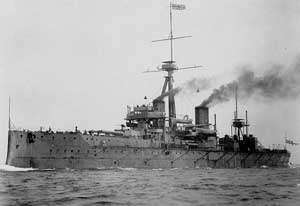
Picture of the HMS Dreadnought.
Photo Courtesy of the Public Domain

flag of United Kingdom
1906
Designation: HMS Dreadnought
Classification Type: Dreadnought Battleship
Ship Class: Devastation class

Country of Origin: United Kingdom
Number in Class: 1

Operators: the United Kingdom


  Ships in Class
HMS Dreadnought

  Collections
  • Dreadnoughts - Bigger Ships, Bigger Guns
  • Pocket Battleships
  • Destroyers - Power of One
  • Tall Ships
  • Carriers of the United States Navy
  • Cruisers
  • Battleships of World War 2


Free GI Bill Guide

Top MF Stuff: Military Pay Scale Chart | Military Ranks | World War 2 Weapons | Sniper Rifles | Conversion Calculators


©2009 www.MilitaryFactory.com • Content ©2003-2009 MilitaryFactory.com • All Rights Reserved • Disclaimer Privacy Policy Site Map Origins
Most photographic images appearing on this site are courtesy of the United States Department of Defense and are approved for public use.
Other images acquired through the public domain. Digital art work courtesy of Dan Alex.
Business Consulting by Kyle Williams

Material presented throughout this website is for historical and entertainment value and should not to be construed as usable for
hardware restoration, maintenance or general operation. Please consult manufacturers for such information.

Site Contact: militaryfactory at gmail dot com (replace "at" with "@" and "dot" with ".") eXTReMe Tracker