Global Firepower | Military Industrial Complex | Second World War History
Home | Military Pay Scale Chart | Aircraft | Infantry Weapons | Military Vehicles | Navy Ships | Military Education | French Military Victories | Military Ranks | WW2 Weapons
Military Factory Latest from Military Factory
Thumbnail picture of the Dardo infantry fighting vehicle
Dardo IFV
Thumbnail picture of the Supermarine Scimitar fighter
Supermarine Scimitar
Thumbnail picture of the Centauro B1 8x8 tank killer
Centauro 8x8
Thumbnail picture of the Novi Avion fighter
Novi Avion
Thumbnail picture of the FR F2 bolt-action sniper rifle
FR F2
Thumbnail picture of the Lebel Model 1886 bolt-action rifle
Lebel Model 1886
2009 Military Pay Scale Chart - for Army, Navy, Air Force and Marines
  By Type
    · Age of Sail
    · Aircraft Carriers
    · Escort Carriers
    · Amphibious
    · Amphibious Assault
    · Battleships
    · 2nd Class Bttlshps
    · Cargo Ships
    · Cruisers
    · Destroyers
    · Dreadnoughts
    · Pre-Dreadnoughts
    · Frigates
    · Ironclads
    · Midget Submarines
    · Mine Sweepers
    · Patrol Craft
    · Pocket Battleships
    · Special Forces
    · View All Ships
  Submarines
    · Full List
    · Diesel-Electric
    · Ballistic Missile
    · Nuclear Attack
  World War 2
    · Full List
    · Aircraft Carriers
    · Battleships
    · Destroyers
    · Submarines
    · US Warships
  Vietnam War
    · Full List

MilitaryFactory > Navy Ships > HMS Conqueror (S48)
 
 
More Pictures CompareX2 Conversions Dictionary Acronyms

HMS Conqueror (S48)

The HMS Conqueror survived combat action against Argentine forces in the Falklands War and serves today as a museum ship.
By JR Potts, AUS 173d AB

Bookmark and Share

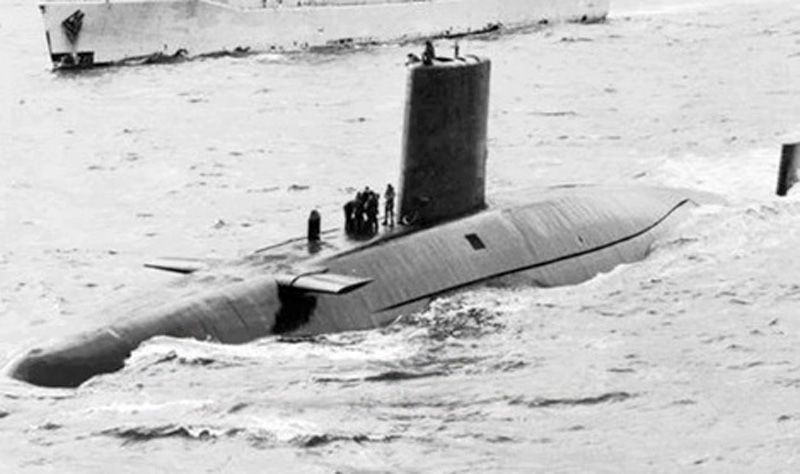
HMS Conqueror nicknamed the "Conks" was a Churchill-class nuclear-powered fleet submarine that served in the Royal Navy from 1971 to 1990. Conqueror was the third and last of her class, along with the HMS Churchill and HMS Courageous each manned by 103 officers and rates. The class was named after Winston Churchill who served as the British Prime Minister and First Lord of the Admiralty The main aim of these submarines was to counter the Soviet threat by spying on the USSR nuclear submarine movements at sea and shadowing and if necessary attacking Russian ships and submarines if the Cold War got hot.

The Churchill class was ordered by the Royal Navy to replace the Valiant class fleet boats and was designed by the Vickers Shipbuilding and Engineering Ltd. Company and built at Cammell Laird in Birkenhead. The boat dimensions and displacement were the same as the Valiant class but some internal changes in sonar electronics and communication gear was upgraded. She displaced 4,900 tones and was 286.7 feet (86.9 m) long, her draught was 27 feet (8.2 m), and the beam width 33.3 feet (10.1 m).

The propulsion was supplied to the boat by a single Rolls-Royce PWR nuclear pressurized water cooled reactor. The reactor created steam to power two English Electric geared turbines, producing a total of 20,000 shaft horsepower (15,000 kW) for the single shaft. The power plant allowed a maximum of 28 knots (52 km/h) speed while submerged. The Kelvin Type 1008 surface-search radar was fitted. The ships were built with a Type 2001 sonar array, but this was replaced in the late 1970s with a Type 2020 array and a Type 2026 towed array from behind the boat that can be let out and retrieved.

Torpedoes included the reliable the Mark 8 that came into service in 1913 and were used in WW I & II with much success and can be also dropped by aircraft. The 21” torpedo warhead has 320 lb (145 kg) of TNT and travels at a speed of 35 kts (65 km/h) towards its target up to 2.3 km (2,500 yds). The Mark 24 Tigerfish torpedoes were a heavy acoustic homing torpedo that was found to be unreliable. During tests on the weapon it was found that if the torpedo hit the target more than not without exploding. Many when fired did not find the target with the homing computer failing so the torpedo just fell away from the target. The third weapon on board was the UGM-84 Harpoon missile purchased from the United States. It is an all weather over the horizon anti ship missile system in submarines the missile is fitted with a solid-fuel rocket booster and encapsulated in a container to enable submerged submarines to launch through a torpedo tube to skim the surface towards its target to escape detection.

The Falklands War was between Great Britain and Argentina in over the rightful ownership of the Falkland Islands, South Georgia and the South Sandwich Islands. On April 2, 1982 an undeclared Falklands War began with the Argentine invasion and occupation of the Falkland Islands and South Georgia which British civilians and military forces were taken prisoner. The initial invasion was considered lawful by Argentina as the Islands in dispute were listed in her constitution since 1994 so it was seen as re-occupation of its own territory. The UK saw the landings and taking of prisoners as an invasion of overseas British Sovran territory.

The next day after the Argentine invasion of the Falklands on April 3, 1982 the Royal Navy issued orders to Cdr Chris Wreford-Brown commander of the HMS Conqueror to set sail from Faslane Naval Base on the River Clyde in Scotland. The orders were to rendezvous Conqueror with the British task force in the exclusion zone around the Falklands, the sail took twenty-one days at flank speed. Conquerors orders were to scan the area for enemy shipping, particularly her assigned primary target the light cruiser the ARA General Belgrano... She was deployed in a task force near the Falkland Islands, with the ARA General Belgrano to the south. The British had assigned HMS Spartan, a nuclear-powered submarine, to track down the 19,900 ton Veinticinco de Mayo and sink her if necessary Veinticinco de Mayo who previously served in the Royal Navy as HMS Venerable and the Royal Netherlands Navy as HNLMS Karel Doorman. In the first weeks of the Falklands War Veinticinco de Mayo deployed her aircraft against the Royal Navy task force with some success. The air group consisted of A-4Q Skyhawks supported by S-2 Tracker anti-submarine warfare aircraft and Sikorsky Sea King helicopters.

On 30 April, Conqueror spotted the Argentine light cruiser, ARA General Belgrano. Belgrano was sailing southwest of the Falklands with a small task force of two destroyers. Conqueror shadowed the force for days requesting permission to sink the Belgrano who was outside the exclusion zone or the imposed or area of engagement issued by the British. The Belgrano split off from her escort destroyers and began approaching the British Task Force, this was the trigger that increased the Royal Navy’s fears of a pincer attack with Belgrano attacking from the south, and the Veinticinco de Mayo from the north. Belgrano’s fate was sealed. After some debate in White Hall Conqueror was ordered to proceed with the attack on the Belgrano. Soon after receiving the order the Belgrano changed her course due to ARA Veinticinco de Mayo being out of position and not ready to launch aircraft against the British fleet.

Conqueror moved into the best firing position so a spread of three torpedoes could be fired with a high success of at least one hit. Three Mark 8 torpedoes were launched, the first hit forward towards the bow. This shot was trying to hit far enough forward to blow the bow of the ship off and explode the forward powder magazine. Neither worked the bulk heads held and no sailors were in the area, a lucky break for the crew. The second torpedo exploded behind the second smoke stack outside the limit of the side armor plating exploding in the aft machine room. The explosion blew upward through the mess halls and a crew wreck room killing 275 men and ripped a sixty foot long hole in the main deck. Again luck for the crew and the ship, no fire, but smoke filled much of the ship and the explosion damaged the electrical systems, preventing a radio distress call to be sent as an SOS. The Conqueror retired to a safe position to wait and observe the ship began to list to port and sink by the head. Twenty minutes after the attack Captain Bonzo of the Belgrano ordered the crew to abandon ship and life rafts were lowered, the sailors helped the wounded into the boats in moderate but increasing seas.

The two escort destroyers were unaware of the sinking due to no distress signal being sent or flares being seen so they continued on their course dropping depth charges. When they realized what happened to the Belgrano, it was dark and the seas swells had increased making rescue of the scattered life rafts almost impossible. It wasn’t till May 5 that all the crew boats were found by Argentine and Chilean ships. In all 770 men were found in the boats with 321 members of the brave crew and two civilians being killed in the attack.

Conqueror continued to hide from the Argentine Air Force attempts to locate and sink the boat in the days after the attack. The sinking of the Belgrano sobered the Argentine people and their government. Conqueror and Spartan’s presence in the area provided the task force sophisticated monitoring data tracking Argentine aircraft departing the mainland. The remainder of the Argentine fleet retired back into their home port never again to venture out. They became useless for the conflict over concern for their safety.

Argentina surrendered the islands to the UK on June 14, 1982 but show no sign of relinquishing her claim on the islands to this day. In 1994 the Argentine government and Captain Bonzo indicated the sinking of the Belgrano was a legal act under the rules of engagement of the day. After the war, Conqueror returned to Faslane, her home port and today is a museum ship.

History text ©2003-2009 www.MilitaryFactory.com • All Rights Reserved
No Reproduction Without Permission • Corrections / Comments to MilitaryFactory at Gmail dot com

Last Updated: 2/25/2009


  Specifications for the HMS Conqueror (S48)
arrow downDimensions:
Length: 286.7ft (87.39m)
Beam: 33.3ft (10.15m)
Draught: 27ft (8.23m)

arrow downPerformance:
Surface Speed: 0kts (0mph)
Submerged Speed: 28kts (32mph)
Range: Essentially Unlimited

arrow downStructure:
Complement: 103
Suface Displacement: 4,900tons
arrow downPower:
Engine(s): 1 x Rolls-Royce PWR Nuclear reactor; 1 x shaft.
arrow downArmament Suite:
6 × 533mm 21-inch bow submerged torpedo tubes
Mark 8 21” torpedoes
Mark 24 Tigerfish torpedoes
UGM-84 Harpoon Missiles

More Pictures CompareX2 Conversions Dictionary Acronyms

  Special Navy Ship Collections

Collections:
United States Navy Carriers
Modern Warships

World War 2:
Destroyers of World War 2
Navy Ships of World War 2
USN Warships of World War 2
Submarines of World War 2

Vietnam War:
Warhips of the Vietnam War

Miscellaneous:
Battle of Trafalgar
How Submarines Work
United States Navy Classification


  Recent Navy Ship Section Additions
Thumbnail picture of the USS New York LPD-21 amphibious support landing dock
USS New York (LPD-21)
Thumbnail picture of the Bell PACV/ACV hovercraft
Bell PACV/ACV
Thumbnail picture of the USS United States frigate of 1797
USS United States

  Contacting MilitaryFactory.com
We can only get better if you tell us how. You can contact MilitaryFactory.com at MilitaryFactory at gmail dot com (replace "at" with "@" and "dot with ".") with any questions, comments or corrections. We also accept related military imagery that you approve for us to use on our website. Keep in mind, however, that due to volume, we may not directly respond to your inquiry. Please add us to your list of non-blocked recipients!

Aircraft Carriers

  Navy Ship Profile:


Picture of the HMS Conqueror (S48).


flag of United Kingdom
1971
Designation: HMS Conqueror (S48)
Classification Type: Nuclear Attack Submarine
Ship Class: Churchill-class

Country of Origin: United Kingdom
Number in Class: 3

Operators: United Kingdom


  Ships in Class
HMS Churchill (S46); HMS Conqueror (S48); HMS Courageous (S50)

  Collections
  • Dreadnoughts - Bigger Ships, Bigger Guns
  • Pocket Battleships
  • Destroyers - Power of One
  • Tall Ships
  • Carriers of the United States Navy
  • Cruisers
  • Battleships of World War 2


Free GI Bill Guide

Top MF Stuff: Military Pay Scale Chart | Military Ranks | World War 2 Weapons | Sniper Rifles | Conversion Calculators


©2009 www.MilitaryFactory.com • Content ©2003-2009 MilitaryFactory.com • All Rights Reserved • Disclaimer Privacy Policy Site Map Origins
Most photographic images appearing on this site are courtesy of the United States Department of Defense and are approved for public use.
Other images acquired through the public domain. Digital art work courtesy of Dan Alex.
Business Consulting by Kyle Williams

Material presented throughout this website is for historical and entertainment value and should not to be construed as usable for
hardware restoration, maintenance or general operation. Please consult manufacturers for such information.

Site Contact: militaryfactory at gmail dot com (replace "at" with "@" and "dot" with ".") eXTReMe Tracker