Military Factory
Military Pay Chart
Global Firepower
Military Industrial Complex
Second World War
Home
Military Pay Scale
Military Ranks
Small Arms
Aircraft
Land Systems
Navy
Education
Military Factory Facebook Logo
flag of Germany

FGS Braunschweig (F260) Corvette (2008)

Authored By JR Potts, AUS 173d AB | Last Updated: 2/15/2012

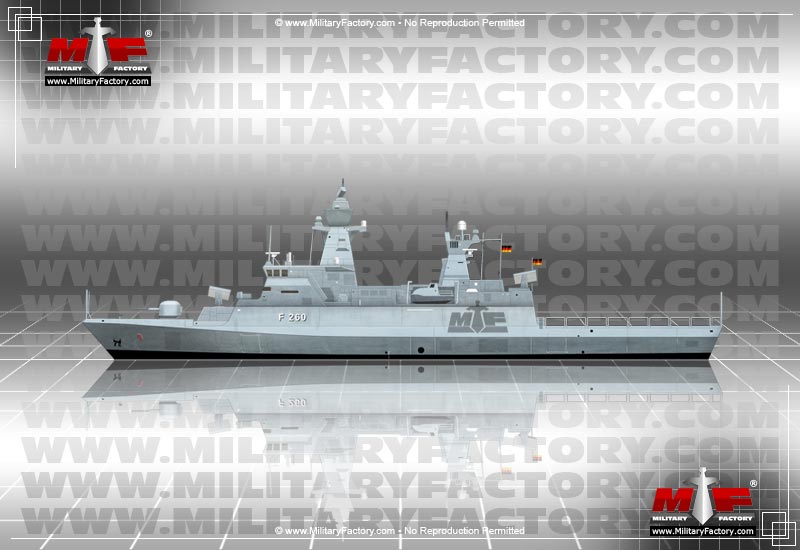
The F260 Braunschweig is an ocean-going corvette-class warship and the lead ship of her class.

Find a School Near You
Follow Military Factory on Facebook:
Trending on Military Factory:
Recent Articles:
After World War 2 many navies of the world began trending towards construction of smaller warships. The cost of building large capital warships, plus the massive shipyards and resources needed to construct said ships, ran into the hundreds of billions of dollars. Shrinking post-war defense budgets, the advent of missile technology and advanced aircraft were all major reasons why the "big gun" battleship was lost to naval history. In fact, there has not been a battleship built anywhere in the world since the last Iowa-class vessel was commissioned in 1944. The "corvette" category of fighting ship is not a new ship type by any means but is regaining popularity with many nations fielding a navy, especially those that border smaller bodies of shared water. Displacement of these vessels run between 600 to 3,000 tons - a far cry from the mammoth battleships of World War 2.

The newest German Navy corvette is the "K130" Braunschweig-class of ocean-going vessels. The F260 Braunschweig is the lead ship of her five-strong class and is listed at 1,840 tons displacement. These corvettes are small enough to be maneuverable for costal patrol sorties but are designed large enough to content with "blue water" ocean-bound missions as well. Construction of the class is such that the vessel is manufactured as separate major components and brought together for final assembly at a shipyard. For the F260 Braunschweig, final assembly occurred at the Blohm & Voss shipyard. Her keel was laid down on December 3rd, 2004 and she was officially launched on April 19th, 2006.

The Braunschweig was commissioned on April 16th, 2008 but, during her sea trials, a defect was found in her engine gear system - the gearing being from Swiss contractor MAAG of Winterthur. Other ships have been completed with this same engine arrangement and have not experienced this severe gear failure. MAAG chose to save weight for better speeds and used lightweight gears in the process, this in turn having created the defects identified in early trials. The first two vessels were commissioned nonetheless while the last three corvettes in the class have had their commissioning delayed until the gears can be replaced.

The F260 measures in at only 292 feet, 5 inches long (89.12 meters) with a beam of 43 feet, 7 inches (13.28 meters) wide. She draws minimal water at 11 feet, 2 inches (3.4 meters). The vessel is powered by the aforementioned 2 x diesel engines from Switzerland, the MTU 20V 1163 TB 93, each producing 14.8MW and driving two controllable-pitch propellers. When the gears are in full swing, the ship can make 26 knots (48 km/h or 30 mph) with a range out to 4,000 nautical miles (7.400 km - with a constant speed of at 15 knits (28km/h) (17mph)). Fuel supplies are minimal, however, and she needs a tender after seven days at sea. The F260 fields a crew of 65 officers and enlisted crew. The vessel sports a sleek, modern look about her and is built with some inherent stealth features that help to contain radar and infrared signatures.

Armament-wise, the Braunschweig is completed with 1 x 76mm Otobreda main gun, 2 x 27mm MLG cannons, 4 x RBS-15 Mk 3 surface-to-surface, anti-ship missiles. There is also a mine-laying capability when required. Close-in defense is provided for by 2 x 21 cell RAM missile launchers. The 76mm deck gun is a system compact enough to be installed on small warships and sports a rate-of-fire from 85 to 120 rpm. This makes it applicable for anti-missile defense, anti-aircraft defense and anti-surface ship defense while also doubling as an offensive weapon for fire support during amphibious landings. The two mounted MLG 27mm autocannons are intended for incoming missiles threats as well as low-flying aircraft and are single-barrel weapons of high performance, operated by a fully automatic, electrically-fired, gas-operated system with selective rates of 1,000 or 1,700 rounds-per-minute.

There is an aft hanger specifically built to house two of the six "Camcopter" S-100 unmanned helicopter vehicles ordered by the German Navy. This UAV is made by the Austrian concern of Schiebel and resembles a small helicopter whose weight is roughly 440 pounds (200 kg) and has fuel capacity for six hours of flight time. She is powered by a 55 horsepower Diamond engine that can make 140 mph (220km) per hour to a maximum of 18,000 feet (5,500m). The S-100 is not currently a weapons platform but can carry various payloads like electro-optics and infrared sensors which help to broaden the "reach" of the Braunschweig itself. The external flight deck at the stern is large enough to accept and launch one manned medium-class helicopter.
Text ©2003-2013 www.MilitaryFactory.com • All Rights Reserved • No Reproduction Permitted
MilitaryFactory.com does NOT sell equipment/weaponry. Material presented throughout this website is for historical and entertainment value and should not to be construed as usable for hardware restoration, maintenance or general operation. Please consult manufacturers for such information. Our disclaimer. Email corrections / Comments to MilitaryFactory at Gmail dot com.

Specifications for the
FGS Braunschweig (F260)
Corvette


Country of Origin: Germany
Initial Year of Service: 2008
Operators: Germany


Crew: 65


Length: 292.5ft (89.15m)
Beam: 43.7ft (13.32m)
Draught: 11.1ft (3.38m)
Displacement: 2,027tons


Machinery: 2 x MTU 20V 1163 TB93 diesel engines drving 2 x propeller shafts.

Surface Speed: 26kts (30mph)
Range: 4,603miles (7,408km)


Armament:
1 x 76mm OTO-Breda Dual-Purpose Naval Gun
2 x 27mm MLG autocannons
4 x RBS-15 Mk 3 anti-ship missiles
2 x 21-cell Rolling Airframe Missile (RAM) Close-in Weapon System (CIWS).
Mine dispenser as needed.


Air Arm: 2 x Camcopter S-100 UAV helicopters (optional)


Ship Class: K130 Braunschweig-class
Number-in-Class: 5
Ships-in-Class: F260 Braunschweig; F261 Magdeburg; F262 Erfurt; F263 Oldenburg; F264 Ludwigshafen am Rhein

ALL NAVY SHIP CATEGORIES
Site Disclaimer | Privacy Policy | Site Map | MF Origins


©2013 www.MilitaryFactory.com • Content ©2003-2013 MilitaryFactory.com • All Rights Reserved • Site Contact Email: militaryfactory at gmail dot com. The "Military Factory" name and MilitaryFactory.com logo are registered ® trademarks and protected by all applicable domestic and international intellectual property laws.


Top MF Stuff: 2013 Military Pay Scale | Military Ranks | WW2 Weapons | Sniper Rifles | Kts to Mph | WW1 Aircraft | Automatic Rifles | Aircraft Cockpits | Vietnam War Weapons | Main Battle Tanks | Submachine Guns | Shotguns | French Military Victories


Most photographic images appearing on this site are courtesy of the United States Department of Defense and are approved for public use. Other images acquired through the public domain. Digital art work courtesy of Dan Alex. Business Consulting by Kyle Williams. Material presented throughout this website is for historical and entertainment value and should not to be construed as usable for hardware restoration, maintenance or general operation. Please consult manufacturers for such information.


eXTReMe Tracker