Military Factory
Military Pay Chart
Global Firepower
Military Industrial Complex
Second World War
Home
Military Pay Scale
Military Ranks
Small Arms
Aircraft
Land Systems
Navy
Education
Military Factory Facebook Logo
flag of France

Bretagne (1915) Battleship (1915)

Authored By Staff Writer | Last Updated: 5/9/2013

The Bretagne was sunk by the HMS Hood before the German military could claim the French Fleet in the Mediterranean during World War 2.

Find a School Near You
Follow Military Factory on Facebook:
Trending on Military Factory:
Recent Articles:
The Bretagne battleship served the French Navy throughout the bulk of World War 1 and operated throughout the inter-war years and into the early part of World War 2. She was subsequently attacked and sunk by the British Royal Navy in Algeria who feared her - and the French Fleet - falling into German hands. Over 1,000 French sailors went down with her, ending a twenty-five year tenure and causing a national rift between the two nations.

By this time in history, France was consistently behind in the grand "Dreadnought" naval race of the world's militaries. The dreadnought proved the preeminent battleship of her 20th Century, coupling "big gun" design with steam propulsion. While the world lay quiet for a time at the turn of the century, the arrival of the dreadnought pushed forth a new weapons race for many of the world powers involved - specifically between Britain and Germany - this also during a time when a nation's power was still measured by strength at sea. Dreadnoughts came to be measured within three categories - Pre-Dreadnoughts, Dreadnoughts and Super-Dreadnoughts. Many of these vessels were ultimately taken to the scrapman's torch following the long and bloody global conflict defined as World War 1 - this was pushed forth by the ensuing Washington Naval Treaty and agreed upon by naval powers the world over.

To seemingly catch up to the other powers at play, French authorities ordered the design and construction of three battleships to be designated as the Bretagne, Provence and Lorraine - the Bretagne to act as lead to her sister ships. To help cut down on construction time in the shipyard, it was suggested that the new battleships take the most out of the previous Courbet class of fighting ship. The main guns were lifted from the cancelled Normandie-class battleship.

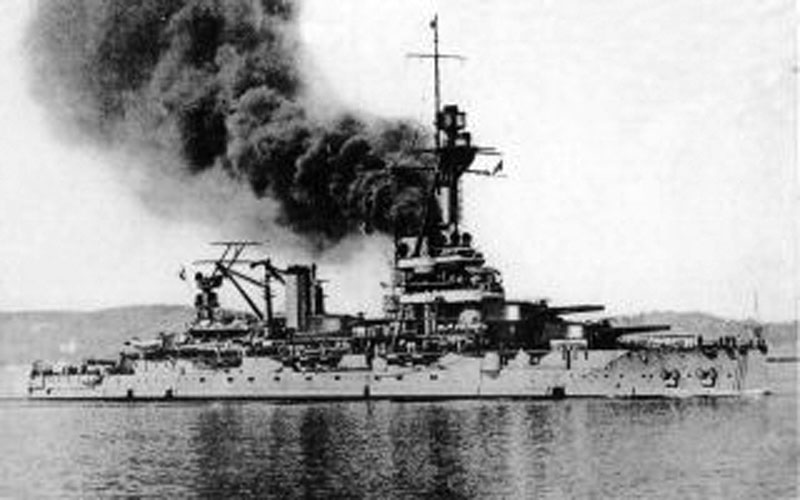
As it came, the Bretagne was an impressive-looking vessel. She sported a conventional hull with a sharp raised bow. She held two large main gun turrets in twin-mountings forward and two main gun turrets in twin-mountings aft. Interestingly, a fifth turret with a twin-mount emplacement was settled directly amidships for a total of ten main guns. Her superstructure dominated amidships and held her twin masts, bridge and twin funnels. Power was supplied by 18 to 24 boilers and 4 x shaft Parson turbines. All this generated an output of up to 29,000 horsepower giving the vessel a top speed nearing 20 knots. Her length measured in at over 544 feet and she was ranged out to 4,700 nautical miles when speeding at 10 knots. Her standard crew complement was 1,133 officers and enlisted personnel. Armor protection at the belt was 270mm. Her three decks held 40mm each and the casemates were listed at 170mm thick. The turrets each maintained up to 340mm of armor plate while the conning tower measured in at 314mm. In all, she displaced some 26,180 tons on a full load.

Armament centered around the aforementioned main guns, these 10 x 340mm/45 Modele 1912 series guns, each in twin-mountings per turret structure. This was furthered by 4 x 47mm cannons and 4 x 450mm torpedo tubes for anti-ship defense. Torpedoes aboard battleships were a large part of the armament concerning World War 1 vessels and this thinking carried over some into World War 2 surface warships until ultimately leaving torpedo attacks to dedicated submarine platforms. Additional defense was afforded by the 22 x 138.6 Mle 1910 series medium-class naval surface guns. After 1935, these gun systems were narrowed to just 14 x 138.6mm Mle 1910 guns with 8 x 75mm/50 Modele 1922 guns to boot.

The Bretagne was laid down on July 1st, 1912, by the Arsenal de Brest shipbuilder. Upon her completion, she was launched on April 21st, 1913, and was officially commissioned for service in the French Navy in September of 1915. She received her namesake "Bretagne" from the French region known as "Region of Brittany" of "Region Bretagne", the westernmost landmass peninsula on French soil.

The Bretagne was stationed throughout the Mediterranean during her time in World War 1, from 1916 to 1918. Modernization projects from 1921 to 1923 made her a slightly better fighting vessel and included partial oil firing systems. Further modernization transpired from 1927 to 1930. She underwent yet another program from 1932 to 1935 and added new boilers with 43,000 horsepower output, though her top speed increased only one knot. She would remain in operations across the Mediterranean region at the start of World War 2. Germany invaded French soil on May 10th, 1940, and the French nation capitulated on June 21st, 1940. The fall of Paris left many fighting units cut-off, surrendering or on the run. As such, the Bretagne set sail for the Algerian port of Mers-el-Kebir to join the rest of the surviving French Fleet.

Britain realized the importance of having had lost France as a military ally in mainland Europe. The French Navy could still remain a symbol of power but, at this point, could easily fall into service for the invading Germans or Italians. There was a sense of urgency to assure the British government that, should the French fleet come under direct German threat, French sailors need sabotage their vessels for the greater good. The British Admiralty sent an order to guarantee such action on France's part. Captain C.S. Holland of the HMS Hood - the British capital ship - visited with French authorities and included French Admiral Gensoul. However, any British solution was rebuffed - the French would not surrender their ships to the British, nor join the British as an ally nor surrender their ships to foreign friendly parties in foreign ports elsewhere. After a final message from British Prime Minister Churchill to holland urging a swift end to the matter, Holland set forth a deadline that came and went. Ultimately, he ordered the guns of the HMS Hood to open fire, this on July 3rd, 1940. His crew diligently answered with trained accuracy and expediency. Swordfish aircraft from the carrier Ark Royal directed the action from above and consulted gunnery crews for improved accuracy in their subsequent shots. The HMS Valiant and HMS Resolution were part of the shelling fray.

Bretagne was one of the many French Fleet ships anchored in the harbor still. She was also one to take the main brunt of the British salvos and endured the first of such hits onto her design. French sailors were immediately killed or thrown overboard from the blast. Hot oil leaked across the harbor and did more damage to the living who managed a fall into the water. Thick black smoke stifled the air, suffocating those that managed to live between these direct salvos. HMS Hood's shells penetrated through the decks of the Bretagne and struck her magazine, ultimately dooming the ship for good. She listed to one side and eventually settled upside down, reportedly sinking in a short 20 seconds according to eye witness French sailors. Between 977 and 1,012 French sailors went down with the ship (sources vary) in fighting that lasted only one half-hour. Some French vessels tried to manage their way out of the harbor - and some did with success - but the French fleet proved a sitting duck in this surprise situation, caught unawares by the unseen and ultimate British intention.
Continue to Page 2 (of 2) >>
Text ©2003-2013 www.MilitaryFactory.com • All Rights Reserved • No Reproduction Permitted
MilitaryFactory.com does NOT sell equipment/weaponry. Material presented throughout this website is for historical and entertainment value and should not to be construed as usable for hardware restoration, maintenance or general operation. Please consult manufacturers for such information. Our disclaimer. Email corrections / Comments to MilitaryFactory at Gmail dot com.
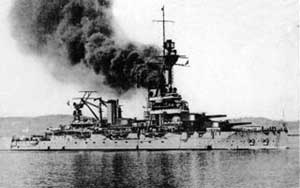
Picture of Bretagne (1915)
View All Images (1)

Specifications for the
Bretagne (1915)
Battleship


Country of Origin: France
Initial Year of Service: 1915
Operators: France


Crew: 1,133


Length: 545ft (166.12m)
Beam: 88ft (26.82m)
Draught: 32ft (9.75m)
Displacement: 28,956tons


Machinery: 18 to 24 x boilers; 4 x shaft Parsons turbines delivering up to 29,000 horsepower.


Surface Speed: 20kts (23mph)
Range: 5,256miles (8,459km)


Armament:
10 x 13.4-inch (340mm) /45 Modele 1912 main guns (twin mountings).
4 x 47mm anti-aircraft cannons
4 x 450mm torpedo tubes
22 x 138.6mm Mle 1910 cannons

POST-1935:
10 x 13.4-inch (340mm) /45 Modele 1912 main guns (twin mountings).
4 x 47mm anti-aircraft cannons
4 x 450mm torpedo tubes
14 x 138.6mm Mle 1910 cannons
8 x 75mm/50 Modele 1922 cannons


Ship Class: Bretagne-class
Number-in-Class: 3
Ships-in-Class: Bretagne; Provence; Lorraine

ALL NAVY SHIP CATEGORIES
Site Disclaimer | Privacy Policy | Site Map | MF Origins


©2013 www.MilitaryFactory.com • Content ©2003-2013 MilitaryFactory.com • All Rights Reserved • Site Contact Email: militaryfactory at gmail dot com. The "Military Factory" name and MilitaryFactory.com logo are registered ® trademarks and protected by all applicable domestic and international intellectual property laws.


Top MF Stuff: 2013 Military Pay Scale | Military Ranks | WW2 Weapons | Sniper Rifles | Kts to Mph | WW1 Aircraft | Automatic Rifles | Aircraft Cockpits | Vietnam War Weapons | Main Battle Tanks | Submachine Guns | Shotguns | French Military Victories


Most photographic images appearing on this site are courtesy of the United States Department of Defense and are approved for public use. Other images acquired through the public domain. Digital art work courtesy of Dan Alex. Business Consulting by Kyle Williams. Material presented throughout this website is for historical and entertainment value and should not to be construed as usable for hardware restoration, maintenance or general operation. Please consult manufacturers for such information.


eXTReMe Tracker