Military Factory
Military Pay Chart
Global Firepower
Military Industrial Complex
Second World War
Home
Military Pay Scale
Military Ranks
Small Arms
Aircraft
Land Systems
Navy
Education
Military Factory Facebook Logo
flag of United States

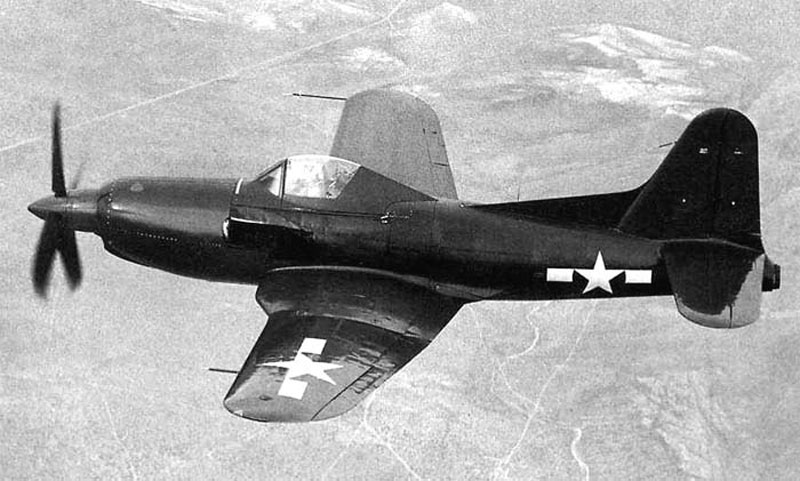
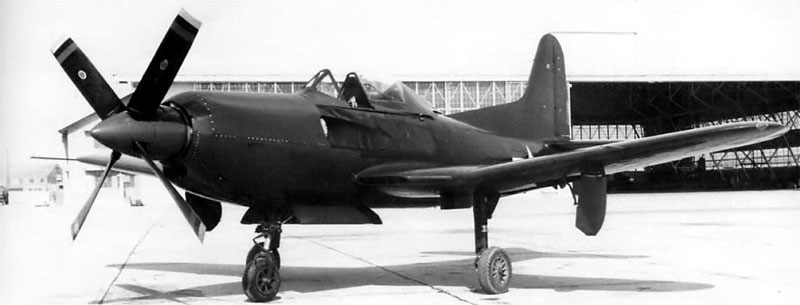
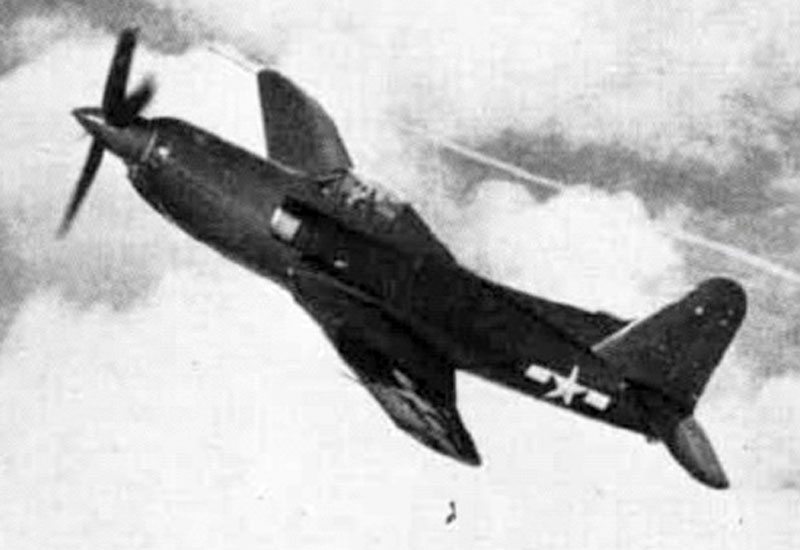
Ryan XF2R Dark Shark Fighter (1946)

Authored By Staff Writer | Last Updated: 10/26/2012

The XF2R Dark Shark was another Ryan Aeronautical attempt at producing a hybrid turboprop-jet fighter for the US military.

Find a School Near You
Follow Military Factory on Facebook:
Trending on Military Factory:
Recent Articles:
The Ryan "Dark Shark" was an impressive developmental hybrid fighter design considered for service with both the United States Navy and United States Air Force shortly after World War 2. The aircraft attempted to mate a turboprop engine installation with a turbojet engine to achieve excellent performance specifications during a time when turbojets lacked the necessary force and long term reliability to power fighter aircraft - particularly from the short decks of aircraft carriers. However, advances in the field of jet propulsion provided an end to such hybrid designs and the Dark Shark would go on to exist in only a single prototype - interest on the part of the USN and USAF waning when tempted by the power of dedicated jet-powered fighters for their new-breed squadrons.

At this point in aviation history - that is the period encompassing the latter stages of World War 2 - early turbojets lacked much in the way of power and were thirsty breeds at their core. While they offered up some inherent benefits over most conventional piston-powered aircraft, they were relatively infant in their use of technology, warranting some governmental organizations to consider the option of pairing proven piston engine technology with turbojet engines to make up for the latter's deficiencies. This movement led to a brief period in military aviation history that attempted the hybrid concept though the producing little in the way of notable, quantitative aircraft - the jet age had evolved sufficiently enough by the time of the early 1950s to promote true jet-powered airframes ahead of the once-dominant, conventional piston-powered types.

Ryan Aeronautical Company had previously attempted a hybrid-powered aircraft in their FR Fireball for the United States Navy. She proved to be a short-lived fighter platform that utilized a piston engine and turbojet engine to achieve a combined thrust output (and thusly much improved performance specifications) than aircraft using solely one of the two installations. For the most part, the Fireball was a conventional aircraft in layout save for the hybrid engine arrangement and sat atop a retractable powered tricycle landing gear arrangement. Power stemmed from a General Electric J31-GE-3 series turbojet engine mated to a Wright R-1820-72W Cyclone radial piston engine - each delivering 1,600lbf of thrust and 1,350 horsepower respectively. She was crewed by a pilot in a forward-set cockpit and some 66 examples were produced from 1944 into 1945 - the final year of World War 2. However, the end of the war spelled the end of the need for the Fireball and production was ended - she formed just a single squadron in her short time in service with the United States Navy, seeing her use discontinued by the end of 1947.

The United States Navy looked at another Ryan Aeronautical Company development, this the improved XF2R "Dark Shark", as a possible addition to its carrier-based inventory. Design-wise, she proved sleeker than the Fireball and also fitted a hybrid engine arrangement though the basic piston engine being replaced by a turboprop one. The cockpit was more centralized in the well-contoured fuselage with the four-bladed propeller engine at the front of the design and the turbojet engine buried within the aft portion of the fuselage. The empennage was conventional and the Dark Shark was also supported by a tricycle landing gear arrangement. A prototype was formally ordered for construction and first flew on November 1st, 1946 out of Edwards Air Force base. In essence, the Dark Shark was a further development of the Fireball concept though within a new body design and introducing turboprop power.

General Electric was responsible for the two powerplants and responded with their J31 series turbojet and T31 turboprop installations. The J31 was notable for it also powered the Bell P-59 Airacomet - America's first jet fighter - as well as the Ryan FR Fireball and became the first jet engine to be produced in quantity within the United States though it held origins in the British Whittle W.1 series. The propeller-minded T31 turboprop engine went on to power the abandoned Vultee XP-81 (of which only two prototypes were built) and never materialized into any serious production numbers (28 were built in all). The type did, however, become the first turboprop engine to be mass-produced anywhere in the United States. The J31 offered 1,600lbs of thrust in a pushing action while the T31 added 1,760 horsepower in pulling the airframe. When these powerplants were paired in the Dark Shark, they supplied the fighter with a top speed nearing 500 miles per hour, a service ceiling just under 40,000 feet and a rate of climb equal to 4,850 feet per minute. The engines were fed via air intake inlets found along the wing leading edges. Compared to the fabled North American P-51D Mustang fighter of World War 2, the Dark Shark exceeded her listed performance statistics of a 437 mile per hour top speed and 3,200 feet per minute rate-of-climb.

Like most other heavy hitters utilized throughout the war for the Americans, the Dark Shark was simply armed with heavy caliber machine guns - going against the accepted norm of larger caliber cannons as those found in aircraft from Britain, Germany and the Soviet Union. The Dark Shark would be armed with 4 x 12.7mm (.50 caliber) Browning M2 heavy machine guns. Machine guns did offer up high rates-of-fire and larger ammunition loads than those as found on competing cannon systems. Beyond the machine gun battery, there were no other stated weapon options for the Dark Shark. Comparatively, the P-51D Mustang was armed with 6 x 12.7mm machine guns in the wings and had provisions for the carrying of bombs in the strike role.

While evaluations revealed the Dark Shark to be a sound aircraft design in most respects, advances in jet technology doomed any further development on the type. Additionally, the Dark Shark did not improve upon the performance numbers of the preceding Fireball attempt leading the United States Navy to move towards obtaining stocks of jets now featuring evermore powerful engines, leaving the Dark Shark to exist in only one abandoned prototype form. The United States Air Force also showed interest in the Ryan creation but elected to follow-up on pure jet fighters themselves. The single Dark Prototype was, however, slightly modified per the USAF to take on a Westinghouse J-34 series turbojet engine to become the "XF2R-2" prototype. To aspirate the new engine, the intake duct work of the original XF2R was revised to include two side-mounted air intakes with the leading edge wing inlets of the original being dropped altogether from the design. This new designation gave rise to the former Dark Shark being recognized as the "XF2R-1" from thereon.
Text ©2003-2013 www.MilitaryFactory.com • All Rights Reserved • No Reproduction Permitted
MilitaryFactory.com does NOT sell equipment/weaponry. Material presented throughout this website is for historical and entertainment value and should not to be construed as usable for hardware restoration, maintenance or general operation. Please consult manufacturers for such information. Our disclaimer. Email corrections / Comments to MilitaryFactory at Gmail dot com.
Picture of Ryan XF2R Dark Shark
Pic of the Ryan XF2R Dark Shark
Image of the Ryan XF2R Dark Shark
View All Images (3)

Specifications for the
Ryan XF2R Dark Shark
Fighter


Country of Origin: United States
Manufacturer: Ryan Aeronautical - USA
Initial Year of Service: 1946
Production: 1


Focus Model: Ryan XF2R Dark Shark
Crew: 1


Length: 35.99ft (10.97m)
Width: 41.99ft (12.80m)
Height: 14.01ft (4.27m)
Weight (Empty): 0lbs (0kg)
Weight (MTOW): 11,001lbs (4,990kg)


Powerplant: 1 x General Electric T31 turboprop engine delivering 1,760 horsepower; 1 x General Electric J31 turbojet engine delivering 1,600lbf of thrust.


Maximum Speed: 497mph (800kmh; 432kts)
Maximum Range: 0miles (0km)
Service Ceiling: 39,042ft (11,900m; 7.4miles)
Rate-of-Climb: 4,850 feet per minute (1,478m/min)


Hardpoints: 0
Armament Suite:
4 x 12.7mm (0.50 caliber) M2 Browning air-cooled, heavy machine guns.


Variants:
XF2R "Dark Shark" - Base Prototype Designation; single example produced.


XF2R-1 - Redesignation post-XF2R-2 appearance.

XF2R-2 - Fitted with Westinghouse J-34 turbojet engine for USAF evaluation.


Operators: United States

ALL AIRCRAFT CATEGORIES

BY DECADE:


1900 to 1909
1910 to 1919
1920 to 1929
1930 to 1939
1940 to 1949
1950 to 1959
1960 to 1969
1970 to 1979
1980 to 1989
1990 to 1999
2000 to 2009
2010 to 2019
2020 to 2029
VIEW ALL
Compare Aircraft


BY TYPE:


Anti-Submarine Warfare (ASW)
Attack Helicopters
Bomber Aircraft
Medium Bombers
Heavy Bombers
Close-Air Support (CAS)
Commercial Aircraft
Dive Bombers
Electronic Warfare Aircraft (EWA)
Experimental / X-Planes
Fighter Aircraft
Floatplane Aircraft
Flying Boat Aircraft
Aerial Refueling Tankers
Helicopters (ALL)
Interceptor Aircraft
Multi-Role Aircraft
Navy Carrier Aircraft
Night Fighters
Reconnaissance / Scout
Search & Rescue (SAR)
Scout Helicopters
Special Purpose
Torpedo Bombers
Trainer Aircraft
Transport Aircraft
Transport Helicopters
Unmanned Aerial Vehicles (UAVs)
Unmanned Combat Air Vehicles (UCAVs)


COLLECTIONS:


4th Generation Fighter Aircraft
5th Generation Fighter Aircraft
US X-Planes
Classic US Warbirds
French Military Helicopters
Grumman "Cats"
Howard Hughes Aircraft
Indian Air Force
Israeli Air Force
Libyan Aircraft
Modern Chinese Aircraft
Modern Chinese Fighters
Modern Military Aircraft
Modern North Korean Aircraft
Modern Trainer Aircraft
Modern US Aircraft
Mikoyan Aircraft
Sukhoi Aircraft
Syrian Aircraft
Top 10 Fighter Aircraft of All Time


AIRCRAFT BY CONFLICT:


Arab-Israeli War (1948)
Cuban Missile Crisis (1959-1962)
Falklands War (1982)
Indo-Pak War (1965, 1971)
Iran-Iraq War (1980-1988)
Lebanon War (1982)
Operation Allied Force (1999)
Operation Desert Storm (1991)
Six Day War (1967)
Spanish Civil War (1936)
Soviet-Afghan War (1979-1989)
Yom Kippur War (1973)


MISCELLANEOUS:


Aircraft Cockpits
Aircraft Manufacturers List
Aircraft Timeline

WORLD WAR 2:


1939 Aircraft
1940 Aircraft
1941 Aircraft
1942 Aircraft
1943 Aircraft
1944 Aircraft
1945 Aircraft
1946 Aircraft
Australian Aircraft
Battle of Britain Aircraft
Bombers
Four-Engine Bombers
British Aircraft
British Bombers
British Transports
Dive Bombers
Canadian Aircraft
Fighters
Chinese Aircraft
French Aircraft
German Aircraft
German Fighters
German Flying Boats
German Jets
Secret Weapons of the Luftwaffe
Italian Aircraft
Imperial Japanese Aircraft
Imperial Japanese Fighters
Mitsubishi Bombers
Navy Aircraft
Pearl Harbor
Polish Aircraft
Romanian Aircraft
US Aircraft
US Bombers
US Navy Aircraft
Soviet Aircraft
Torpedo Bombers
Trainer Aircraft
Transport Aircraft
Tuskegee Airmen Aircraft
W.A.S.P. Aircraft
WW2 Aircraft Ranked by Speed
VIEW ALL


WORLD WAR 1:


1914 Aircraft
1915 Aircraft
1916 Aircraft
1917 Aircraft
1918 Aircraft
Aircraft Timeline
Austro-Hungarian Aircraft
Bomber Aircraft
British Aircraft
Fighters
Flying Boats
French Aircraft
Imperial German Aircraft
Italian Aircraft
Scout Aircraft
Russian Empire Aircraft
US Aircraft
WW1 Aircraft Ranked by Speed
VIEW ALL


KOREAN WAR:


Australian Aircraft
Korean War Aces
Korean War Jets
North Korean Aircraft
US Military Aircraft
VIEW ALL


VIETNAM WAR:


Helicopters
North Vietnam Air Force
US Airpower
VIEW ALL


COLD WAR:


1950s French Aircraft
British V-Bombers
Cold War Bombers
Soviet Aircraft
Soviet Bombers
Soviet Interceptors
Soviet Helicopters
Strategic Air Command
US Aircraft
US Bombers
US Interceptors
VIEW ALL

Site Disclaimer | Privacy Policy | Site Map | MF Origins


©2013 www.MilitaryFactory.com • Content ©2003-2013 MilitaryFactory.com • All Rights Reserved • Site Contact Email: militaryfactory at gmail dot com. The "Military Factory" name and MilitaryFactory.com logo are registered ® trademarks and protected by all applicable domestic and international intellectual property laws.


Top MF Stuff: 2013 Military Pay Scale | Military Ranks | WW2 Weapons | Sniper Rifles | Kts to Mph | WW1 Aircraft | Automatic Rifles | Aircraft Cockpits | Vietnam War Weapons | Main Battle Tanks | Submachine Guns | Shotguns | French Military Victories


Most photographic images appearing on this site are courtesy of the United States Department of Defense and are approved for public use. Other images acquired through the public domain. Digital art work courtesy of Dan Alex. Business Consulting by Kyle Williams. Material presented throughout this website is for historical and entertainment value and should not to be construed as usable for hardware restoration, maintenance or general operation. Please consult manufacturers for such information.


eXTReMe Tracker