Military Factory
Military Pay Chart
Global Firepower
Military Industrial Complex
Second World War
Home
Military Pay Scale
Military Ranks
Small Arms
Aircraft
Land Systems
Navy
Education
Military Factory Facebook Logo
flag of Imperial Germany

Bergmann MP18/I (Maschinenpistole 18/I) Submachine Gun (1918)

Authored By Staff Writer | Last Updated: 7/15/2012

The Bergmann MP18 is largely considered the first true submachine gun firearm.

Find a School Near You
Follow Military Factory on Facebook:
Trending on Military Factory:
Recent Articles:
While much of the attention of early submachine guns is ultimately paid to the Germans and their MP18 (Maschinenpistole 18), it was the Italians who were the first national army to officially adopt the submachine gun as a standardized weapon class with their introduction of the 9mm Glisenti Twin Villar Perosa in 1915. The design was a rather clunky and unorthodox instrument with no initial stock while spade grips managed the firing function and feeding was by way of a pair of 25-round detachable box magazines. It was only the Italians lack of foresight that saw this weapon utilized in the static light machine gun role rather than a true submachine gun weapon and this rather doomed it to the pages of history paving the way for the MP18 introduced in 1918. The Italians did eventually reveal a much improved, more traditional, submachine gun form by the end of World War 1 in the Beretta Model 1918 - this surviving long enough to see service in World War 2.

The submachine gun, as a class of weapon, was an intriguing middle ground between that of the service rifle and pistol and that of the machine gun. While the rifle could be used (to some extent) at a more intimate level in storming a trench (with bayonet fixed) and the pistol proved its worth in extremely close combat, the machine gun offered high-capacity volume fire with excellent man-stopping capabilities with suppression effects. As such, the submachine gun was essentially a portable machine gun, firing a smaller pistol-type cartridge, and decidedly more useful in the intimate meetings concerning trench warfare where combat was often decided within a few feet between combatants. The results of World War 1 inspired many post-war firearms endeavors in attempting to field a capable, portable man-stopping device for the individual infantryman should trench warfare make a return to the fields of Europe.

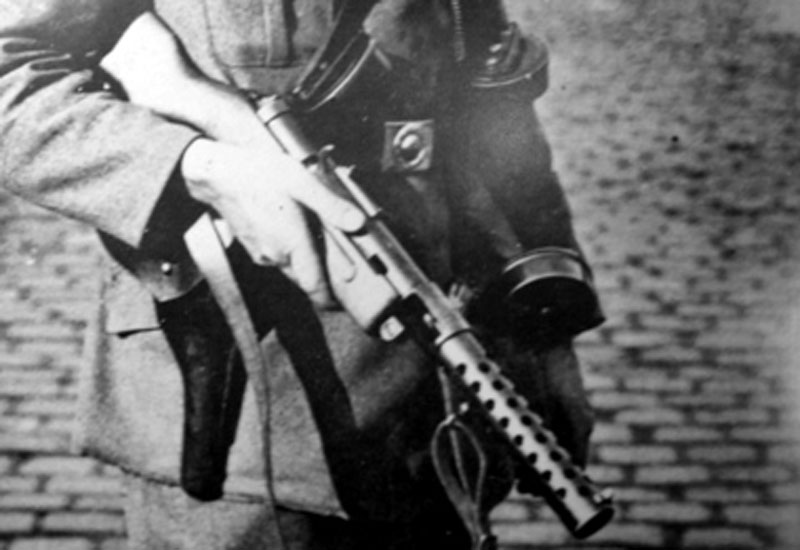
For the Germans, victory in World War 1 was becoming an evermore elusive prospect in 1918. Engineer Hugo Schmeisser began work on a compact automatic weapon as early as 1916 though the blowback action of his design dated as far back as the late 1890s. In this time, Schmeisser developed the blowback system of operation for various Bergmann pistols prior and gave thought to applying the same principle to a larger weapon system intended to fire a more powerful cartridge. Since the use of high-capacity magazines fired from a pistol proved cumbersome and limiting, he utilized a traditional wooden rifle-style body which incorporated the grip, shoulder stock and foregrip while the internals were added in the usual fashion as in a service rifle. The barrel was seated within a perforated barrel jacket to help with cooling, intended to counter the overheating of the barrel due to the automatic fire of the weapon. The internal action included a floating firing pin, bolt assembly and return spring which made the voluminous fire possible while keeping the action reliable. There was no muzzle device and iron sights were affixed over the receiver and over the muzzle. Should sling loops were fitted under the shoulder stock and under the barrel jacket. The integrated forend allowed for a firm two-hand hold when firing from the shoulder in the typical "three-point" stance. The magazine feed was offset to the left of the receiver with the charging handle set to the right. The magazine itself was of particular note for it consisted of a small drum with an extending shaft to which this part connected to the receiver side. Based on its appearance, these magazines came to be known as "snail" magazines and were the same as those initially developed as high-capacity drums for 9mm Parabellum pistols. The initial submachine gun design fired from a 20-round box magazine but this was ultimately dropped in favor of the drum magazine in the 9x19mm Parabellum caliber. Cyclic rate-of-fire was approximately 400 to 500 rounds per minute. The weapon was formally known as the "Maschinenpistole 18/I", otherwise known popularly (and simply) as the"MP18/I" or "MP18".

As its designation suggests, the MP18 was officially adopted in 1918 and arrived in time for the "Kaisershclacht Offensive" along the Western Front. Despite perhaps as many as 50,000 units on order, only 10,000 or so were actually available in the contest (some sources state much less). The German Army's intent was to field six such guns per company with one dedicated ammunition handler in tow as part of the "Strosstrupen" trench assault troops charged with storming enemy positions. The lack of numbers and appropriate tactics training negated any such ventures and guns were used whenever and however they could be used in the scope the war. In practice, these early forms shown their magazine feeds to be complicated and prone to stoppages in the heat of battle - further limiting their usefulness. It is suggested that as many as 30,000 MP18s were eventually completed by the end of the fighting in November 1918 - Germany finding herself on the losing side of the long and bloody conflict. After the feed mechanism was reworked by way of a special adapter, the MP18 proved a rather reliable and robust field weapon. Regardless of the weapon's individual success, Germany was saddled with the cost of the war and ultimately severely restricted by the provisions found within the Versailles Treaty in the number of - and type of - weapons she could hold in inventory or manufacture for the military (weapons such as the MP18 were specifically singled out). Despite the deadly automatic nature of the MP18 design, the submachine gun somehow survived as a police/security weapon (though with 20-round magazines) while still being banned - production, under secret it seems, continued regardless.

The MP18 was an innovative and revolutionary design in the scope of firearms that went on to influence other submachine gun projects well into the 1960s. The blowback system of operation became the standard for many famous designs to follow and undoubtedly inspired such interwar designs like the Soviet PPD which essentially retained the same form and function of the MP18 before it. Confiscated stocks of MP18s went on to serve in the French national army after World War 1 while the weapon was still in German circulation at the start of World War 2 and used as second line weapons. The French were keen enough on the German design that they developed a 20- and 32-round detachable box magazine all their own, doing away with the snail drum magazine restriction. License production versions from Belgium also featured the French-inspired additions. The MP18 was eventually found with 20-, 30- and 50-round box magazines and was also seen under license production from Swiss gunmaker SIG in 7.63x25mm Mauser and .30 Luger chamberings. A safety was asked for, and finally granted, in later German police production models.

The MP18 was eventually succeeded by the improved "Maschinenpistole 28/II" ( known simply as the "MP28") of 1928. Several other direct evolutions of the MP18 existed in Austria, Spain, France, Britain, China and elsewhere.
Text ©2003-2013 www.MilitaryFactory.com • All Rights Reserved • No Reproduction Permitted
MilitaryFactory.com does NOT sell equipment/weaponry. Material presented throughout this website is for historical and entertainment value and should not to be construed as usable for hardware restoration, maintenance or general operation. Please consult manufacturers for such information. Our disclaimer. Email corrections / Comments to MilitaryFactory at Gmail dot com.
Picture of Bergmann MP18/I (Maschinenpistole 18/I)
View All Images (1)

Specifications for the
Bergmann MP18/I (Maschinenpistole 18/I)
Submachine Gun


Country of Origin: Imperial Germany
Manufacturer: Bergmann Waffenfabrik - Germany / Qingdao Iron Works - China / SIG - Switzerland / Belgium
Initial Year of Service: 1918


Overall Length: 832mm (32.76in)
Barrel Length: 200.00mm (7.87in)
Weight (Empty): 9.22lbs (4.18kg)


Cartridge: 9x19mm Parabellum; 7.63x25mm Mauser
Action: Blowback; Open Bolt
Feed: 32-round detachable drum magazine; 20-, 30- or 50-round detachable box magazine
Muzzle Velocity: 1,247ft/sec (380m/sec)
Rate-of-Fire: 500 rounds per minute
Sights: Iron Front and Rear


Variants:
MP18/I - Base Series Designation


Maschinenpistole 18/I - Formal Designation


Operators: Belgium; Bolivia; Finland; France; Germany; Imperial Germany; Imperial Japan; Ireland; Nazi Germany; Paraguay; Portugal; Spain; Sweden; Switzerland; Taiwan; Yemen

ALL SMALL ARMS CATEGORIES

BY YEAR:


1700 to 1799
1800 to 1899
1900 to 1909
1910 to 1919
1920 to 1929
1930 to 1939
1940 to 1949
1950 to 1959
1960 to 1969
1970 to 1979
1980 to 1989
1990 to 1999
2000 to 2009
2010 to 2019
VIEW ALL
Compare Guns


BY TYPE:


Anti-Aircraft Weapons
Anti-Material Rifles
Anti-Tank Weapons
Automatic Rifles
Bolt-Action Rifles
Carbine Guns
Flamethrowers
Flintlock Guns
Grenade Launchers
Hand Grenades
Lever-Action Rifles
Machine Guns
Mortars
Musket Guns
Pistols / Handguns
Recoilless Rifles
Revolvers
Rocket Launchers
Shotguns
Silenced Guns
Sniper Rifles
Special Weapon Systems
Submachine Guns
VIEW ALL


SPECIAL:


18th Century Warfare
3 Soldiers Statue
Battle of Mogadishu
Chainmail Armor
Firearm Types Defined
French Military Victories
Medieval Crossbow
Medieval Longbow
Vietnam War Casualties
Vietnam War Memorial

WORLD WAR 2:


British Guns
French Guns
German Guns (ALL)
German Rifles
Italian Guns
Japanese Guns
Soviet Guns
US Guns
US Infantry Regiment-Level Guns
Machine Guns
Pistols
Submachine Guns
Sniper Rifles
VIEW ALL


WORLD WAR 1:

Pistols
Rifles
Machine Guns
Mortars
US Guns
VIEW ALL


KOREAN WAR:

Machine Guns
VIEW ALL


VIETNAM WAR:

Mortars
VIEW ALL


COLLECTIONS:


Ancient Weapons
British SAS Weapons
Civil War Guns
Colt Guns
Glock Guns
GROM Polish Special Forces
Guns of Libya
Guns of North Korea
Guns of Syria
Guns of WW1 & WW2
Heckler & Koch Guns
Kalashnikov Guns
Modern Russian Guns
Navy SEAL Weapons
Spetsnaz Weapons
Weapons of Desert Storm
Wild West Guns
Winchester Guns


HOLLYWOOD/GAMES:


Guns of the Walking Dead

Site Disclaimer | Privacy Policy | Site Map | MF Origins


©2013 www.MilitaryFactory.com • Content ©2003-2013 MilitaryFactory.com • All Rights Reserved • Site Contact Email: militaryfactory at gmail dot com. The "Military Factory" name and MilitaryFactory.com logo are registered ® trademarks and protected by all applicable domestic and international intellectual property laws.


Top MF Stuff: 2013 Military Pay Scale | Military Ranks | WW2 Weapons | Sniper Rifles | Kts to Mph | WW1 Aircraft | Automatic Rifles | Aircraft Cockpits | Vietnam War Weapons | Main Battle Tanks | Submachine Guns | Shotguns | French Military Victories


Most photographic images appearing on this site are courtesy of the United States Department of Defense and are approved for public use. Other images acquired through the public domain. Digital art work courtesy of Dan Alex. Business Consulting by Kyle Williams. Material presented throughout this website is for historical and entertainment value and should not to be construed as usable for hardware restoration, maintenance or general operation. Please consult manufacturers for such information.


eXTReMe Tracker