Military Factory
Military Pay Chart
Global Firepower
Military Industrial Complex
Second World War
Home
Military Pay Scale
Military Ranks
Small Arms
Aircraft
Land Systems
Navy
Education
Military Factory Facebook Logo
flag of France

Brandt mle 27 (Mortier Brandt de 81mm modele 27) Infantry Mortar (1927)

Authored By Martin Foray | Last Updated: 4/10/2011

Nearly all modern mortars since have borrowed some of the French Brandt system.

Find a School Near You
Follow Military Factory on Facebook:
Trending on Military Factory:
Recent Articles:
The Brandt mle 27 mortar served various world powers (in some form or another) throughout the latter portion of the 1920s and 1930s, ultimately seeing action in World War 2. The weapon was based on the revolutionary British Stokes Mortar that saw combat in World War 1 but was, in itself, an evolutionary step forward in the mortar design process. The type served its operators well and became the standard originating design for several notable and successful designs all based on the French Brandt.

The British Stokes Mortar

Towards the second half of World War 1, the British introduced the 3-inch Stokes Mortar designed by engineer Sir Wilfred Stokes (1860-1927). The type saw widespread use in the British Army and was further passed on to Commonwealth forces as well as to the armies of Portugal and the United States. The Stokes Mortar, while appearing rather basic in both form and function, proved something of an evolutionary step in the field of lobbed artillery. The design was very much in the mold of modern-day mortar systems with its cylindrical launch tube, adjustable support frame and recoil-absorbing base plate and fired an explosive grenade. Such a weapon served its operators well for it could be fired from confined areas and from behind cover. The Stokes Mortar went on to become the basis for many-a-mortar system in the years and, ultimately, decades following. The weapon served with the British Army up until 1936 before it was replaced in service by the more modern "Ordnance ML 3-inch" infantry mortar.

Brandt Improves the Stokes

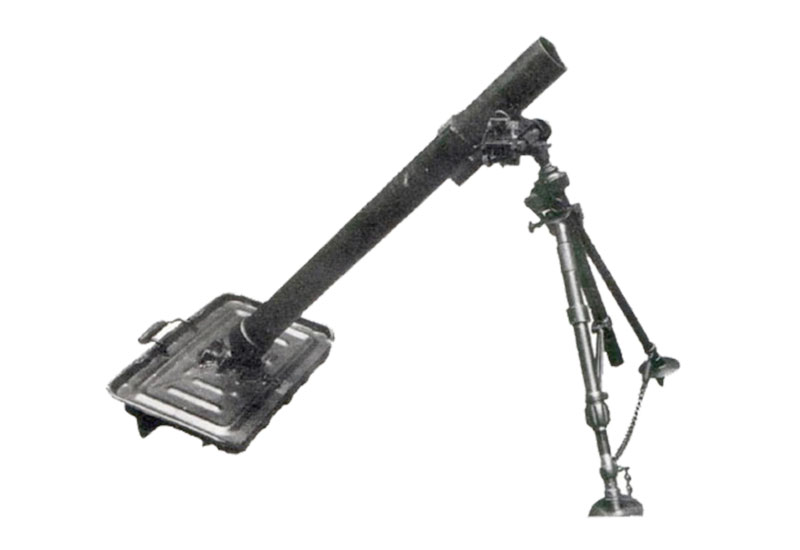
The Brandt Company of France, led by French engineer Edgar Williams Brandt (1880-1960), took the basic Stokes design and developed it further to coincide with the development of all-new mortar projectiles. The basic form remained faithful to the Stokes design but enough revisions were instituted to produce a more evenly-keeled end-product suitable for war - she was a more efficient design that was easier to use and implement. The complete weapon system weighed in at 132lbs and featured a firing tube of 1.26 meters in length. The mortar was operated by three personnel and was designed around an 81mm projectile offered in two shell types - a "light" version weighing in at 3.25 and a "heavy" version weighing in at 6.9 kilograms. Range was out to 1,900 meters (lesser so when using its heavier available projectile - approximately out to 1,000 meters) and a trained and experienced crew could fire up to 18 rounds per minute. The crew could break down the entire system into three individual components for ease of transport. The firing tube weighed 46lbs while the bipod and base plate measured in at 41lbs and 45lbs respectively. Elevation limitations were between +45 and +80 degrees while inherent traverse was limited to 8- and 12-degrees. Any further directional adjustments required the crew to physically reposition their mortar. The new mortar was christened the "Brandt mle 27" (known more formally as the "Mortier Brandt de 81mm modele 27") and, as its model name would suggest, the weapon was introduced in 1927.

Brandt mle 27 General Operation

Operation of the Brandt mle 27 was conventional even by modern standards. Adjustments were made through an integrated elevation crank handle on the bipod that affected a screw-type installation under the muzzle end of the firing tube. The "layer" could sight through an apparatus at the top left-hand side of the bipod assembly - this placed him away from the muzzle as a safety measure. One operator would introduce a primed 81mm projectile into the muzzle and let it fall down the firing tube, ultimately striking an awaiting firing pin located at the base of the firing tube. This would ignite the projectile's propellant payload and force the shell out of the launch tube at speed. The tube was internally smoothbore so "rifling" did not spin the projectile to stabilize it in flight, instead, each projectile was fitted with stabilizing fins for this purpose. The projectile simply followed the predetermined trajectory arc set by the layer towards a target area. Shells were primarily High-Explosive (HE) in nature, suitable for dislodging dug-in enemy troops, attacking unprotected concentrations of soldiers from above or disabling soft-skinned vehicles to an extent. Her purpose was first and foremost to make hell for enemy infantry. A smoke projectile could be used to cover offensive actions or defensive maneuvers as needed. This projectile was also developed to include a family of smoke charges offered in various colors for in-the-field signaling and such.

The Improved Brandt mle 27/31

Once in operational service, the Brandt mle 27 proved an ultimate success and a vast improvement over the original British Stokes Mortar of decades prior. She was revised in a few short years to become the "Brandt mle 27/31" of 1931 and capable of firing an ever-expanding array of improved 81mm projectiles. Such was the design success of the French Brandt that the Austrians, Danes, Germans, Japanese, Dutch, Russians, Italians and Americans utilized her as the standard in designing their own line of infantry mortars of the 81mm caliber and beyond. Other nations looking to avoid licensing fees simply copied the Brandt design outright though none were as highly regarded as the French version. Each of these Brandt "clones" was, as can be expected, slightly different than the original French design to coincide with various military requirements put forth by their respective operators.

World War Finds Europe

In the 1930s, Adolph Hitler came to power as Germany's chancellor and the governments of Japan and Italy were laying forceful claim to evermore world real estate. The Spanish Civil War (1936-1939) across the Iberian peninsula proved a testbed of sorts for several world powers including the Germans and Soviets and war soon found the rest of Europe thereafter. Germany invaded France in May of 1940 and the French Army was pressed into full action and, along with them, their 8,000 Brandt mortars were called into play. Further production was also handled in Czechoslovakia, Netherlands, Poland and Yugoslavia and, therefore, many became property of the German Army following respective conquests. In the German Army inventory, designations were unique to each country of origin and became the Austrian 8.14cm GRW 33(o), Czechoslovakian 8.14cm GRW 278(t), Danish 8.14cm GRW 275(d), Dutch 8.14cm GRW 286(h), French 8.14cm GRW 278(f), Polish 8.14cm GRW 31 (p) and Yugoslavian 8.14cm GRW 270(j). The Brandt mle 27 and mle 27/31 mortars and all her derivatives saw extensive combat actions throughout the war. Her design succeeded in outlasting the global conflict and existed in several post-war forms during the Cold War.

Brandt Mortar Influence

As the Stokes Mortar before it, the Brandt mortar influenced much in the way of newer designs for decades following its introduction and its reach can still be seen in many of the mortar designs utilized by the militaries of today. While the forms of today outclass the Brandt series in nearly every way, the Brandt still serves as a standard thanks to its finely tuned and inherently strong French design.
Text ©2003-2013 www.MilitaryFactory.com • All Rights Reserved • No Reproduction Permitted
MilitaryFactory.com does NOT sell equipment/weaponry. Material presented throughout this website is for historical and entertainment value and should not to be construed as usable for hardware restoration, maintenance or general operation. Please consult manufacturers for such information. Our disclaimer. Email corrections / Comments to MilitaryFactory at Gmail dot com.
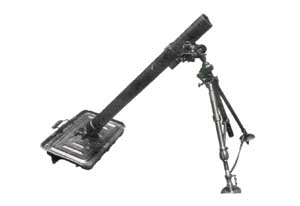
Picture of Brandt mle 27 (Mortier Brandt de 81mm modele 27)
View All Images (1)

Specifications for the
Brandt mle 27 (Mortier Brandt de 81mm modele 27)
Infantry Mortar


Country of Origin: France
Manufacturer: State Factories - France
Initial Year of Service: 1927


Overall Length: 1260mm (49.61in)
Barrel Length: 1,260.00mm (49.61in)
Weight (Empty): 123.46lbs (56.00kg)


Cartridge: 81mm
Action: Manually-Operated; Firing Pin Activated
Feed: Single-Shot; Reusable Tube
Muzzle Velocity: 571ft/sec (174m/sec)
Rate-of-Fire: 18 rounds per minute
Range: 10,223ft (3,116m; 3,408yds)
Sights: Adjustable Elevation Controls


Variants:
mle 27 - Base Series Designation appearing in 1927.


mle 27/31 - Modified form appearing in 1931

81.4mm Mortar - Czech Designation

van Mortier 8 - Dutch Designation

81mm Mozdzierz wz. 31 - Polish Designation

8.1cm Kragujewac MVM 31/38 - Yugoslavian Designation.

8.14cm GRW 33(o) - German Army Designation for captured Austrian versions.

8.14cm GRW 278(t) - German Army Designation for captured Czech versions.

8.14cm GRW 275(d) - German Army Designation for captured Danish versions.

8.14cm GRW 286(h) - German Army Designation for captured Dutch versions.

8.14cm GRW 31(p) - German Army Designation for captured Polish versions.

8.14cm GRW 270(j) - German Army Designation for captured Yugoslavian versions.

8.14cm GRW 278(f) - German Army Designation for captured French versions.


Operators: China; France; Ireland; Nazi Germany; Netherlands; Soviet Union; United States

ALL SMALL ARMS CATEGORIES

BY YEAR:


1700 to 1799
1800 to 1899
1900 to 1909
1910 to 1919
1920 to 1929
1930 to 1939
1940 to 1949
1950 to 1959
1960 to 1969
1970 to 1979
1980 to 1989
1990 to 1999
2000 to 2009
2010 to 2019
VIEW ALL
Compare Guns


BY TYPE:


Anti-Aircraft Weapons
Anti-Material Rifles
Anti-Tank Weapons
Automatic Rifles
Bolt-Action Rifles
Carbine Guns
Flamethrowers
Flintlock Guns
Grenade Launchers
Hand Grenades
Lever-Action Rifles
Machine Guns
Mortars
Musket Guns
Pistols / Handguns
Recoilless Rifles
Revolvers
Rocket Launchers
Shotguns
Silenced Guns
Sniper Rifles
Special Weapon Systems
Submachine Guns
VIEW ALL


SPECIAL:


18th Century Warfare
3 Soldiers Statue
Battle of Mogadishu
Chainmail Armor
Firearm Types Defined
French Military Victories
Medieval Crossbow
Medieval Longbow
Vietnam War Casualties
Vietnam War Memorial

WORLD WAR 2:


British Guns
French Guns
German Guns (ALL)
German Rifles
Italian Guns
Japanese Guns
Soviet Guns
US Guns
US Infantry Regiment-Level Guns
Machine Guns
Pistols
Rifles
Submachine Guns
Sniper Rifles
VIEW ALL


WORLD WAR 1:

Pistols
Rifles
Machine Guns
Mortars
US Guns
VIEW ALL


KOREAN WAR:

Machine Guns
VIEW ALL


VIETNAM WAR:

Mortars
VIEW ALL


COLLECTIONS:


Ancient Weapons
British SAS Weapons
Civil War Guns
Colt Guns
Glock Guns
GROM Polish Special Forces
Guns of Libya
Guns of North Korea
Guns of Syria
Guns of WW1 & WW2
Heckler & Koch Guns
Kalashnikov Guns
Modern Russian Guns
Navy SEAL Weapons
Spetsnaz Weapons
Weapons of Desert Storm
Wild West Guns
Winchester Guns


HOLLYWOOD/GAMES:


Guns of the Walking Dead

Site Disclaimer | Privacy Policy | Site Map | MF Origins


©2013 www.MilitaryFactory.com • Content ©2003-2013 MilitaryFactory.com • All Rights Reserved • Site Contact Email: militaryfactory at gmail dot com. The "Military Factory" name and MilitaryFactory.com logo are registered ® trademarks and protected by all applicable domestic and international intellectual property laws.


Top MF Stuff: 2013 Military Pay Scale | Military Ranks | WW2 Weapons | Sniper Rifles | Kts to Mph | WW1 Aircraft | Automatic Rifles | Aircraft Cockpits | Vietnam War Weapons | Main Battle Tanks | Submachine Guns | Shotguns | French Military Victories


Most photographic images appearing on this site are courtesy of the United States Department of Defense and are approved for public use. Other images acquired through the public domain. Digital art work courtesy of Dan Alex. Business Consulting by Kyle Williams. Material presented throughout this website is for historical and entertainment value and should not to be construed as usable for hardware restoration, maintenance or general operation. Please consult manufacturers for such information.


eXTReMe Tracker