Military Factory
Military Pay Chart
Global Firepower
Military Industrial Complex
Second World War
Home
Military Pay Scale
Military Ranks
Small Arms
Aircraft
Land Systems
Navy
Education
Military Factory Facebook Logo
flag of United States

Winchester Model 1876 Lever-Action Repeating Rifle (1876)

Authored By Staff Writer | Last Updated: 8/16/2011

The Winchester Model 1876 was brought along to fulfill the need for a rifle to fire a bevy of new and more powerful cartridges appearing on the scene.

Find a School Near You
Follow Military Factory on Facebook:
Trending on Military Factory:
Recent Articles:
With the arrival of evermore powerful centerfire cartridges appearing on the firearms front, it was only natural for the Winchester Repeating Firearms Company of New Haven, Connecticut to develop a new rifle based on the proven Winchester function. Up to this point, the Winchester concern had worked on guns competing to fire the established rimfire and centerfire cartridge types. The Winchester Model 1876, therefore, became their "full-power" answer - and also went under the name of "Centennial Model" due to it appearing in time for American's 100-year birthday celebration. A total of 63,872 Model 1876s are believed to have been produced beginning in 1876 and spanning through to 1898.

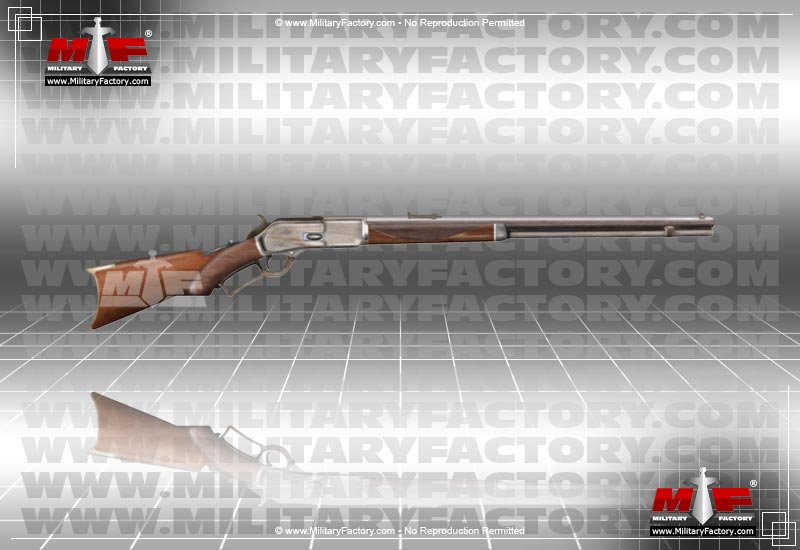
The Model 1876 looked every bit the part of a Winchester lever-action firearm - more akin in appearance to the Model 1873 before it - complete with its squared receiver design, integrated lever system under the grip, full stock, integral magazine tube under the barrel and wood furniture to round things out. Despite its outward similarities to the Model 1873, the Model 1876 actually held origins in an 1868 Winchester design that was never produced for the open market. The main difference in the Model 1876 over preceding Winchester designs was its enlarged receiver section designed specifically to utilized the aforementioned full-power cartridges - thusly the receiver was also of greater strength to contend with the greater power inherent in these rounds. The loading gate was still set to the lower right side of the receiver with the ejection port along the top. The hammer was naturally set to the rear of the receiver with the trigger below it. The forend was well-rounded and used in two-handed firing for both support (in aiming) and to protect the operator from a hot barrel (something the preceding Henry rifles lacked). Aiming was aided by a front fixed-post and a rear graduated sight. The shoulder stock was capped by a brass buttplate. The tube magazine could hold 15 rounds of ammunition. The barrel could be octagonal or rounded in shape depending on the model type and overall metal construction and trim work was completed in nickel, silver and gold finishes.

Like other Winchester rifles, the Model 1876 appeared in two distinct forms beyond the basic rifle - a shortened carbine model suitable for when on horseback and the lengthier "musket" type of longer range. To go along with the changes to the receiver, each version featured longer barrels - 22 inches for the carbine version and 32 inches for the musket version (these seen with rounded barrels). The standard Model 1876 rifle barrel was between 26 to 28 inches in length though there were 23 inch and as long as 36 inch lengths available with varying lengths in between. The first production Model 1876s were chambered to fire the .45-75 WCF cartridge but other variations in the family line eventually allowed firing of the .40-60, .45-60 and .50-95 Express cartridges within time.

In practice, the Model 1876 proved its worth as a Winchester product. She was a powerful firearm with great stopping capabilities and her in-the-field reliability was well respected by frontiermen. More notable names to have utilized the Model 1876 included the Texas Rangers, Canadian Mounted Police (stamped with "NWMP" on the stock), Chiricahua Apache war chief Geronimo and avid hunter Teddy Roosevelt.
Text ©2003-2013 www.MilitaryFactory.com • All Rights Reserved • No Reproduction Permitted
MilitaryFactory.com does NOT sell equipment/weaponry. Material presented throughout this website is for historical and entertainment value and should not to be construed as usable for hardware restoration, maintenance or general operation. Please consult manufacturers for such information. Our disclaimer. Email corrections / Comments to MilitaryFactory at Gmail dot com.
Picture of Winchester Model 1876
View All Images (1)

Specifications for the
Winchester Model 1876
Lever-Action Repeating Rifle


Country of Origin: United States
Manufacturer: Winchester Repeating Arms Company - USA
Initial Year of Service: 1876


Overall Length: 1252mm (49.29in)
Barrel Length: 620.00mm (24.41in)
Weight (Empty): 9.48lbs (4.30kg)


Cartridge: .40-60 WCF; .45-60 WCF; .45-77 WCF; .50-95 Express
Action: Lever-Action; Repeating
Feed: 15-round tubular magazine
Muzzle Velocity: 1,100ft/sec (335m/sec)
Range: 300ft (91m; 100yds)
Sights: Graduated Rear; Fixed Front Post


Variants:
Model 1876 - Varying caliber chambering including .40-60 WCF; .45-60 WCF; .45-77 WCF; .50-95 Express; enlarged and reinforced receiver; lengthened forearm; carbine length increased to 22 inches; musket length increased to 32 inches.


Operators: Canada; United States

ALL SMALL ARMS CATEGORIES

BY YEAR:


1700 to 1799
1800 to 1899
1900 to 1909
1910 to 1919
1920 to 1929
1930 to 1939
1940 to 1949
1950 to 1959
1960 to 1969
1970 to 1979
1980 to 1989
1990 to 1999
2000 to 2009
2010 to 2019
VIEW ALL
Compare Guns


BY TYPE:


Anti-Aircraft Weapons
Anti-Material Rifles
Anti-Tank Weapons
Automatic Rifles
Bolt-Action Rifles
Carbine Guns
Flamethrowers
Flintlock Guns
Grenade Launchers
Hand Grenades
Lever-Action Rifles
Machine Guns
Mortars
Musket Guns
Pistols / Handguns
Recoilless Rifles
Revolvers
Rocket Launchers
Shotguns
Silenced Guns
Sniper Rifles
Special Weapon Systems
Submachine Guns
VIEW ALL


SPECIAL:


18th Century Warfare
3 Soldiers Statue
Battle of Mogadishu
Chainmail Armor
Firearm Types Defined
French Military Victories
Medieval Crossbow
Medieval Longbow
Vietnam War Casualties
Vietnam War Memorial

WORLD WAR 2:


British Guns
French Guns
German Guns (ALL)
German Rifles
Italian Guns
Japanese Guns
Soviet Guns
US Guns
US Infantry Regiment-Level Guns
Machine Guns
Pistols
Rifles
Submachine Guns
Sniper Rifles
VIEW ALL


WORLD WAR 1:

Pistols
Rifles
Machine Guns
Mortars
US Guns
VIEW ALL


KOREAN WAR:

Machine Guns
VIEW ALL


VIETNAM WAR:

Mortars
VIEW ALL


COLLECTIONS:


Ancient Weapons
British SAS Weapons
Civil War Guns
Colt Guns
Glock Guns
GROM Polish Special Forces
Guns of Libya
Guns of North Korea
Guns of Syria
Guns of WW1 & WW2
Heckler & Koch Guns
Kalashnikov Guns
Modern Russian Guns
Navy SEAL Weapons
Spetsnaz Weapons
Weapons of Desert Storm
Wild West Guns
Winchester Guns


HOLLYWOOD/GAMES:


Guns of the Walking Dead

Site Disclaimer | Privacy Policy | Site Map | MF Origins


©2013 www.MilitaryFactory.com • Content ©2003-2013 MilitaryFactory.com • All Rights Reserved • Site Contact Email: militaryfactory at gmail dot com. The "Military Factory" name and MilitaryFactory.com logo are registered ® trademarks and protected by all applicable domestic and international intellectual property laws.


Top MF Stuff: 2013 Military Pay Scale | Military Ranks | WW2 Weapons | Sniper Rifles | Kts to Mph | WW1 Aircraft | Automatic Rifles | Aircraft Cockpits | Vietnam War Weapons | Main Battle Tanks | Submachine Guns | Shotguns | French Military Victories


Most photographic images appearing on this site are courtesy of the United States Department of Defense and are approved for public use. Other images acquired through the public domain. Digital art work courtesy of Dan Alex. Business Consulting by Kyle Williams. Material presented throughout this website is for historical and entertainment value and should not to be construed as usable for hardware restoration, maintenance or general operation. Please consult manufacturers for such information.


eXTReMe Tracker