Military Factory
Military Pay Chart
Global Firepower
Military Industrial Complex
Second World War
Home
Military Pay Scale
Military Ranks
Small Arms
Aircraft
Land Systems
Navy
Education
Military Factory Facebook Logo
flag of United States

Kentucky Rifle (Deckard Rifle / Longrifle / Pennsylvania Rifle) Muzzle-Loading Musket (1730)

Authored By JR Potts, AUS 173d AB | Last Updated: 7/7/2010

The introduction of rifling within the barrel of the Kentucky Rifle made it a more accurate musket past fifty yards when compared to the British Brown Bess.

Find a School Near You
Follow Military Factory on Facebook:
Trending on Military Factory:
Recent Articles:
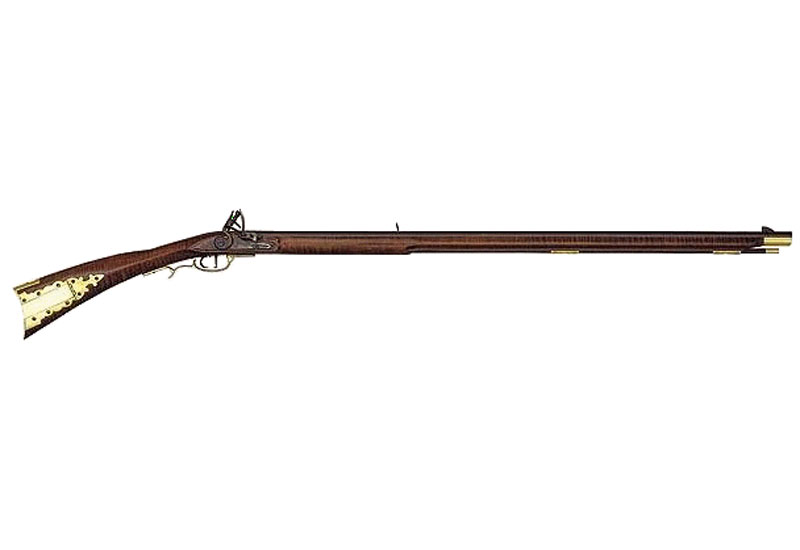
The development and naming of the Long Rifle is argued between riflemen of Kentucky and Pennsylvania even to this day. The most accepted history is that the rifle was first forged in Lancaster, Pennsylvania during 1730 by immigrant gunsmiths originating from Switzerland and Germany. The first quality Long Rifles were credited to a gunsmith named Jacob Deckard from Pennsylvania. Many were also made in Virginia and the Carolinas, making the rifle the first American-made firearm. For many years, the rifle was referred to as the "Long" or "Hog" rifle. However, over time, "Kentucky Long Rifle" became the popular name of choice. It was a special weapon - a slender, long-rifled barrel with a maple stock, balanced to hold.

The immigrant gunsmiths saw a need and made a rifle that fit the requirements of the frontiersman. The most widely accessible weapon of the day was the smoothbore musket and it was not designed to be a hunting weapon. The major issues driving the change - along with limited range - was the lack of quality black powder and availability of lead for both proved expensive to acquire. The gunsmiths reduced the bore size of the Kentucky barrel from 0.45 to 0.50 caliber, allowing more "balls" to be molded per pound of lead. The barrel was also increased in length up to as much as 48-inches with 44-inches being the standard. The extra length and smaller bore of the Kentucky barrel allowed use of less powder, producing increased firepower over that of the contemporary British "Brown Bess" musket rifle, a rifle having an unpredictable trajectory owed to her design.

To load the new rifle, the butt was rested on the ground and a powder horn was used to keep the black powder dry. The shooter would visually measure an amount of black powder from the horn into a metal cup-type charger and then tip the powder down the muzzle. Additional improvements were made to the barrel by adding "rifling" - grooves cut into the inside lining of the barrel that caused the ball to spin as it made its way out, achieving accuracy over longer ranges than the basic smoothbore musket. As such, Kentucky rifled barrels had spiraled lands and groves so as the musket ball was fired through the barrel, it took a rotary motion on an axis that coincided with the line of flight. Loading the flintlock was accomplished through the muzzle with an undersized ball wrapped in a greased patch. This patch made the ball fit tightly in the barrel and served to stop gas from escaping between the ball and the bore. A slender wood ramrod was used to tamp the ball and patch against the powder in the bottom of the barrel. The powder horns plug was again removed and powder was shaken on the pan and the touch hole was filled with powder. A steel-faced "frazzle" was drawn down to cover the pan to avoid setting off the powder prematurely. A rotating cock hammer, holding a piece of flint clamped in place, snapped forward when the trigger was pulled, striking an L-shaped piece of steel (the frizzen). The contact of flint against steel created the needed sparks to ignite a small portion of priming powder in the flash pan, forcing flame through the barrel’s touch hole and on into the main black powder charge, ultimately exploding the ball out the barrel. This process was practiced over and over to reduce the time of loading.

Daniel Boone carried a Kentucky Rifle throughout his forays into the dangerous woods of Kentucky and through the Cumberland Gap. Eventually, his use of the rifle spread among the people and the Kentucky was considered a necessity by frontiersmen; every frontier family owned at least one. Rifle shooting was a way of life along the American frontier. Most men carried a Kentucky Rifle wherever they went and most settlements would have shooting contests on holidays. The rifle became recreation for the backwoodsman and settler alike, as well as being used for hunting and protection. The Kentucky Long Rifle was more accurate than all muskets made up to that time and soon became legendary as being lethal over 200 yards.

The most popular musket of the day was the aforementioned Brown Bess that fired large spherical balls of lead and was essentially a smoothbore caliber shotgun. The "Bess" was loaded down the muzzle so the musket ball had a loose fit on the powder in the barrel. When the musket was fired, the ball bounced up and around the sides of the barrel and as it left the muzzle with the final direction being essentially unpredictable by the operator, leading to mixed accuracy results at increased ranges. The inaccurate large ammunition held no spin though the low velocity was deadly on impact nonetheless. The erratic, unpredictable motion rendered these muskets ineffective beyond a range of about 60 yards. The abilities and limitations of the musket determined the British Army battle tactics in the 18th Century. The British soldier marched in lines abreast towards the enemy formations. On command, the infantry pointed their muskets and fired in orderly volleys at the enemy from 50 to 60 yards away. Many battles were decided by a few volleys followed by a bayonet charge and ending in barbaric hand-to-hand fighting engagements usually solved with the heavy butt end of the Brown Bess against the head or torso of an unfortunate soul.

Knowing the limitations and effectiveness of the Brown Bess during the 1776 Revolutionary War, George Washington wanted to recruit frontiersmen who owned Kentucky Rifles. General Washington called for and assembled some 1,400 riflemen who carried a Kentucky. The British soon gave the buckskin clad riflemen as much distance as possible. The backwoodsman would act as snipers and brought fire down on the British ranks (especially the clearly marked British officers) before the enemy could fire on the colonists, ultimately helping to win the war for burgeoning American. The War of 1812 brought the British soldier again under the sights of the Kentucky Rifle. In 1815, General Andrew Jackson collected some town folks and an army of Kentuckians to stop the British at the Battle of New Orleans.

As men pushed west, the frontiersman on foot gave way to the mountain man who traveled with a horse and a pack animal. Game for mountain men became larger elk, buffalo, mule deer and both brown and grizzly bears and the Kentucky Rifle was soon found lacking in the required stopping power for such targets. Additionally, as these souls traveled on horseback, the long barreled rifle hung up in the brush and trees.

The Hawken brothers were gunsmiths in Lancaster, Pennsylvania and saw the need for a shorter muzzle loading rifle with a heavier slug averaging .50 to .54 in caliber. The Hawken Rifle became the new rifle standard in America. The muzzle-loading rifle did not disappear entirely when cartridge arms appeared during and shortly after the American Civil War. Few farmers and ranchers could afford the new Winchester or Sharps cartridge repeating rifles. These new rifles fired faster but, when hunting, the one shot muzzleloader could do the job. Many gunsmiths continued to make muzzleloaders into the 1880’s and America’s first weapon - the Kentucky Long Rifle - was still prized for this reason.
Text ©2003-2013 www.MilitaryFactory.com • All Rights Reserved • No Reproduction Permitted
MilitaryFactory.com does NOT sell equipment/weaponry. Material presented throughout this website is for historical and entertainment value and should not to be construed as usable for hardware restoration, maintenance or general operation. Please consult manufacturers for such information. Our disclaimer. Email corrections / Comments to MilitaryFactory at Gmail dot com.
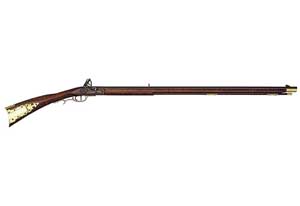
Picture of Kentucky Rifle (Deckard Rifle / Longrifle / Pennsylvania Rifle)
View All Images (1)

Specifications for the
Kentucky Rifle (Deckard Rifle / Longrifle / Pennsylvania Rifle)
Muzzle-Loading Musket


Country of Origin: United States
Manufacturer: State Factories and Local Gunsmiths - USA
Initial Year of Service: 1730


Overall Length: 1651mm (65.00in)
Barrel Length: 1,220.00mm (48.03in)
Weight (Empty): 0.00lbs (0.00kg)


Cartridge: 0.50 (also 0.36 to 0.45)
Action: Single-Shot, Muzzle-Loaded, Rifled Flintlock
Feed: Single-Shot Ball
Rate-of-Fire: 1 rounds per minute
Range: 225ft (69m; 75yds)
Sights: Forward and Rear


Variants:
Kentucky Long Rifle - Base Series Designation


Pennsylvania Rifle - Alternative Name

Deckard Rifle - Alternative Name

Longrifle - Alternative Name

Hog Rifle - Alternative Name


Operators: United States

ALL SMALL ARMS CATEGORIES

BY YEAR:


1700 to 1799
1800 to 1899
1900 to 1909
1910 to 1919
1920 to 1929
1930 to 1939
1940 to 1949
1950 to 1959
1960 to 1969
1970 to 1979
1980 to 1989
1990 to 1999
2000 to 2009
2010 to 2019
VIEW ALL
Compare Guns


BY TYPE:


Anti-Aircraft Weapons
Anti-Material Rifles
Anti-Tank Weapons
Automatic Rifles
Bolt-Action Rifles
Carbine Guns
Flamethrowers
Flintlock Guns
Grenade Launchers
Hand Grenades
Lever-Action Rifles
Machine Guns
Mortars
Musket Guns
Pistols / Handguns
Recoilless Rifles
Revolvers
Rocket Launchers
Shotguns
Silenced Guns
Sniper Rifles
Special Weapon Systems
Submachine Guns
VIEW ALL


SPECIAL:


18th Century Warfare
3 Soldiers Statue
Battle of Mogadishu
Chainmail Armor
Firearm Types Defined
French Military Victories
Medieval Crossbow
Medieval Longbow
Vietnam War Casualties
Vietnam War Memorial

WORLD WAR 2:


British Guns
French Guns
German Guns (ALL)
German Rifles
Italian Guns
Japanese Guns
Soviet Guns
US Guns
US Infantry Regiment-Level Guns
Machine Guns
Pistols
Rifles
Submachine Guns
Sniper Rifles
VIEW ALL


WORLD WAR 1:

Pistols
Rifles
Machine Guns
Mortars
US Guns
VIEW ALL


KOREAN WAR:

Machine Guns
VIEW ALL


VIETNAM WAR:

Mortars
VIEW ALL


COLLECTIONS:


Ancient Weapons
British SAS Weapons
Civil War Guns
Colt Guns
Glock Guns
GROM Polish Special Forces
Guns of Libya
Guns of North Korea
Guns of Syria
Guns of WW1 & WW2
Heckler & Koch Guns
Kalashnikov Guns
Modern Russian Guns
Navy SEAL Weapons
Spetsnaz Weapons
Weapons of Desert Storm
Wild West Guns
Winchester Guns


HOLLYWOOD/GAMES:


Guns of the Walking Dead

Site Disclaimer | Privacy Policy | Site Map | MF Origins


©2013 www.MilitaryFactory.com • Content ©2003-2013 MilitaryFactory.com • All Rights Reserved • Site Contact Email: militaryfactory at gmail dot com. The "Military Factory" name and MilitaryFactory.com logo are registered ® trademarks and protected by all applicable domestic and international intellectual property laws.


Top MF Stuff: 2013 Military Pay Scale | Military Ranks | WW2 Weapons | Sniper Rifles | Kts to Mph | WW1 Aircraft | Automatic Rifles | Aircraft Cockpits | Vietnam War Weapons | Main Battle Tanks | Submachine Guns | Shotguns | French Military Victories


Most photographic images appearing on this site are courtesy of the United States Department of Defense and are approved for public use. Other images acquired through the public domain. Digital art work courtesy of Dan Alex. Business Consulting by Kyle Williams. Material presented throughout this website is for historical and entertainment value and should not to be construed as usable for hardware restoration, maintenance or general operation. Please consult manufacturers for such information.


eXTReMe Tracker