Military Factory
Military Pay Chart
Global Firepower
Military Industrial Complex
Second World War
Home
Military Pay Scale
Military Ranks
Small Arms
Aircraft
Land Systems
Navy
Education
Military Factory Facebook Logo
flag of France

Hotchkiss Model 1914 (Mle 1914) Medium / Heavy Machine Gun (1914)

Authored By Staff Writer | Last Updated: 11/30/2012

The French Hotchkiss Model 1914 machine gun was the last of the Hotchkiss machine gun line born in the late 1800s.

Find a School Near You
Follow Military Factory on Facebook:
Trending on Military Factory:
Recent Articles:
During the late 1800s, there only existed a few proven "true" machine gun concepts anywhere in the world. Countless attempts were made an generating a repeat-fire weapon utilizing a full-sized rifle cartridge and of these only the Browning and Maxim developments proved worthy. Both relied on the recoil principle to drive the barrel rearwards for each successive shot. In 1893, an Austro-Hungarian cavalry officer by the name of Baron von Odkolek brought to the French concern of Hotchkiss et Cie his prototype for a new machine gun operating from a gas-piston system. The Odkolek design utilized a gas cylinder which tapped propellant gasses from the barrel to actuate a piston with each successive shot, in essence providing the foundation for what was the world's first true gas-operated weapon - a system of operation hugely commonplace in machine guns today.

Hotchkiss took on Odkolek's design and paid a straight sum of money for the rights. Development proved costly and lengthy, ultimately realizing the Odkolek concept sound though suffering from overheated barrels and a reliable function. The overheating issue was of concern as this could lead to fracturing of the barrel assembly, rendering the gun useless. During the period, this failure was usually rectified by way of water cooling - water filling a jacket surrounding the barrel. So long as there was a water supply, the weapon could technically be fired indefinitely without issue. The downside to this arrangement was the requirement of a consistent water supply to be on hand during operation as the water would gradually evaporate over time. As such, more work would be needed on the base Odkolek design to find an air-cooled solution.

The remainder of the project then fell to American Lawrence V. Benet who operated as chief engineer at Hotchkiss. Refinements to the Odkolek system then yielded the first Hotchkiss pattern machine gun as the "Model 1895" chambered for the French Army 8x50R Lebel cartridge, the same as use in the Lebel service rifle. As overheating issues persisted, Benet had developed a barrel supported at its base by brass cooling fins intended to help disperse heat build-up. In this reworked version, the machine gun was formally adopted by the French Army in 1897 as the "Model 1897" and became the world's first efficient air-cooled machine gun in service anywhere. It was designed to fire from a 24- or 30-round stiff metallic brass ammunition strips which were fed from the left side of the receiver, the empty clip emerging from the right. Support hardware included a tripod which, somewhat surprisingly, lacked any adjustable options. A modified version of this production model then emerged in 1900 as the "Model 1900" featuring steel barrel cooling fins and wholly adjustable tripod mounting system. A rate-of-fire adjuster was added later.

Furthering the family line, a variant intended as a portable, light automatic weapon was born in a 1909 initiative as the "Model 1909". The product went on to see service with American (Benet-Mercie M1909) and British (Hotchkiss Mk I) forces as well and fed from 30-round stiff metal ammunition strips inserted through a new, relocated underside feed mechanism. While proving too heavy for the intended "walking shooter" role in French Army service, the machine gun still lived on as a fixture on various aircraft, combat tanks and as a static system in defense of strategic fortifications.

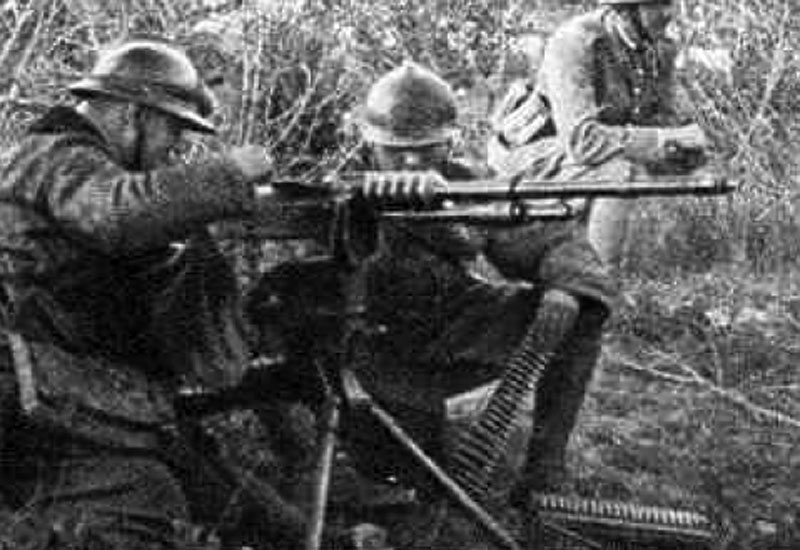
When the world went to war in the summer of 1914 (to begin World War 1), French war industry was forced to keep pace with the demand. The French Army turned to a modernized version of the Model 1900 which introduced refined internals and lacked the safety system of the original. The weapon became the "Model 1914". Manufacturing was streamlined for the better and new stiff 24-round metal ammunition strips were developed. Furthermore, three-round clips were developed which could be linked together to form a full 249-round "articulated belt" while being fed through the weapon in the same fashion. The end-product resulted in a refined automatic firearm with good manufacturing qualities that made for a reliable weapon. While not as light as had been hoped, the weapon could still be brought to bear in a defensive manner and utilized, with some work, as an offensive-minded weapon. The Model 1914 entered service in 1914 and was, amazingly, retained as such until 1945. The Model 1914 became the last in the long line of Hotchkiss machine guns and served as the standard French heavy machine gun of World War 1 and beyond, supplanting the St Etienne Heavy Machine Gun in the same role. Some 47,000 Model 1914 units were delivered to the French Army during World War 1 up until the end of fighting in November of 1918. An 11mm "balloon busting" variant firing incendiary bullets was also born in the war effort. The United States Army in France alone received 7,000 Model 1914 machine guns upon arriving in 1917-1918. Model 1914 machine guns also armed early French combat tanks of the war including the famous Renault FT-17 light tank.

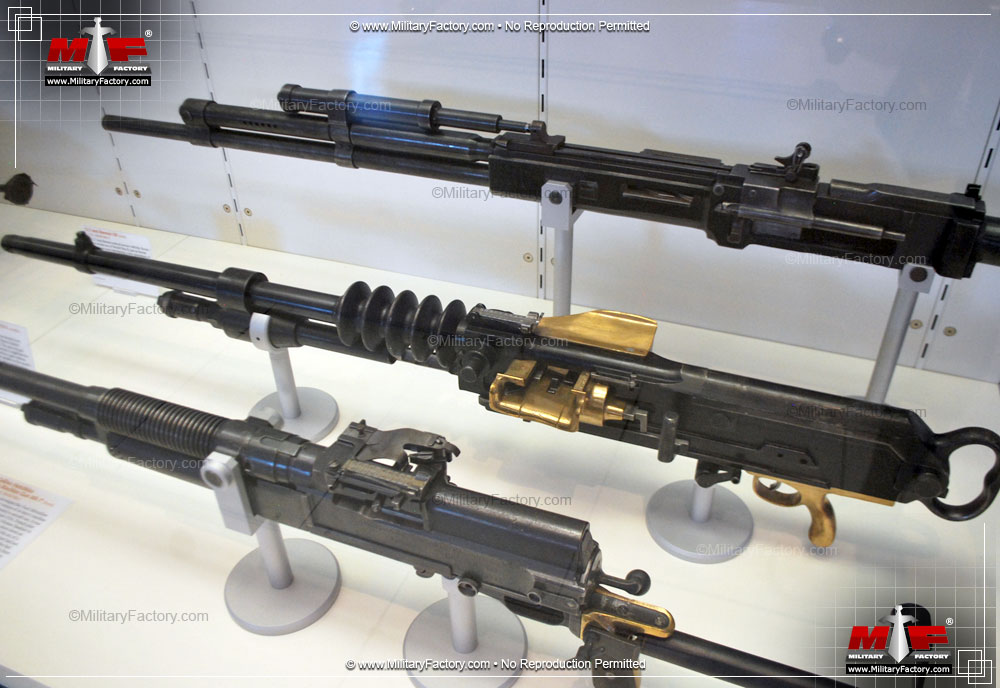
Design of the Model 1914 was somewhat conventional in overall scope. The receiver was a boxy, rectangular shape housing the needed internal working components. It supported a pistol grip with integral trigger unit as well as a vertical charging handle set to the left side of the receiver. The barrel measured 31 inches in length and its base was shrouded in five noticeable cooling fins intended to help dissipate heat build-up. The gas cylinder was mounted under the barrel and tapped the barrel along its midway point. The barrel was not capped by a flash suppressor of any sort though a forward iron sight was fitted. Along the sides of the receiver were support arms for the adjustable tripod mounting. A large loop handle was affixed to the receiver of the receiver. Overall weight was 54lbs with a listed rate-of-fire of 500 rounds per minute and muzzle velocity of 2,325 feet per second. The Hotchkiss Model 1914 was truly a classic and successful machine gun of her time.

The Model 1914 was produced under license in Spanish factories and this allowed them to be used in number by both sides of the Spanish Civil War (1936-1939). By the time of World War 2 (1939-1945), the Model 1914 was still in widespread circulation with French and Belgian forces which allowed the Germans, having conquered Belgium and northern France, to reconstitute stocks of the weapon as defensive measures along the "Atlantic Wall" in defense of the shores of the growing German Empire under Adolph Hitler. The Model 1914, therefore, could claim to have seen combat service all through World War 2, joining a select group of weapons seeing service in both major World Wars. Many examples were also outfitted to various French-designed tanks prior to the war including the mammoth Char 2C. The French continued to use their Model 1914s in static defensive roles during their engagements in French Indochina and Algeria (the Algerian Revolution of 1954-1962) and by Legionnaires in Morocco and elsewhere.

In addition to the stated war record, Model 1914 machine guns saw combat service in the Mexican Revolution (1910-1920) and the Polish-Soviet War (1919-1921). As such, operators of the type proved numerous and went on to include Belgium, Chile, Greece, Italy, Brazil, France, Germany (Nazi), the Empire of Japan, Mexico, Norway, Peru, Poland, Spain (built under license), Sweden, Turkey and the United States. The Japanese utilized a license-produced version of the Hotchkiss Model 1914 as the "Type 3 Heavy Machine Gun". Naturally, these were chambered for the local 6.5x50mm Arisaka cartridge. The Type 92 was similar in scope and function and from the Hotchkiss lineage though tailored for the larger 7.7x58mm Arisaka cartridge to help improve effectiveness.
Text ©2003-2013 www.MilitaryFactory.com • All Rights Reserved • No Reproduction Permitted
MilitaryFactory.com does NOT sell equipment/weaponry. Material presented throughout this website is for historical and entertainment value and should not to be construed as usable for hardware restoration, maintenance or general operation. Please consult manufacturers for such information. Our disclaimer. Email corrections / Comments to MilitaryFactory at Gmail dot com.
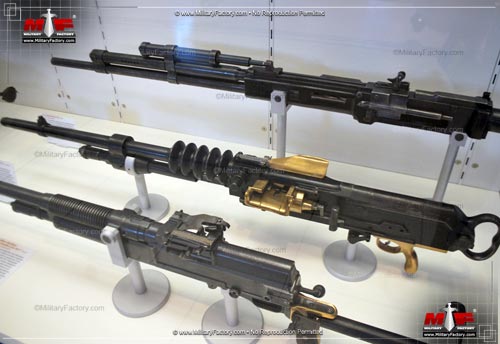
Picture of Hotchkiss Model 1914 (Mle 1914)
View All Images (1)

Specifications for the
Hotchkiss Model 1914 (Mle 1914)
Medium / Heavy Machine Gun


Country of Origin: France
Manufacturer: Hotchkiss et Cie - France / State Arsenal - Japan / State Arsenal - Spain
Initial Year of Service: 1914


Overall Length: 1390mm (54.72in)
Barrel Length: 787.00mm (30.98in)
Weight (Empty): 53.79lbs (24.40kg)


Cartridge: 8x50mmR Lebel; 6.5x50mm Arisaka; 7.7x58mm Arisaka
Action: Gas-Operated Piston
Feed: 24- or 30-round metal strips; 250-round articulated metal belt
Muzzle Velocity: 2,375ft/sec (724m/sec)
Rate-of-Fire: 500 rounds per minute
Sights: Iron


Variants:
Model 1895 - Original Odkolek invention


Model 1897 - First adopted French Army pattern; brass cooling fins; fed with metallic 24- or 30-round ammunition belts; non-adjustable tripod mounting.

Model 1900 - Incorporation of steel cooling fins; new adjustable tripod; rate-of-fire selector later added.

Model 1909 - Light Support Machine Gun variant; underside feed from 30-round metal strip.

Model 1914 - Redesigned Model 1900; fed by 25-round metal strip belt; support for linked 3-round belts to create 249-round "articulated belt" feed; refined manufacturing process.

Machine Rifle, Benet-Mercie, Caliber .30 M1909 - US Army designation of Model 1909 development.

Gun, Machine, Hotchkiss Mark I - British Army designatio of Model 1909 development.


Operators: Belgium; Brazil; Chile; Greece; France; Nazi Germany; Japan; Mexico; Norway; Peru; Poland; Spain; Sweden; Turkey; United Kingdom; United States

ALL SMALL ARMS CATEGORIES

BY YEAR:


1700 to 1799
1800 to 1899
1900 to 1909
1910 to 1919
1920 to 1929
1930 to 1939
1940 to 1949
1950 to 1959
1960 to 1969
1970 to 1979
1980 to 1989
1990 to 1999
2000 to 2009
2010 to 2019
VIEW ALL
Compare Guns


BY TYPE:


Anti-Aircraft Weapons
Anti-Material Rifles
Anti-Tank Weapons
Automatic Rifles
Bolt-Action Rifles
Carbine Guns
Flamethrowers
Flintlock Guns
Grenade Launchers
Hand Grenades
Lever-Action Rifles
Machine Guns
Mortars
Musket Guns
Pistols / Handguns
Recoilless Rifles
Revolvers
Rocket Launchers
Shotguns
Silenced Guns
Sniper Rifles
Special Weapon Systems
Submachine Guns
VIEW ALL


SPECIAL:


18th Century Warfare
3 Soldiers Statue
Battle of Mogadishu
Chainmail Armor
Firearm Types Defined
French Military Victories
Medieval Crossbow
Medieval Longbow
Vietnam War Casualties
Vietnam War Memorial

WORLD WAR 2:


British Guns
French Guns
German Guns (ALL)
German Rifles
Italian Guns
Japanese Guns
Soviet Guns
US Guns
US Infantry Regiment-Level Guns
Machine Guns
Pistols
Rifles
Submachine Guns
Sniper Rifles
VIEW ALL


WORLD WAR 1:

Pistols
Rifles
Machine Guns
Mortars
US Guns
VIEW ALL


KOREAN WAR:

Machine Guns
VIEW ALL


VIETNAM WAR:

Mortars
VIEW ALL


COLLECTIONS:


Ancient Weapons
British SAS Weapons
Civil War Guns
Colt Guns
Glock Guns
GROM Polish Special Forces
Guns of Libya
Guns of North Korea
Guns of Syria
Guns of WW1 & WW2
Heckler & Koch Guns
Kalashnikov Guns
Modern Russian Guns
Navy SEAL Weapons
Spetsnaz Weapons
Weapons of Desert Storm
Wild West Guns
Winchester Guns


HOLLYWOOD/GAMES:


Guns of the Walking Dead

Site Disclaimer | Privacy Policy | Site Map | MF Origins


©2013 www.MilitaryFactory.com • Content ©2003-2013 MilitaryFactory.com • All Rights Reserved • Site Contact Email: militaryfactory at gmail dot com. The "Military Factory" name and MilitaryFactory.com logo are registered ® trademarks and protected by all applicable domestic and international intellectual property laws.


Top MF Stuff: 2013 Military Pay Scale | Military Ranks | WW2 Weapons | Sniper Rifles | Kts to Mph | WW1 Aircraft | Automatic Rifles | Aircraft Cockpits | Vietnam War Weapons | Main Battle Tanks | Submachine Guns | Shotguns | French Military Victories


Most photographic images appearing on this site are courtesy of the United States Department of Defense and are approved for public use. Other images acquired through the public domain. Digital art work courtesy of Dan Alex. Business Consulting by Kyle Williams. Material presented throughout this website is for historical and entertainment value and should not to be construed as usable for hardware restoration, maintenance or general operation. Please consult manufacturers for such information.


eXTReMe Tracker