Military Factory
Military Pay Chart
Global Firepower
Military Industrial Complex
Second World War
Home
Military Pay Scale
Military Ranks
Small Arms
Aircraft
Land Systems
Navy
Education
Military Factory Facebook Logo
flag of United States

Mortar, 60mm M2 Muzzle-Loading Light Mortar (1940)

Authored By Dan Alex | Last Updated: 11/16/2010

God bless the French - the French-inspired 60mm M2 served the American soldier from World War 2 to the Vietnam War.

Find a School Near You
Follow Military Factory on Facebook:
Trending on Military Factory:
Recent Articles:
The M2 60mm light mortar served US Army and Marine forces in World War 2 and through the Korean and the Vietnam wars, becoming the standard light company mortar beginning in 1940. The weapon was a license-production copy of the 60mm mortar system designed by talented French weapons engineer Edgar William Brandt (1880-1960) and developed for American use by the US Army Ordnance Department. The 60mm model had its roots in the 81mm M1 Mortar, itself having origins in another of Brandt's designs. The decision behind the development of the M2 60mm Mortar was to bring some portable fire support to American infantry forces in the field - something akin to the portability of a hand grenade with the firepower of an 81mm mortar.

Beginning in the 1920's, the US Army looked at procuring a light-class mortar system to fulfill such a need. Several mortar designs were entertained but the 60mm creation by Edgar Brandt was selected and license-production of the French system within the United States was granted. US Army evaluations soon followed, encompassing much of the 1930s, with the first eventual production order for some 1,500 examples put into motion sometime in January of 1940. The official designation of the American version became "Mortar, 60mm M2".

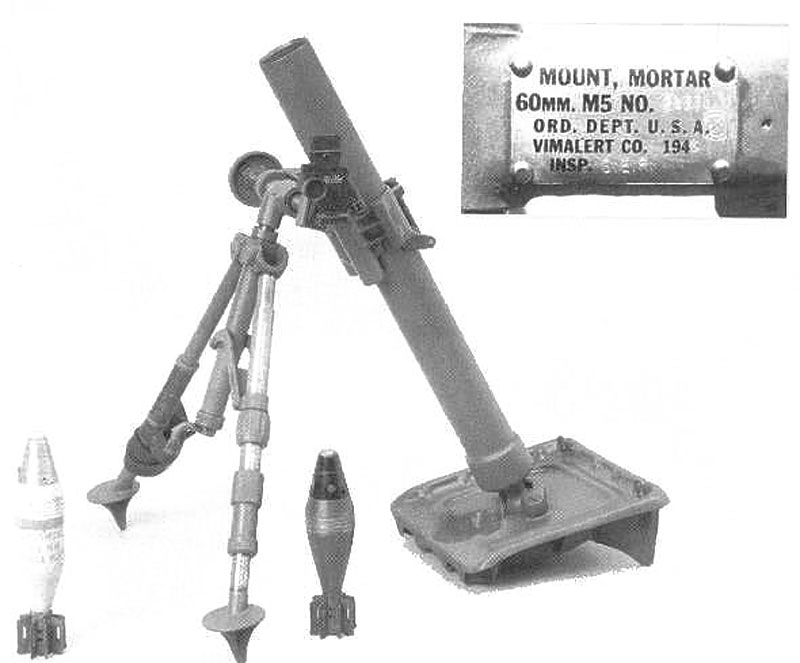
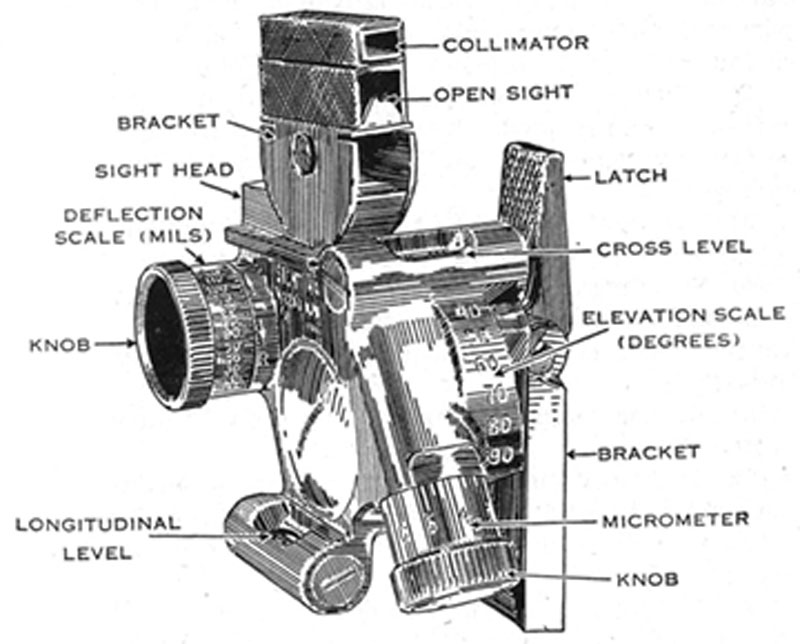
The M2 was made up of three major components consisting of the firing tube, baseplate and bipod. The firing tube was of a smoothbore design and made of metal, weighing in at 12.8lbs. The tube sat atop the metal rectangular M5 baseplate of another 12.8lbs. A 16.4lb bipod fitted to the upper half of the tube allowed the weapon to sit at an angle. The weight of the M2 system was listed at 42lbs and the barrel measured in at 28.6 inches in length. The mortar system was fully positional along its firing axis via mechanisms fitted at the bipod hinge, allowing for great accuracy at distance. In fact, the M2 was able to outdistance many of the light mortars of her day, explaining the popularity of the weapon from then on. Her elevation limitations were reported at +40 to +85 degrees with a 7-degree traverse. The operator managed an M4 collimator sight for trajectory adjustments (the same sight as found on the M1 81m Mortar system). The base cap sat within the tube and contained the firing pin. As a muzzle-loading weapon, the operator need only drop the mortar projectile down the mouth of the tube and protect himself from the subsequent launch blast. This method of operation allowed the mortar crew to supply a steady rate of accurate firepower in support of infantry operations before them. A trained crew could effectively fire off 18 rounds in a minute and reach ranges from 100 yards out to 2,000 yards with each projectile maintaining a possible 17-to 35-foot blast radius. A maximum rate-of-fire by a trained crew could reach 30 to 35 rounds-per-minute while extreme circumstances state a rate per minute of 100 rounds!

The 60mm 2.94lb mortar projectiles themselves were stout in shape, tapered at both ends, and stabilized in flight via multiple static fins. Muzzle velocity was approximately 518 feet per second. Available ammunition types included the primary M49A2 High Explosive (HE) round, the M302 white phosphorous smoke round and the 3.5lb M83 illuminating projectile round (25 second burn time). The M302 appeared somewhat late in World War 2 and could be used for both screening friendly movements or engaging enemy personnel as a deadly incendiary round. Practice rounds were made available for target training.

In practice, the M2 proved highly reliable and accurate as an indirect fire support weapon. The mortar system could be fielded at a moment's notice and directed for high-angled fire in both an offensive and a defensive role. With this capability, the M2 proved priceless in engaging enemies dug into trenches, ravines or along slopes. World War 2 alone accounted for the production of some 60,000 M2 systems. Production was handled by the Firestone Tire and Rubber Company as well as the Read Machinery Company and Kennedy-Van Saun Corporation.

The M2 did maintain its own level of limitations during her use. Perhaps most detrimental was the overall weight of the system as well as the weight of her ammunition. Though portable, the combined weight of the M2's bipod, firing tube and baseplate ultimately added up and the battlefield lethality of the mortar team was only as durable as its ammunition supply. Additionally, any mortar system suffered when engaging an enemy hiding under the protection of thick forest or jungle canopies where projectiles might find it hard to penetrate. Other than these points however, mortar teams proved invaluable to the base rifle company during the war. 60mm mortars served US military personnel in both the European and Pacific theaters - in the latter, they proved most effective against the dug-in and sometime suicidal Japanese troops.

A typical Marine mortar section in World War 2 was part of the Weapons Platoon, Rifle Company with its section leader being a Sergeant in rank. Three mortar squads were a part of this section with these being commanded by a Corporal. A total of 16 Marines made up the mortar section. The Weapons Platoon was deleted in May of 1944, relocating the mortar section under the control of company headquarters while operating in combat under the orders of the rifle company commander. Twenty Marines now made up the new 60mm Mortar Section.

French forces in Algeria and Indochina as well as South Vietnamese forces in Vietnam also utilized the M2.

Edgar Brandt's 60mm, 81mm and 120mm mortar systems went on to become something of a standard for the rest of the military world after World War 2, his designs copied to the extreme. His expertise also helped in the development of HEAT-based rifle grenades and HEAT warheads in general. He was credited with the invention of the discarding-sabot artillery shell. While his original business began in 1902 as the "etablissements Brandt", this has since evolved today to become the TDA Armements SAS under the Thales Group corporate banner.

The 60mm mortar, owing to its portability, came to be known as the a commander's "hip pocket artillery".
Text ©2003-2013 www.MilitaryFactory.com • All Rights Reserved • No Reproduction Permitted
MilitaryFactory.com does NOT sell equipment/weaponry. Material presented throughout this website is for historical and entertainment value and should not to be construed as usable for hardware restoration, maintenance or general operation. Please consult manufacturers for such information. Our disclaimer. Email corrections / Comments to MilitaryFactory at Gmail dot com.
Picture of Mortar, 60mm M2
Pic of the Mortar, 60mm M2
View All Images (2)

Specifications for the
Mortar, 60mm M2
Muzzle-Loading Light Mortar


Country of Origin: United States
Manufacturer: Firestone Tire and Rubber Company; Kennedy Van-Saun Corporation; Read Machinery Company - USA
Initial Year of Service: 1940


Overall Length: 0mm (0.00in)
Barrel Length: 726.00mm (28.58in)
Weight (Empty): 42.00lbs (19.05kg)


Cartridge: 60mm
Action: Muzzle Loading; Primer Impact
Feed: Single-Shot
Muzzle Velocity: 518ft/sec (158m/sec)
Rate-of-Fire: 18 rounds per minute
Range: 5,955ft (1,815m; 1,985yds)
Sights: M4 collimater sight


Variants:
Mortar, 60mm M2 - Base Series Designation itself based on a French design.


Operators:
France; South Vietnam; United States

ALL SMALL ARMS CATEGORIES

BY YEAR:


1700 to 1799
1800 to 1899
1900 to 1909
1910 to 1919
1920 to 1929
1930 to 1939
1940 to 1949
1950 to 1959
1960 to 1969
1970 to 1979
1980 to 1989
1990 to 1999
2000 to 2009
2010 to 2019
VIEW ALL
Compare Guns


BY TYPE:


Anti-Aircraft Weapons
Anti-Material Rifles
Anti-Tank Weapons
Automatic Rifles
Bolt-Action Rifles
Carbine Guns
Flamethrowers
Flintlock Guns
Grenade Launchers
Hand Grenades
Lever-Action Rifles
Machine Guns
Mortars
Musket Guns
Pistols / Handguns
Recoilless Rifles
Revolvers
Rocket Launchers
Shotguns
Silenced Guns
Sniper Rifles
Special Weapon Systems
Submachine Guns
VIEW ALL


SPECIAL:


18th Century Warfare
3 Soldiers Statue
Battle of Mogadishu
Chainmail Armor
Firearm Types Defined
French Military Victories
Medieval Crossbow
Medieval Longbow
Vietnam War Casualties
Vietnam War Memorial

WORLD WAR 2:


Australia
Britain
France
Germany (ALL)
German Rifles
Italy
Japan
Soviet Union
United States
US Infantry Regiment Guns
Machine Guns
Pistols and Handguns
Rifles
Submachine Guns
Sniper Rifles
VIEW ALL


WORLD WAR 1:

Pistols
Rifles
Machine Guns
Mortars
US Guns
VIEW ALL


KOREAN WAR:

Machine Guns
VIEW ALL


VIETNAM WAR:

Mortars
VIEW ALL


COLLECTIONS:


Ancient Weapons
British SAS Weapons
Civil War Guns (ALL)
Civil War Pistols
Colt Guns
Glock Guns
GROM Polish Special Forces
Guns of Libya
Guns of North Korea
Guns of Syria
Guns of WW1 & WW2
Heckler & Koch Guns
Kalashnikov Guns
Modern Russian Guns
Navy SEAL Weapons
Spetsnaz Weapons
Weapons of Desert Storm
Wild West Guns
Winchester Guns


HOLLYWOOD/GAMES:


Guns of the Walking Dead

Site Disclaimer | Privacy Policy | Site Map | MF Origins


©2013 www.MilitaryFactory.com • Content ©2003-2013 MilitaryFactory.com • All Rights Reserved • Site Contact Email: militaryfactory at gmail dot com. The "Military Factory" name and MilitaryFactory.com logo are registered ® trademarks and protected by all applicable domestic and international intellectual property laws.


Top MF Stuff: 2013 Military Pay Scale | Military Ranks | WW2 Weapons | Sniper Rifles | Kts to Mph | WW1 Aircraft | Automatic Rifles | Aircraft Cockpits | Vietnam War Weapons | Main Battle Tanks | Submachine Guns | Shotguns | French Military Victories


Most photographic images appearing on this site are courtesy of the United States Department of Defense and are approved for public use. Other images acquired through the public domain. Digital art work courtesy of Dan Alex. Business Consulting by Kyle Williams. Material presented throughout this website is for historical and entertainment value and should not to be construed as usable for hardware restoration, maintenance or general operation. Please consult manufacturers for such information.


eXTReMe Tracker