Military Factory
Military Pay Chart
Global Firepower
Military Industrial Complex
Second World War
Home
Military Pay Scale
Military Ranks
Small Arms
Aircraft
Land Systems
Navy
Education
Military Factory Facebook Logo
flag of France

Lebel Model 1886 Bolt-Action Rifle (1887)

Authored By Staff Writer | Last Updated: 11/11/2009

The revolutionary Lebel 8mm bolt-action rifle served the French from 1887 to 1936, becoming the standard French infantry rifle of World War 1.

Find a School Near You
Follow Military Factory on Facebook:
Trending on Military Factory:
Recent Articles:
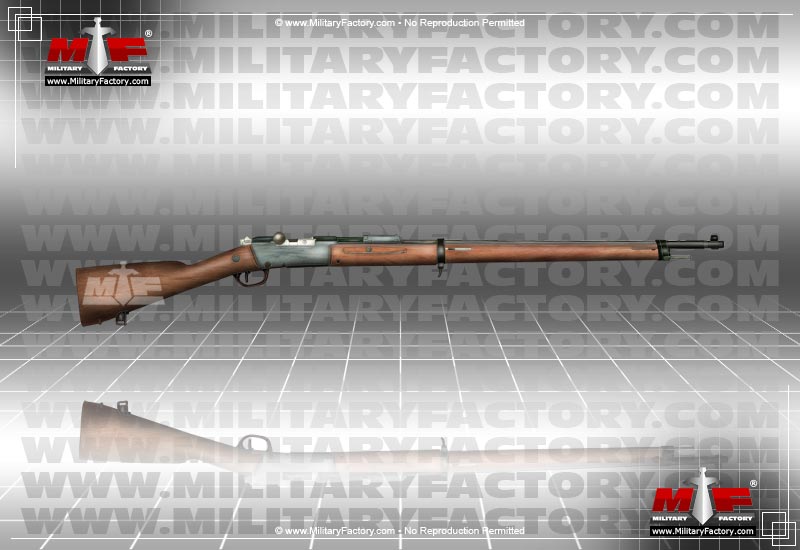
The Lebel Model 1886 (more formally as the "Fusil Modele 1886 ") was the standard infantry rifle of the French Army before and throughout World War 1. The weapon lived a production life that was long enough to see action in World War 2. The weapon was designed in 1886 to take advantage of smokeless gunpowder invented in 1884. For a time, the Model 1886 was a revolutionary step forward and gave a distinct advantage to the French infantryman. By the time of World War 1 in 1914 however, rifle technology had advanced past the Model 1886 as compared to her contemporaries on the battlefield. It is estimated that some 2,880,000 total Lebel Model 1886 rifles were produced up until 1929. The Lebel was credited as being the first rifle designed for use with smokeless powder ammunition and the first to make a "boat-tailed" ammunition as standard.

The Lebel Model 1886 was a bolt-action rifle firing the 8mm Lebel round. The bolt system itself was a derivative of the one as found on the single-shot Gras 1874 rifle series it replaced. As the operator moved the bolt backwards, a mechanical lift introduced a new cartridge into line with the chamber. The closing of the bolt moved the cartridge into the firing chamber, introducing another cartridge onto the lift mechanism with help from a spring in the magazine tube. The rifle was now made ready to fire. The bolt head was locked into the receiver itself by two opposed front locking lugs.

The cartridge of choice for the new rifle became the equally-new Lebel 8mm (8x50R Lebel Mle 86), a smokeless powder ammunition utilizing a small caliber jacketed bullet. This first practical use of smokeless powder was made possible thanks to French chemist Paul Marie Eugene Vieille in 1884. The new cartridge was designed by Lieutenant Colonel Nicolas Lebel, a French senior officer then part of the design committee and whom the rifle was eventually named after. The cartridge was known as the "Balle M". In 1898, the round-nose Balle M was replaced in use by the "boat-tailed" spitzer "Balle D" cartridge - this necessitating a revision to the spring-loaded tube magazine as well. Original Lebels were identified by their two-piece stocks and unique receivers. A cruciform-type bayonet of considerable length (20.5 inches) could be affixed to the underside of the muzzle. In all, the Lebel Model 1886 was a long and heavy battlefield rifle while at the same time being noted for her reliability and robustness.

The tube magazine was situated under the barrel and ran forward, fitting up to 8 cartridges loaded as single rounds and charged rearwards via a pressure spring. In addition to the cartridges in the magazine, the receiver could house an additional two cartridges - one in the transporter and another in the firing chamber - essentially allowing the French soldier access to 10 ready-to-fire cartridges in his gun. The weapon weighed in at 9.73lbs when loaded with 8-rounds and 9.21lbs when unloaded. She held an overall length of 4.28 feet but this was substantially increased when fitted with a bayonet. The bayonet was still part of the modern battlefield and many military authorities still sided with the idea of "the longer the better" when it came to bayonets, expecting all combat to eventually be decided within close-quarters. The barrel added a length of 2.62 feet to the rifle receiver with integrated stock and featured 4 grooves with a right-to-left twist. Muzzle velocity was listed at up to 2,300 feet per second. Range was reported to be up to 4,500 yards but this was, of course, dependent on operator training and certain conditions. The tough construction of the rifle also made it the perfect launcher for the VB rifle grenade.

The Model 1886 was a strange mating of ideas into what as to be a "modern" rifle system. The Model 1886 allowed its operator the ability to target enemies at greater ranges than its contemporaries while at the same time carry a lighter type of ammunition. The standard French soldier armed with his Lebel M1886/M93 brought along anywhere between 88 and 120 rounds of ammunition. While the weapon also introduced the revolutionary smokeless cartridge, the internal makeup of the Model 1886 design was something of a reverse approach considering that in some short years to follow, better rifle systems would outclass the Model 1886. The tube magazine was something of a throwback to earlier 19th Century rifle design - most commonly associated with "Wild West" Winchester lever-action rifles and the like - an arrangement that dangerously fitted each live cartridge in a nose-to-base arrangement and thereby potentially increasing the chances of an internal explosion within the magazine tube. Several steps were eventually initiated to the design of the Model 1886 that reduced the chance of such explosions including a double primer cup design for French-issued ammunition. The acceptance of "clip-loading" rifles such as the .303 Lee Enfield of 1895 would replace the spring-loaded tube magazine in due time.

The Model 1886 entered service with the French Army in 1886, immediately replacing the single-shot Fusile Gras M80 Modele 1874 rifle. Production was handled by a variety of factories that included Manufacture d'Armes de Chatellerault (beginning 1887), Manufacture d'Armes de St. Etienne (early 1900s) and Manufactured 'Armes de Tulle (throughout World War 1). At the time of its inception, the Model 1886 put the French Army ahead of the competition at least in the short term, particularly when in comparison to its immediate neighbors still using black gunpowder rifles and with whom France would most likely be placed into combat against. Once in circulation, practical experience revealed several drawbacks of the base Model 1886. This resulted in the entire receiver being revised and reinforced. The rear site was also redesigned for the better and a hook was added to the muzzle. The bolt-head had a hole bored into its design to allow for the escape of gasses resulting from a ruptured cartridge. The resulting changes produced the new "Model 1886/93".

As the length of the original Model 1886 and the improved Model 1886/M93 left something to be desired by mounted (cavalry) troops and battlefield support personnel, the "Model 1886R35" was devised as a shortened form of the base long rifle. As the original rifle measured in at over 4 feet long, the Model 1886R35 created a more manageable battlefield tool. The new variant featured both a shortened forestock and barrel assembly as well as a new rear sight to compensate for the rifles reduced length - now listed at 37.20 inches, down from its original 51 inches.

The Lebel Model 1886 saw official service with the French Army from 1887 to 1936 though many were in circulation that it survived long enough to see combat into the Second World War (including use by the French resistance). While the Lebel of World War 2 was often of a cut-down length, the full-length Lebel rifle was available as reserve weapons. The Lebel was also used in actions encompassing the Boxer Rebellion and during the French colonial battles at the turn of the century.

The Lebel was eventually supplemented in French Army service during World War 1 by the clip-loading Berthier Rifle introduced in 1902, this being issued primarily to colonial troops. While a general upgrade to the Lebel and also making use of the 8mm Lebel cartridge, the rifle in its early form offered only a three-shot capability. This was a drastic detriment to the French soldier when his German enemy would be fielding a 5-shot Gewehr 98 rifle. Likewise, his British counterparts would make use of their 10-shot Enfield rifles. A later revision finally introduced a five-shot cartridge version.

Similarly, the 7mm Meunier Rifle became the product of a secret French program begun in 1909. The program's goal was to develop a new-generation, semi-automatic infantry rifle of accuracy and reliability. The weapon was officially introduced in 1910 as a Lebel replacement intended to take the field as early as 1914 but the beginning of World War 1 cancelled the plan for its mass production - the fear being that introduction of an entirely new weapon system on the eve of war would be detrimental to the defense of France.
Text ©2003-2013 www.MilitaryFactory.com • All Rights Reserved • No Reproduction Permitted
MilitaryFactory.com does NOT sell equipment/weaponry. Material presented throughout this website is for historical and entertainment value and should not to be construed as usable for hardware restoration, maintenance or general operation. Please consult manufacturers for such information. Our disclaimer. Email corrections / Comments to MilitaryFactory at Gmail dot com.
Picture of Lebel Model 1886
View All Images (1)

Specifications for the
Lebel Model 1886
Bolt-Action Rifle


Country of Origin: France
Manufacturer: MAS (Manufacture d'Armes St. Etienne); MAT (Manufacture d'Armes de Tulle) - France
Initial Year of Service: 1887


Overall Length: 1304mm (51.34in)
Barrel Length: 798.00mm (31.42in)
Weight (Empty): 9.22lbs (4.18kg)


Cartridge: 8mm Lebel
Action: Bolt-Action Lever
Feed: 8-round tube magazine
Muzzle Velocity: 2,300ft/sec (701m/sec)
Rate-of-Fire: 10 rounds per minute
Range: 10,500ft (3,200m; 3,500yds)
Sights: Iron Sights


Variants:
Lebel Model 1886 - Base Series Designation


Fusile Modele 1886/M93 - Official French Designation.

Fusile Modele 1886R35 - Shortened barrel and forestock; 37.20 inch length; revised rear sight.


Operators: France; Belgium

ALL SMALL ARMS CATEGORIES

BY YEAR:


1700 to 1799
1800 to 1899
1900 to 1909
1910 to 1919
1920 to 1929
1930 to 1939
1940 to 1949
1950 to 1959
1960 to 1969
1970 to 1979
1980 to 1989
1990 to 1999
2000 to 2009
2010 to 2019
VIEW ALL
Compare Guns


BY TYPE:


Anti-Aircraft Weapons
Anti-Material Rifles
Anti-Tank Weapons
Automatic Rifles
Bolt-Action Rifles
Carbine Guns
Flamethrowers
Flintlock Guns
Grenade Launchers
Hand Grenades
Lever-Action Rifles
Machine Guns
Mortars
Musket Guns
Pistols / Handguns
Recoilless Rifles
Revolvers
Rocket Launchers
Shotguns
Silenced Guns
Sniper Rifles
Special Weapon Systems
Submachine Guns
VIEW ALL


SPECIAL:


18th Century Warfare
3 Soldiers Statue
Battle of Mogadishu
Chainmail Armor
Firearm Types Defined
French Military Victories
Medieval Crossbow
Medieval Longbow
Vietnam War Casualties
Vietnam War Memorial

WORLD WAR 2:


British Guns
French Guns
German Guns (ALL)
German Rifles
Italian Guns
Japanese Guns
Soviet Guns
US Guns
US Infantry Regiment-Level Guns
Machine Guns
Pistols
Submachine Guns
Sniper Rifles
VIEW ALL


WORLD WAR 1:

Pistols
Rifles
Machine Guns
Mortars
US Guns
VIEW ALL


KOREAN WAR:

Machine Guns
VIEW ALL


VIETNAM WAR:

Mortars
VIEW ALL


COLLECTIONS:


Ancient Weapons
British SAS Weapons
Civil War Guns
Colt Guns
Glock Guns
GROM Polish Special Forces
Guns of Libya
Guns of North Korea
Guns of Syria
Guns of WW1 & WW2
Heckler & Koch Guns
Kalashnikov Guns
Modern Russian Guns
Navy SEAL Weapons
Spetsnaz Weapons
Weapons of Desert Storm
Wild West Guns
Winchester Guns


HOLLYWOOD/GAMES:


Guns of the Walking Dead

Site Disclaimer | Privacy Policy | Site Map | MF Origins


©2013 www.MilitaryFactory.com • Content ©2003-2013 MilitaryFactory.com • All Rights Reserved • Site Contact Email: militaryfactory at gmail dot com. The "Military Factory" name and MilitaryFactory.com logo are registered ® trademarks and protected by all applicable domestic and international intellectual property laws.


Top MF Stuff: 2013 Military Pay Scale | Military Ranks | WW2 Weapons | Sniper Rifles | Kts to Mph | WW1 Aircraft | Automatic Rifles | Aircraft Cockpits | Vietnam War Weapons | Main Battle Tanks | Submachine Guns | Shotguns | French Military Victories


Most photographic images appearing on this site are courtesy of the United States Department of Defense and are approved for public use. Other images acquired through the public domain. Digital art work courtesy of Dan Alex. Business Consulting by Kyle Williams. Material presented throughout this website is for historical and entertainment value and should not to be construed as usable for hardware restoration, maintenance or general operation. Please consult manufacturers for such information.


eXTReMe Tracker