Military Factory
Military Pay Chart
Global Firepower
Military Industrial Complex
Second World War
Home
Military Pay Scale
Military Ranks
Small Arms
Aircraft
Land Systems
Navy
Education
Military Factory Facebook Logo
flag of United States

Colt Model 1860 New Army Percussion Revolver (1860)

Authored By Dan Alex | Last Updated: 11/25/2011

The Colt New Army Model 1860 revolver was produced in the hundreds of thousands during the American Civil War.

Find a School Near You
Follow Military Factory on Facebook:
Trending on Military Factory:
Recent Articles:
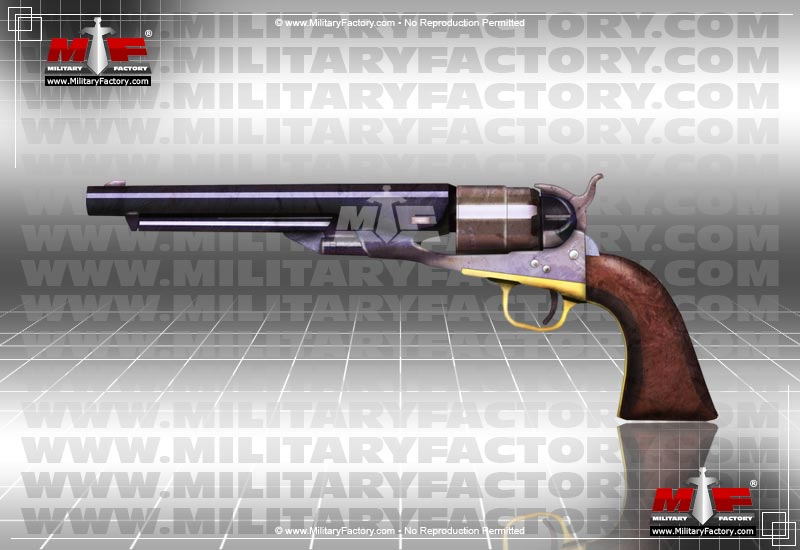
Colt brought about their New Army Model revolver in 1860 and it quickly proved itself the definitive combat revolver of the time. Designed to succeed the Colt 3rd Model Dragoon series of revolvers, the Model 1860 was essentially a re-envisioning of the Colt Navy Model of 1851 which, itself, proved a success with US Army forces despite the designation (originally intended for US Navy personnel). The New Army Model 1860 was produced in the hundreds of thousands owing much to the bloody conflict that was the American Civil War as the US Army standard issue sidearm and went on to become one of the most recognized and popular handguns of the war. Beyond its use in that conflict, the Colt New Army Model 1860 figured prominently in the Indian Wars to follow.

Like other Colt developments, the Model 1860 New Army was of single-action in design, meaning that the operator needed to actuate the hammer to cock the weapon which rotated the cylinder to the next available ammunition chamber. Only then could the user squeeze the trigger and complete the firing action. Each successive shot needed to be cocked in this fashion. Outwardly, the New Army Model revolver followed much in line with previous Colt offerings including the "open frame" receiver which was used to describe the lack of a supporting structure over the cylinder proper. The barrel was naturally fitted ahead of the cylinder and well contoured. Underneath the barrel ran an integrated ratcheting loading lever which was used to ram the firing chamber contents down towards the percussion caps. The user pulled down on the loading lever to which an arm, acting as a ramrod, would move rearwards towards each bullet chamber and force their contents into the cylinder. The action on the slightly oversized ball rounds also trimmed some of the lead off and effectively sealed each chamber. This sealing was important as to prevent ignition of powder residue across the mouths of the other chambers - this could lead to a cylinder rupture or severe injury for the user.

The weapon was loaded first with 35 grains of gunpowder in each cylinder (via a flask carried by the operator) and then a .44 ball was added as ammunition. These were added to each chamber (from the front end) and rammed home by the loading arm. Percussion caps needed to be set at each chamber rear along the cylinder rear on provided nipples. Once cocked, the weapon was then made ready to fire. The user could let off six rounds before requiring a reload. Alternatively, soldiers could be issued "paper" cartridges containing both the preset amount of gunpowder and the ball bullet in a single handy container. In this fashion, the user needed only to enter each paper cartridge into each chamber from the front and ram the contents down with the loading lever. Percussion caps were still required at each chamber rear.

Other physical features of the revolver included a fixed iron sight provided aft of the muzzle. The hammer spur protruded upwards and away from the receiver to allow the thumb to manage its action. The pistol grip - covered on both sides by a beautiful walnut finish - was ergonomically curved and smooth to fit firmly in the firing hand. The thin trigger unit was set within an equally thin trigger ring. The cylinder was either fluted or un-fluted while the frame of original models was completed from steel.

In practice, the New Army Model 1860 saw widespread use, particularly during the American Civil War (1861-1865) which marked a production boom for the Colt Manufacturing Company. The initial 1,000 or so production-quality models were completed with 7.5-inch barrels but most were eventually seen with the more popular 8-inch barrels from there on. Not only did it see action with Union forces but the Confederates noted its robust and effective value enough to produce illegal local copies all their own. As a military sidearm, the New Army Model 1860 was everywhere battles were waged. It served as a sidearm to officers, infantry and cavalry personnel as well as second-line units. Some military versions were even fitted with an optional wooden shoulder stock (about as long as the pistol itself) to assist in a three-point stabilization system when firing, leading to reported accuracy benefits at range.

All told, some 200,500 examples were produced during the span of 1860 and 1873, most with the aforementioned 8-inch barrels. Of these, 127,156 were produced to fulfill the US government contract during wartime.
Text ©2003-2013 www.MilitaryFactory.com • All Rights Reserved • No Reproduction Permitted
MilitaryFactory.com does NOT sell equipment/weaponry. Material presented throughout this website is for historical and entertainment value and should not to be construed as usable for hardware restoration, maintenance or general operation. Please consult manufacturers for such information. Our disclaimer. Email corrections / Comments to MilitaryFactory at Gmail dot com.
Picture of Colt Model 1860 New Army
View All Images (1)

Specifications for the
Colt Model 1860 New Army
Percussion Revolver


Country of Origin: United States
Manufacturer: Colt Patent Firearms Manufacturing Company - USA
Initial Year of Service: 1860


Overall Length: 355mm (13.98in)
Barrel Length: 203.00mm (7.99in)
Weight (Empty): 2.65lbs (1.20kg)


Cartridge: .44 Ball
Action: Single-Action; Repeating; Percussion Cap
Feed: 6-Shot Rotating Cylinder
Muzzle Velocity: 750ft/sec (229m/sec)
Rate-of-Fire: 6 rounds per minute
Range: 225ft (69m; 75yds)
Sights: Open Iron Front, Fixed


Variants:
Model 1860 New Army - Base Series Designation


Operators:
Confederate States; United States

ALL SMALL ARMS CATEGORIES

BY YEAR:


1700 to 1799
1800 to 1899
1900 to 1909
1910 to 1919
1920 to 1929
1930 to 1939
1940 to 1949
1950 to 1959
1960 to 1969
1970 to 1979
1980 to 1989
1990 to 1999
2000 to 2009
2010 to 2019
VIEW ALL
Compare Guns


BY TYPE:


Anti-Aircraft Weapons
Anti-Material Rifles
Anti-Tank Weapons
Automatic Rifles
Bolt-Action Rifles
Carbine Guns
Flamethrowers
Flintlock Guns
Grenade Launchers
Hand Grenades
Lever-Action Rifles
Machine Guns
Mortars
Musket Guns
Pistols / Handguns
Recoilless Rifles
Revolvers
Rocket Launchers
Shotguns
Silenced Guns
Sniper Rifles
Special Weapon Systems
Submachine Guns
VIEW ALL


SPECIAL:


18th Century Warfare
3 Soldiers Statue
Battle of Mogadishu
Chainmail Armor
Firearm Types Defined
French Military Victories
Medieval Crossbow
Medieval Longbow
Vietnam War Casualties
Vietnam War Memorial

WORLD WAR 2:


Australia
Britain
France
Germany (ALL)
German Rifles
Italy
Japan
Soviet Union
United States
US Infantry Regiment Guns
Machine Guns
Pistols and Handguns
Rifles
Submachine Guns
Sniper Rifles
VIEW ALL


WORLD WAR 1:

Pistols
Rifles
Machine Guns
Mortars
US Guns
VIEW ALL


KOREAN WAR:

Machine Guns
VIEW ALL


VIETNAM WAR:

Mortars
VIEW ALL


COLLECTIONS:


Ancient Weapons
British SAS Weapons
Civil War Guns (ALL)
Civil War Pistols
Colt Guns
Glock Guns
GROM Polish Special Forces
Guns of Libya
Guns of North Korea
Guns of Syria
Guns of WW1 & WW2
Heckler & Koch Guns
Kalashnikov Guns
Modern Russian Guns
Navy SEAL Weapons
Spetsnaz Weapons
Weapons of Desert Storm
Wild West Guns
Winchester Guns


HOLLYWOOD/GAMES:


Guns of the Walking Dead

Site Disclaimer | Privacy Policy | Site Map | MF Origins


©2013 www.MilitaryFactory.com • Content ©2003-2013 MilitaryFactory.com • All Rights Reserved • Site Contact Email: militaryfactory at gmail dot com. The "Military Factory" name and MilitaryFactory.com logo are registered ® trademarks and protected by all applicable domestic and international intellectual property laws.


Top MF Stuff: 2013 Military Pay Scale | Military Ranks | WW2 Weapons | Sniper Rifles | Kts to Mph | WW1 Aircraft | Automatic Rifles | Aircraft Cockpits | Vietnam War Weapons | Main Battle Tanks | Submachine Guns | Shotguns | French Military Victories


Most photographic images appearing on this site are courtesy of the United States Department of Defense and are approved for public use. Other images acquired through the public domain. Digital art work courtesy of Dan Alex. Business Consulting by Kyle Williams. Material presented throughout this website is for historical and entertainment value and should not to be construed as usable for hardware restoration, maintenance or general operation. Please consult manufacturers for such information.


eXTReMe Tracker