Global Firepower | Military Industrial Complex | Second World War History
Home | Military Pay Scale Chart | Aircraft | Infantry Weapons | Military Vehicles | Navy Ships | Military Education | French Military Victories | Military Ranks | WW2 Weapons
Military Factory Latest from Military Factory
Thumbnail picture of the Dardo infantry fighting vehicle
Dardo IFV
Thumbnail picture of the Supermarine Scimitar fighter
Supermarine Scimitar
Thumbnail picture of the Centauro B1 8x8 tank killer
Centauro 8x8
Thumbnail picture of the Novi Avion fighter
Novi Avion
Thumbnail picture of the FR F2 bolt-action sniper rifle
FR F2
Thumbnail picture of the Lebel Model 1886 bolt-action rifle
Lebel Model 1886
2009 Military Pay Scale Chart - for Army, Navy, Air Force and Marines
  BY TYPE
    · Anti-Aircraft
    · Anti-Materiel
    · Anti-Tank
    · Automatic Rifles
    · Bolt-Action Rifles
    · Howitzers
    · Lever-Action Rifles
    · Machine Guns
    · Mortars
    · Muskets
    · Pistols
    · Revolvers
    · Shotguns
    · Sniper Rifles
    · Special Weapons
    · Submachine Guns
    · View All Weapons

Military Factory > Infantry Weapons > M1917 Enfield (American Enfield)
 
 
More Pictures QuickGraphs Ballistics Chart CompareX2 Acronyms

M1917 Enfield (American Enfield)

The M1917 was a development of the German Mauser 98 rifle series and was produced to the tune of some 2,193,429 examples.
By Staff Writer

Bookmark and Share

Britain had already begun the task of replacing their Short Magazine Lee Enfield (SMLE) infantry rifles in the years preceding the First World War. The Royal Arms Factory at Enfield was charged with finding a solution to this requirement. The new rifle was to play upon the strengths of the excellent German Mauser 98 series and provide the British infantryman with a capable manstopper. However, the sudden explosion of events becoming World War 1 effectively shelved this long-developing rifle concept and pushed the British to look for a quicker and easier-to-produce alternative ready for mass production. The British therefore took the somewhat-developed Mauser-based concept and formatted it to fire the old standard .303 caliber ammunition. Production of the new P14 (or "Pattern 14") was fielded overseas to American factories made up of Winchester, Remington and Remington subsidiary Baldwin Locomotive Works at Eddystone, Pennsylvania. The three companies produced P14 designs which were further designated by their place of manufacture (as Winchester, Remington or Eddystone) .

As America entered the First World War, it too found itself with next to nothing in the way of an established arms-producing industry, let alone a serviceable standard infantryman rifle. In fact, arms production in the United States was such that there were not enough rifles being produced to supply American soldier. As the aforementioned American-based factories were already providing Allied soldiers with local-production versions of the excellent British-design Enfield Pattern 14 rifles, it was decided to utilize the type to produce a similar rifle chambered to fire the American standard .30-06 caliber cartridge. This decision wisely cut down design time and lowered production costs for the new "M1917" rifle. Once again, Winchester, Remington and Eddystone all provided the rifle in quantity with totals being 545,511, 545,541 and 1,181,09 respectively. Production for the new American rifle could even continue unhindered alongside the British P14's for both rifles were essentially completed at the same factories.

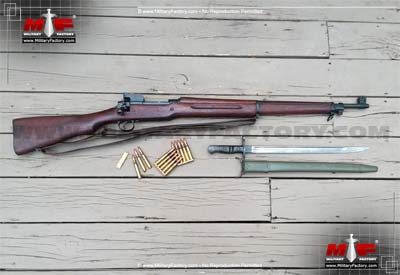
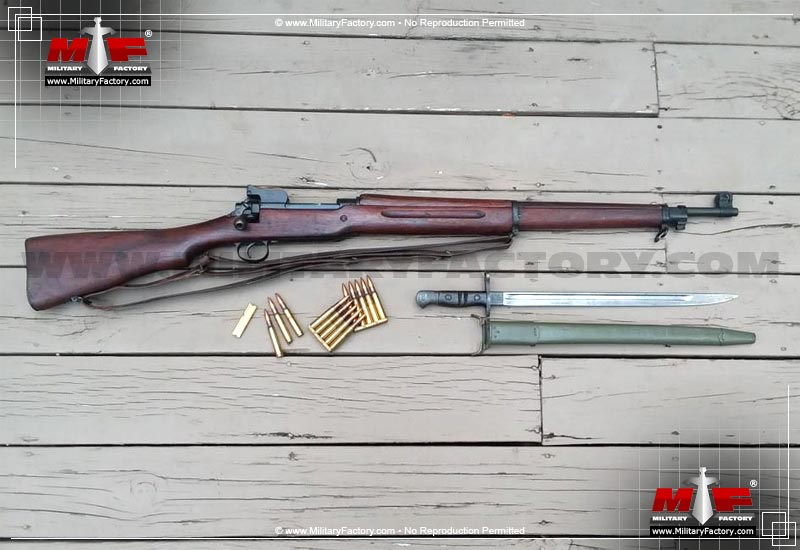
The M1917 external appearance was characterized with its encapsulating wood work and internal and sometimes exposed metal highlights. Traditional sights were located aft by the trigger unit and bolt lever and at the end of the barrel. The bolt lever sat along the right rear portion of the gun body. The trigger sat just underneath and at the base of the integrated rifle buttstock and grip. Shoulder strap connections were located at the buttstock underside and under the belly of the wooden barrel housing. The American model was fed from a 6-round magazine supporting the more powerful (over the British .303 cartridge) .30-06 Springfield (8.62x63mm) cartridge and operated via the aforementioned bolt lever action based on the Mauser turn bolt. Muzzle velocity was reported at 2,700 feet per second while the gun weighed in at just over 9 pounds. As was common to all service rifles in The Great War, a bayonet could be affixed to the M1917, providing for a lethal "reach" against enemy soldiers at close quarters.

The American M1917 proved a bit more forgiving in some regards for if the British .303 cartridge was to be inserted into the firing chamber (by mistake, for example), and though the M1917 could not fire the round but, the action would produce a "repairable" jam. Conversely, if the American Springfield round were introduce into the British Enfield P14 rifle, it would make the rifle inoperable. Thusly, the weapons and their ammunition were not wholly interchangeable as one might suspect, despite their associated origins.


In the end, American soldiers were fielded with a solid and reliable (though notably heavy) bolt-action rifle where up to three quarters of US infantrymen fielded the type by war's end. Surplus M1917's remained in large quantity after November 1918, with many seeing storage while a good number were released into civilian hands. A total of some 2,193,429 production examples were delivered. Operators of the type went on to include the United States, United Kingdom, Philippines, France and China.

Between wars, Remington furthered the Mauser concept in their commercial Remington Model 30 rifle series. The M1917 also survived in a 7mm form sold to Honduras and a modified 8x57 Mauser form delivered in time for the Spanish Civil War.

The M1917 Enfield did in fact see continued service into World War 2 though these rifles were often limited to training forces, reserve units, lend-lease customers or "home guard" elements. China and France (Free French) were both Lend-Lease recipients as were the British taking care to mark their arriving M1917 rifles with a red stripe to differentiate them from their own P14 rifles. American mortar and artillery crews were issued the rifle for a time during the conflict.

The M1917 was formally known in the US Army inventory as the "United States Rifle, cal .30, Model of 1917."

It is not uncommon to find the m1917 in serviceable condition, even today, as proven by its many appearances during weapons raids conducted by coalition forces in Iraq.

History text ©2003-2009 www.MilitaryFactory.com • All Rights Reserved • No Reproduction Without Permission • Corrections / Comments to MilitaryFactory at Gmail dot com

Last Updated: 11/2/2009


  Specifications for the M1917 Enfield (American Enfield)
arrow downOperation:
Action: Bolt-Action
Cartridge: 7.62x63mm (.30-06 Springfield)
Feed System: 6-round magazine
Muzzle Velocity: 2,700ft/sec (823m/sec)
Effective Range: 1,640ft (500m; 547yds)
Sights: Iron Sights

arrow downDimensions:
Overall Length: 1,175mm (46.26in)
Barrel Length: 660mm (25.98in)
Empty Weight: 4.17kg (9.19lbs)


More Pictures QuickGraphs Ballistics Chart CompareX2 Acronyms

  Special Infantry Weapons Collections

Weapon Groups:
Ancient Weapons
Chainmail Armor
Glock Handguns
Heckler & Koch
Kalashnikov Rifles
Medieval Longbow
Medieval Crossbow

World War 2:
Weapons of World War 2
US Infantry Regiment Weapons in World War 2
Guns of World War 2

Miscellaneous:
18th Century Warfare
Battle of Mogadishu
French Military Victories
Three Soldiers Statue
Vietnam War Casualties
Vietnam War Memorial
Vietnam War Weapons
Weapons of Desert Storm


  Recent Infantry Weapons Additions
Thumbnail picture of the FR F2 bolt-action sniper rifle
FR F2
Thumbnail picture of the Lebel Model 1886 bolt-action rifle
Lebel Model 1886
Thumbnail picture of the Winchester Model 1873 rifle
Winchester 1873

  Contacting MilitaryFactory.com
We can only get better if you tell us how. You can contact MilitaryFactory.com at MilitaryFactory at gmail dot com (replace "at" with "@" and "dot with ".") with any questions, comments or corrections. We also accept related military imagery that you approve for us to use on our website. Keep in mind, however, that due to volume, we may not directly respond to your inquiry. Please add us to your list of non-blocked recipients!

  Profile:


Picture of the M1917 Enfield (American Enfield)
Image Courtesy of the United States Department of Defense

flag of United States
1917
Designation: M1917 Enfield (American Enfield)
Classification Type: Bolt-Action Rifle
Manufacturer: Winchester / Remington / Baldwin Locomotive Works - USA

Country of Origin: United States

Operators: France; China; Philippines; United Kingdom; United States


  Variants
Mauser 98 - German rifle on which the British P14 was developed from.

P14 ("Pattern 14") - The British Enfield version on which the M1917 was copied from; firing the .303 cartridge.

M1917 - Base Series Designation; based on the P14; modified to fire the Springfield .30-06 cartridge.

M1917 "Winchester" - M1917 rifles produced by Winchester; 545,511 examples produced.

M1917 "Remington" - M1917 rifles produced by Remington; 545,541 examples produced.

M1917 "Eddystone" - M1917 rifles produced by Remington subsidiary Baldwin Locomotive Works at Eddystone, Pennsylvania; 1,181,09 examples produced.

M1917 (7.7mm) - Modified for export to Honduras.

M1917 (8x57 Mauser) - Modified for export to Spain.

  Collections
  • Ultimate Lockpick - Combat Shotguns
  • Sniper! - Tools of a Deadly Trade
  • Machine Gun - Weapon of Mass Suppression
  • Heckler & Koch - World Renowned
  • Big Guns - Anti-Materiel Rifles


Free GI Bill Guide

Top MF Stuff: Military Pay Scale Chart | Military Ranks | World War 2 Weapons | Sniper Rifles | Conversion Calculators


©2009 www.MilitaryFactory.com • Content ©2003-2009 MilitaryFactory.com • All Rights Reserved • Disclaimer Privacy Policy Site Map Origins
Most photographic images appearing on this site are courtesy of the United States Department of Defense and are approved for public use.
Other images acquired through the public domain. Digital art work courtesy of Dan Alex.
Business Consulting by Kyle Williams

Material presented throughout this website is for historical and entertainment value and should not to be construed as usable for
hardware restoration, maintenance or general operation. Please consult manufacturers for such information.

Site Contact: militaryfactory at gmail dot com (replace "at" with "@" and "dot" with ".") eXTReMe Tracker