Sentinel Arms Striker
The Striker design initially originated with Hilton Walker in the early 1980s and saw use with the South African Police and military.
By Staff Writer
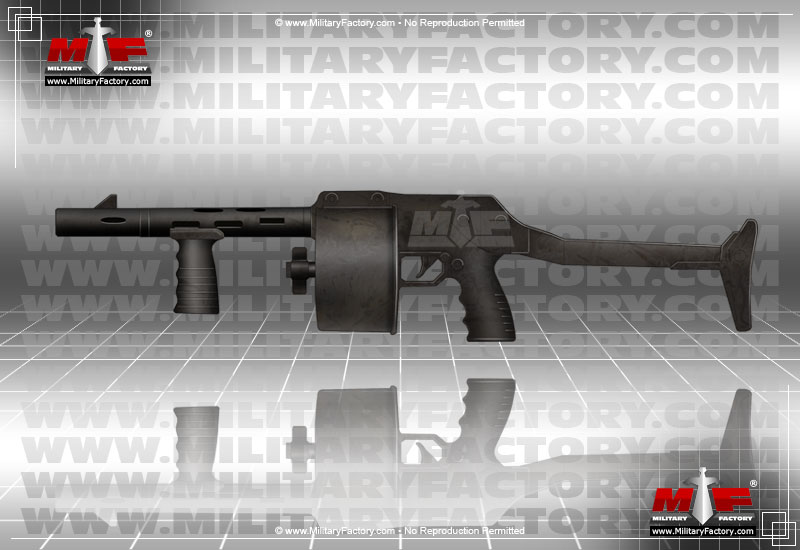
The Amsel Stryker was a two-handed, semi-automatic repeating shotgun firing a variety of 12 gauge ammunition from a 12-round rotating cylinder. The weapon featured a foldable stock, pistol grip with attached trigger group, a 12-inch barrel and an integrated foregrip. Originally developed by Hilton Walker out of the Republic of Rhodesia (bordering the north of South Africa), the system was accepted into service with the South Africa Police and military upon his arrival to the South African Republic in the early 1980s under the Amsel brand (Rhodesia ceased to exist from 1979 onwards, becoming Zimbabwe in 1980). From there, the weapon went on to achieve some level of notoriety and proved to be more than just a novelty shotgun. Its high magazine count and short barrel length made it an ideal weapon system for both military and security roles - the former useful as a manstopper and a breaching "tool" while the latter serviceable in riot-control duties.
The automatic shotgun had long been a dream of many-a-gunsmith since the advent of the shotgun itself. Most shotguns throughout the 20th century relied on operator actions to extract the spent shell casing and introduce a new shell into the chamber for firing. This was commonly done through actions such as a pump-slide mechanism. The Stryker now allowed the operator the ability for a semi-automatic fire mode through a healthy 12-round ammunition count. The operator need only squeeze the trigger to fire off each consecutive round as oppose to operating a lever or pump slide allowing for a substantial higher rate-of-fire over contemporary shotguns. Essentially, the Stryker relied the tried-and-proven principles developed during the heyday of the standard revolver. Reloading of the actual cylinder was a manual process via a right-side opening located on the rear plate of the cylinder housing. The cylinder itself remained with the gun body through all actions and was only removed for maintenance.
However, to compensate for the Stryker's larger and heavier ammunition container, Walker relied on a pre-wound "clock-work" type spring to rotate the cylinder. Though effective in some regard, it made the automated reloading process longer than desired and the rotating cylinder action itself was prone to skipping available rounds in the loaded chambers. The Stryker also proved a somewhat cumbersome affair despite its relatively short length, though more due to its large cylindrical magazine housing as the stock was collapsible over the top of the gun body. Walker was forced to reassess his weapon and re-imagined it in the "Protecta", a design doing away with the slow rotating cylinder and introducing a manually-rotating cylinder instead.
Beyond the original Stryker and the improved Protecta, the weapon system evolved into a handful of useful variants in the shortened "Protecta Bulldog", the American-market "Sentinel Arms Striker-12", the "Cobray/SWD Streetsweeper" with 18-inch barrel for the budget conscious and the small "Cobray/SWD Ladies Home Companion". Viewed as an "assault weapon", the Stryker was banned in Canada and its availability in the United States was limited though not impossible.
The Stryker itself was something of a revolutionary product in its own right in that it became one of the earliest production attempts at a trigger-actuated/cylinder-fitted shotgun to actually come to market for security and military forces. In some ways, Walker's original attempt has today been perfected in the new advanced and fully-automatic shotgun designs being actively used and tested by such forces such as the Russian Spetsnaz and the United States Marine Corps. With technology providing the capability and the military providing the need, the soldier of today can be armed with a devastating man-stopper and ultimate "lockpick" realized in the new generation of fully-automatic/rotating cylinder shotguns such as the IZHMASH Saiga-12 and the Auto Assault-12 (AA-12).
History text ©2003-2009 www.MilitaryFactory.com • All Rights Reserved •
No Reproduction Without Permission • Corrections / Comments to MilitaryFactory at Gmail dot com
Last Updated: 10/16/2009
|