The original Centurion Main Battle Tank (A41) of 1945 was a hugely successful British Army initiative enacted during World War 2 and realized shortly after the conflict had ended. The type saw service in the Korean War under the banner of the United Nations and went on to see extensive action in both Indo-Pak wars. Additional service saw them in the hands of the Israeli Army during the Six Day War and the upcoming Yom Kipper War where the type gave a good account of itself. In all, some 4,400 units were ultimately produced (strong production numbers for a Cold War tank) and these served well beyond the British Army inventory, seeing service with European powers as well as Middle East players. At the time of her inception, the Chieftain marked the most powerful Western combat tank in existence until unseated by the equally excellent German Leopard 2 series of the 1980s.
Despite the Centurion's dominance, the Cold War battlefield was an ever-evolving chessboard of technology-driven pieces and this produced ever more efficient weaponry in the process. As such, the impressive nature of once-formidable tanks such as the Centurion soon began to give way to new anti-armor measures being developed and fielded primarily by the Soviet Union - to which many of these weapons would inevitably be passed on to allies and satellite states within time. Work therefore began on finding the "next British Army main battle tank" and this led to a Leyland-designed tracked vehicle mounting the new and powerful L11 120mm series rifled main gun. Whereas historical approaches to British armor valued speed and battlefield mobility above all else, the Leyland submission decidedly focused on a heavily armored vehicle with firepower to boot. By 1959, a pilot vehicle was ready for formal review leading to the evaluation of six more prototypes spanning from 1961 to 1962. The vehicle - known as the "FV 4201" - was adopted for service in May of 1963 with service beginning in 1965. Production was managed along two separate assembly lines and eventually included the Leyland and Vickers brand labels.
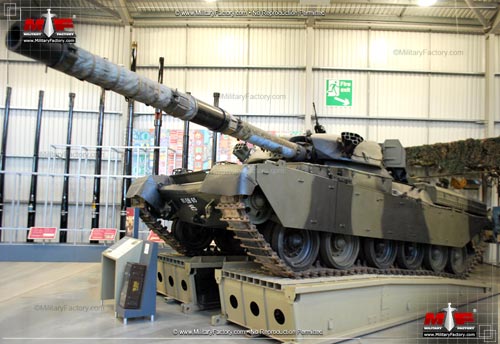
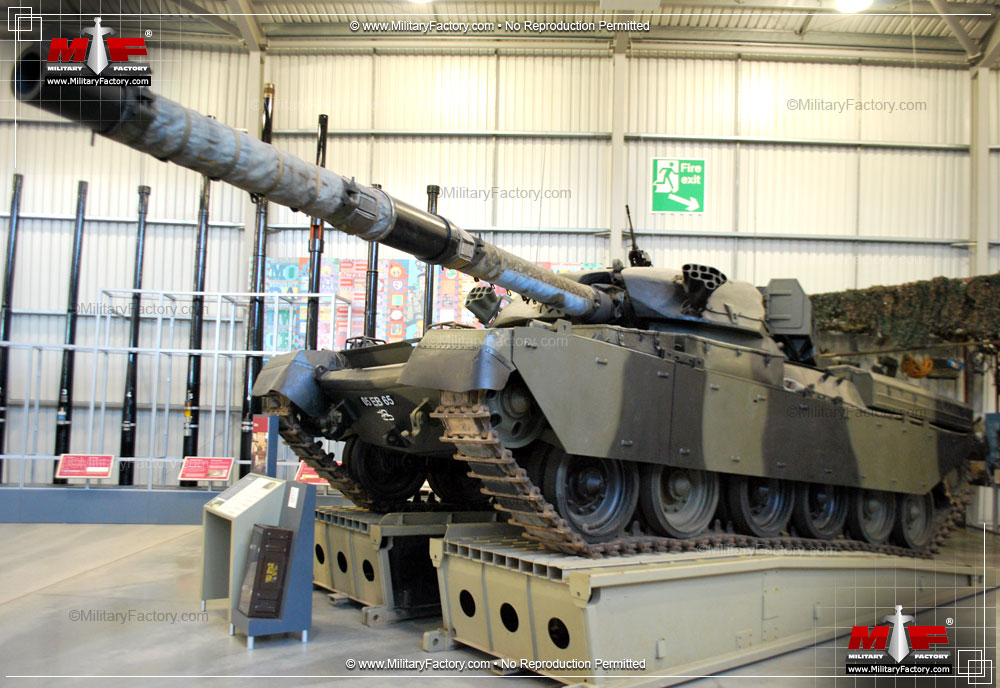
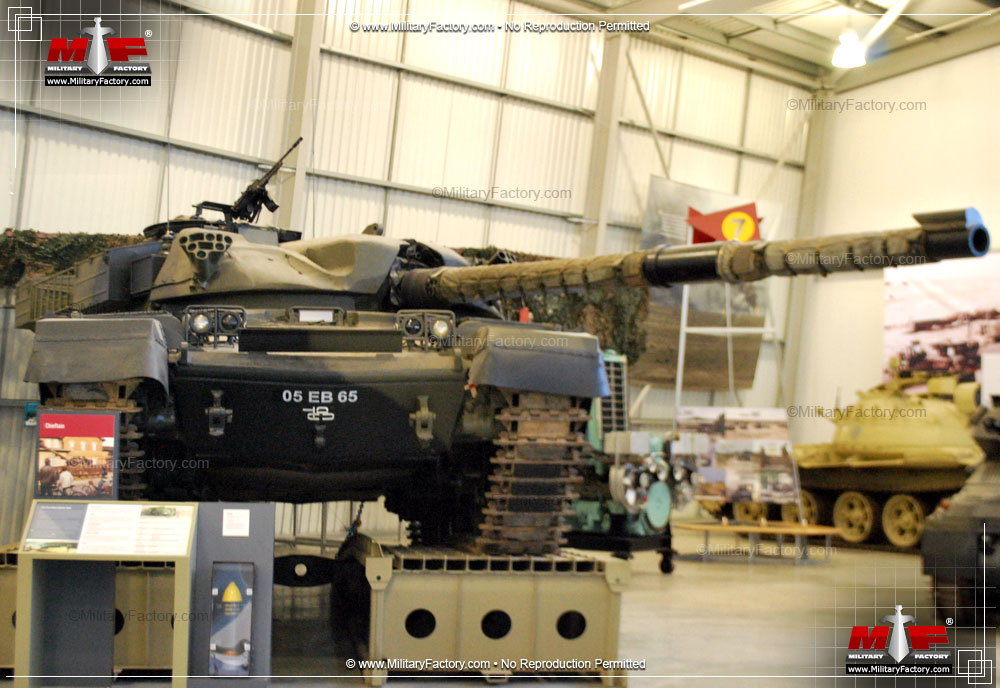
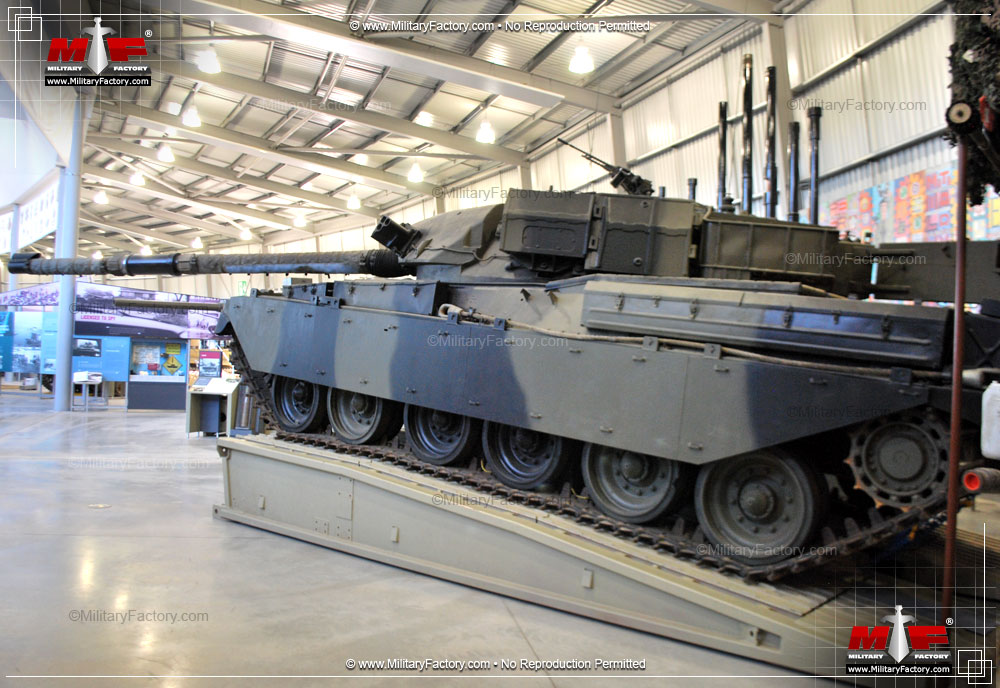
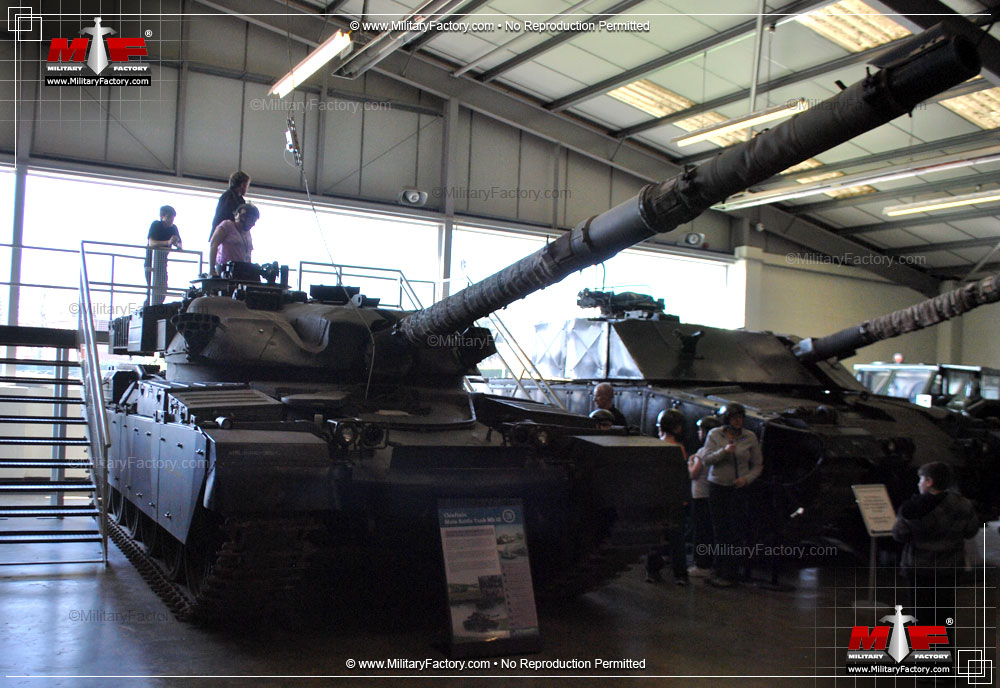
Outwardly, the Chieftain was of a conventional design approach with a four-man crew, 360-traversing turret mounting the main armament and a rear-mounted engine. Like other vehicles of this class, the Chieftain made use of a heavily-sloped, near-horizontal glacis plate leading up to a shallow hull roof. The driver was seated at the center-front of the hull just ahead of the turret ring. The remaining three crew - the tank commander, gunner and loader - held positions within the turret assembly. The commander and gunner were grouped, seated in tandem with the commander rear, along the right side of the turret in a traditional fashion with the loader to the left side of the turret. The cast turret itself was well-formed and heavily sloped with a low profile, the main gun barrel situated along the front facing with noticeable turret overhang (bustle rack) at the rear. The commander and loader were each afforded an access hatch along the turret roof as was the driver with a hatch in the forward hull. The driver drove in a near-horizontal reclined position when the tank was "buttoned down". The running gear consisted of six road wheels to a track side with the drive sprocket at the rear and the track idler at the front. Track return rollers guided the upper track sections. The upper regions of track and hull were generally protected over in armor skirts which concealed the return rollers and most of each road wheel - this feature a now-well accepted protective measure first implemented on a large scale in combat tanks during World War 2. Night driving was aided by a pair of headlights at the front of the hull. Stowage boxes were set over each fender for personal crew effects and general mission gear and storage baskets and boxes were also present along the turret sides.
In later marks, an NBC (Nuclear-Biological-Chemical) protection system was installed for the entire crew (the unit attached externally to the rear of the turret) and the commander, gunner and driver were all given night vision devices for improved low-light level performance.
Despite its excellent qualities elsewhere, the true "heart and soul" of the Chieftain system was undoubtedly its rifled 120mm L11 series main gun. The weapon was mated to a very accurate fire control system that provided precision firing at distance and "on-the-move". Comparatively, the earlier Centurion was given the smaller-caliber, though still excellent, L7 105mm series main gun. The weapon would soon run its course on the modern battlefields as Western tanks would now pitted against ever more powerful Soviet types. The L11 main gun was given an elevation range of -10 to +20 and fired a variety of cleared ammunition types. These included Armor-Piercing Fin Stabilized Discarding Sabot rounds (APFSDS), Armor-Piercing Discarding Sabot (APDS) rounds, High-Explosive Squash Head (HESH) rounds and basic Smoke munitions. The Chieftain crew could therefore engage both "hard" and "soft" targets as required. The fire control system (FCS) was fully-digital and the main gun fully-stabilized. In addition to the main gun, there was a 7.62mm L7 (essentially a British copy of the Belgian FN MAG) coaxial machine gun fitting in the turret and intended for keeping enemy infantry at bay. A second 7.62mm machine gun was fitted at the commander's cupola for point defense against both infantry and low-flying aircraft threats. To cover the tank's offensive or defensive movements from enemy gunners, the Chieftain was also afforded twelve electrically-actuated smoke grenade dischargers fitted as two banks of six, one bank mounted to each turret front side. There were 64 rounds of 120mm ammunition stored about the Chieftain's turret and hull as well as 6,000 rounds of 7.62mm ammunition (early Chieftain production tanks also fielded a 12.7mm "ranging" machine gun and these were given 300 rounds of 12.7mm ammunition). The 120mm ammunition was housed in water-tight holds containing both bag charge and loading ammunition to help prevent inadvertent explosions from direct hits or internal fires.
The original aforementioned 12.7mm heavy machine gun utilized for ranging was eventually replaced by the aptly-named "Tank Laser Sight" (TLS) system which took over the same role albeit in a more technological fashion.
Leyland developed the L60 multi-fuel compression ignition engine of 750 horsepower output at 2,100rpm and it was this system that powered the definitive Chieftain mark. This supplied the vehicle with a top speed of 30 miles per hour on ideal road surfaces and less so on uneven, off road-minded terrains. Operational range was 250 to 280 miles depending on terrain and driving habits. A fire extinguishing system was installed at the engine compartment for obvious reasons. In profile, the powerplant forced a raised engine compartment but in no way impeded performance nor the relatively low overall profile of the tank itself - turret included. The vehicle could ford up to 1.066 meter high water sources (aided by an integrated "splash board" identified around and ahead of the driver's area) and cross 3.149 deep trenches. Gradients of 60% could be managed as well. The hull was suspended atop a Horstmann suspension system developed by Hortsmann Defence Systems Ltd. If the Chieftain had one limitation it was in her selection of a multi-fueled engine design which was said to have never reached the intended output level as expected.
The initial Chieftain production mark was the Mk 1 which served in 40 delivered examples utilized primarily for trials and tanker training beginning in 1965. The Mk 2 became the initial service-ready model and these were supplied with 650 horsepower Leyland engines. A new commander's cupola was devised, an uprated engine introduced and additional equipment added to make the Mk 3 variant. The final definitive Chieftain production model became the Mk 5 and these added NBC protection units at the turret bustle as well as further uprated engines.
The Mk 6, Mk 7, Mk 8 and Mk 9 marks were essentially upgrades of earlier production models that introduced improved engines. The following Mk 10 was based on the Mk 9 upgrade and included the "Stillbrew Crew Protection Package" (SCPP) along the turret as well as an improved fire control system. The Mk 11 was itself an upgrade of the Mk 10 which saw the original IR/white light searchlight replaced with the Barr & Stroud "Thermal Observation and Gunnery System" (TOGS). TOGS allowed for adverse weather and night fighting capabilities which expectedly broadened the tactical scope of Chieftains for the better. The Mk 12 and Mk 13 variants were proposed Chieftain upgrades that would have featured additional improvements throughout but these marks were done in by the arrival of the excellent Challenger 2 series main battle tank. The "Chieftain 900" was a developmental Chieftain derivative protected by "Chobham" armor, a special breed of composite armor born out of British research at Chobham Common in Surrey.
900 Chieftain tanks were ultimately manufactured for the British Army. Its acceptance and use by one of the major military powers of the day inevitably drew interest from allies seeking a more modern MBT solution. As such, the Chieftain line also proved an export success beginning with Kuwait's purchase of 175 total units (these being Chieftain "Mk 5TK" models). Operators went on to include both Iran and Iraq (captured Iranian examples), Jordan (as the "Shir 1" / "Khalid" series) and Oman. Iran was by far the largest foreign operator of the Chieftain, receiving 707 examples in their MBT, AVLB and ARV form before the Islamic Revolution of 1979. Jordan took delivery of 274 units. Oman managed 27 (12 refurbished ex-British Army and 15 new-build as the "Qayd al Ardh"), these received in the early-to-mid 1980s.
During the Iran-Iraq War of the 1980s, Iraq captured around 100 Chieftains and operated at least 30 of these for time before passing them on to Jordan. The Iranians went on to upgrade their Chieftains to the newer "Mobarez" standard.
Like other combat tank systems before it, the Chieftain chassis and hull were adaptable for a broader range of battlefield applications to include a bulldozer variant, a mine clearing vehicle, an armored recovery vehicle (FV4204 ARV), a bridgelayer (FV4205 AVLB), armored recovery repair vehicle (FV4204 ARRV) and armored engineering vehicle (Armored Vehicle Royal Engineers - AVRE). As also the case with previous MBT entries, the Chieftain's derivatives outlasted the original combat hulls by decades. The Chieftain chassis was also the basis of the Chieftain "Marksman" self-propelled air defense vehicle mounting the "Marksman" series turret with 2 x 35mm cannons. The Chieftain "Sabre" was similar in scope, fitting a turret with 2 x 30mm cannons and intended for mobile air defense.
By 1996, the Chieftain Main Battle Tank was moved out of frontline service within the British Army inventory, replaced by the Challenger 1 and Challenger 2 series tanks. However, the many battlefield guises it produced remained in service for some time later, proving their worth and then some in operations to follow. The Challenger 1 came online in 1983 before being itself replaced by the more capable Challenger 2 in 1998.
Power & Performance Those special qualities that separate one land system design from another. Performance specifications presented assume optimal operating conditions for the Chieftain Mk 5 Main Battle Tank.
1 x Leyland L60 2-stroke 6-cylinder multi-fuel diesel engine developing 750 horsepower driving conventional track-and-wheel-arrangement. Installed Power
30 mph 48 kph Road Speed
280 miles 450 km Range
Structure The physical qualities of the Chieftain Mk 5 Main Battle Tank.
4 (MANNED) Crew
35.4 ft 10.79 meters O/A Length
11.5 ft 3.5 meters O/A Width
9.5 ft 2.89 meters O/A Height
121,254 lb 55,000 kg | 60.6 tons Weight
Armament & Ammunition Available supported armament, ammunition, and special-mission equipment featured in the design of the Chieftain MBT Main Battle Tank.
1 x 120mm L11 main gun in turret.
1 x 12.7mm ranging machine gun (later removed) in turret.
1 x 7.62mm co-axial machine gun in turret.
1 x 7.62mm machine gun at commander's cupola on turret roof.
2 x 6 Smoke grenade dischargers on turret.
AMMUNITION: 64 x 120mm projectiles.
300 x 12.7mm ammunition.
6,000 x 7.62mm ammunition.
12 x Smoke Grenades.
Variants Notable series variants as part of the Chieftain MBT family line.
Chieftain Mk 2 - Fitted with 650 bhp engine
Chieftain Mk 3 - Improved Chieftain
Chieftain Mk 3/3P - Export Variant
Chieftain Mk 5 - Featured an uprated engine
Chieftain Mk 5/3P - Export Variant
Chieftain Mk 5/2K - Kuwaiti export models; 165 examples devlivered.
Chieftain Mk 6 - Standardization of previous production mark; ranging machine gun added to main gun; improved engine performance.
Chieftain Mk 7 - Standardization of previous production mark; ranging machine gun added to main gun; improved engine performance.
Chieftain Mk 8 - Standardization of previous production mark; ranging machine gun added to main gun; improved engine performance.
Chieftain Mk 9 - Revised intermediate production mark; IFCS.
Chieftain Mk 10 - Revised intermediate production mark; IFCS (Improved Fire Control System); night and all-weather fighting capability with Thermal Observation and Gunnery Sight implementation; "Stillbrew" passive armor.
Chieftain Mk 11 - Revised intermediate production mark; IFCS; night and all-weather fighting capability with Thermal Observation and Gunnery Sight implementation; "Stillbrew" passive armor..
"Shir 1" - Modified Chieftain; Iranian export; 125 examples delivered; later named "Khalid".
"Shir 2" - Iranian Export; 1,225 examples ordered though never produced or delivered due to the regime change of 1979 in Iran; based on late model Chieftains; would be used as basis of the proceeding Challenger MBT series.
Chieftain ARV - Armored Recovery Vehicle
Chieftain AVLB - Armored Bridgelayer
Chieftain AVRE - Armored Vehicle Royal Engineer
Chieftain ARRV - Armored Recovery and Repair Vehicle.
Operators Global customers who have evaluated and/or operated the Chieftain MBT. Nations are displayed by flag, each linked to their respective national land systems listing.
Total Production: 2,083 Units Contractor(s): Leyland Motors / Vickers / BAe Systems Land Systems - UK
The "Military Factory" name and MilitaryFactory.com logo are registered ® U.S. trademarks protected by all applicable domestic and international intellectual property laws. All written content, illustrations, and photography are unique to this website (unless where indicated) and not for reuse/reproduction in any form. Material presented throughout this website is for historical and entertainment value only and should not to be construed as usable for hardware restoration, maintenance, or general operation. We do not sell any of the items showcased on this site. Please direct all other inquiries to militaryfactory AT gmail.com. No A.I. was used in the generation of this content.