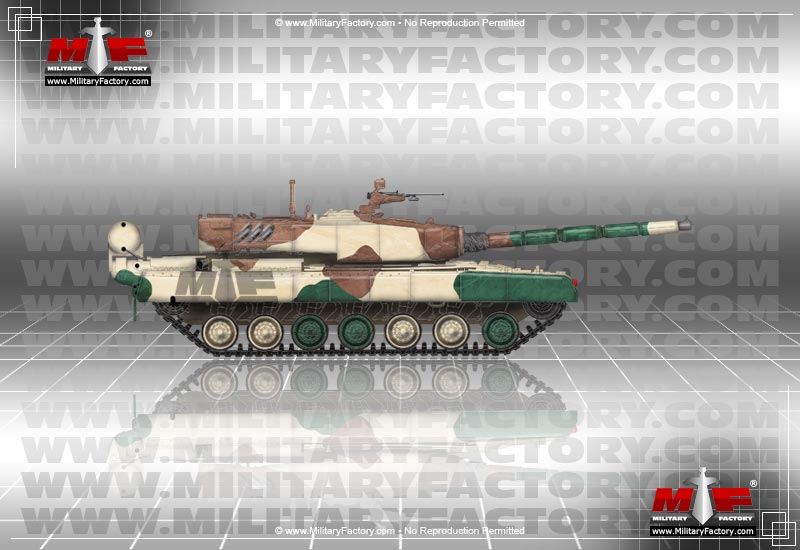
The Arjun (named after the Indian mythological hero "Arjuna") represents the first indigenous Indian tank design. Having received priceless experience in the local license production of the Vijayanta (essentially the British Vickers Defense Systems Mk 1) and years of armored warfare lessons in the two Indo-Pak Wars, the Indian Defense Research and Development Organization (DRDO) set about to design and produce their own MBT to satisfy the eventual need for a replacement tank in the Indian Army. The resulting Arjun became a tremendous effort - brought about with outside help from Germany, Netherlands and Israel - by local Indian companies. Unfortunately, the system has been plagued by cost overruns and project delays and - in some inner circles - is believed to has run its useful course. As such, this once-promising tank system is considered obsolete by some.
Despite development beginning as early as 1974, the first Arjun prototype did not appear in 1984 and was designed to be a 40-ton main battle tank mounting the then industry-standard 105mm main gun. Since the early Indian Army requirement was laid down, however, the Arjun has ballooned into a heavier 58-ton displacement with the larger and more potent 120mm main gun.
Externally, the conventional design of the Arjun shares many similarities with current-generation main battle tank models found elsewhere. The system accommodates four personnel made up of the driver, gunner, loader and tank commander. The driver situated in the hull while the rest of the crew is fitted into the 360-degree traversable turret. The Arjun retains a respectably low profile and fits 7 roads wheels to each track side and features upper armor skirts for added protection. External fuel tanks can be stored at the rear of the hull for increase range. Overall, the Arjun is designed with sharp clean lines though with very little in the way of sloped angles, particularly along the sides of the turret. The Kanchan modular composite armor is of steel construction while Explosive Reactive Armor can be added as optional. Some amphibious capability has been demonstrated which only enhance the systems overall value.
Armament consists of the powerful 120mm rifled main gun ready to fire HEAT, APFSDS or HESH projectiles as well as LAHAT anti-tank missiles. As is standard practice among modern tank systems, a Mag 7.62mm Tk715 anti-infantry machine gun if fitted co-axially in the turret alongside the main gun. Beyond that, a single 12.7mm (.50 caliber) HCB anti-aircraft machine gun is fitted to the top of the turret. A total of 39 projectiles of 120mm ammunition are carried in specialized containers that are kept separate from the crew for an added level survivability. Up to 12 smoke grenade dischargers are fitted to the rear side faces of the turret (six to a side).
Extensive attention has been placed on the Israeli Elbit-brand two-axis fire-control system - this coupled with the Arjun's complicated - yet state-of-the-art - hyrdopneumatic suspension system and gun stabilization components theoretically allow the Arjun to achieve a good "first-hit" capability on par with most any current generation MBT.
Power is derived from the German-based MTU 838 Ka 501-series turbocharged, water-cooled, diesel-fueled engine generating some 1,400 horsepower tied to the German-based Renk transmission system. This powerplant is mated to an Indian-produced turbocharger allowing for speeds of 72 kilometers-per-hour with a range of 200 kilometers. A more powerful 1,500 horsepower engine was also in the works at one time.
It was envisioned that the Arjun chassis - as with most other armies maintaining a capable MBT design - would be used in a myriad of related yet specialized battlefield support vehicles. Among them was a developed prototype Armored Recovery Vehicle though an armored reconnaissance, a 155mm-armed self-propelled gun (known as the "Bhima"), bridge layer and air defense vehicle were also planned. An interesting combination of the Arjun turret and a T-72 class chassis has also appeared in the prototype form of the 120mm-armed Tank-EX "Karna" mbt development.
As it stands, the Arjun has undergone trials for battlefield acceptance. However, the system has fallen well short of expectations with deficiencies in its fire control system as related to accuracy, consistent engine failures, poor speed and suspension troubles. The tank has also had issues when operating in the hot regional temperatures. These issues, along with cost overruns, have forced the Indian government to cast its disappointment with India's first indigenous tank design to that point that the Ministry of Defense has looked outwardly to fulfill India's tank needs. It was last reported that "some" progress had been made in rectifying the Arjun's shortfalls.
With the Arjun program moving along at a such a slow pace, it has been decided by the government to purchase large quantities of Russian-made T-90 main battle tanks for the interim - at least 347 are to be imported - a move no doubt spurred along by Pakistan's increasingly numeric armored forces. License production of the T-90 has also been granted to India to locally produce the Russian tank. As it stands, some 32 pre-production Arjun vehicles have been built along with an initial prototype and 12 follow-up models. A planned 124 is currently still on order, though a vastly lower figure than the original 1,500 to 2,000 tanks envisioned at the projects beginning.
With this joint partnership between Russia and India, Russia has offered its design arm to help in a new next-generation Indian tank venture, announced in 2008. The system is expect to be made ready by 2020 which could effectively spell the end of the Arjun.
With so much promise and optimism for India's first home-grown tank, the project has fallen into a sad state of affairs. When first unveiled, it was compared favorably to the western M1 Abrams and Leopard 2 series of tanks - those tanks themselves were designs with origins in the 1970s - but with the current pace of Arjun development, the system will be viewed as obsolete by most should she ever see operational service. If production is truly capped at 124 examples, her reach will in no way compare favorably to other more successful tanks in her class.
Update January 2014:
To date, some 125 of the Arjun tank line have been produced and these of the Mk I model series. The Indian Army has contracted for a further 124 tanks of the Mk II model series. Formal entry for the tank line was in 2004 with the 43rd Armoured Regiment of the Indian Army Armoured Corps being the recipient. Testing in the spring of 2010 saw the Arjun compare favorably to the Russian T-90 MBT which proved a good sign for the Indian product. The vehicle proved capabilities in hitting moving targets, wading through deep water sources and traversing cross country.
The Mk II model was unveiled in 2011 as an improved variant. Trials for the type began in the middle of 2011 and included evaluation of a night vision system, improved ammunition and gun laying, support for Explosive Reactive Armor (ERA) blocks, improved navigation suite and increased missile firing capabilities. Overall power has been increased while overall weight slightly reduced. Testing continued into 2012 which allowed the Indian Army to further evaluate the incoming model which ultimately led to the added procurement contract for new vehicles. As it stands, the Mk II model is a vast, more refined upgrade, to the original Arjun line and promises a better return on investment when compared to the original offering.
It is expected that the Indian Army will purchase at least 300 Arjun Mk II tanks.
Power & Performance Those special qualities that separate one land system design from another. Performance specifications presented assume optimal operating conditions for the DRSO Arjun (Lion) Mk 1 Main Battle Tank (MBT).
1 x MTU 838 Ka 501 12-cylinder liquid-cooled turbocharged diesel engine developing 1,400 horsepower at 2,500rpm. Installed Power
42 mph 68 kph Road Speed
300 miles 483 km Range
Structure The physical qualities of the DRSO Arjun (Lion) Mk 1 Main Battle Tank (MBT).
4 (MANNED) Crew
33.4 ft 10.19 meters O/A Length
12.6 ft 3.84 meters O/A Width
7.6 ft 2.32 meters O/A Height
129,191 lb 58,600 kg | 64.6 tons Weight
Armament & Ammunition Available supported armament, ammunition, and special-mission equipment featured in the design of the DRDO Arjun (Lion) Main Battle Tank (MBT).
1 x 120mm rifled main gun.
1 x 12.7mm HCB anti-aircraft machine gun.
1 x 7.62mm Tk715 co-axial machine gun.
12 x smoke grenade dischargers.
AMMUNITION: 39 x 120mm projectiles.
3,000 x 7.62mm ammunition.
1,000 x 12.7mm ammunition.
12 x Smoke grenades.
Variants Notable series variants as part of the DRDO Arjun (Lion) family line.
Arjun Mk 1 - Production Model Designation
Arjun ARV - Armored Reconnaissance Vehicle
Arjun AVLB - Proposed Armored Vehicle Launching Bridge
Arjun - Proposed Air Defence Variant
Arjun Tank-EX - T-72M1 chassis with Arjun MBT turret.
"Bhim" - Proposed 155mm self-propelled gun design; fitted with South African Denel T6 turret.
Operators Global customers who have evaluated and/or operated the DRDO Arjun (Lion). Nations are displayed by flag, each linked to their respective national land systems listing.
Total Production: 124 Units Contractor(s): DRDO / CVRDE / Heavy Vehicles Factory - India
[ India ]
1 / 1
Image copyright www.MilitaryFactory.com; No Reproduction Permitted.
Going Further... The DRDO Arjun (Lion) Main Battle Tank (MBT) appears in the following collections:
The "Military Factory" name and MilitaryFactory.com logo are registered ® U.S. trademarks protected by all applicable domestic and international intellectual property laws. All written content, illustrations, and photography are unique to this website (unless where indicated) and not for reuse/reproduction in any form. Material presented throughout this website is for historical and entertainment value only and should not to be construed as usable for hardware restoration, maintenance, or general operation. We do not sell any of the items showcased on this site. Please direct all other inquiries to militaryfactory AT gmail.com. No A.I. was used in the generation of this content.