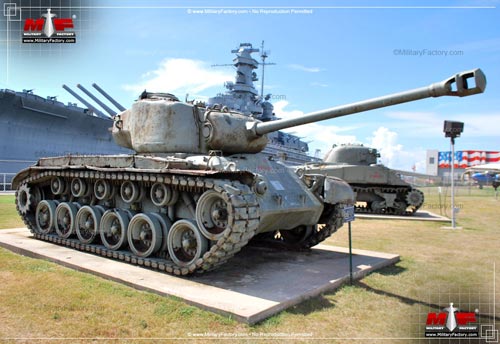
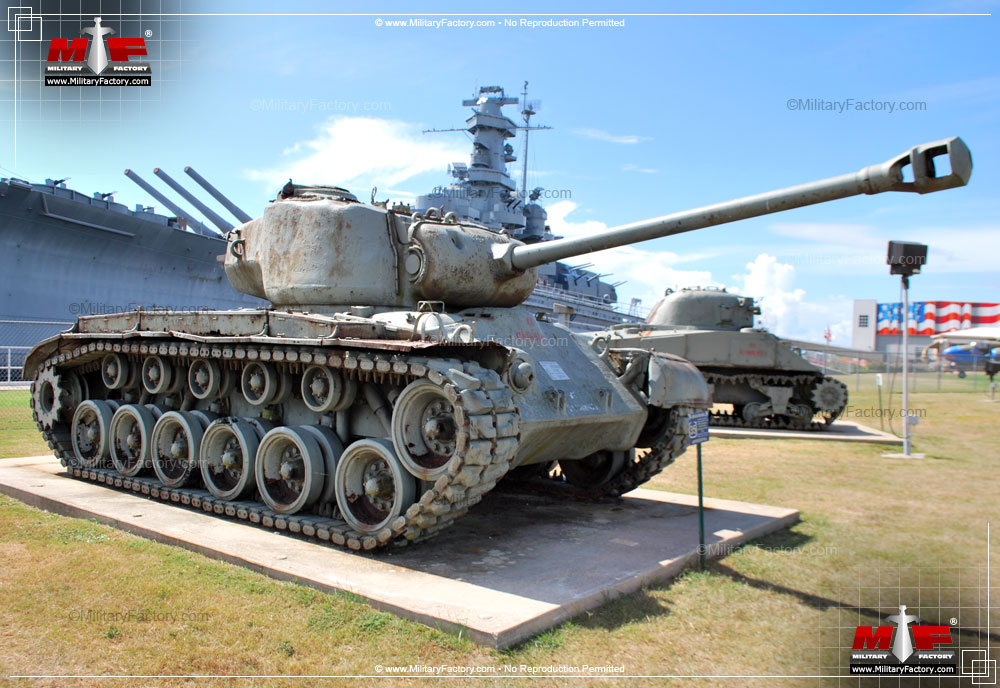
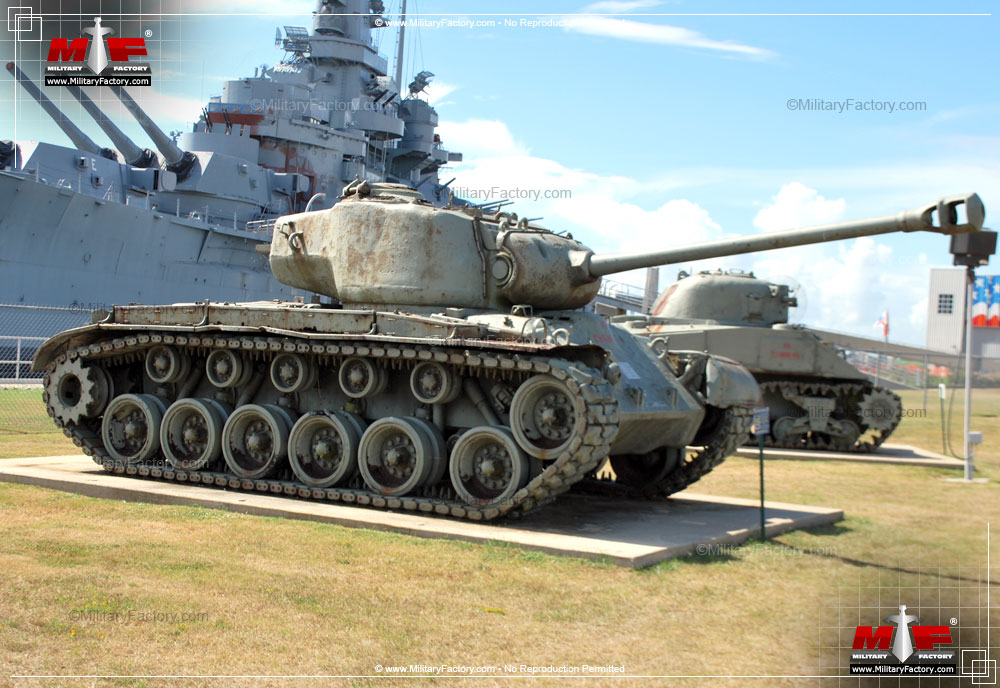
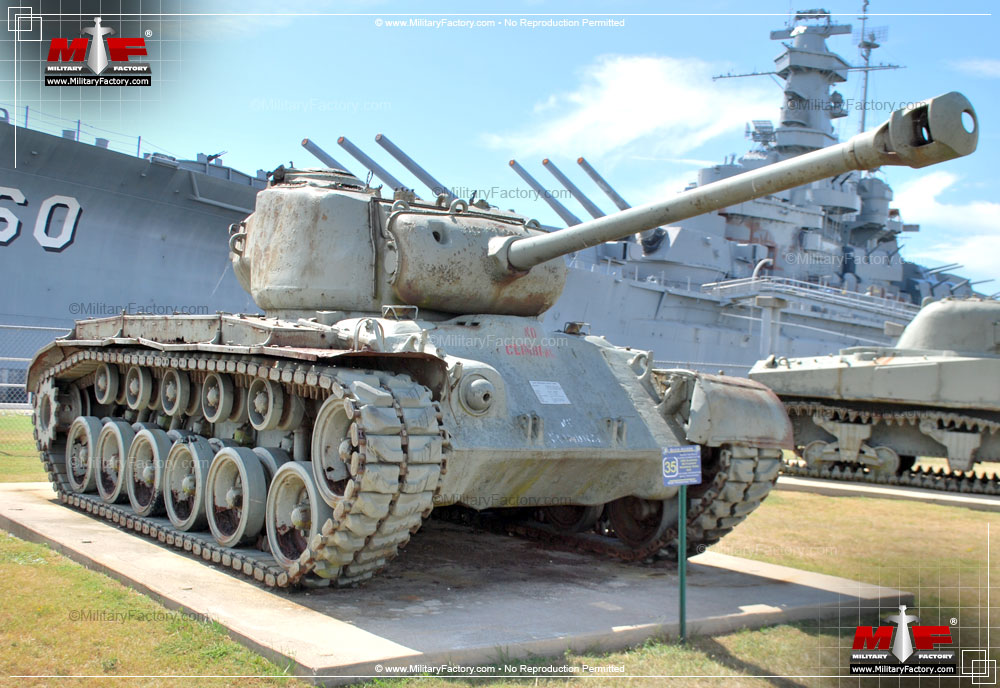
The M26 "Pershing" made its official appearance towards the end of World War 2 and was appropriately named after World War 1 General John J. Pershing (known as "Black Jack") of the American Expeditionary Force (AEF) in France. The M26 Pershing had a slow and arduous beginning during a time when the need for such a "heavy tank" was not part of US Army priority. Instead, efforts were primarily focused on production of M3 Lee/Grant and M4 Sherman medium tanks, the latter which went on to form a large part of British and American armored forces by war's end. It was not until the debut of the German "Panther" and "Tiger" heavy tank series on the battlefields of Europe that the need for a heavily armed - and armored - tank combat system came to the forefront. Heavy tanks would prove the norm by the end of the war with Germany, Britain, the United States and the Soviet Union all showcasing heavy tank designs of varying success. One of the more notable and successful developments became the Soviet "Josef Stalin" IS series mounting the powerful 122mm main guns and stubbornly thick armor. Some armored developments were even deemed "super heavy" tanks that exceeded all previous norms of tank designs in both dimensions and firepower - with most of these outrageous and optimistic designs attributed to the Germans (the Super Heavy Tank Panzer VIII "Maus" being a prime example, only two of which were built; the Landkreuzer P.1000 "Ratte" was another).
By the time of the scheduled Allied invasion of the French coastline on D-Day, the Panther enjoyed strength in numbers and easily outmatched it closest Allied counterpart - the M4 Sherman. It was only after the Allies received first-hand experience against these German Panthers in post-D-Day invasion reports did the need for an improved American tank take hold in the minds of warplanners. The Panthers supplied a healthy combination of armor protection and armor penetration, the latter with a formidable and proven German main gun. This enabled German tanks to fire at Allied armor even before Allied armor was in range to fire back. Additionally, the heavier German tank types often required skillful hits along the more vulnerable sides or rear and combinations of actions from multiple Shermans. Conversely, the Shermans comparably lacked in point defense armor protection and made due with their original 75mm main guns - this eventually upgraded to 76mm models and better armor in the form of the Sherman "Jumbo".
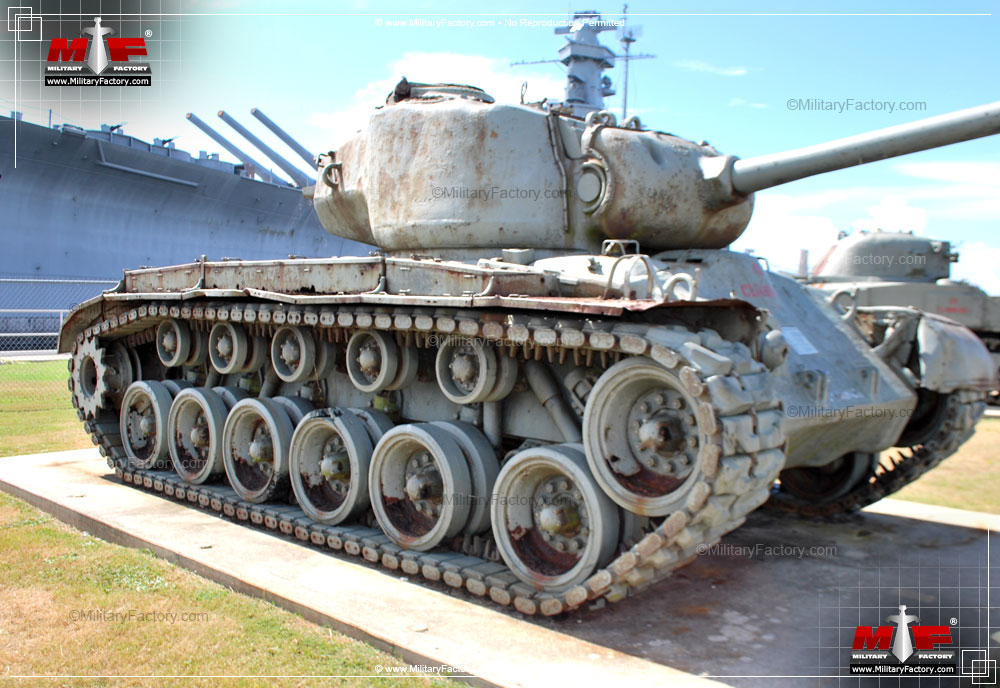
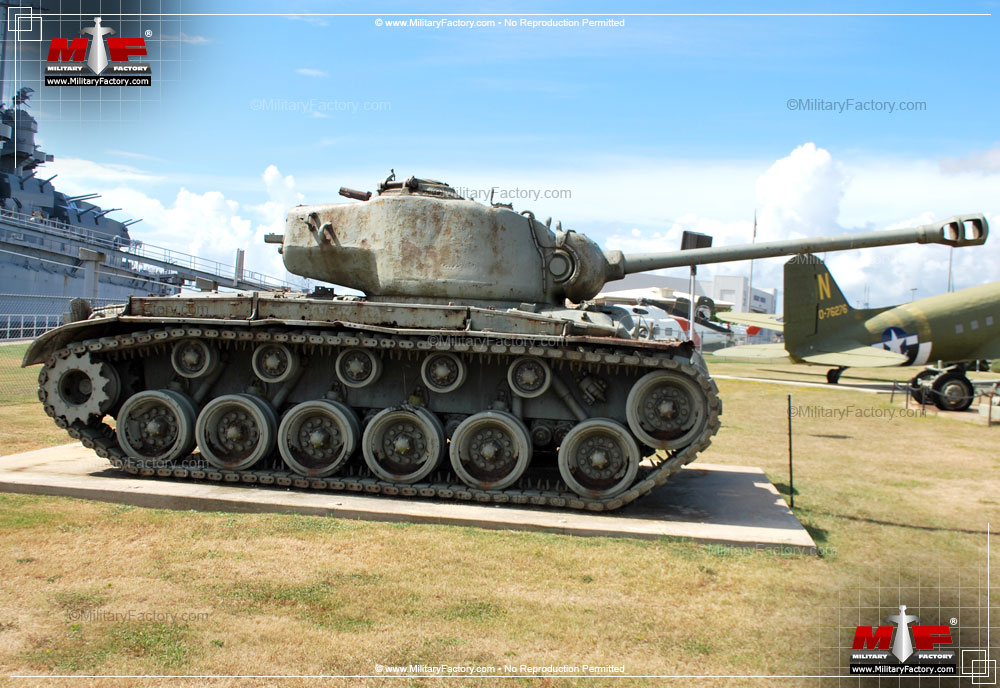
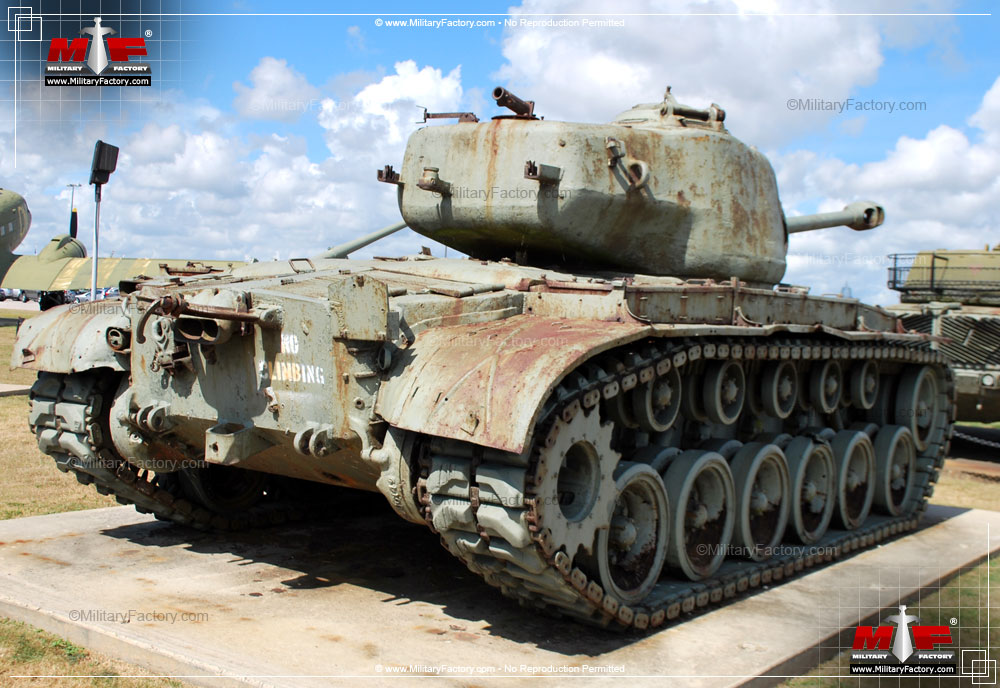
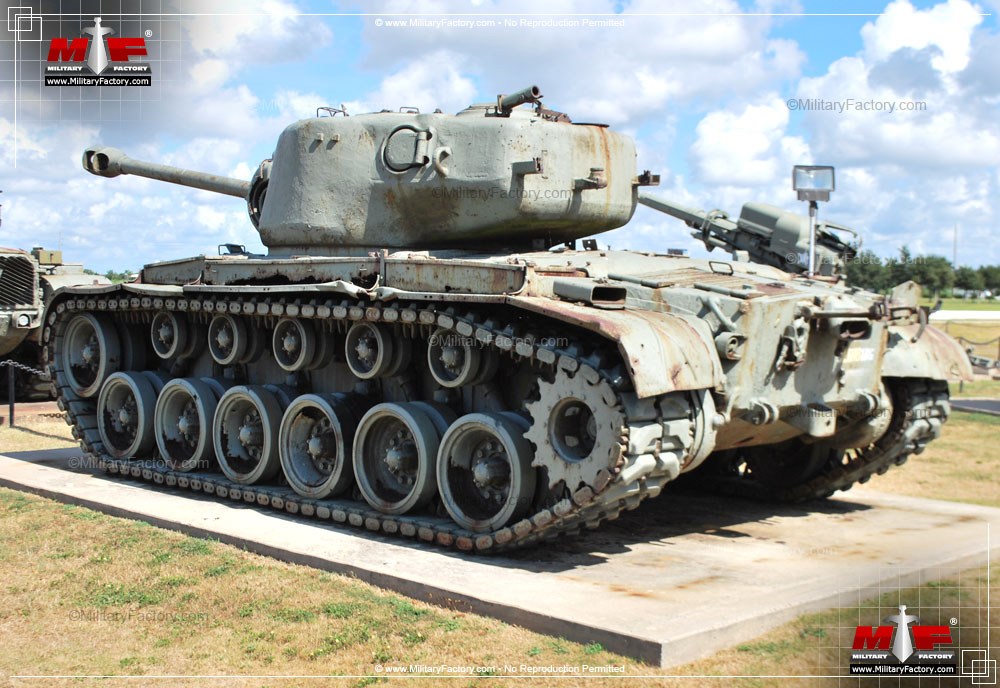
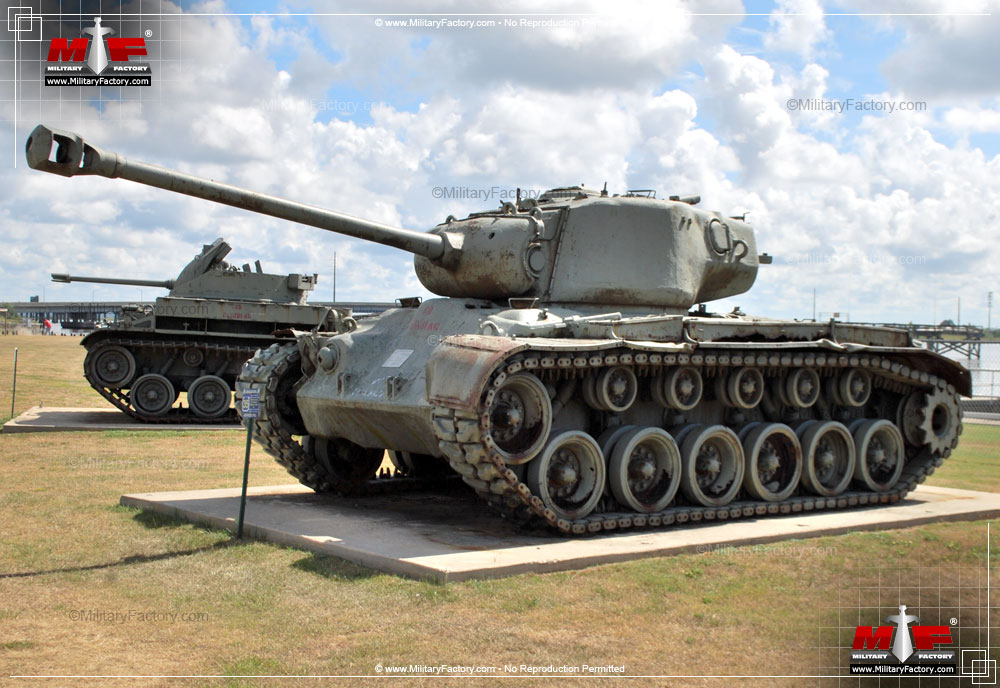
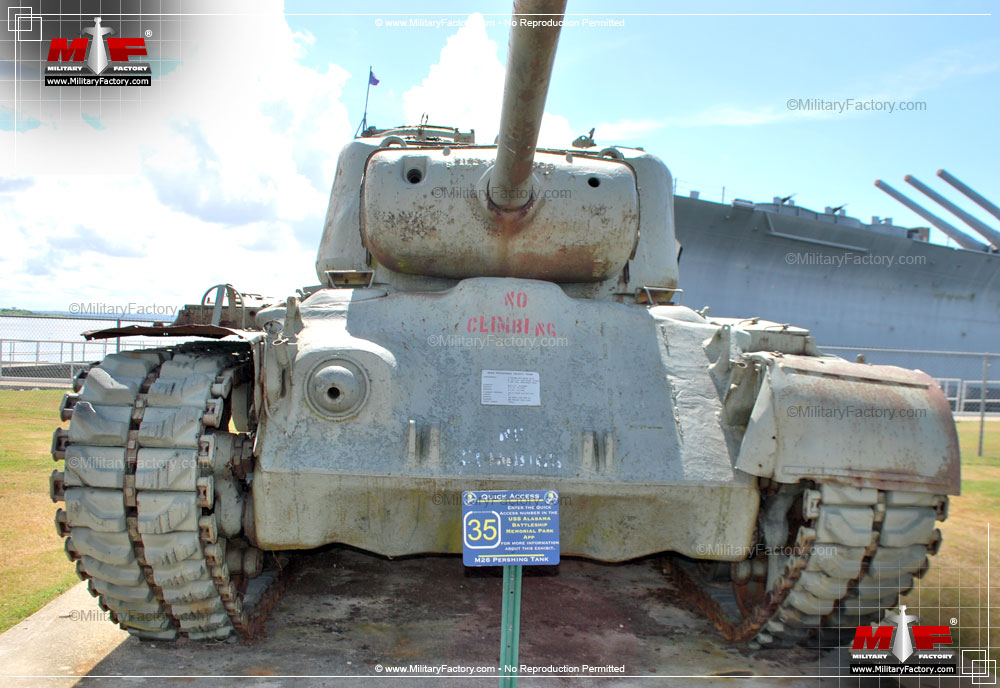
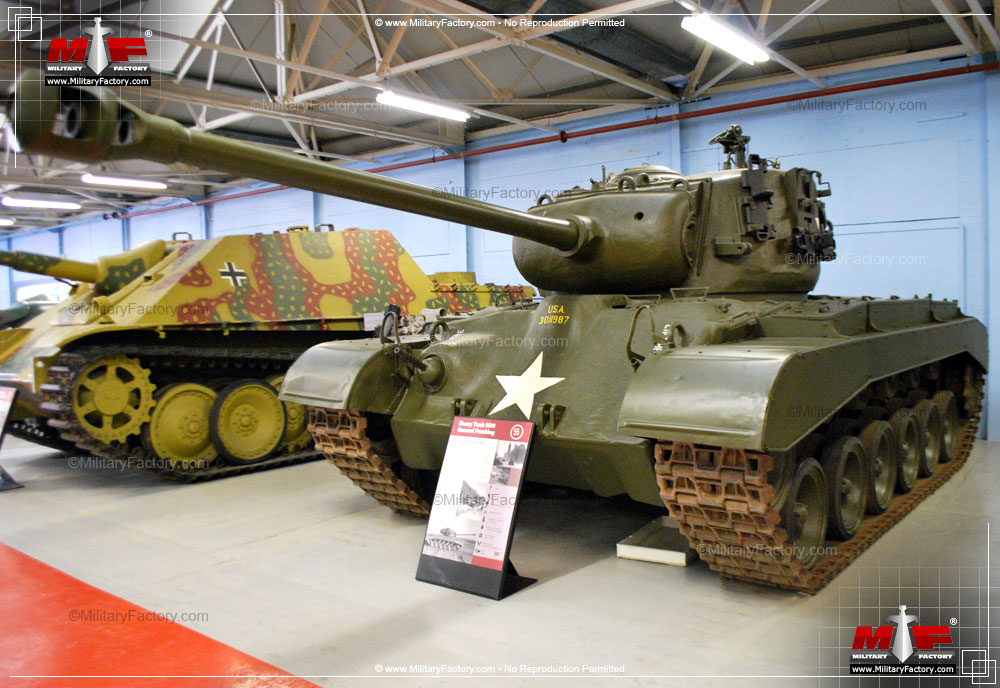
Design work began on a new American heavy tank and considerable effort was then made to develop a gun system capable of competing with the new German tanks. This resulted in several prototypes that were trialed for effectiveness and one prototype (pilot) vehicle, designated as the "T26E3", was formally selected for serial production as the "Heavy Tank M26" with the nickname of "Pershing". The resulting Pershing design was armed with a potent 90mm M3 main gun (this weapon deemed nearly on par with the fabled German 88mm dual-use FlaK / anti-tank gun system). Armor-wise, the M26 Pershing did not disappoint and was thick-skinned compared to the Sherman for maximum protection, particularly along her front facing. The vehicle was crewed by five personnel to include a driver (seated front left hull), a bow-gunner/radio operator (seated front right hull) and a gunner, loader and commander - all seated in the traversing turret. The bow gunner manned a 7.62mm Browning machine gun fitted in a ball mounting with limited arc in the front right of the hull. The gunner managed a coaxially-mounted 7.62mm Browning machine gun fitted alongside the 90mm main gun. This machine gun could be used against targets where the 90mm gun proved too excessive. A single 12.7mm Browning heavy machine gun was fitted atop the turret for use against soft-armored vehicles and low-flying aircraft. 70 rounds of 90mm ammunition could be carried aboard and this was supplemented by 5,000 rounds of 7.62mm ammunition and a further 550 rounds of 12.7mm ammunition. Power-wise, the Pershing was fitted with a Ford GAF 8-cylinder gasoline-fueled engine of 400 to 450 horsepower output allowing top speeds of 25 miles per hour with a 100 mile operational range. Off road performance was considerably less at 5.25 miles per hour. In all, the M26 Pershing weighed in at some 46 tons.
In all, the M26 was the closest tank system that the Allies would field that was similar in scope, function and power to the German Panther. The Panther itself was later labeled as the best "all-around" combat tank of the German Army though the late-war "King Tiger" series was undoubtedly the most potent - lacking only numerical superiority and valuable fuel when attempting to reach its full potential late in the war.
The first M26 Pershings to reach combat theaters arrived in Europe in early 1945. By this time, Germany was fully embroiled in a defensive war along multiple fronts and quickly losing ground by the week - the Soviets were raising hell in the east and the combined Allied contingent was to the west, north and south. In April, Berlin was falling to the Red Army and Hitler committed suicide in his underground bunker. The war in Germany was over in May with the surrender of its military forces conducted by top ranking commanders. The arriving M26 Pershings were delivered simply too late to the theater for any valuable tactical use to be brought about though at least 200 were reportedly on European soil, these with the 3rd and 9th American Armored Divisions and a further 100 examples were being kept in reserve to further bolster strength in the region should they have been needed. Only about twenty M26s would go on to see any sort of combat-related action in all of World War 2 and some M26s attached to the 3rd Armored Division netted themselves a pair of Tiger tanks and a Panther at ranges out to 1,000 yards - a luxury previously afforded only to the latest German tanks. A King Tiger and another Panther were destroyed by "Super Pershings" mounting the developmental T15E1 high-velocity 90mm gun and extra armor near Dessau in early April. Only a few Super Pershings made it to Europe and this was only very late into the war. The Pershing would also form a portion of the Allied armored column crossing the bridge at Remagen over the Rhine River - these arriving under the proud banner of the American 9th Armored Division on March 7th, 1945.
Despite the capitulation of Germany, the Empire of Japan fought on in the Pacific for a few months longer, necessitating the ultimate use of Atomic weapons to end the war. Before that, M26 Pershings arrived in the Pacific Theater and were intended for actions in the invasion of Okinawa against the determined Imperial Japanese Army (IJA). However, as in Europe, these Pershings simply arrived too arrived late to be of any effective use in the grand scheme of the war - a dozen M26s never finishing being offloaded from their amphibious transports at Okinawa before the fighting came to an end. Moreso, the IJA had never fielded competent tanks of medium or even heavy classes and the M4 Sherman seemingly held her ground against such an army - the IJA made much use of outdated light tank classes for the duration of the war.
In the post-war world, M26 Pershing ended up as museum pieces or in storage while a collection served to bolster the NATO defense of Europe from a perceived Soviet invasion during the early phases of the Cold War. Only the United States, Belgium and Italy would ever use the M26 in any true operational form. Variants apart from the T26E3 prototype and M26 initial production models (noted for their use of the M3 gun and a double-baffled muzzle brake) included the M26A1 featuring the M3A1 gun, single-baffled muzzle brake and bore evacuator along the barrel. The M26A1E2 was fitted with the developmental T15E1 main gun (as the "Super Pershing") utilizing single-piece projectiles. The T26E4 was a prototype with the T15E2 main gun and two-piece projectiles. The M26E1 was given the long-barreled T54 gun making use of single-piece projectiles. The M26E2 was completed with a new powerpack and running gear as well as the M3A1 main gun (this evolved to become the M46 "Patton" tank series). The T26E2 was another prototype development armed with the 105mm field howitzer as a self-propelled gun, ultimately becoming the "Heavy Tank M45". The T26E5 was still another developmental form attempting to provide better armor protection with sections as thick as 279mm. For the main production form of the M26 Pershing, the suspension system of choice became a basic torsion type system with Ford engines.
This did not prove the end of the line for the M26, however, for it would go on to see extensive combat actions in the upcoming Korean War (1950-1953). Communist forces from the North - with the blessing of the Soviet Union and China - invaded the South to begin the three-year long conflict on the Korean Peninsula. Initially, progress by the North proved excellent against an ill-prepared UN/US/South Korean contingent. It was not until the allied force got their bearings that a counter attack drove the North Koreas passed the 38th paralellel and into the North. China soon joined the North and drove the allied forces back to the original line before fighting subsided. In the war, the M26 was able to contend well against the fabled Soviet-built T-34/85 - an 85mm armed version of the classic T-34 medium tank that was used to route the German Army from Soviet lands in World War 2. In fact, the M26 acquitted herself quite well in the Korean War, credited with destroying up to half of all T34s engaged. The terrain and accompanying weather was unforgiving and the bravery of M26 crews shown through in the results. It were only highly-modified 76mm-armed M4 Shermans that accounted for the other half of destroyed T34 tanks. Both China and North Korea fielded the Soviet T34 which was made available through a massive Soviet production campaign during World War 2 numbering in the tens of thousands of completed examples. The need for allied tanks proved so great in the Korean War that M26 Pershings were brought back out of storage or uprooted as museum/outdoor displays and prepped for combat.
With the evolution of the battle tank and the arrival of the Main Battle Tank, the M26 Pershing was reclassified as a "Medium Tank". She would, however, prove invaluable to the new generation of American tank designs leaving the drawing boards and influence the multi-generational "Patton" series beginning with the M46 Patton. The M46 was merely a base M26 Pershing design with a new engine, transmission and main gun. This was followed by the M47 (unofficially the "Patton II"), the M48 Patton and culminating in the M60 Patton Main Battle Tank. These tanks spanned the 1950s and 1960s before the arrival of the M1 Abrams in the late 1970s, early 1980s.
The definitive production mark of the Pershing was the simply-titled "M26" mark to which over 2,000 of the type were produced. In all, and including all prototypes and experimental models, it is believed that over 4,550 Pershings were produced.
Power & Performance Those special qualities that separate one land system design from another. Performance specifications presented assume optimal operating conditions for the M26 Pershing Heavy Tank / Medium Tank.
1 x Ford GAF 8-cylinder gasoline-fueled engine developing 500 horsepower driving conventional track-and-wheel arrangement. Installed Power
25 mph 40 kph Road Speed
100 miles 161 km Range
Structure The physical qualities of the M26 Pershing Heavy Tank / Medium Tank.
5 (MANNED) Crew
28.4 ft 8.65 meters O/A Length
11.5 ft 3.51 meters O/A Width
9.1 ft 2.78 meters O/A Height
92,594 lb 42,000 kg | 46.3 tons Weight
Armament & Ammunition Available supported armament, ammunition, and special-mission equipment featured in the design of the M26 Pershing Heavy Tank / Medium Tank.
1 x 90mm main gun in turret.
1 x 12.7mm Anti-Aircraft (AA) machine gun on pintle mounting atop turret.
1 x 7.62mm co-axial machine gun.
1 x 7.62mm bow-mounted trainable machine gun.
AMMUNITION: 70 x 90mm projectiles.
550 x 12.7mm ammunition.
5,000 x 7.62mm ammunition.
Variants Notable series variants as part of the M26 Pershing family line.
T26 - Initial Prototype; single example produced.
T26E1 (M26A1E2) - Fitted with T15E1 90mm high-velocity main gun; single-piece projectiles; 10 examples produced.
T26E2 - Prototype fitted with 105mm field howitzer for use as self-propelled gun platform for close-support actions; becoming the "Heavy Tank M45".
T26E3 - Main Prototype Designation; becoming M26 production model.
T26E4 - Developmental Variant; long-barreled T15E2 main gun; two-piece projectiles; 25 examples produced.
T26E5 - Prototype with revised armor protection; 27 examples produced.
M26 - Main Production Model based on the T26E3 prototype; M3 main gun; double-baffled muzzle brake; over 2,000 examples produced.
M26A1 - Fitted with M3A1 main gun; single-baffled muzzle brake; bore evacuator on barrel; over 1,200 examples produced.
M26E1 - Long-barreled 90mm T54 main gun; single-piece projectiles; 2 examples produced
M26E2 - New powerpack and running gear; fitted with M3A1 90mm main gun; basis for the upcoming M46 Patton tank series; 800 examples produced.
Heavy Tank M45 - Based on the T26E2 prototype; 185 examples produced.
Operators Global customers who have evaluated and/or operated the M26 Pershing. Nations are displayed by flag, each linked to their respective national land systems listing.
Total Production: 4,550 Units Contractor(s): Fisher Tank Arsenal / Detroit Tank Arsenal - USA
[ Belgium; Italy; United States ]
1 / 10
Image copyright www.MilitaryFactory.com; No Reproduction Permitted.
2 / 10
Image copyright www.MilitaryFactory.com; No Reproduction Permitted.
3 / 10
Image copyright www.MilitaryFactory.com; No Reproduction Permitted.
4 / 10
Image copyright www.MilitaryFactory.com; No Reproduction Permitted.
5 / 10
Image copyright www.MilitaryFactory.com; No Reproduction Permitted.
6 / 10
Image copyright www.MilitaryFactory.com; No Reproduction Permitted.
7 / 10
Image copyright www.MilitaryFactory.com; No Reproduction Permitted.
8 / 10
Image copyright www.MilitaryFactory.com; No Reproduction Permitted.
9 / 10
Image copyright www.MilitaryFactory.com; No Reproduction Permitted.
10 / 10
Image copyright www.MilitaryFactory.com; No Reproduction Permitted.
The "Military Factory" name and MilitaryFactory.com logo are registered ® U.S. trademarks protected by all applicable domestic and international intellectual property laws. All written content, illustrations, and photography are unique to this website (unless where indicated) and not for reuse/reproduction in any form. Material presented throughout this website is for historical and entertainment value only and should not to be construed as usable for hardware restoration, maintenance, or general operation. We do not sell any of the items showcased on this site. Please direct all other inquiries to militaryfactory AT gmail.com. No A.I. was used in the generation of this content.