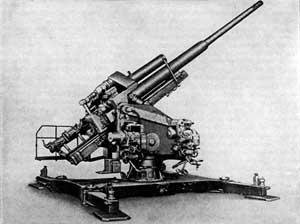
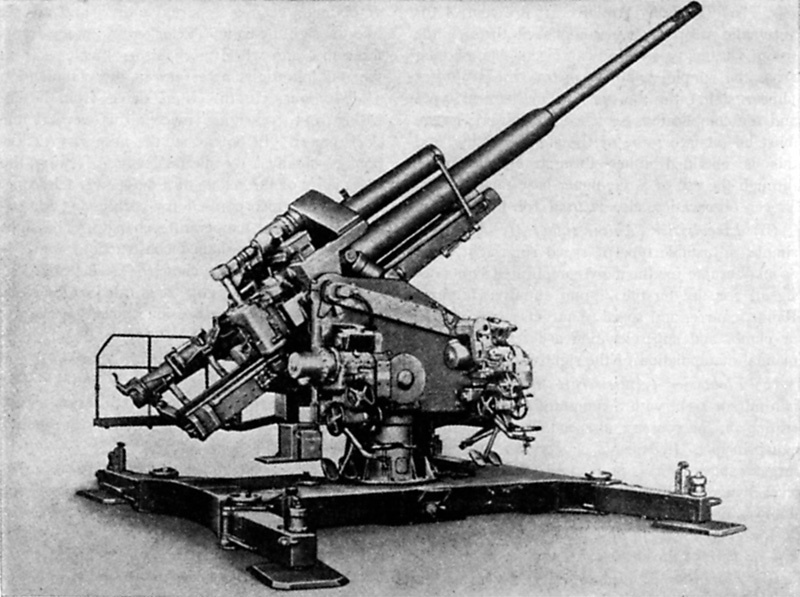
The 128mm FlaK 40 was one of the largest anti-aircraft weapon systems employed by the Germans in World War 2. Design of the type began as early as 1936 under the charge of the Rheinmetall-Borsig concern and then known as the "Gerat 40", intended as an in-the-field gun system for the German Army. Little priority was given to the project initially and a pilot gun was tested in 1937, proving the design sound though heavy and of limited value to the Army and its mobile nature. As such, the weapon was now redirected for the static anti-aircraft role that saw her mounting platform reworked in response. The end result became the "12.8cm FlaK 40", a fine anti-aircraft system that would see combat action in World War 2 while being limited by general availability.
Outwardly, the weapon was designed in the traditional German scope concerning its FlaK gun family. The weapon rotated freely upon a fixed platform that would be bolted into solid ground helping to counter the inherently violent recoil of the massive gun. The barrel was affixed to the gun mount and contained the necessary recoil mechanism and traversing controls. Multiple crew were required to manage the weapon successfully. Overall weight was nearly 37,500lbs while the gun barrel measured in at over 25 feet long. The FlaK 40 fired a 128mm projectile up to 35,000 (perhaps as high as 48,500 feet according to some sources). The crew managed a horizontal sliding breech for loading/reloading with a powered rammer and the recoil mechanism was hydropneumatic in nature. Elevation of the gun was -3 to +88 degrees with a full 360-degree traversal possible. The muzzle velocity was rated at 2,887 feet per second which allowed the weapon the capability it needed to respond in shorter order than previous German FlaK gun offerings (even the fabled "88"). Production of FlaK 40 guns began in 1942 to which they began to enter service that same year. The weapon proved costly and complicated to manufacture in great numbers so deliveries were slow and overall numbers would ultimately be limited.
While the FlaK 40 was typically utilized on its static carriage system, production was already under way of six "mobile" versions, these mounted atop multiple-axle transport carriages to help content with the massive weapons weight over distances. Despite their mobile classification, these examples still proved heavy and cumbersome to maneuver with any great haste. It came to be that the weapon was eventually dismantled between two loads for transport but even this method was equally time consuming and impractical, forcing the Germans to revert back to the original single-load process for transporting the weapon.
Due to the heavy nature of the weapon system as a whole, the FlaK 40 was eventually settled as a static gun emplacement along few - though critical - airspace routes throughout the Reich. Berlin and Vienna were two such locales protected FlaK 40 guns and even then some of these weapons had specially constructed towers designed to manage their weight and take on even greater vantage points. To compensate for the FlaK 40s limited tactical value, engineers eventually managed a railcar variant that supplied only limited additional mobility.
As the Allied bombing campaign (day and night) was taking an ever increasing toll on German war-making capacities, a twin-gun variant was also developed and these were designated as "12.8cm FlaK 40 Zwilling". These were essentially the same class of weapon though completed with two side-by-side 128mm gun barrels, appropriate fire control systems and dual loading facilities all fitted to the original mount. Production of this form also began in 1942 to which some 34 examples were available by February of 1945. Again, the sheer weight and complexity of these systems made their availability limited and, thusly, they were utilized strictly around key Reich centers.
One final FlaK 40 alternative became the "12.8cm PaK 40" gun system. This was an anti-tank evolution of the FlaK 40 intended to arm the new "Sturer Emil" tracked heavy tank destroyers. However the Rheinmetall design lost out to a Krupp submission after evaluation. Regardless, only two Sturer Emil prototypes were completed before the end of the war in May of 1945.
In all, 1,125 FlaK 40 systems were produced between 1942 and 1945.
Power & Performance Those special qualities that separate one land system design from another. Performance specifications presented assume optimal operating conditions for the 12.8cm FlaK 40 Towed Anti-Aircraft Artillery.
None. This is a towed artillery piece. Installed Power
7 miles 11 km Range
Structure The physical qualities of the 12.8cm FlaK 40 Towed Anti-Aircraft Artillery.
8 (MANNED) Crew
25.6 ft 7.8 meters O/A Length
37,479 lb 17,000 kg | 18.7 tons Weight
Armament & Ammunition Available supported armament, ammunition, and special-mission equipment featured in the design of the 12.8cm FlaK 40 Towed Anti-Aircraft Artillery.
1 x 128mm main gun barrel
AMMUNITION: Dependent upon ammunition carrier.
Variants Notable series variants as part of the 12.8cm FlaK 40 family line.
12.8cm FlaK 40 - Base Series Designation
Operators Global customers who have evaluated and/or operated the 12.8cm FlaK 40. Nations are displayed by flag, each linked to their respective national land systems listing.
Total Production: 1,125 Units Contractor(s): Rheinmetall-Borsig - Nazi Germany
[ Nazi Germany ]
1 / 1
View of the 12.8cm FlaK 40 anti-aircraft artillery system
Going Further... The 12.8cm FlaK 40 Towed Anti-Aircraft Artillery appears in the following collections:
The "Military Factory" name and MilitaryFactory.com logo are registered ® U.S. trademarks protected by all applicable domestic and international intellectual property laws. All written content, illustrations, and photography are unique to this website (unless where indicated) and not for reuse/reproduction in any form. Material presented throughout this website is for historical and entertainment value only and should not to be construed as usable for hardware restoration, maintenance, or general operation. We do not sell any of the items showcased on this site. Please direct all other inquiries to militaryfactory AT gmail.com. No A.I. was used in the generation of this content.