The Canon de 155 C modele 1917 Schneider was a standardized French Army heavy field howitzer receiving its baptism of fire in World War 1, seeing extensive combat service in World War 2 and made its way to several major world military inventories including that of the United States and Imperial Russia / Soviet Union. The weapon was born of the earlier M1915 series guns that were forced to evolve with the changing requirements of war during World War 1. Amazingly, some modern foreign units still train on their trusty M1917 guns for the weapon went on to see widespread circulation particularly after the First World War.
Origins of the M1917 lay in the preceding M1915 design. The M1915, known formally as the "Canon de 155 C modele 1915 Schneider", was (as its designation suggests) adopted in 1915 through the French Army. The M1915 was, itself, based on a previous Schneider design centered around a 152mm projectile. The M1915 was chambered for a massive 155mm projectile and the entire system constituted the barrel, breech with hydro-pneumatic recoil mechanism and gun shield mounted to a wheeled carriage, the latter to facilitate transport by pack animal (as many as eight horses were required). The weapon operated through an interrupted screw-type breech opening to which was fed the shell and then the separate brass cartridge case containing the propellant charge. Operational range was 2,700 yards which categorized the M1915 as long-range artillery in French Army service.
In June of 1914, Archduke Franz Ferdinand of Austria was assassinated by Yugoslav nationalist Gavrilo Princip and it was this single event that sparked the beginning of World War 1 as old-held alliances came into play against long-standing grudges. The Austro-Hungarian Empire declared war on Serbia to which the Russian Empire mobilized in its defense, prompting the German Empire to declare war on Russia. When the Germans crossed into Belgium and Luxembourg in an attempt to neutralize France, the United Kingdom declared war on Germany. Italy eventually sided with the Allies while the Austro-Hungarian Empire, the German Empire and the Ottoman Empire (Turkey) formed the "Central Powers". The United States would later join the war in 1917 and play a more critical role into 1918, the final year of the conflict. By the end of 1914, the once-fluid fronts had descended into a stalemate of trench networks to begin the bloody business of "Trench Warfare" and all the physical and psychological horrors that go along with it (trenchfoot, shellshock, mustard gas, etc...).
With France now committed to open war against its neighbors, all manner of weapons were pressed into action including M1915 artillery. As the war progressed, stores of 155mm ammunition were proving expensive to keep in large supply and the brass used in their manufacture was a sought after commodity elsewhere. This prompted a change to bagged powder instead of the original brass cartridge cases. However, the M1915 was ill-equipped to handle the new ammunition scheme and Schneider was charged with reworking the breech system to accept it. Breeches were taken from existing Canon de 155mm GPF field guns and mated to the existing barrels and carriages of the M1915 series. Manufacture of the guns proceeded as a slower pace than expected which assured that the guns, in their new forms, would not enter service in the required numbers until 1917 and this gave rise the "Canon de 155 C modele 1917 Schneider" designation - or "M1917" for short.
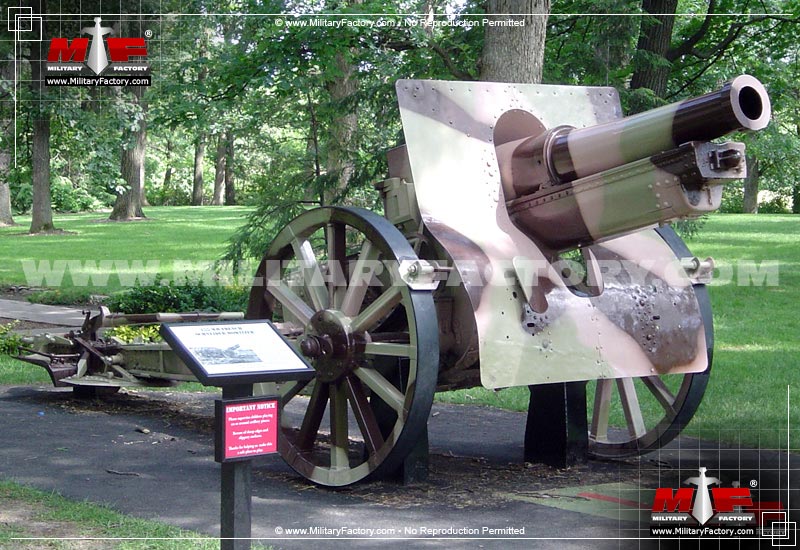
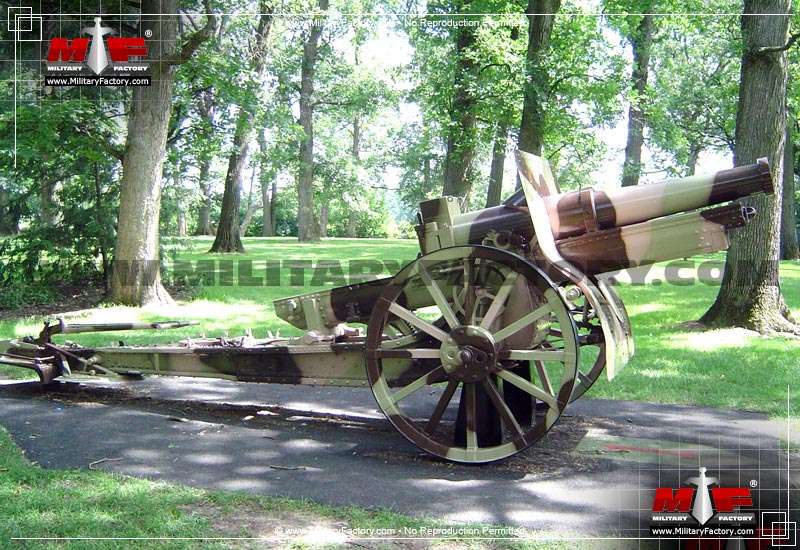
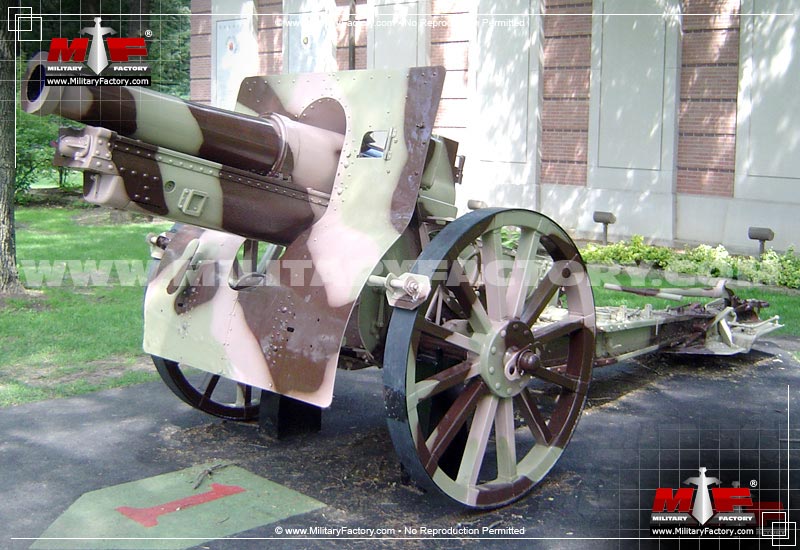
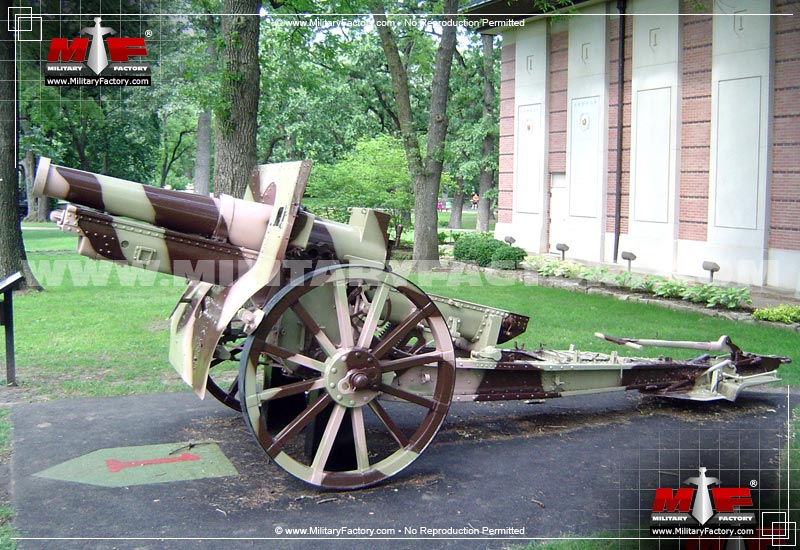
Total production eventually netted some 3,000 M1917 guns between late-1916 and into 1918 and these followed the earlier M1915 versions in both form and function, able to utilized the 155mm projectile fired from a proven breech and barrel combination. The weapon still resided on a twin steel-wheeled, multi-spoked mounting which allowed for on-the-spot traversal by the gunnery crew and long-range transport by pack animals. The breech was set behind a thin curved armor shield intended to protect the crew from head-on small arms fire and shell splinters. The large recoil mechanism remained under the barrel and allowed the gun to be fired without having the entire system recoil out of position rearwards, thusly forcing the gunnery crew to realign the weapon against the target area (a common detriment to older field guns). As a field howitzer, the M1917 lobbed its explosives through both direct and indirect line-of-sight fire fired from behind the frontlines. The barrel was of a noticeably short design which made the heavy weapon somewhat compact and no muzzle brake of any sort was fitted. a loading tray (this sometimes removed) was fitted to the rear of the breech. Tow arms were joined when the howitzer was in transport and spread out and down when the weapon was made ready to fire. Some later forms appeared with rubber tires and flat-faced shields by 1918.
The M1917 weighed in a 7,300lbs and sported a barrel length of just over seven feet. Each 155mm shell weighed in at 100lbs. The barrel could elevate through 0- and 42-degrees with a limited 6-degree traversal before the crew was required to twist the weapon on its wheels. A trained and experienced gunnery crew could loose up to three rounds per minute for the sustained fire role. This was useful in softening up key target areas of infantry and machine guns prior to a massive offensive. Each projectile exited the barrel at a timely 1,500 feet-per-second out to a maximum range of 12,400 yards.
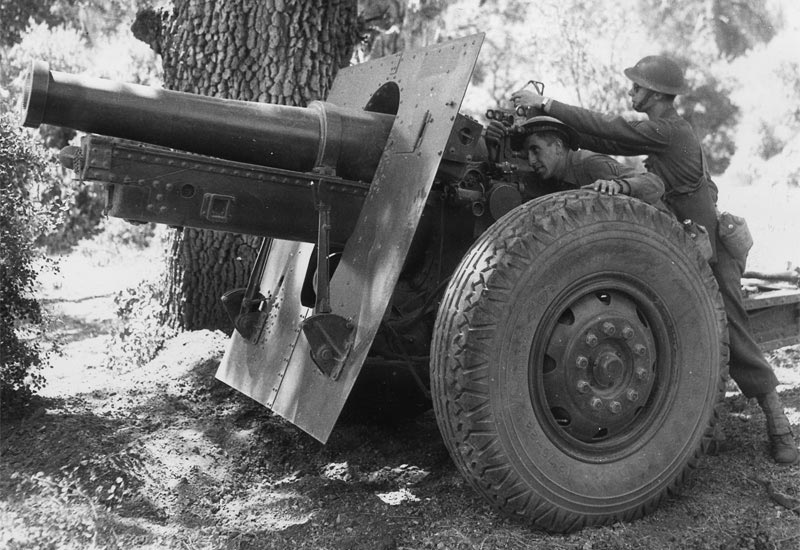
The M1917 proved the more practical weapon and earlier M1915 guns soon saw the same reworked breech mechanism of the M1917 installed. Such guns formed the standard heavy field howitzer of many an army during the conflict. When the Americans arrived in France, they took on stocks of the French guns and state-side production introduced the "M1918" with its rubber tires and the aforementioned flat-faced shield though these models were adopted too late to see action in Europe. They did, however, remain in the American inventory well into the 1930s and 1940s, seeing action in World War 2. other World War 1 recipients of the French gun became Belgium, Italy and the Russian Empire. World War 1 ended with the Armistice in November of 1918.
After the war, the M1917 saw all manner of use throughout foreign lands including Argentina, Australia, Bolivia, Finland, Greece, Poland, Spain and Yugoslavia. Its reach was such that the weapon was still in wide circulation by the time of World War 2. Enough French units still equipped the type during the Battle of France that the conquering Germans reconstituted captured examples under the German Army designation of 15.5cm sFH 414(f) ("f" used to indicate their French origins). Similarly, after the offensive rush into the Soviet Union by German forces in 1941 during "Operation Barbarossa", captured Soviet M1917 guns were marked under the 15.5cm sFH 449(r) designation ("r" used to indicate their Russian origins). After the surrender of Italy in September of 1943, the Germans reused ex-Italian systems under the 15.5cm sFH 414(i) designation. Captured Polish samples after the German/Soviet conquer of 1939 saw a similar fate as the 15.5cm sFH 17(p). Many also found their way to Hitler's famed "Atlantic Wall" defense network situated along the coast facing Britain. American ground forces were still in possession of their M1918 series guns and managed these in service until the end of the conflict in 1945.
By all accounts, the M1917, and her presented variants, gave a good showing through two major world conflicts and appeared as a stalwart system through many "lesser" ones. Both sides of the Spanish Civil War (1936-1939) made use of the type and modern Argentine and Bolivian artillery sections still train on their M1917s - a testament to their timeless design and reliability.
Power & Performance Those special qualities that separate one land system design from another. Performance specifications presented assume optimal operating conditions for the Canon de 155 C modele 1917 Schneider Heavy Field Howitzer.
None. This is a towed-artillery piece. Installed Power
7 miles 11 km Range
Structure The physical qualities of the Canon de 155 C modele 1917 Schneider Heavy Field Howitzer.
6 (MANNED) Crew
7.1 ft 2.176 meters O/A Length
7,275 lb 3,300 kg | 3.6 tons Weight
Armament & Ammunition Available supported armament, ammunition, and special-mission equipment featured in the design of the Canon de 155 C modele 1917 Schneider Heavy Field Howitzer.
1 x 155mm main gun barrel.
AMMUNITION: Dependent upon ammunition carrier.
Variants Notable series variants as part of the Canon de 155 C modele 1917 Schneider family line.
Canon de 155 C modele 1917 Schneider - Formal Designation.
C17S - French Army Designation
155mm Howitzer Carriant, Model of 1917 (Schneider) - US Army Designation
155mm Howitzer Carriant, Model of 1918 (Schneider) - USA Army Designation
15.5cm sFH 449(r) - German Army designation of captured Soviet samples during WW2.
152 H/17 - Finnish Army Designation
Haubica 155mm wz. 1917 Schneider - Polish Army Designation.
15.5cm sFH 17(p) - German Army designation of captured Polish samples during WW2.
Obus Schneider L.30.05 modelo 1928 calibre 155mm - Argentine Army designation
15.5cm sFH 413(b) - German Army designation of captured Belgian samples during WW2.
Obice da 155/14 PB - Italian Army Designation
15.5cm sFH 414(i) - German Army designation of captured Italian samples during WW2.
Operators Global customers who have evaluated and/or operated the Canon de 155 C modele 1917 Schneider. Nations are displayed by flag, each linked to their respective national land systems listing.
Total Production: 3,020 Units Contractor(s): Schneider et Cie - France / State Arsenals - United States
[ Argentina; Australia; Belgium; Bolivia; Finland; France; Greece; Kingdom of Italy; Nazi Germany; Poland; Russia; Spain; United States; Yugoslavia ]
1 / 6
Image copyright www.MilitaryFactory.com; No Reproduction Permitted.
2 / 6
Image copyright www.MilitaryFactory.com; No Reproduction Permitted.
3 / 6
Image copyright www.MilitaryFactory.com; No Reproduction Permitted.
4 / 6
Image copyright www.MilitaryFactory.com; No Reproduction Permitted.
5 / 6
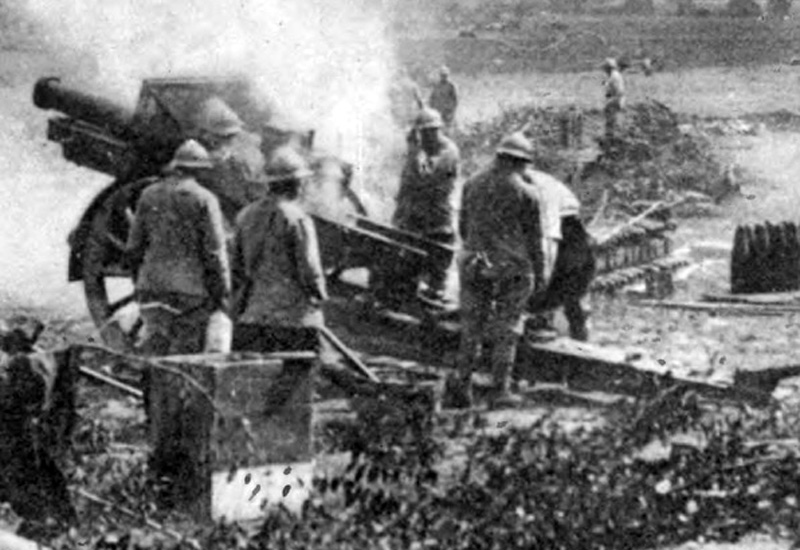
A French gunnery crew manages their Canon de 155 C modele 1917 field howitzer during combat
6 / 6
An American gunnery crew prepares their M1918 field howitzer
The "Military Factory" name and MilitaryFactory.com logo are registered ® U.S. trademarks protected by all applicable domestic and international intellectual property laws. All written content, illustrations, and photography are unique to this website (unless where indicated) and not for reuse/reproduction in any form. Material presented throughout this website is for historical and entertainment value only and should not to be construed as usable for hardware restoration, maintenance, or general operation. We do not sell any of the items showcased on this site. Please direct all other inquiries to militaryfactory AT gmail.com. No A.I. was used in the generation of this content.