Realizing their tank force was largely inadequate in dealing with Allied armor across the Pacific Campaign, the Imperial Japanese Army (IJA) enacted a new program to produce an increasingly capable design to counter the 30-ton American M4 Sherman appearing in ever greater numbers. As the direct "M4 Sherman-Counter" - the 30-ton Type 4 "Chi-To" - was inevitably delayed, work began on modifying the existing 15-ton Type 97 "Chi-Ha" as an interim measure. The original Type 97 was born out of a mid-1930s requirement and entered production in 1938, seeing 1,162 examples completed until 1943. The design ended up being lightly armed (57mm Type 97 main gun) and lightly armored (8mm to 26mm), making it highly susceptible to all manner of anti-tank measures employed by the Allies. With these limitations in mind, work progressed on the improved design in 1943 as losses across Japanese-held territories began to mount.
The ubiquitous American M4 Sherman managed armor protection (up to 76mm) and main armament (either 75mm or 76mm) that grossly overshadowed that as appearing in any of the current Japanese designs of the time. Selecting the Type 97 was a logistically-friendly initiative which would allow the IJA to field a complementary tank system until the Type 4 could be brought online in force. The modified Type 97, designated as the Type 3 "Chi-Nu" thusly retained the original running gear and hull though the selection of the 75mm Type 3 (a modified form of the Type 90 Field Gun) required an all-new turret. The end-product looked a bit more modern than previous IJA attempts but still showcased design features of an age gone by - particularly the tall side profile the vehicle promoted.
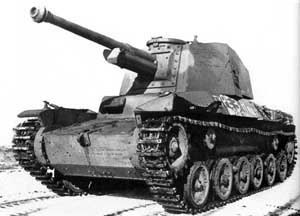
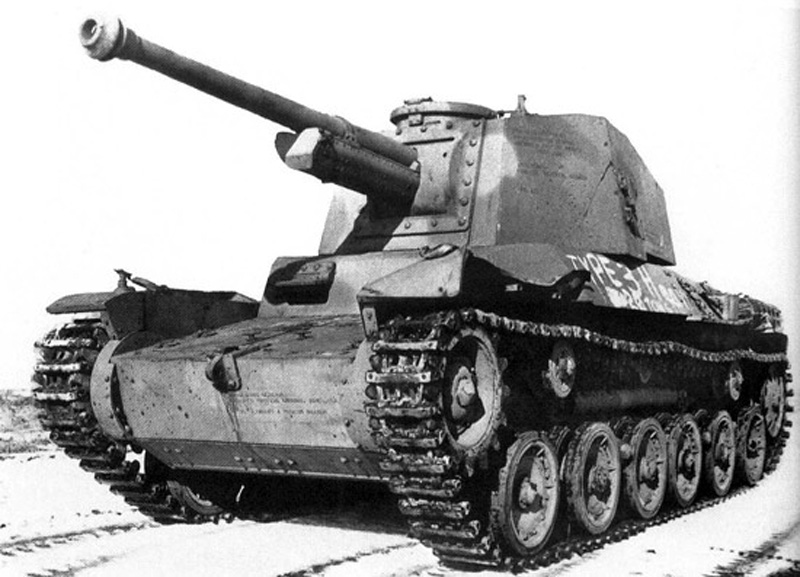
The Type 3's outward design was conventional in all respects. The running gear consisted of a thin track linkage system running about a six-wheeled, double-tired road system with the drive sprocket at the front of the hull and the track idler at the rear. Two track return rollers were present. The hull was basic in its design with a sloped glacis plate leading up to the short hull superstructure and the engine was installed at the rear. The central portion of the hull was allocated to the fighting compartment which was made home to the turret bustle, applicable systems and ammunition stowage. The driver managed his position from the front right of the vehicle with limited vision through a slotted hinged port. A bow machine gunner was to his left. The turret sat atop the hull superstructure and its design was such that it proved an awkward-looking beast, tall in its basic profile with angled panels making up the six sides. The large main gun barrel protruded from the front turret panel with the recoil mechanism set under the base of the barrel. The barrel was further capped by a short muzzle brake. A commander's cupola was noted at the right side of the turret roof. The turret managed an elevation between -10 and +25 degrees and could engage targets through 360-degrees traversal. The main gun was rather noteworthy as Japanese tank designs go for its 2,200 feet per second muzzle velocity allowed for good penetration of 90mm of armor out to 100 meters - the weapon becoming the largest caliber gun ever installed on a Japanese Army tank during the whole of the war. Self-defense armament was through the bow-mounted 7.7mm Type 97 machine gun and nothing more. Armor protection was between 12mm and 50mm in thickness across the various facings, thicker armor allocated to the frontal regions in a conventional manner. The vehicle was crewed by five personnel including the driver, commander, bow gunner, gunner and loader.
Power for the Type 3 was through a Mitsubishi Type 100 series V-12 diesel-fueled engine providing 240 horsepower at 2,000rpm. The selection of diesel-fuel limited combustion of the tank when directly hit by enemy fire. Combined with the bell crank suspension system retained from the Type 97 design, the 18-ton vehicle was granted a top road speed of 39 km/h with an operational range out to 210 kilometers - suitable for keeping up with a main mechanized force.
Despite the logistical friendliness of the project, wartime resources and attention were tied to other, more critical, programs of the time and, thusly, the Type 3 languished in a holding pattern for some time. It was only in 1944 that approval had been given to begin serial production and, by this time, whatever strategic advantage had been gained by the Japanese military in the years prior was all but lost - her air power and naval force slowly being ebbed away by British, American and Allied forces in turn. As such, the Type 3 joined the many other late-war Japanese developments called to the defense of the homeland against the presumed Allied invasion still to come. Some 166 Type 3 tanks were produced and production continued up to the time of the Japanese surrender in August of 1945. However, its limited numbers meant that the Type 3 would never be allowed to engage enemy armor directly during the remaining months of the war. The formal Japanese surrender occurred in early September, bringing about the official end of World War 2 (the war in Europe had concluded in May of 1945). Despite the novel attempt, IJA Type 3 "Chi-Nu" would never directly square off against its intended American M4 Sherman foe, its history cut short by the surrender.
Power & Performance Those special qualities that separate one land system design from another. Performance specifications presented assume optimal operating conditions for the Type 3 Chi-Nu Medium Tank.
1 x Mitsubishi Type 100 V12 diesel-fueled engine developing 240 horsepower at 2,000rpm driving a conventional track-and-wheel arrangement. Installed Power
24 mph 39 kph Road Speed
130 miles 210 km Range
Structure The physical qualities of the Type 3 Chi-Nu Medium Tank.
5 (MANNED) Crew
18.5 ft 5.64 meters O/A Length
7.9 ft 2.41 meters O/A Width
8.8 ft 2.68 meters O/A Height
40,124 lb 18,200 kg | 20.1 tons Weight
Armament & Ammunition Available supported armament, ammunition, and special-mission equipment featured in the design of the Type 3 Chi-Nu Medium Tank.
1 x 75mm Type 3 main gun.
1 x 7.7mm Type 97 machine gun in hull.
AMMUNITION: Not Available.
Variants Notable series variants as part of the Type 3 Chi-Nu family line.
Type 3 Chi-Nu - Base Series Designation; based on the chassis and hull of the preceding Type 97 Medium Tank family.
Operators Global customers who have evaluated and/or operated the Type 3 Chi-Nu. Nations are displayed by flag, each linked to their respective national land systems listing.
Total Production: 166 Units Contractor(s): Mitsubishi - Imperial Japan
[ Imperial Japan ]
1 / 1
Image from the Public Domain.
Going Further... The Type 3 Chi-Nu Medium Tank appears in the following collections:
The "Military Factory" name and MilitaryFactory.com logo are registered ® U.S. trademarks protected by all applicable domestic and international intellectual property laws. All written content, illustrations, and photography are unique to this website (unless where indicated) and not for reuse/reproduction in any form. Material presented throughout this website is for historical and entertainment value only and should not to be construed as usable for hardware restoration, maintenance, or general operation. We do not sell any of the items showcased on this site. Please direct all other inquiries to militaryfactory AT gmail.com. No A.I. was used in the generation of this content.