At the end of World War 1, the German war machine was dismantled - losing its power to manufacture aircraft, tanks, submarines and most other instruments of war. Throughout the 1920s and into the 1930s, there grew a new movement which felt the humiliation wrought onto the German nation by the victors of the conflict. The movement soon encompassed all of German life and allowed leader Adolf Hitler to assume control of the economically depressed populace. The war machine soon grew outside of the limitations of the Versailles Treaty imposed upon the Germans following World War 2. Tanks were being produced under the guise of farming tractors while the burgeoning German air force -the Luftwaffe - was secretly training its pilots on gliders. With the arrival of the Spanish Civil War, all was fair game and the German war machine received its first taste of real combat on all-new developments - Panzers, Messerschmitt, Stukas - all played a major role in developing the German doctrine of "Lightning War", an overwhelming military thrust using coordinated assaults from land and air.
However, as the German military might grew the reach of the German military was surely to be tested. Considering the aspirations that Hitler maintained for his conquest of Europe - beginning with Poland and ending with the United Kingdom and Soviet Union - the problem was going to be a sound logistical force capable of bringing men, weapons and supplies from one point to another. By the late 1930s, the German military inventory boasted a plethora of such "mover" vehicles but there was not the universal solution as required of war. The task of consolidation would fall to General von Schell who proceeded to deliver an ambitious plan to bring the number of German military logistical vehicles to a quarter of the original offering, each solution categorized by role and weight class.
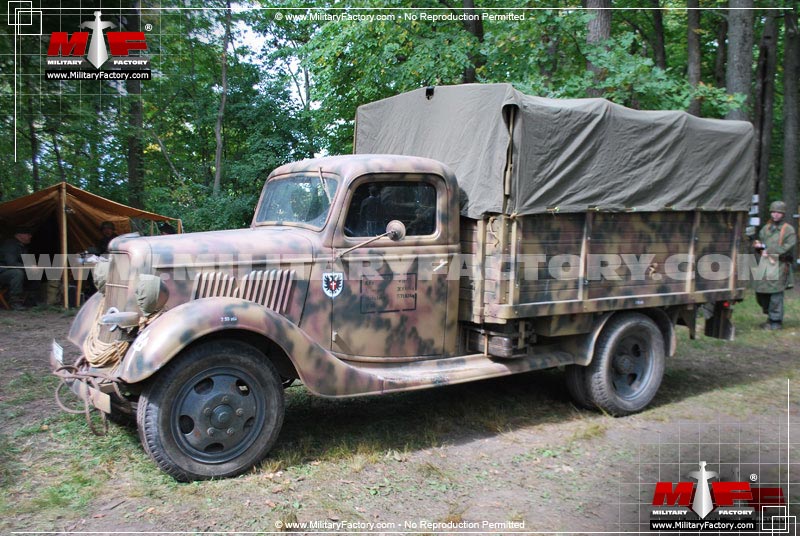
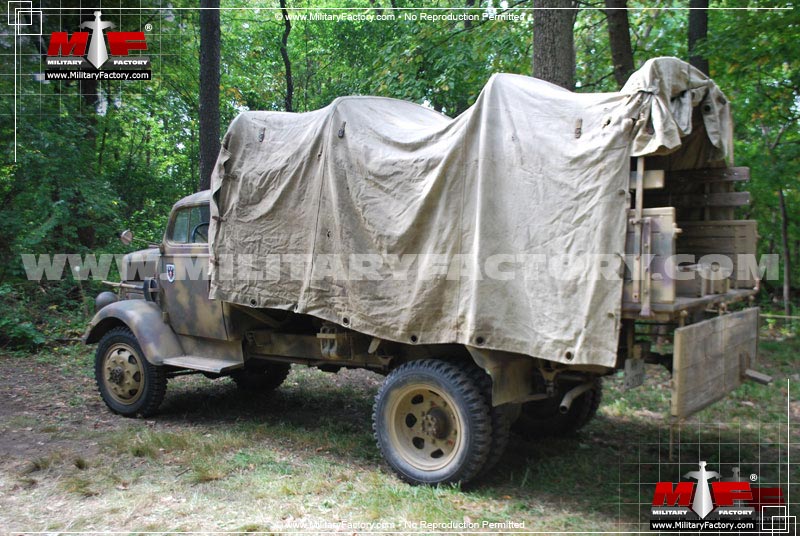
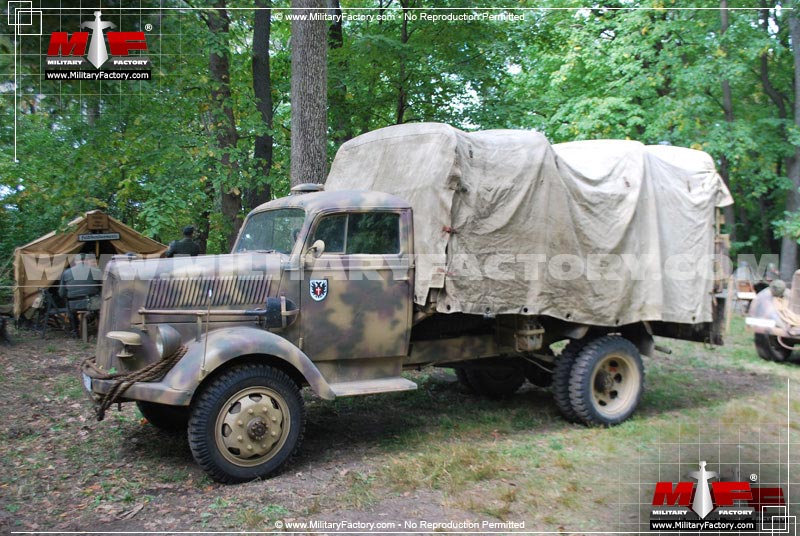
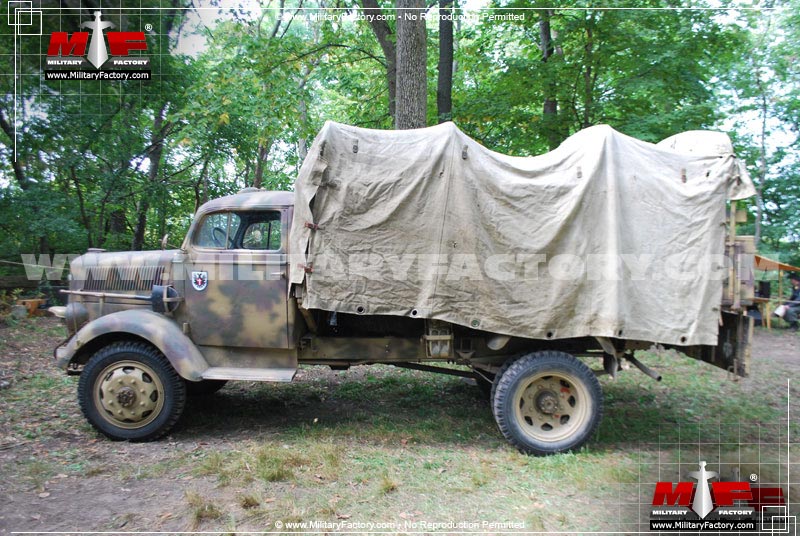
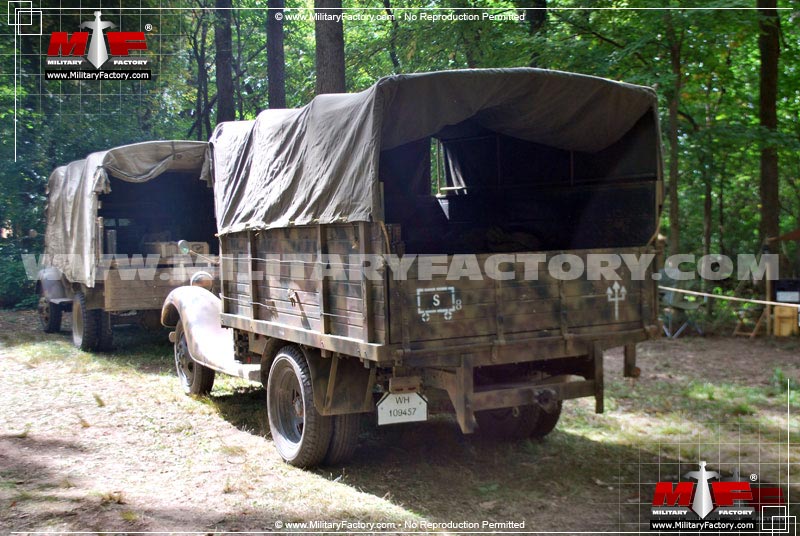
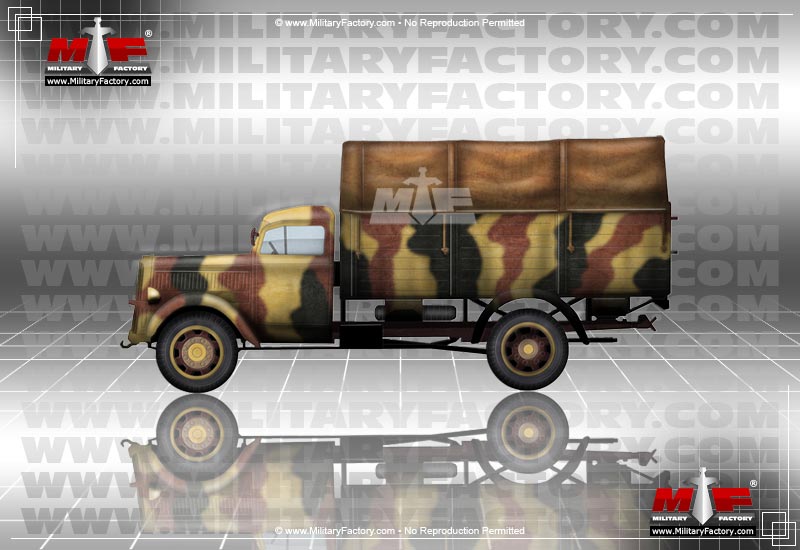
The German concern of Opel AG produced a prime mover choice as a medium utility vehicle that would come to be known as the "Blitz". The basic 4x2 chassis would be evolved into a myriad of useful battlefield roles beyond the standard transport model. The vehicle could be charged with moving supplies, ammunition, medical litters, combat ready troops, general passengers, artillery shells, fuel stores, laundry, mobile field shops, gun carriers and the like. Additionally, the truck could be converted to more military-minded forms as radio stations, command posts and mobile offices for higher-ranking officials. The Opel Blitz design was a conventional system - fitting six wheels (the rear axle wheels doubled as pairs), a forward-set engine compartment with the driver's cab directly aft and a rear-set cargo/passenger area. The cab was windowed on all sides with hinged automobile-style doors for easy entry/exit. Construction was of pressed steel for the metal components and wood for the body while the two-speed transmission system featured no fewer than ten forward gears. These 4x2 forms were further known under the general designation of "Typ S" to categorized their 4x2 wheel nature.
However, the 4x2 wheel arrangement of the early Opel trucks left cross-country performance something to be desired. For the discerning military customer, there emerged a 4x4x form which included all-wheel drive performance (now adding the front axle to the mix) guaranteed provide for better off-road traction and speed. The wheelbase of the original truck design was also further shortened by nearly six engines to provide for better road grip. The 4x4 versions were further categorized in the German inventory under the blanket "Typ A" assignment to signify their 4x4 nature. Additionally, these particular vehicle forms were also known as "Allrad" vehicles for the same reason.
Utility trucks such as the Opel were in great demand, particularly as the nature of war ramped up. Production began in 1937 and proceeded into 1944 to which some 70,000 2x4 Opel "Blitz" trucks were delivered out of German factories. Even Daimler-Benz was ordered to produce the type in its original form, ending production of its own competing 3-ton class truck version. The total was further added to by the arrival of at least 25,000 of the 4x4 type trucks in that span. Sources variably state that overall production of Blitz units was in the vicinity of 82,000 to 130,000 vehicles. In 1944, a standardized German Army version was delivered, this without any Opel company markings on the truck and known as the "DB 701". A 1.5-ton version of the Opel was also recognized during its production run.
The Opel Blitz was powered by a single Opel-brand 6-cylinder gasoline engine developing upwards of 75 horsepower, which proved quite reliable in the field and a 4-cylinder version of 68 horsepower was said to be quite modular between other 4-cylinder engine types. The 6-cylinder installation allowed the vehicle a top road speed of approximately 50 miles per hour with a range out to 255 miles. The vehicle weighed in at 4,600lbs and could be charged with a cargo load of p to 7,250lbs if need be - of course more when pushed in war. The Blitz (its basic production form) measured a running length of 19 feet, 9 inches, with a width nearing 7.5 inches and an overall height of just over 7 feet. During normal and heavy-handed operation, the Opel product proved easy to operate and maintain in hot, cold and overly rugged environments.
It was not a hugely common occurrence for Opel trucks to be armed but in some instances it proved a necessity. In these cases, the truck could be self-defensed by the fitting of a machine gun or cannon to protect from air attacks, these in addition to any of the crew-served weapons generally being supplied to logistical personnel.
The Opel Blitz series maintained a stout presence throughout the war for wartime Germany. The vehicle was a fixture wherever the military needed to operate - be it in North Africa, the Western Front or the Eastern Front. Undoubtedly, caravans of these machines became fodder to low-flying Allied strike aircraft whose sole mission was to target German supply chains. Perhaps the biggest blow to the future of the Opel series was in the results of the heavy Allied bombardment campaigns which saw fit to disrupt all manner of war time production for German industry. Along with this campaign came a shortage of parts and completed machines. While Opel Blitz trucks enjoyed truly high production numbers, by 1945, such production was something of an impossibility for German industry. As such, production towards the end of the war was rather stifled compared to the early years.
Opel Blitz trucks were extensively used across all Fronts. Despite their 4x4 nature, the Soviet winter along the East Front brought the German offensives to a standstill, enough for the Soviet military to recover and regroup in a counter-offensive soon to come. The great winter freeze was even enough to stop the fabled Panzer divisions in their tracks as well as the mule Blitz trucks the German Army depended on. When the snow thawed, similar problems emerged with the vast amounts of soft ground and mud which made movements slow and dangerous.
One key development to help overcome the treacherous going along the East Front was the "Maultier" ("Mule") which essentially proved to be a mating of the Opel chassis (including front wheeled axle) with the track system of the Panzer I light tank acting as the rear drive power. The Panzer 1 had run its course as a viable tank option for the German Army and uses for its existing chassis, weapon systems and tracks were numerous. To compensate for the Opel truck chassis, the drive shaft was shortened somewhat while the axle was relocated more forward. The end result was a rather competent all-purpose, track-driven mover that countered the mess of the Russian Winter to the German's delight. The success of the Maultier in its early showings across the East Front soon made it a fixture in the German inventory for the duration of the war.
Opel continued production of their Blitz trucks even in the years following the end of the war - such was its value to a rebuilding Germany. The most common form of the Opel Blitz found on World War 2 battlefields was formally designated as the "Opel Blitz 6700A".
Power & Performance Those special qualities that separate one land system design from another. Performance specifications presented assume optimal operating conditions for the Opel Blitz Military Utility Truck.
1 x Opel 6-cylinder gasoline-fueled engine developing 74 horsepower driving conventional 4-wheeled arrangement. Installed Power
50 mph 80 kph Road Speed
255 miles 410 km Range
Structure The physical qualities of the Opel Blitz Military Utility Truck.
2 (MANNED) Crew
19.8 ft 6.02 meters O/A Length
7.4 ft 2.265 meters O/A Width
7.1 ft 2.175 meters O/A Height
4,630 lb 2,100 kg | 2.3 tons Weight
Armament & Ammunition Available supported armament, ammunition, and special-mission equipment featured in the design of the Opel Blitz Military Utility Truck.
Usually none. Crew-served personal weapons if carried. Occasionally armed with 7.92 machine guns, 20mm or 37mm cannons for anti-aircraft protection (including Maultier vehicle forms).
AMMUNITION: Not applicable. Dependent upon armament (if any).
Variants Notable series variants as part of the Opel Blitz family line.
Opel Blitz - Base Series Designation; 1.5-ton and 3-ton forms; 70,000 examples produced in 4x2 form.
Opel Blitz 6700A "Allrad" - 4x4 all-wheel drive models; 25,000 examples produced.
Opel "Maultier" ("Mule") - Opel truck chassis and forward axles coupled with track systems of obsolete Panzer I light tanks.
DB 701 - German Army Designation for 1944 production versions lacking any Opel markings.
Operators Global customers who have evaluated and/or operated the Opel Blitz. Nations are displayed by flag, each linked to their respective national land systems listing.
Total Production: 95,000 Units Contractor(s): Opel - Nazi Germany
[ Nazi Germany ]
1 / 6
Image copyright www.MilitaryFactory.com; No Reproduction Permitted.
2 / 6
Image copyright www.MilitaryFactory.com; No Reproduction Permitted.
3 / 6
Image copyright www.MilitaryFactory.com; No Reproduction Permitted.
4 / 6
Image copyright www.MilitaryFactory.com; No Reproduction Permitted.
5 / 6
Image copyright www.MilitaryFactory.com; No Reproduction Permitted.
6 / 6
Image copyright www.MilitaryFactory.com; No Reproduction Permitted.
The "Military Factory" name and MilitaryFactory.com logo are registered ® U.S. trademarks protected by all applicable domestic and international intellectual property laws. All written content, illustrations, and photography are unique to this website (unless where indicated) and not for reuse/reproduction in any form. Material presented throughout this website is for historical and entertainment value only and should not to be construed as usable for hardware restoration, maintenance, or general operation. We do not sell any of the items showcased on this site. Please direct all other inquiries to militaryfactory AT gmail.com. No A.I. was used in the generation of this content.