Despite its formidable reach in the early stages of World War 2, the Japanese Army fell behind her contemporaries in several key areas during the conflict. One such area was in the design and development of effective tracked armored fighting vehicles, their inventories made up largely of outdated designs theories and light tank classifications. The early successful showings of the Japanese Army across both China and Manchuria forged a false thinking that a mobile light armored force was the key to sure victory, setting aside much thought given to the inclusion of medium and heavy tank systems. As such, the Japanese Army would go into full scale world war against the Allies while lacking in key battlefield components. It bears mention that the industrial state within the Empire of Japan encouraged such thinking for mass production methodology largely lagged behind those of Germany, Britain, Russia and the United States. Even Canada and Australia were forced to develop their wartime production facilities from "nothing" to "something". Needless to say, this lack of manufacturing capacity went on to limit the types - and quantity - of Japanese armored vehicles and self-propelled gun systems for the duration of the Pacific campaign.
At this point in the war, the Japanese found themselves with a surplus of old Type 38 150mm (5.9 inch) field howitzers. These were originally based on a German Krupp design and were introduced as early as 1905. For their time, they were relatively adequate weapons firing a formidable shell weighing nearly 80lbs at ranges out to 6,542 yards. However, the inherent design of the breech mechanism made them slow to fire and their age was beginning to show through for many of the remaining Type 38 systems in stock were either run down through regular use or naturally aging with time. As such, the weapon, being regarded as obsolete, was largely removed from the Japanese inventory in 1942.
Similarly, the Type 97 Chi-Ha tank was entering its final period of usefulness in the modern world. She was technically regarded as nothing more than a "light tank" design elsewhere but, within the doctrine of Japanese armored warfare, she was categorized as a "medium" tank system. She was relatively inexpensive to produce and utilized riveted construction throughout while mounting a low-velocity 57mm Type 97 main gun. The use of riveted construction bears mention here as it was a tank production practice that had been abandoned by other modern militaries. However, such construction was a largely forced factor for the Japanese based on her current industrial capabilities. The hull sat on a Bell crank suspension system and fitted a traversing turret offset to the right side of the design. She was crewed by four personnel and could make 23.6 miles per hour on paved roads. Two Type 97 machine guns complemented the cannon main armament and the Type 97 series went on to become the most-produced Japanese tank of World War 2, first appearing in 1938 in time to take part in the Second Sino-Japanese War. Total production reached 2,092 of which 930 of these was a 47mm armed variant.
With that said, Japanese authorities thought the Type 38 gun still a serviceable mount and the Type 97 chassis still retained a few good years in yet - plus both were available in some number and success was witnessed with the Germans adding their 15-cm sIG 33 guns to tracked chassis such as captured Czech Panzer 38(t) tanks in Europe. The decision was therefore made to mate the two weapon systems into a makeshift, inexpensive self-propelled gun system with Mitsubishi Heavy Industries being made the primary contracting activity.
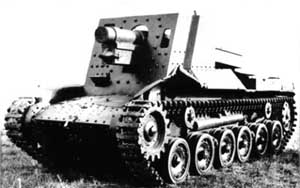
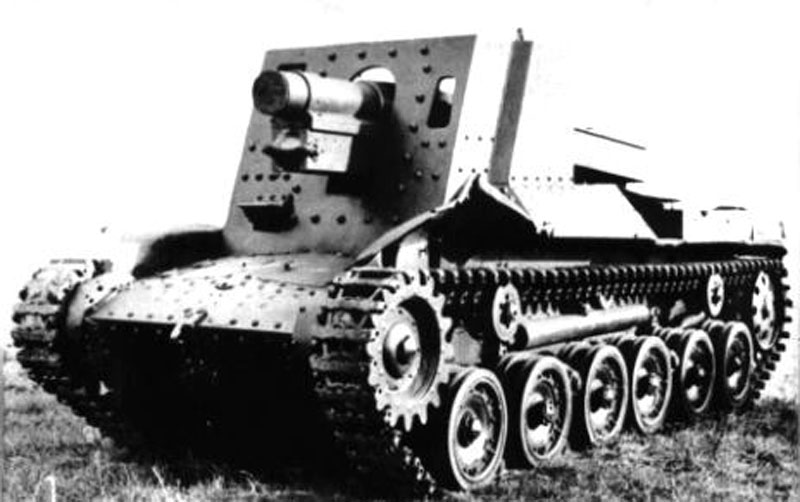
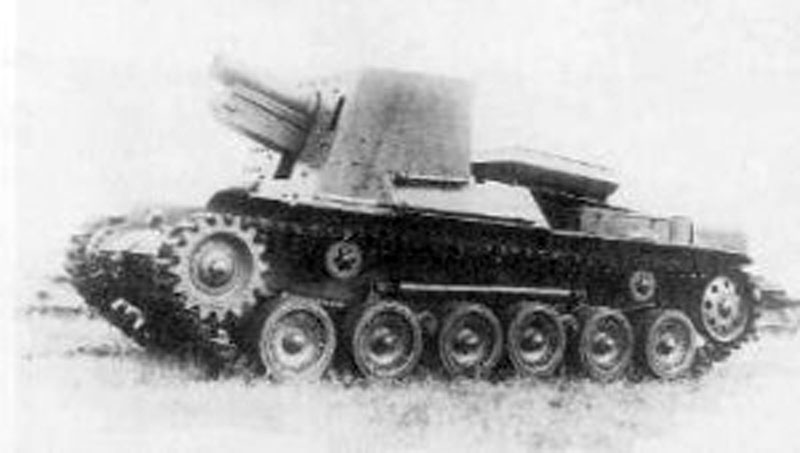
The Type 38 gun would be seated in a fixed superstructure that was protected only by a forward shield or armor that slightly protected the forward sides. The crew of four or five personnel would operate the gun breech in an open-air setting, exposed to the elements and battlefield dangers but systems such as these were always intended to operate behind direct lines of contact. The gun was situated well-forward in the design with the Type 97 hull left largely intact. There were a set of tracks straddling either side of the tank hull with six road wheels to a track side. The drive sprocket was located at the front of the design with the track idler at the rear. Three track return rollers were positioned along the underside of the upper track element. The glacis plate was well sloped and the engine remained at the rear. Only a portion of the Type 97's lower superstructure remained, the rest of the design being capped by the impromptu open-air gun mount. The superstructure and gun mount essentially replaced the original turret assembly of the base Type 97 and was wholly fixed in place with some elevation flexibility. Power was derived from a Mitsubishi Type 100 air-cooled V12 diesel engine outputting some 170 horsepower. This allowed for speeds up close to 24 miles per hour with a range out to 156 miles.
Once again the industrial limitations of the Japanese Empire shown through with the Type 4 Ho-Ro. The system was severely limited in production to the point that only twenty five or so vehicles were ever produced. Mass produced forms never appeared as the Type 4 was essentially forged into existence by the hands of laborers without the benefits of assembly line benefits.
With their limited reach from the start, the Type 4 Ho-Ro was seemingly never formally organized into any pairing larger than four vehicles. Once in practice, and despite being designed as a self-propelled gun for field artillery duties, Allied actions soon forced the Type 4 into the close support artillery role instead, often in defense of Japanese-held territories. Her fixed superstructure forced the entire hull to be turned towards a target area for engagement and the open-air nature of her design exposed the crew to every sort of imaginable battlefield danger. Born as an offensive weapon, the Type 4 was forced to become a haphazard defensive weapon by the end of the war. She was utilized by the Japanese Army in defense of Okinawa with limited success but, in the end, her limited quantity and her outdated design led many examples to be destroyed in combat, outdone by more formidable Allied artillery pieces or infantry and armor advances overrunning her positions. Only a handful of complete examples were ever captured by the Allies.
Power & Performance Those special qualities that separate one land system design from another. Performance specifications presented assume optimal operating conditions for the Type 4 Ho-Ro Self-Propelled Artillery / Close-Support Gun.
1 x Mitsubishi Type 100 air-cooled V12 diesel-fueled engine developing 170 horsepower. to a conventional track-and-wheel arrangement. Installed Power
24 mph 38 kph Road Speed
155 miles 250 km Range
Structure The physical qualities of the Type 4 Ho-Ro Self-Propelled Artillery / Close-Support Gun.
5 (MANNED) Crew
18.0 ft 5.5 meters O/A Length
7.5 ft 2.28 meters O/A Width
5.1 ft 1.549 meters O/A Height
29,321 lb 13,300 kg | 14.7 tons Weight
Armament & Ammunition Available supported armament, ammunition, and special-mission equipment featured in the design of the Type 4 Ho-Ro Self-Propelled Artillery / Close-Support Gun.
1 x 150mm Type 38 howitzer main gun.
AMMUNITION: Dependent on ammunition carrier.
Variants Notable series variants as part of the Type 4 Ho-Ro family line.
Type 4 "Ho-Ro" - Base Series Designation
Operators Global customers who have evaluated and/or operated the Type 4 Ho-Ro. Nations are displayed by flag, each linked to their respective national land systems listing.
Total Production: 25 Units Contractor(s): State Factories - Imperial Japan
[ Imperial Japan ]
1 / 2
Front left side view of the Type 4 Ho-Ro self-propelled gun
2 / 2
Left side view of the Type 4 Ho-Ro self-propelled gun
The "Military Factory" name and MilitaryFactory.com logo are registered ® U.S. trademarks protected by all applicable domestic and international intellectual property laws. All written content, illustrations, and photography are unique to this website (unless where indicated) and not for reuse/reproduction in any form. Material presented throughout this website is for historical and entertainment value only and should not to be construed as usable for hardware restoration, maintenance, or general operation. We do not sell any of the items showcased on this site. Please direct all other inquiries to militaryfactory AT gmail.com. No A.I. was used in the generation of this content.