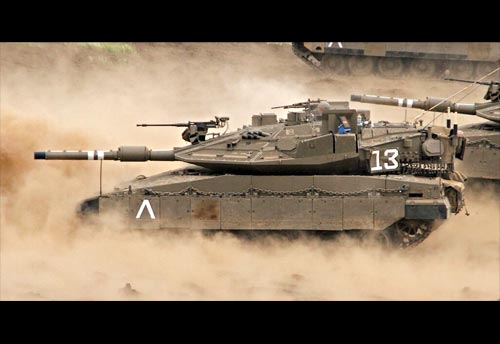
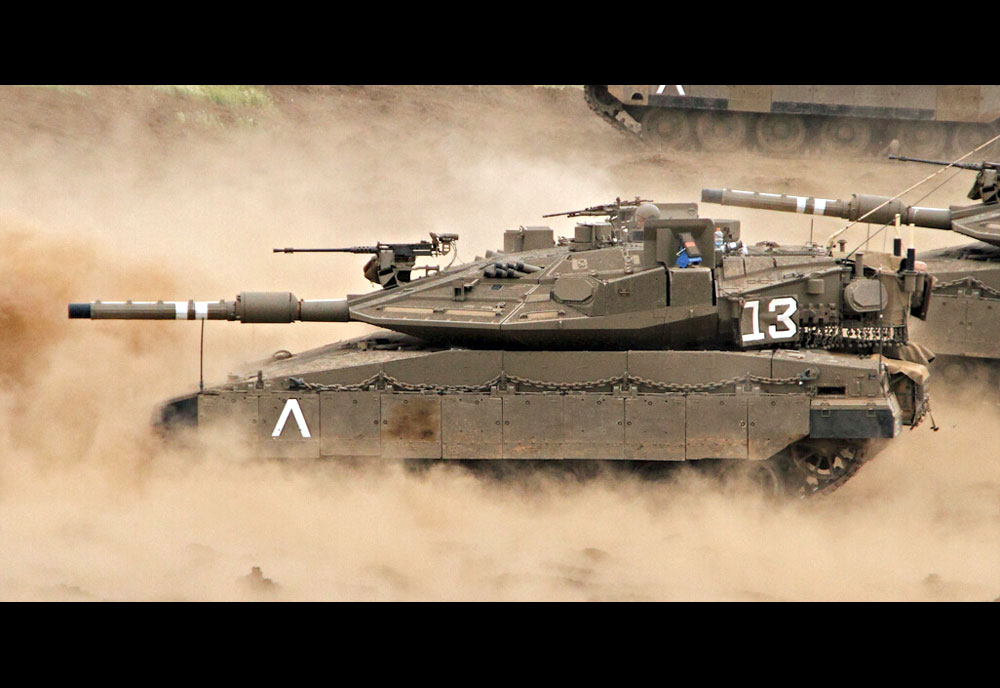
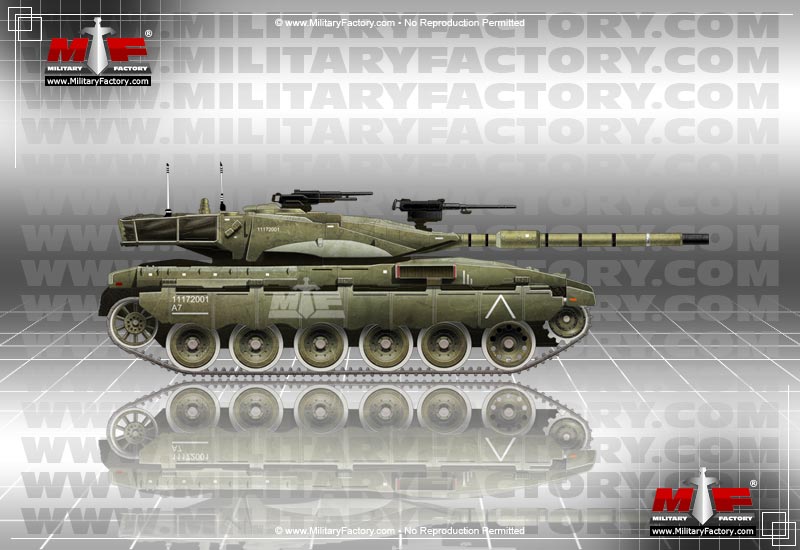
The Merkava series of main battle tank represents the backbone of Israeli armor elements. The system was the result of extensive experience in the field of armored warfare done exclusively with foreign equipment, mostly US products though some British and French systems were also utilized. With the volatile situation surrounding Israel on a day to day basis, it was imperative for the tiny nation to fit its inventory with a system that was tailored to the needs of the Israeli Army. This product would have to be made for the rigors of urban and desert warfare and provide the crew with maximum protection. The resulting Merkava (or "chariot") was just that and continues to be a main part of the Israeli Army forces.
One of the most distinct design features of the Merkava main battle tank was the decision to plant the engine in the front of the hull. Traditional tank designs have always featured the engine at rear to guard against a direct frontal hit rendering the entire system useless. Contrary to this, the Merkava featured the engine at front to help protect the crew from that same frontal direct hit. As such, the driver would be seated further aft, towards the middle of the design and just left forward of the turret. The turret itself was designed with rounded facings and gave the entire tank an extremely low profile making the tank harder to spot or engage at distance. The powerful and (formerly) standard 105mm main gun was fitted to the turret as was a 7.62mm co-axial machine gun. A gun stabilization system offered up fire-on-the-move capability completed with an indigenously-produced targeting computer. Two additional 7.62mm machine guns were also offered for self-defense against aircraft attacks and as anti-infantry weapons. A 60mm mortar was also included in the armament design.
Power in the Mk 1 model was derived from a General Dynamics Land Systems engine - the AVDS-1790-6A - a V-12 diesel performer that generated about 900 horsepower. This powerplant allowed the Merkava speeds of up to 28 miles per hour and a range of nearly 250 miles. At just over 66 tons, the Merkava was hardly a speedster and mobility was questionable, but the entire system was designed to Israeli standards based on exclusive experience and thusly could not be wholly compared to its European counterparts.
The Merkava Mk 2 mark appeared as a further development, sporting improved armor protection and an improved fire control system. More importantly however was the increase of the combat range over the Mk 1, adding nearly a quarter more distance to the performance statistic. The Mk 3 would later appear, sporting the powerful 120mm main gun and an improved powerpack. The latest version of the Merkava series is found in the Merkava Mk 4, which features changes that put it on par or supercede the current generation of main battle tanks. In any case, the Merkava was (and continues to be) a tremendous engineering effort accomplished by a nation that has seen more combat than any other since the final days of World War 2.
Some 250 Mark I series tanks have been produced while a further 580 total Mark II systems have been delivered. Mark III is currently the highest produced system with 750 total examples. The Mark IV has seen 360 produced whith a further 300 eventually being added to the total.
The chassis of the Merkava MBT serves as the basis for the "Tankbulance" armored ambulance, the Namer Infantry Fighting Vehicle (IFV), the Nemmera Armored Recovery Vehicle (ARV) and the prototype Sholef 155mm Self-Propelled Gun (SPG).
March 2022 - An all-modernized variant of the series, the Merkava 5 "Barak", is set to enter service with the IDF in 2023. Changes will include enhanced situational awareness and survivability by way of advanced sensors, the Rafael "Trophy" anti-missile system, and fighter aircraft-like HUD projection system for the commander.
Power & Performance Those special qualities that separate one land system design from another. Performance specifications presented assume optimal operating conditions for the Merkava Mark I Main Battle Tank (MBT).
1 x General Dynamics Land Systems AVDS-1790-6A V-12 diesel engine developing 900 horsepower driving conventional track-and-wheel arrangement. Installed Power
29 mph 46 kph Road Speed
249 miles 400 km Range
Structure The physical qualities of the Merkava Mark I Main Battle Tank (MBT).
4 (MANNED) Crew
28.3 ft 8.63 meters O/A Length
12.1 ft 3.7 meters O/A Width
9.0 ft 2.75 meters O/A Height
132,277 lb 60,000 kg | 66.1 tons Weight
Armament & Ammunition Available supported armament, ammunition, and special-mission equipment featured in the design of the Merkava (Chariot) Main Battle Tank (MBT).
1 x 105mm main gun (1 x 120mm main gun on later models) in front turret face.
1 x 7.62mm co-axial machine gun in front turret face.
2 x 7.62mm machine guns (1 x 12.7mm AA machine gun on later models) on turret roof.
1 x 60mm mortar launcher.
12 x Smoke Grenade Launchers in two banks of six launchers to each turret side.
AMMUNITION: 62 x 105mm projectiles.
10,000 x 7.62mm ammunition.
12 x Smoke grenades.
Variants Notable series variants as part of the Merkava (Chariot) family line.
Merkava Mk I - Initial Production Model Designation; after 1982 Lebanon War, a 60mm remote-fired mortar was installed; shot trap installed beneath turret rear; chain netting introduced to combat rocket attacks; 1 x 105mm main gun.
Merkava Mk II - Introduced 1983; improved armor protection; improved range; updated fire control system, sensors and image intensifiers; improved 60mm roof-mounted mortar launcher; updated for urban/low-intensity warfare; 1 x 105mm main gun; indigenous transmission design; anti-rocket netting.
Merkava Mk IIB - Updated fire control system; thermal optics.
Merkava Mk IIC - Increased armor protection to top of turret.
Merkava Mk IID - Modular Composite Armor on chassis and turret for improved protection.
Merkava Mk III - Introduced 1989; indigenous 1 x 120mm main gun; upgraded powerpack at 1,200hp; new transmission system; improved suspension and fire control system; new threat warning system; laser designators.
Merkava Mk 3 "Baz" - Introduced 1995; improved armor protection; upgraded fire-control system with on-the-move target and fire capability; indigenous AC system.
Merkava Mk 3D - Modular Composite Armor on chassis and turret.
Merkava Mk 3D "Dor-Dalet" - Improved tracks; R-OWS implementation.
Merkava Mk 4 "Windbreaker" - Latest production version; improved fire-control system; improved armor protection; redesigned ammunition hold; 1 x 120mm main gun; HEAT/sabot capability; introduction of 1 x 12.7mm heavy machine gun; improved tracks; digital battlefield management system.
Merkava "Sholef" (Slammer) - Self-Propelled 155mm Gun; prototype; never produced.
ARV - Armored Recovery Vehicle (prototype)
Merkava LIC - Based on Mk III "Baz" and Mk IV tanks but converted for urban warfare.
Merkava "Tankbulance" - Fitted with battlefield medical capabilities through still fitted its with armament.
Merkava IFV "Namer" - Infantry Fighting Vehicle; introduced in 2008.
Merkava ARV "Nemmera" - Armored Recovery Vehicle; two versions with varying crane and winch sizes.
Merkava 5 "Barak" ("Lightning") - Model of 2023; Upgraded Trophy Active Protection System (APS); day / night 360-degree camera equipment; Commander's HUD; enhanced sensor processing.
Operators Global customers who have evaluated and/or operated the Merkava (Chariot). Nations are displayed by flag, each linked to their respective national land systems listing.
Total Production: 2,100 Units Contractor(s): Israeli Ordnance Corps Facility - Israel
[ Israel ]
1 / 2
Image from Rafael Advanced Defense Systems marketing materials.
2 / 2
Image copyright www.MilitaryFactory.com; No Reproduction Permitted.
The "Military Factory" name and MilitaryFactory.com logo are registered ® U.S. trademarks protected by all applicable domestic and international intellectual property laws. All written content, illustrations, and photography are unique to this website (unless where indicated) and not for reuse/reproduction in any form. Material presented throughout this website is for historical and entertainment value only and should not to be construed as usable for hardware restoration, maintenance, or general operation. We do not sell any of the items showcased on this site. Please direct all other inquiries to militaryfactory AT gmail.com. No A.I. was used in the generation of this content.