The Hotchkiss H39 superseded the H35 series light tanks in French Army service, being produced in more numbers than her forerunner while both proving equally important to French Army actions prior to the Fall of France in June of 1940. The original two-man H35 Light Tank appeared in 1936 and was intended as an "infantry support" platform armed modestly with a 37mm SA18 series cannon and a single 7.5mm Reibel machine gun in a traversing turret. Power was served through 6-cylinder, gasoline-fueled engine delivering 78 horsepower for a maximum speed of 17 miles per hour and an operational range of 80 miles. As its designation would suggest, the H36 was adopted for military service in 1936.
Throughout the 1930s, the French joined other powers in a period of vast modernization and many settled on stocks of budget light-class tanks to fulfill the infantry support and cavalry roles. Common doctrine of the day also called for dedicated tanks for each category, cavalry tanks intended as fast armed reconnaissance mounts to which the H35 was developed for. It was only later that the H35 was also adopted into the infantry support role which, as the category name suggests, could be used in support of advancing infantry formations. While a capable platform for its time, the H35 design held several shortcomings - a small-caliber short-barreled main gun, a two-man crew (the commander doubled as the gunner/loader) and an underpowered engine producing 78 horsepower. Armor thickness was 34mm in only a few key areas while 12mm covered the rest. Production of the type topped 400 units before efforts turned to a much better design in the Hotchkiss H39.
The H39 was built upon the stronger qualities of the H35 and was born out of the various evaluation initiatives undertaken of the type beginning back in October of 1936. The newer H39 featured several key changes in her design, most notable was the enlarged hull with its revised rear section. The track running gear was upgraded and improved as a result while engineers installed a new engine of 120 horsepower. With the changes in place, the tank now sported a top speed of 22 miles per hour with an operational range of 94 miles. Armor protection was increased slightly while the main gun remained the short 37mm SA 38 series gun. The H39 was also crewed by two personnel.
French authorities approved of the type and ordered it for serial production, essentially ending the run of the preceding H35 series after approximately 400 units were completed. This provided the opportunity to secure some 1,000 H39 vehicles and prototypes were further handed to Poland and Turkey for evaluation. Some H39s also made their way to Finnish stocks in support of Finland during the "Winter War" against the Soviet Union. In early 1940 - before the German invasion of France - the French Army decided to upgrade their H39s, some with radio, optics and a new, longer-barreled 37mm L/35 SA 38 series main gun, producing the designation of H39/40. About 350 H39 tanks were upgraded to this new standard and these were joined by a further 50 existing H35 tanks.
Between 600 and 800 Hotchkiss H35 and H39 light tanks were available to French warplanners by the time of the German invasion of France in May of 1940. However, many H39s were tied to the slow and cumbersome Char B1 Heavy Tanks and largely misallocated throughout the French response. Useful coordinated attacks by French armor divisions proved few and far between and this worsened the expected defense of France to irrecoverable levels. When utilized properly, H39s proved a more-than-capable foe for German armor in turn but such offensives were scarce. One of the key threats to H39 systems lay in the skillful deployment and operation of German anti-tank guns which showcased the H39's light armor protection as a true weakness on the modern battlefield.
Rather than risk the complete destruction of Paris proper, the French government surrendered after just 1.5 months of fighting. This signaled the end of the governing Third French Republic and proved a disastrous historical military loss and humiliation for the French Army. The allied British (along with some French forces) had no choice but to evacuate through the north across the Channel while Italian forces allied to the Axis helped to secure a small portion of southeastern France. The capture of Paris brought with it the official German occupation of neighboring Luxembourg, Netherlands and Belgium that would last for most of the war. The Vichy French government, allied to Hitler's Germany, would rise in place of the former French government.
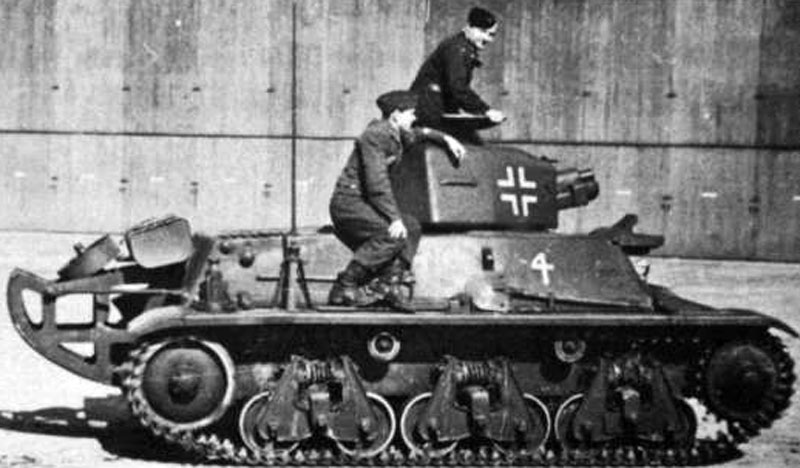
With the French Army now defeated, the Germans moved in to claim stocks of French material to bolster their own ranks. This included the hundreds of H39 tanks available by battle's end. Panzer divisions made use of many French war goods in this fashion, usually utilized for local defense, as second-line units or to replace lost front-line systems from the earlier campaigns. Under German direction, the H39 was given the designation of PzKpfW 39-H 735(f), the "f" to showcase its French origins. After the German invasion of the Soviet Union in June of 1941, the H39 was transported by rail to the Eastern Front due to a mass shortage of capable armor. It proved rather common for the Germans to also replace the given French turrets and armament with more potent German designs in an effort to create better anti-tank stopping measures to counter the heavy use of armor unleashed by the Soviets. The Germans created the 75mm-armed "Marder I" tank destroyer in this fashion as the "7.5cm PaK40(Sf) auf Geschutzwagen 39H(f) Marder I". Similarly the "10.5cm leFH18(Sf) auf Geschutzwagen 39H(f)" was fitted with a 105mm gun platform, both retaining much of the H39 chassis in place. Other logistically-minded developments included the "Atillerieschlepper 38H(f)" artillery tractor and the "Panzerbeobachtungswagen 38H(f)" artillery observation vehicle.
Some stocks of H39s eventually found their way to French colonial holdings in the Middle East and were taken under the control of either Free French forces or Vichy French units. Vichy-held H39s were used in anger during the Syrian/Lebanon Campaign of June-July 1941. However, by 1945, the H39 was more or less an obsolete machine by World War 2 standards and few remained in serviceable numbers. After the war, some H39s fell to the growing Israeli Army who still operated the type into 1956 during the Suez Crisis against Egypt. At least a dozen were operated in their original light, fast reconnaissance role.
Power & Performance Those special qualities that separate one land system design from another. Performance specifications presented assume optimal operating conditions for the Hotchkiss H39 Fast Reconnaissance Light Tank.
1 x Hotchkiss 6-cylinder gasoline-fueled engine developing 120 horsepower driving conventional track-and-wheel arrangement. Installed Power
22 mph 36 kph Road Speed
75 miles 120 km Range
Structure The physical qualities of the Hotchkiss H39 Fast Reconnaissance Light Tank.
2 (MANNED) Crew
13.8 ft 4.22 meters O/A Length
6.4 ft 1.95 meters O/A Width
7.1 ft 2.15 meters O/A Height
26,676 lb 12,100 kg | 13.3 tons Weight
Armament & Ammunition Available supported armament, ammunition, and special-mission equipment featured in the design of the Hotchkiss H39 Fast Reconnaissance Light Tank.
1 x 37mm SA 18 main gun.
1 x 7.5mm Reibel machine gun.
AMMUNITION: 100 x 37mm projectiles.
400 x 7.5mm ammunition.
Variants Notable series variants as part of the Hotchkiss H39 family line.
H35 - Original light tank design on which the H39 is based on.
H39 - Base Production Series Designation.
PzKpfW 38H 735(f) - Captured French H39 systems reconstituted for German Army use.
Artillerieschlepper 38H(f) - German Artillery Tractor utilizing H39 chassis.
7.5cm PaK40(Sf) auf Geschutzwagen 39H(f) Marder I - German Army Tank Destroyer Conversion Model; 24 examples converted as such.
10.5cm leFH18(Sf) auf Geschutzwagen 39H(f) - German Army Mechanized Artillery Conversion Model; 48 examples converted as such.
Panzerbeobachtungswagen 38H(f) - German Army Artillery Observation Vehicle Conversion Model.
Operators Global customers who have evaluated and/or operated the Hotchkiss H39. Nations are displayed by flag, each linked to their respective national land systems listing.
Total Production: 1,000 Units Contractor(s): Hotchkiss - France
The "Military Factory" name and MilitaryFactory.com logo are registered ® U.S. trademarks protected by all applicable domestic and international intellectual property laws. All written content, illustrations, and photography are unique to this website (unless where indicated) and not for reuse/reproduction in any form. Material presented throughout this website is for historical and entertainment value only and should not to be construed as usable for hardware restoration, maintenance, or general operation. We do not sell any of the items showcased on this site. Please direct all other inquiries to militaryfactory AT gmail.com. No A.I. was used in the generation of this content.