Military Factory
Military Pay Chart
Global Firepower
Military Industrial Complex
Second World War
Home
Military Pay Scale
Military Ranks
Small Arms
Aircraft
Land Systems
Navy
Education
Military Factory Facebook Logo
flag of Nazi Germany

Daimler-Benz G4 Staff Car / Heavy Personnel Car (1934)

Authored By Staff Writer | Last Updated: 11/6/2010

Despite its six road wheels, the G4 actually lacked full 6x6 operation.

Find a School Near You
Follow Military Factory on Facebook:
Trending on Military Factory:
Recent Articles:
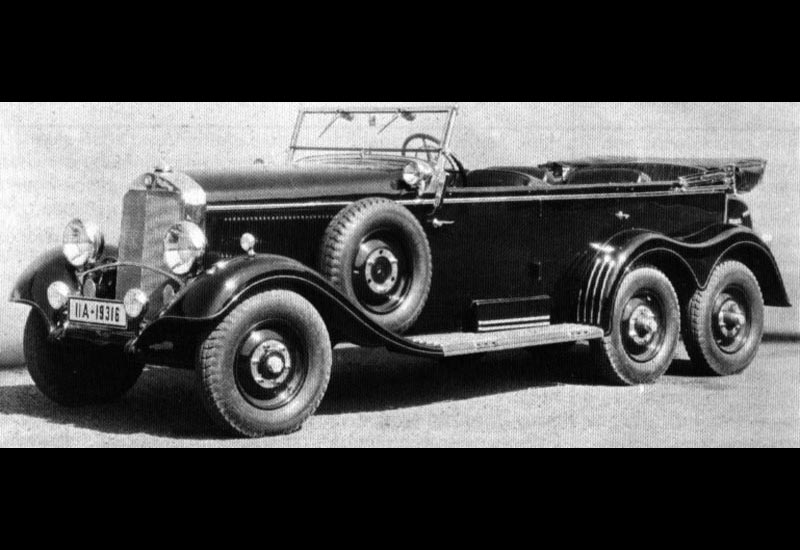
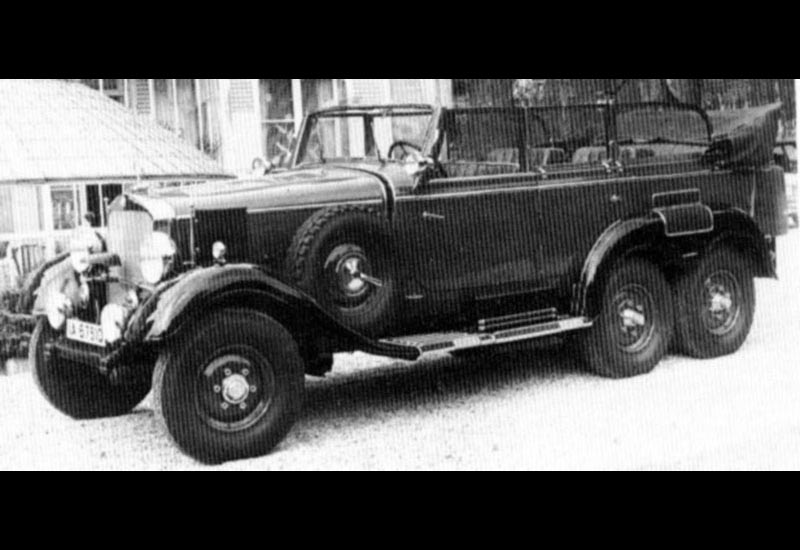
Despite its use as a general staff car as well as centerpiece in many of Hitler's propaganda-driven military parades, the Daimler-Benz G4 vehicle was formally classified as a "heavy personnel car". Hitler himself found favor in the large G4 series as the car provided for a most imposing presentation with its long running length and rugged six-wheeled arrangement. While intended for cross-country operations, the G4 actually lacked all-wheel drive to its six wheels with only the rear axles (with two self-locking differentials) linked as such and the front axles being left out of the equation. As such, the G4 generally suffered in cross-country driving, particularly in off-road actions where the vehicle's immense weight and unwieldy dimensions worked solidly against the driver. Regardless, Hitler was keen on its utilization when touring "post-battle" battlefields or when reaching hard-pressed troop areas for morale visits. When not in use, these special government G4s were stored in the various castles under ownership by the Fuhrer.

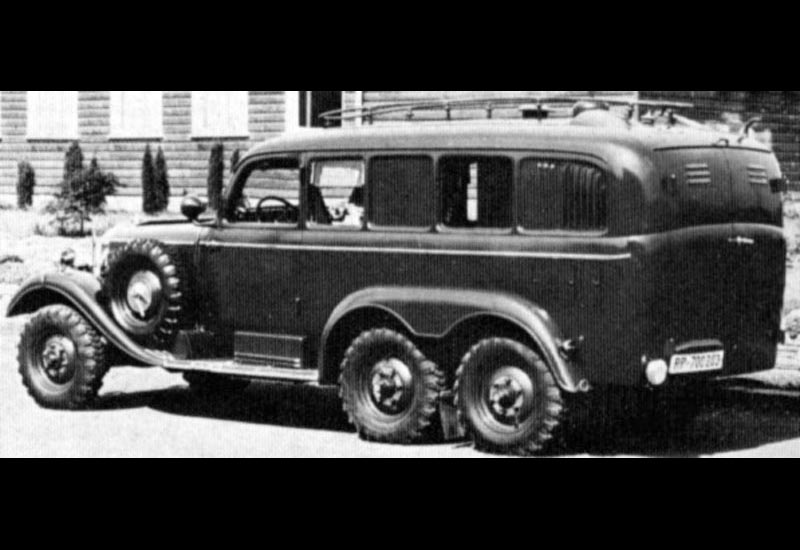
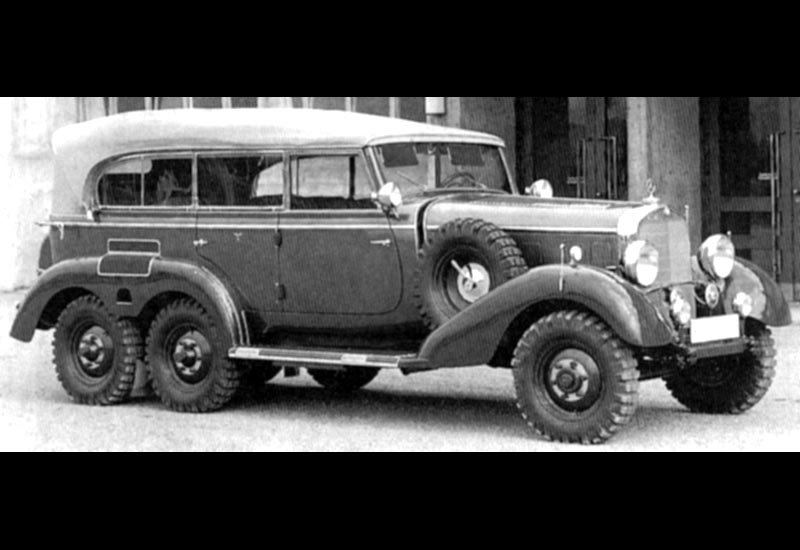
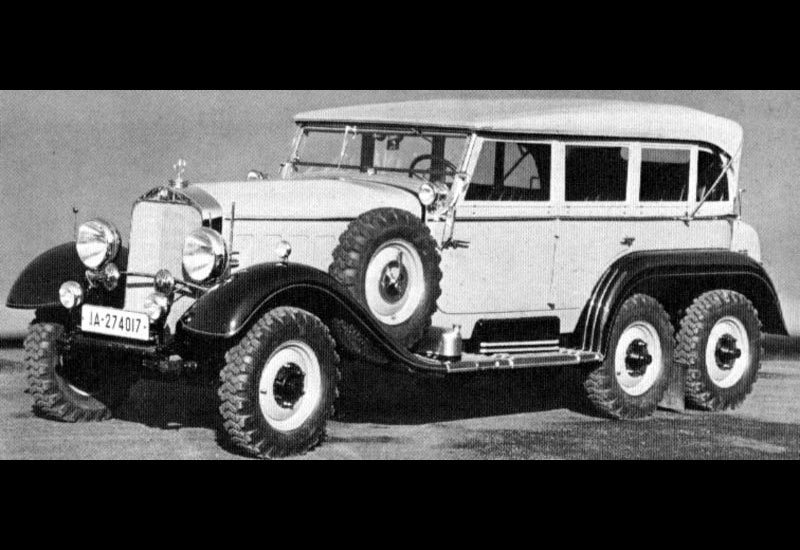
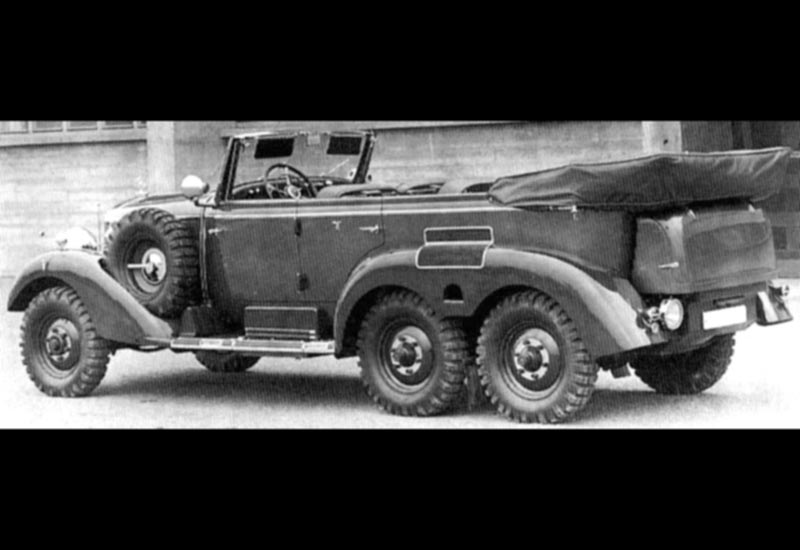
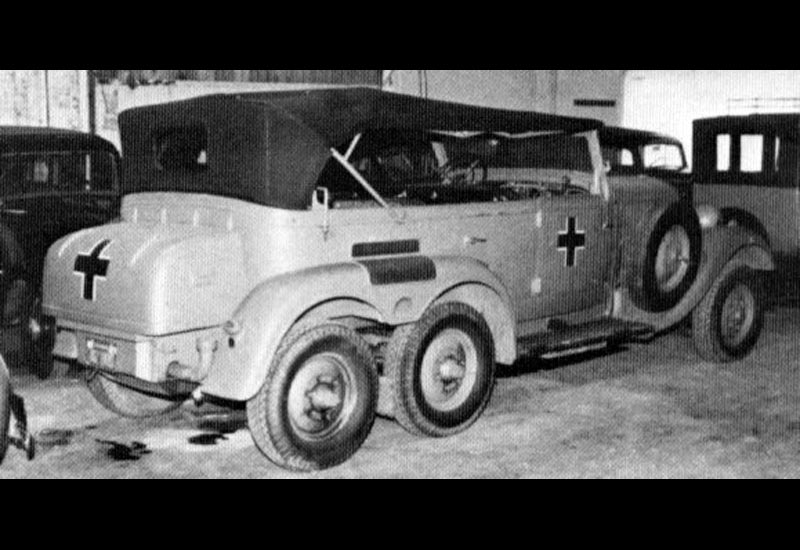
Production of the G4 began in 1934 by the German firm of Daimler-Benz and lasted through 1939. The vehicle was delivered in two distinct finishes for their intended presentation roles - the first was of ceremonial showpiece and the second was of high-ranking personnel transport. The former was delivered with a glossy light gray finish complimented by a black fender and matching black running boards. The latter was delivered with a matte gray military finish as standard. Both versions featured a collapsible, soft-topped covering to protect occupants from the elements as well as solid glass windows. The cover conveniently collapsed in a setting at the rear upper edges of the vehicle frame. A hard-topped version of the vehicle was also produced and made up both a "Radio Car" communications vehicle and "Luggage Vehicle" for Hitler's private entourage when traveling. Some versions lacked the rear passenger side windows as well.

The layout of the G4 was highly conventional despite its unorthodox appearance. The engine was set within a front-mounted compartment and attached to a four-speed manual transmission system driving the rear wheels. The driver was positioned at the front-left and managed steering via a large-radius conventional steering wheel component. Two seats were held forward each with automotive-style doors hinged to open towards the rear for easy entry/exit. The rear occupants were given two sets of seats with one set of doors, these hinged at their forward edge to open in a traditional forward-swinging manner. Running boards lined either side of the vehicle underneath the doors and contoured elegantly against the forward and rear wheel fenders. Power was derived from a Daimler-Benz M24 OR M24 II series air-cooled, 8-cylinder, in-line engine of either 5.0 or 5.4 liter capacity developing up to 110 horsepower at 3,400rpm. Road speed was rated at approximately 42 miles per hour while operating weight was in the vicinity of 3,700 kilograms (8,154lbs). Rounded headlamps at the front of the vehicle assisted in night time driving and were set to either side of the engine grill panel, inside of the forward wheel fenders. Chrome was used throughout the vehicle's design for detailing purposes. Spare wheels were affixed to mounts on either side of the vehicle frame, just ahead of either front door.

Once it became common knowledge that the Fuhrer himself favored the G4 as his own personal staff car, subordinates were quick to follow suit and requested the G4 for their own touring endeavors as a showman's statement to "lesser" personnel. However, less than 150 G4s were ever produced which made them extremely rare finds, with production totals ranging wildly between 57 and 131 examples based on various sources. It is reported that only one example of the Luggage Car and one example of the Radio Car were ever produced by Daimler-Benz. Needless to say, their appearance today in military collections is quite a find in any respect.

Some G4s, particularly those vehicles charged as escorts in transporting high-ranking VIPs, could be outfitted with one or two 7.92mm general purpose machine guns for self-defense. These could be either the early-war MG34 series or the later MG42 model of belt-fed machine gun and mounted on high-standing "stalk" pintles. The forward-mounted pintle was set just behind the front seats while the aft pintle mounting was set behind the rear-most set of seats. When used in combination, this essentially allowed for a 360-degree field of fire though without much protection to the gunnery crew.
Text ©2003-2013 www.MilitaryFactory.com • All Rights Reserved • No Reproduction Permitted
MilitaryFactory.com does NOT sell equipment/weaponry. Material presented throughout this website is for historical and entertainment value and should not to be construed as usable for hardware restoration, maintenance or general operation. Please consult manufacturers for such information. Our disclaimer. Email corrections / Comments to MilitaryFactory at Gmail dot com.
Picture of Daimler-Benz G4
Pic of the Daimler-Benz G4
Image of the Daimler-Benz G4
View All Images (7)

Specifications for the
Daimler-Benz G4
Staff Car / Heavy Personnel Car


Country of Origin: Nazi Germany
Manufacturer: Daimler-Benz - Germany
Initial Year of Service: 1934
Production: 94


Focus Model: Daimler-Benz G4
Crew: 1 + 5


Overall Length: 0.00ft (0.00m)
Width: 0.00ft (0.00m)
Height: 0.00ft (0.00m)
Weight: 4.1 US Short Tons (3,700kg; 8,157lbs)


Powerplant: 1 x Daimler-Benz M24 OR M24 II 8-cylinder, in-line, 5.0 OR 5.4-liter, air-cooled engine delivering 108 horsepower at 3,400rpm.


Maximum Speed: 42mph (67 km/h)
Maximum Range: 0 miles (0 km)


NBC Protection: None
Nightvision: None


Armament:
OPTIONAL:
1 OR 2 x 7.92 MG34 OR MG 42 machine gunson pintle mounts at amidships (behind front bench) and aft (behind rear-most bench). Additionally, any personal weapons could be used in defense.


Ammunition:
200 x 7.92mm ammunition (when equipped with machine guns).


Variants:
G4 - Base Series Designation; eqipped with three different 8-cylinder engines throughout her production life beginning in 1934; some VIP escort versions armed with machine guns; hard-topped and soft-topped versions available.


Operators: Nazi Germany

ALL LAND SYSTEMS CATEGORIES

By Decade:


1910 to 1919
1920 to 1929
1930 to 1939
1940 to 1949
1950 to 1959
1960 to 1969
1970 to 1979
1980 to 1989
1990 to 1999
2000 to 2009
2010 to 2019
VIEW ALL
Compare Tanks


By Type:


4x4 Military Vehicles
6x6 Military Vehicles
8x8 Military Vehicles
Artillery Gun Systems
Anti-Aircraft (AA) Guns
Anti-Aircraft (AA) Vehicles
Anti-Tank (AT) Guns
Anti-Tank (AT) Vehicles
Armored Cars
Armored Personnel Carriers (APC)
Battlefield Robots
Halftrack Vehicles
Heavy Tanks
Infantry Fighting Vehicles (IFV)
Light Tanks
Main Battle Tanks (MBT)
Modern Combat Tanks
Medium Tanks
Military Motorcycles
Multiple Launch Rocket Systems (MLRS)
Reconnaissance Vehicles
Special Purpose Vehicles
Self-Propelled Guns (SPG)
Tank Destroyers
General Purpose / Utility Vehicles


By Nation:


Afghanistan
Britain
China
France
Germany
Iran
Iraq
Israel / Israeli Army
Italy
Libyan Army
North Korea / North Korean Army
Pakistan
Russia
South Korea
Soviet Union
Syrian Army
United States
VIEW ALL

World War 2:


Artillery
Infantry Fighting Vehicles
Tank Destroyers (All)
Tanks (All)
Australian Tanks
British Tanks
Canadian Tanks
Cruiser Tanks (UK)
Czechoslovakian Tanks
French Tanks
German Tanks
German Tank Destroyers
German FlaK Guns
German Reconnaissance Vehicles
Hungarian Tanks
Italian Tanks
Japanese Tanks
Romanian Tanks
Soviet Tanks
Swedish Tanks
US Tanks
VIEW ALL


World War 1:


France WW1 Tanks
Germany WW1 Tanks
Britain WW1 Tanks
US WW1 Tanks
WW1 Artillery
WW1 Tanks (all)
VIEW ALL


Spanish Civil War:

VIEW ALL


Korean War:

Tanks
VIEW ALL


Vietnam War:

VIEW ALL


Cold War:

Cold War Tanks
Cold War American Tanks
Falklands War
Post-WW2 British Tanks
VIEW ALL


Gulf War (1991):

VIEW ALL


Miscellaneous:

Armored Vehicle Chassis Types

Site Disclaimer | Privacy Policy | Site Map | MF Origins


©2013 www.MilitaryFactory.com • Content ©2003-2013 MilitaryFactory.com • All Rights Reserved • Site Contact Email: militaryfactory at gmail dot com. The "Military Factory" name and MilitaryFactory.com logo are registered ® trademarks and protected by all applicable domestic and international intellectual property laws.


Top MF Stuff: 2013 Military Pay Scale | Military Ranks | WW2 Weapons | Sniper Rifles | Kts to Mph | WW1 Aircraft | Automatic Rifles | Aircraft Cockpits | Vietnam War Weapons | Main Battle Tanks | Submachine Guns | Shotguns | French Military Victories


Most photographic images appearing on this site are courtesy of the United States Department of Defense and are approved for public use. Other images acquired through the public domain. Digital art work courtesy of Dan Alex. Business Consulting by Kyle Williams. Material presented throughout this website is for historical and entertainment value and should not to be construed as usable for hardware restoration, maintenance or general operation. Please consult manufacturers for such information.


eXTReMe Tracker