The T-60 light scout tank was designed and developed to replace the outclassed T-38 series of amphibious light scout tank and was generally regarded as on par with the German Panzer II series. Additionally, the type was designed with the thought that it could be relatively easily produced en masse across Soviet factories that were ill-equipped to produce the stream of larger classes of battlefield tanks as required by the Red Army. The early phases of the war had also shown the existing series of light tanks then in use by the Red Army to be unsuitable for future actions required of Soviet ground forces, particularly in the nature of infantry support. Also, the designs had shown themselves to be overtly unfriendly to mass production practices as required by the constraints of war.
In 1938, with the ugly facts in hand, Soviet leader Joseph Stalin himself ordered the design and production of a new breed of light tanks numbering 10,000 in strength to fill the growing void. These new systems would be more potently armed with a 20mm repeating cannon to replace the conventional machine gun armament of existing light tanks. At the very least, this would give advancing Soviet infantry a potent punch when running headlong into battlefield mayhem. Production would be handled by a mix of state-run facilities.
A first prototype - T30A - was completed, the design being attributed to Nicholas Astrov and his team at Factory No. 37. The 20mm main gun was fitted to a traversing turret that offered a wide field of fire. Armored was strategically slanted though not particularly thick, maintaining the tanks categorization as a "light" system. A co-axial machine gun was added to the armament mix to help protect the tank from direct enemy infantry grenade attacks. A second prototype - T30B -featured a different version of the required 20mm main gun armament, this being the 20mm L/82.4 series with origins in an aircraft-mounted design. The new gun broadened the ammunition choices for the growing light tank project. Armor in the second prototype was made heavier in critical areas and production methodology was improved over that of the T30A prototype. Both prototypes were selected for production and the T30A went on to enter service as the T-40 amphibious light tank of 1940 while the T30B became the T-60 light scout tank of 1941.
The T-60 production began in earnest and despite being produced from a span of 1941 to 1942, some 6,292 examples were ultimately completed. Production was split between Factory No. 37 of Moscow, Factory No. 38 of Kirov and the Gorky Automobile Plant. The series would go on to see operational service through to the end of the war in 1945, a testament to its solid design, ease of manufacturing and its availability in large numbers.
Once in active service, the T-60 fit the Soviet need of the moment. It proved capable of handling the mud and snow common to Soviet and European winters and could traverse swampy areas as well. The T-60 design provided for better crew protection than her German Panzer II contemporary but proved less reliable in the long run and lacked critical radio equipment that the German design possessed. However, the T-60 made up for its limitations by offering up better operational ranges and rugged cross-country support. Established production methods also ensured that the T-60 could be rolled out of factories in greater frequency than that of her German adversary. With production now in full swing, T-60 ranks were growing and its appearance as a battlefield fixture began to match. Production was slowed to an extent with key Soviet losses to German advances, T-60 facilities falling to the enemy as a result. Regardless, the existing individual factories hit monthly production highs in keeping up with Red Army demand.
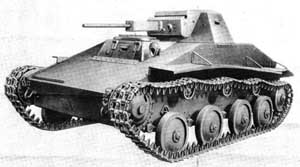
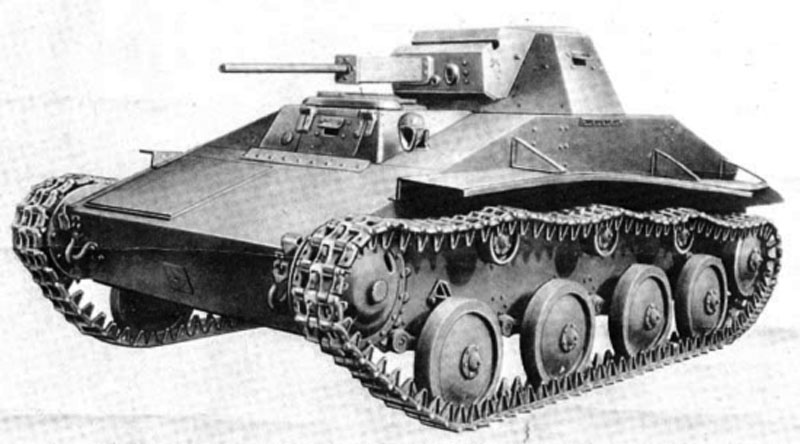
The T-60 sported four rubber-tired road wheels to a track side. The track systems straddled the welded hull and were supported by three track return rollers each. Suspension was via a torsion bar arrangement while each track was covered over in a thin armor "hood" covering. The glacis plate of the hull was well-sloped and slightly curved upward allowing for natural protection from incoming projectiles, small arms fire and artillery "spray". The hull contoured into a shallow superstructure with a sloped front facing and slab sides. The 360-degree, eight-sided traversing turret was fitted to the top of the superstructure and allowed for an unfettered field of engagement while also showcasing slanted facings for self-preservation. The turret design also proved easier to produce in quantity than previous light tank offerings. Vision slots were identifiable along the turret sides as well as the superstructure front. The engine was held in a rear compartment, powering the forward drive sprockets with the idler wheels held at the rear of the hull. Armor protection for the crew and critical systems alike ranged from 7mm to 35mm across critical facings. The T-60 was crewed by two personnel taking up the driver and gunner positions. Power was derived from a single GAZ-202 series 6-cylinder engine developing some 70-76 horsepower output. This supplied the tank with a top speed of up to 27.3 miles per hour as well as a range out to 217 to 270 miles on a 320 liter internal fuel tank. Armament was a combined showing of two gun types - primary armament was in the form of 1 x 20mm TNSh cannon with the secondary armament being 1 x 7.62mm DT general purpose machine gun in a co-axial turret mounting. 750 to 780 rounds of 20mm ammunition were carried aboard as well as 945 rounds of 7.62mm ammunition.
As the T-60's role on the battlefield became more defined and established, the chassis was used in a few variants of note. The T-60-1 was unveiled with a Zis-60 series engine delivering up to 110 horsepower for improved performance. The T-60A appeared with solid road wheels and increased armor protection. A proposal sought to fit a 23mm VYa series cannon in place of the base 20mm setup to produce an "up-gunned" T-60. This design fell to naught when it was realized that the recoil produced by the weapon had a dastardly effect of jamming the T-60 turret in place. Similarly-mind projects undertook the mounting of the proven 37mm Zis-19 cannon to the T-60 turret but the ammunition required for these guns were needed elsewhere along the list of Soviet Army priorities. The fitting of the 45mm Zis-19 series was also entertained but nothing became of this program. The T-60 chassis served as the basis for the abandoned T-90 anti-aircraft tank system. One interesting T-60 project undertaken in 1942 sought to convert the tank into a aerodynamic "glider" - attaching wings and a tail section to a lightened T-60 chassis - for delivery by TB-3 bombers to forward operating light elements. This project was inevitably canceled for there were no Soviet bombers capable of successfully delivering the tank in this form.
Captured Soviet systems in Romanian service were reconstituted as the TACAM T-60, a tank destroyer to be used against their former owners. Some 34 T-60s were captured by the Romanian Army and utilized as such until these systems were recaptured in turn by Soviet forces. Romania had, by this time, left their Axis-minded ways in August of 1944 to side with the Allies.
All other attempts to bring the T-60 to a more lethal state were abandoned with the arrival of the newer T-70 light tank series appearing in 1942. As T-70 numbers increased, T-60 needs decreased resulting in the end of the line for the little machine. Regardless, the T-60 proved an invaluable - if short-lived - addition to Soviet military actions against Germany in the early stages of the war.
Power & Performance Those special qualities that separate one land system design from another. Performance specifications presented assume optimal operating conditions for the T-60 Light Tank Tracked Combat Vehicle.
1 x GAZ-202 6-cylinder water-cooled inline engine developing 70 horsepower. Installed Power
27 mph 44 kph Road Speed
280 miles 450 km Range
Structure The physical qualities of the T-60 Light Tank Tracked Combat Vehicle.
2 (MANNED) Crew
13.5 ft 4.1 meters O/A Length
7.5 ft 2.3 meters O/A Width
5.7 ft 1.75 meters O/A Height
12,787 lb 5,800 kg | 6.4 tons Weight
Armament & Ammunition Available supported armament, ammunition, and special-mission equipment featured in the design of the T-60 Light Tank Tracked Combat Vehicle.
1 x 20mm TNSh L/82.4 main gun in turret.
1 x 7.62mm coaxial DT general purpose machine gun in turret.
AMMUNITION: 750 to 780 x 20mm projectiles.
945 x 7.62mm ammunition.
Variants Notable series variants as part of the T-60 family line.
T-60 - Base Production Series Designation; fitted with GAZ-202 engine of 70 horsepower.
T-60-1 - Fitted with Zis-60 engine of 100 horsepower.
T-60A - Solid road wheels; increased armor protection.
TACAM T-60 - Tank Destroyer designation utilized by Romanian Army of captured Soviet T-60 examples.
Operators Global customers who have evaluated and/or operated the T-60. Nations are displayed by flag, each linked to their respective national land systems listing.
Total Production: 6,292 Units Contractor(s): Factory No.37 / Factory No.38 / GAZ - Soviet Union
[ Nazi Germany (captured examples); Romania; Soviet Union ]
1 / 2
Front left side view of the T-60 light tank
2 / 2
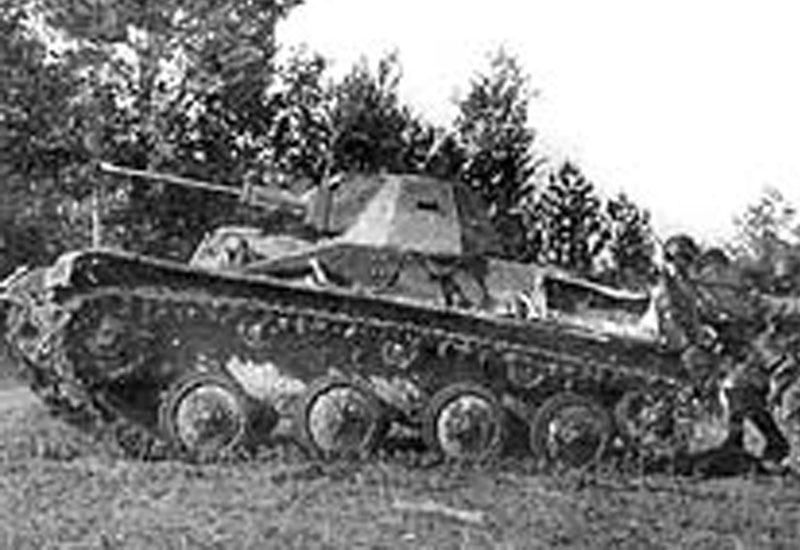
Troops take cover behind an advancing T-60 light tank
The "Military Factory" name and MilitaryFactory.com logo are registered ® U.S. trademarks protected by all applicable domestic and international intellectual property laws. All written content, illustrations, and photography are unique to this website (unless where indicated) and not for reuse/reproduction in any form. Material presented throughout this website is for historical and entertainment value only and should not to be construed as usable for hardware restoration, maintenance, or general operation. We do not sell any of the items showcased on this site. Please direct all other inquiries to militaryfactory AT gmail.com. No A.I. was used in the generation of this content.