Military Factory
Military Pay Chart
Global Firepower
Military Industrial Complex
Second World War
Home
Military Pay Scale
Military Ranks
Small Arms
Aircraft
Land Systems
Navy
Education
Military Factory Facebook Logo
flag of United States

M3 37mm AT 37mm Anti-Tank Gun (1940)

Authored By JR Potts, AUS 173d AB | Last Updated: 5/8/2013

The 37mm Gun M3 became America's first anti-tank gun system to enter service.

Find a School Near You
Follow Military Factory on Facebook:
Trending on Military Factory:
Recent Articles:
Even before World War 2, the United States Army had already begun development of an anti-tank gun. The system was required to weigh less than 1,000 lbs, able to be towed by the standard jeep and field a projectile that could pierce tank armor of the then-current tank systems of the 1930's.

In the development stage, the US War Department, like most national militaries, first looked at foreign guns that met the weapon standards and purchased them or co-opted the desired elements into the existing system to make for a pseudo-indigenous end-product. Two of the field guns being evaluated were the French Hotchkiss 25mm and the German Rheinmetall 37mm gun. In the 1930's, the German gun had the capability of destroying any tank in service anywhere in the world.

In January of 1937, the US Army Ordnance Department assigned the infantry branch to oversee design work. They sought a lightweight gun which could be moved about the battlefield by a crew of 4 to 6 personnel. This desire for mobility restricted use of larger-caliber guns greater than the 37mm. The Army felt confident with the caliber, as did other armies around the globe during the 1930s (to include such types as the Swedish Bofors, Japanese type 94 and Type 1 and both Czechoslovakian vz. 34, vz. 37 guns). As such, the US military opted to go with the German 37mm design as their template, resulting in the American "M3" - a design, despite her origins in the German product, was significantly revised for American use and even used different ammunition.

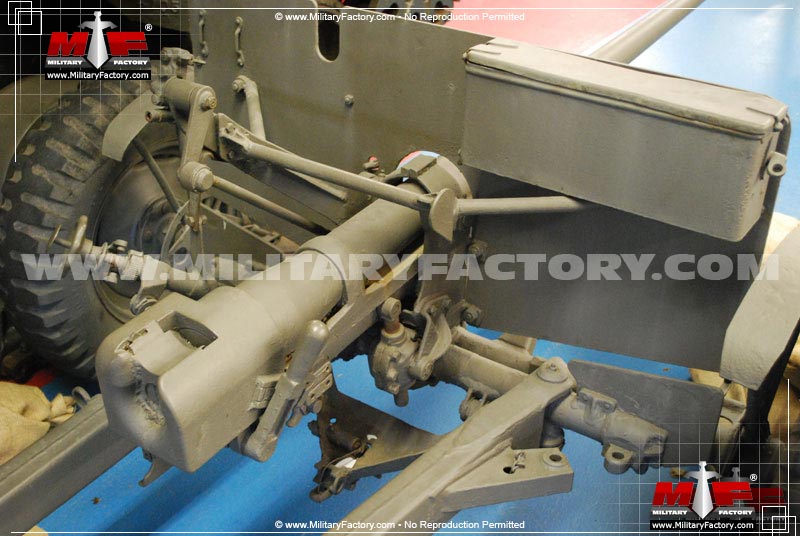
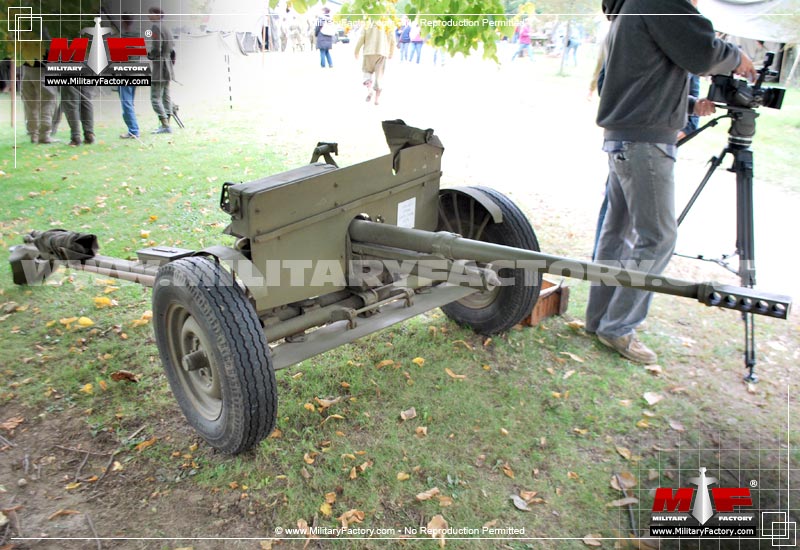
The gun was manufactured by Watervliet Arsenal, New York that was founded in 1813 (and still in service today, though referred to as "America's Cannon Factory"). The barrel was small enough to be forged as a single unit. The decision of the all-important rifling became 12 right-hand twisted grooves and a single turn in 25 calibers. The breech mechanism selected was of the vertical sliding block type. The square breech ring maintained the breech end of the barrel screwed into it. The breech ring was a solid piece with the center removed to allow the block to slide vertically up and down inside it. The vertical type was liked by the crews because the top face of the block could act as a loading tray for the shell, and the block could not jam the trail if the breech was opened at a high elevation. The breech ring and block were designed to withstand the violent rearward caused by the propellant gas pressure when the gun fired. The mechanism was made up of seven main parts: the breech ring, breech block, gearing (to open and close the breech), breech block buffer, extractors (to remove the empty cartridge), devices to limit movement and safety devices to prevent firing until the block and/or gearing was fully closed.

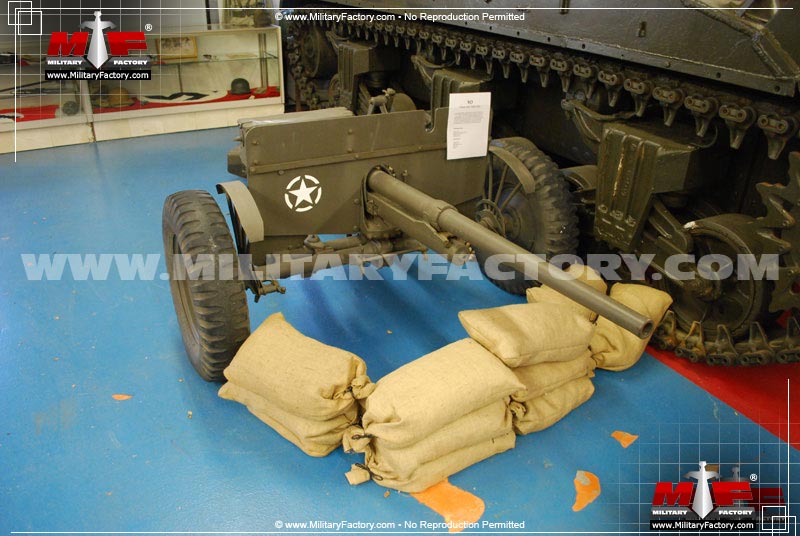
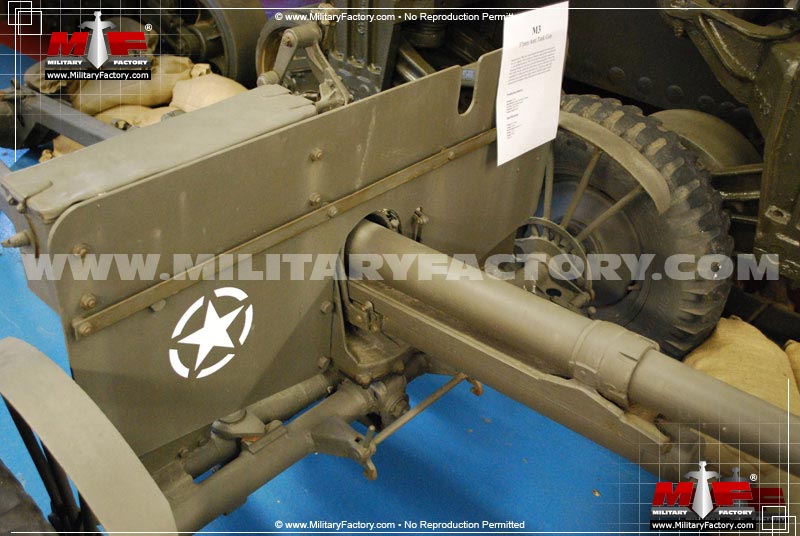
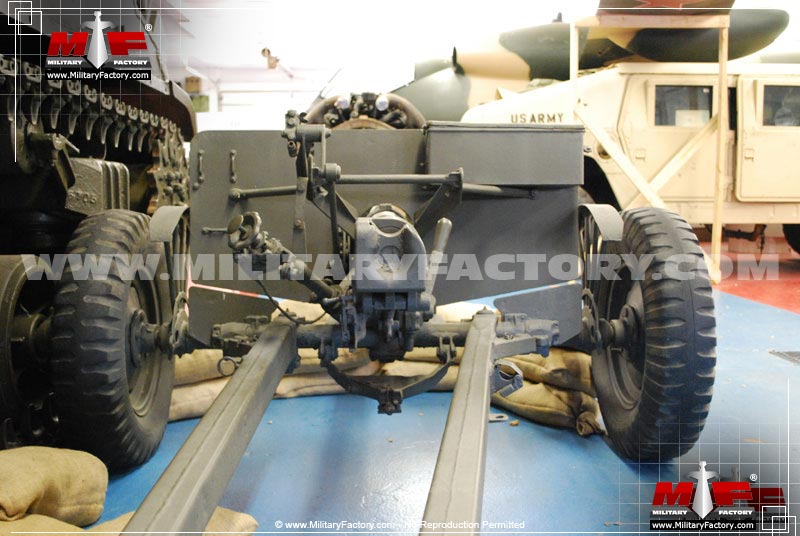
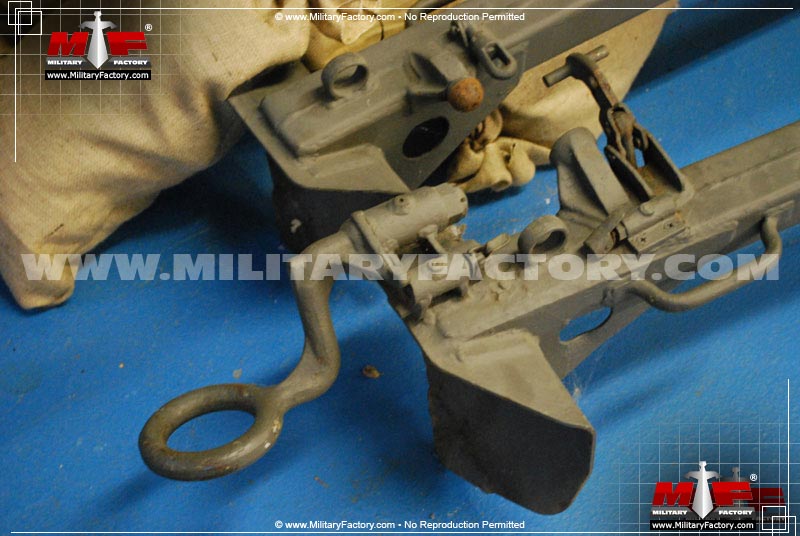
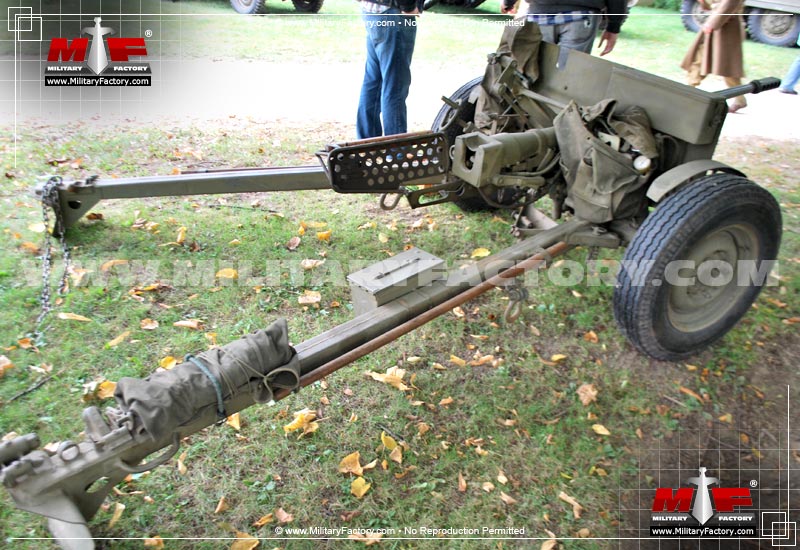
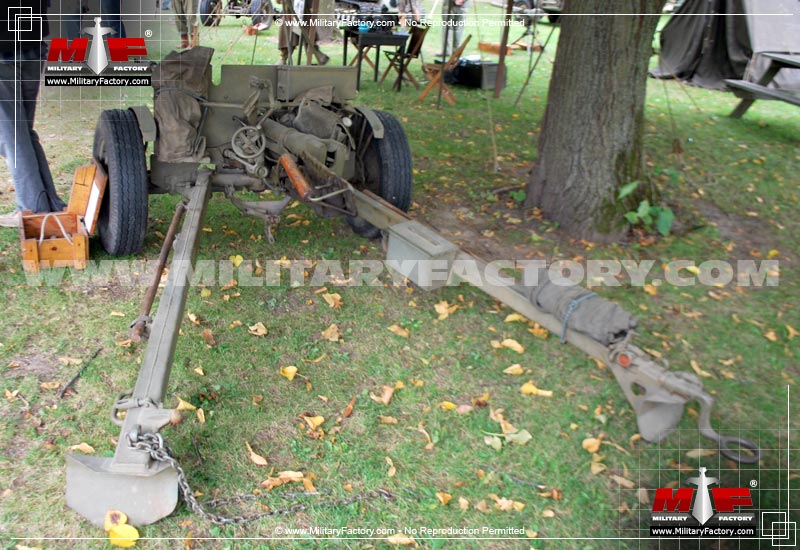
The carriage was built by the Rock Island Arsenal in Illinois. The arsenal started producing ordnance and other military items in the 1880's and is now the largest government-owned weapons manufacturing arsenal in the United States. The carriage was of a split-trail type with pneumatic air-filled tires allowing for better towing by a jeep or truck. When the gun was detached from the towing vehicle, the crew would move the gun into position for firing by hand. For stability, the wheel segment supports mounted on the axle next to the wheels could be lowered to provide a more stable firing position. They could then be raised before the gun was moved to the next firing position.

The telescopic sight and both elevation and traverse controls of 60 degrees were located along the left side of the system so the gunner could aim the weapon. The maximum elevation was +15 degrees and the maximum depression could be -15 degrees. The traverse gear had a release mechanism which allowed free movement of the barrel in case a quick traverse was needed with the normal 5-man crew. Other than practice and dummy rounds, the primary ammunition used with the M3 were made up of three types - the M51 APC, M63 HE and M2 canister projectiles. The M51 anti-tank armor piercing capped shot shell (APC) which weighted 3.48 lbs (1.579 kg) and had steel shot with a 3-second tracer and could penetrate 2.4 inches of armor at 500 yards with a maximum range of 7,500 yards. The M63 was a "general purpose" high explosive (HE) shell weighing 3.13 lbs (1.420 kg) and having a maximum range of 12,800 yards. The explosive round was encased within a steel covering and fitted 0.85 of a pound of TNT with a BD fuse. The M2 canister anti-personnel round weighed 3.49 lbs (1.583 kg) and contained 122 lead balls.

The US Army organized the M3 within infantry anti-tank battalions. Four 37mm guns were assigned to be towed by 1/4-ton jeeps and twelve such guns had 3/4-ton or 2-1/2-ton trucks as their prime movers. A division fielded twenty-four guns with many of these towed by M2 halftracks. By 1942, the Army had formed its first airborne divisions and forty-four M3's were assigned to field parachute artillery. The new 10th Mountain Division had twenty-five of the 37mm guns assigned to its infantry regiments. During 1942, all Army armored divisions had a total of sixty-eight M3's in service. At the beginning of the war, the Marine Corps was committed to using the 20mm gun for the anti tank role but were furnished the newer, more effective 37mm gun within time. By 1943, the 37mm gun had become the AT weapon of choice of the Marines.

In the Battle of Kasserine Pass of 1943 in North Africa, advanced medium and heavy tanks systems fielded by the Germans had already made the 37mm gun a marginal anti-tank weapon. The M3 did prove useful against lighter Italian armored components, however, and was effective against the smaller Renault R35 tanks throughout the Italian Campaign. Similarly, in the Pacific Theater, the Japanese Army was keen on using light tanks and the M3 proved adequate in stopping them. On Guadalcanal, US Marines and, later, the Army, used the M3 with good results against the Type 95, Type 96, and Type 97 tanks with their 12mm armor. The Japanese "banzai" attacks - essentially suicidal front offenses - were perfect for the canister shot of the M3 and, with the system being very mobile, the gun could relatively easily be directed to fire all over the island and against mountain terrain - no Japanese Army cave or pill box was safe. At the Battle of Tarawa, Marines are known to have picked up a M3 over a five foot seawall to fire directly at Japanese bunkers.

If the M3 proved to have a limitation, it was in her rather smallish shield meant to protect the crew against incoming enemy fire. As a result, American Marines would take it upon themselves to weld additional shielding onto the M3 structure. Though this increased her operational weight, it provided priceless protection for her all-important crew.

The M3's wartime service was exceptional and her reach made sure she would be remembered in World War 2 history. Her combat forays made for great marketing and she was introduced within the inventories of foreign nations within time including many American-allied nations in South America. Despite being phased out of service with the American Army soon after the end of World War 2, the M3 survived in a frontline role with other armies into 1970.

Notable operators included the Soviet Union (via Lend-Lease), the United Kingdom, Canada and France. South American operators settling on the M3 included Bolivia, Chile, Columbia and El Salvador. Cuba also armed with the M3 as did China.

T3 was used as the prototype designation. T7 was another prototype but this fitted with a semi-automatic sliding breech. The T8 was yet another prototype but differed in fitting a Nordenfelt sliding breech. The T9 prototype was a 37mm automatic cannon that became the M4 production model. The M10 prototype became the M3 production model and sported the manual vertical block breech. The M3 designation signified the base production series family line. The M3A1 was noted for the introduction of a threaded barrel to accept an optional muzzle brake - this being introduced in 1942. The M5 was a tank-mounted version of the M3 gun with a shorter barrel and introduced in 1939. The M6 was another tank-mounted version with the original barrel length, a semi-automatic breech and introduction beginning in 1940.
Text ©2003-2013 www.MilitaryFactory.com • All Rights Reserved • No Reproduction Permitted
MilitaryFactory.com does NOT sell equipment/weaponry. Material presented throughout this website is for historical and entertainment value and should not to be construed as usable for hardware restoration, maintenance or general operation. Please consult manufacturers for such information. Our disclaimer. Email corrections / Comments to MilitaryFactory at Gmail dot com.
Picture of M3 37mm AT
Pic of the M3 37mm AT
Image of the M3 37mm AT
View All Images (5)

Specifications for the
M3 37mm AT
37mm Anti-Tank Gun


Country of Origin: United States
Manufacturer: Watervliet Arsenal / Rock Island Arsenal - USA
Initial Year of Service: 1940
Production: 18,702


Focus Model: M3 37mm AT
Crew: 5


Overall Length: 12.86ft (3.92m)
Width: 5.28ft (1.61m)
Height: 3.15ft (0.96m)
Weight: 0.5 US Short Tons (413kg; 911lbs)


Powerplant: None. This is a towed system.


Maximum Speed: 0mph (0 km/h)
Maximum Range: 4 miles (7 km)


NBC Protection: None
Nightvision: None


Armament:
1 x 37mm gun barrel

Ammunition types included AP-T, APCBC-T, HE, Canister, practice, drill and blank cartridges.


Ammunition:
Dependent on ammunition type and carrier.


Variants:
T3 - Prototype; initial prototype model.


T7 - Prototype; semi-automatic sliding breech.

T8 - Prototype; fitted with Nordenfelt sliding breech.

T9 - Prototype becoming the M4 production series; 37mm automatic cannon; 1939.

T10 - Prototype becoming the M3 production series; manual vertical block breech.

M3 - Base Series Designation; manually-operated breech.

M3A1 - Threaded barrel for optional muzzle brake; introduced 1942.

M5 - Tank-mounted version; shortened barrel; introduced in 1939.

M6 - Take-mounted version; original barrel length; semi-automatic breech; introduced in 1940.


Operators: Bolivia; China; Canada; Chile; Columbia; Cuba; El Salvador; France; Soviet Union; United Kingom; United States

ALL LAND SYSTEMS CATEGORIES

By Decade:


1910 to 1919
1920 to 1929
1930 to 1939
1940 to 1949
1950 to 1959
1960 to 1969
1970 to 1979
1980 to 1989
1990 to 1999
2000 to 2009
2010 to 2019
VIEW ALL
Compare Tanks


By Type:


4x4 Military Vehicles
6x6 Military Vehicles
8x8 Military Vehicles
Artillery Gun Systems
Anti-Aircraft (AA) Guns
Anti-Aircraft (AA) Vehicles
Anti-Tank (AT) Guns
Anti-Tank (AT) Vehicles
Armored Cars
Armored Personnel Carriers (APC)
Battlefield Robots
Halftrack Vehicles
Heavy Tanks
Infantry Fighting Vehicles (IFV)
Light Tanks
Main Battle Tanks (MBT)
Modern Combat Tanks
Medium Tanks
Military Motorcycles
Multiple Launch Rocket Systems (MLRS)
Reconnaissance Vehicles
Special Purpose Vehicles
Self-Propelled Guns (SPG)
Tank Destroyers
General Purpose / Utility Vehicles


By Nation:


Afghanistan
Britain
China
France
Germany
Iran
Iraq
Israel / Israeli Army
Italy
Libyan Army
North Korea / North Korean Army
Pakistan
Russia
South Korea
Soviet Union
Syrian Army
United States
VIEW ALL

World War 2:


Artillery
Infantry Fighting Vehicles
Tank Destroyers (All)
Tanks (All)
Australian Tanks
British Tanks
Canadian Tanks
Cruiser Tanks (UK)
Czechoslovakian Tanks
French Tanks
German Tanks
German Tank Destroyers
German FlaK Guns
German Reconnaissance Vehicles
Hungarian Tanks
Italian Tanks
Japanese Tanks
Romanian Tanks
Soviet Tanks
Swedish Tanks
US Tanks
VIEW ALL


World War 1:


France WW1 Tanks
Germany WW1 Tanks
Britain WW1 Tanks
US WW1 Tanks
WW1 Artillery
WW1 Tanks (all)
VIEW ALL


Spanish Civil War:

VIEW ALL


Korean War:

Tanks
VIEW ALL


Vietnam War:

VIEW ALL


Cold War:

Cold War Tanks
Cold War American Tanks
Falklands War
Post-WW2 British Tanks
VIEW ALL


Gulf War (1991):

VIEW ALL


Miscellaneous:

Armored Vehicle Chassis Types

Site Disclaimer | Privacy Policy | Site Map | MF Origins


©2013 www.MilitaryFactory.com • Content ©2003-2013 MilitaryFactory.com • All Rights Reserved • Site Contact Email: militaryfactory at gmail dot com. The "Military Factory" name and MilitaryFactory.com logo are registered ® trademarks and protected by all applicable domestic and international intellectual property laws.


Top MF Stuff: 2013 Military Pay Scale | Military Ranks | WW2 Weapons | Sniper Rifles | Kts to Mph | WW1 Aircraft | Automatic Rifles | Aircraft Cockpits | Vietnam War Weapons | Main Battle Tanks | Submachine Guns | Shotguns | French Military Victories


Most photographic images appearing on this site are courtesy of the United States Department of Defense and are approved for public use. Other images acquired through the public domain. Digital art work courtesy of Dan Alex. Business Consulting by Kyle Williams. Material presented throughout this website is for historical and entertainment value and should not to be construed as usable for hardware restoration, maintenance or general operation. Please consult manufacturers for such information.


eXTReMe Tracker