Military Factory
Military Pay Chart
Global Firepower
Military Industrial Complex
Second World War
Home
Military Pay Scale
Military Ranks
Small Arms
Aircraft
Land Systems
Navy
Education
Military Factory Facebook Logo
flag of United States

Half-Track Car M2 / M9 Half-Track Multi-Purpose Armored Personnel Carrier (1940)

Authored By JR Potts, AUS 173d AB | Last Updated: 5/5/2010

The M2 half-track proved just as important to the Allied cause as her German counterparts.

Find a School Near You
Follow Military Factory on Facebook:
Trending on Military Factory:
Recent Articles:
The United States Army learned by experience in World War 1 that trying to move men and machine through mud and snow proved a logistical nightmare. The Army understood the day of the horse drawn limber and caisson had come to an end so a solution was in order. Early attempts at "half-track" vehicles built by the Citroen Company were viewed as crude machines at best - these systems had their rear wheels removed while having applied a kegresse rubber belt installed to provide rear propulsion to, what were essentially, converted commercial automobiles and trucks. However, the new concept finally allowed for more modernized transport over soft or uneven terrain.

In the 1920’s, the US War Department bought a number of these vehicles for evaluation and testing began by the Army Ordnance Department. It became apparent that rubber was not the answer and a metal interlinked caterpillar track was suggested. A prototype with this style of track was built in 1939 by the White Motor Company, a large commercial truck manufacturer of the 1920s. White absorbed smaller truck companies like Autocar, Stearling and Reo and these mounting acquisitions gave White a number of factory locations to make it more susceptible to potentially lucrative Government contracts.

A lightly armored half-track vehicle was a requirement for the burgeoning US Army and there was a deeper need for this vehicle to maintain a dual-purpose role within the ranks. First it would replace the horse and mule as the prime mover for both artillery and supplies and, second, it would serve as an Armored Personal Carrier (APC) with reconnaissance capabilities. The contract went to the White Motor Company who used their own in-house engine for power and took the rear assembly from the T9 half-track truck, connecting it to their existing M3 Scout Car. This clever use of existing components made the assembly much cheaper and allowed the final product to be issued to the Army on schedule. The new vehicle was called the "T7 Half-Track Car" but testing in the field proved it was underpowered for the prime mover role as an artillery tractor. After additional upgrades, including fitting ever larger engines, the final product became the well-known "Half-Track Car M2".

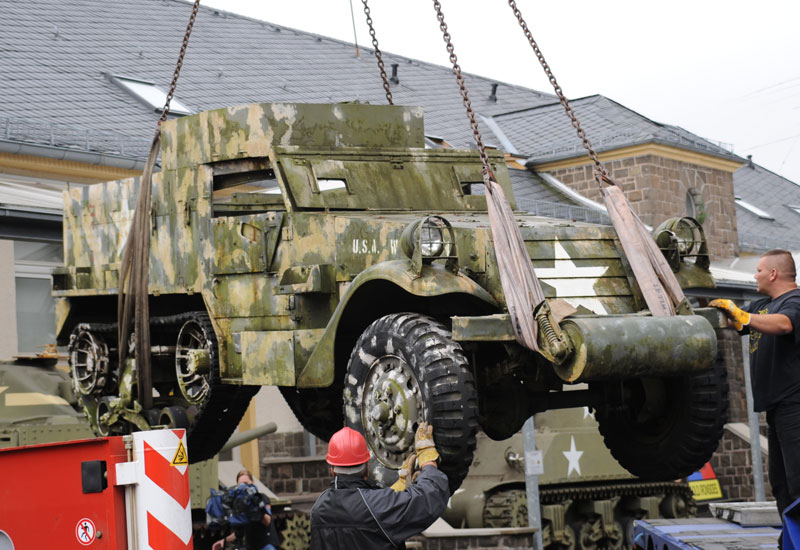
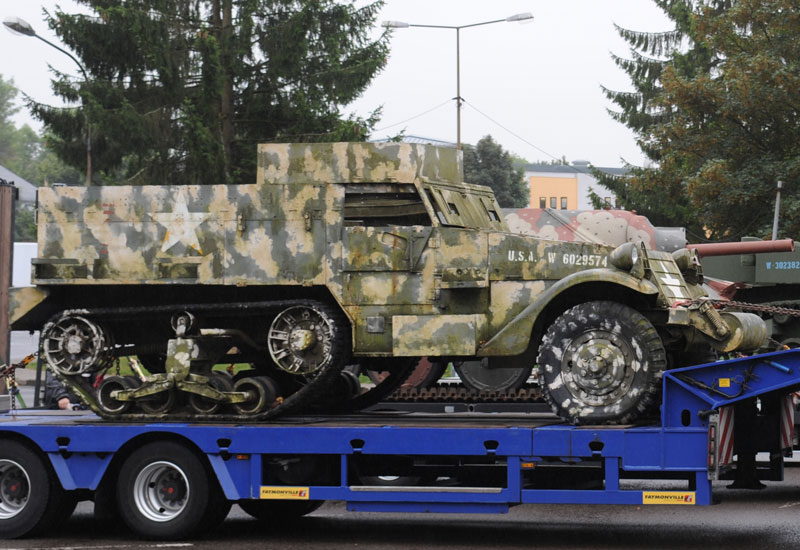
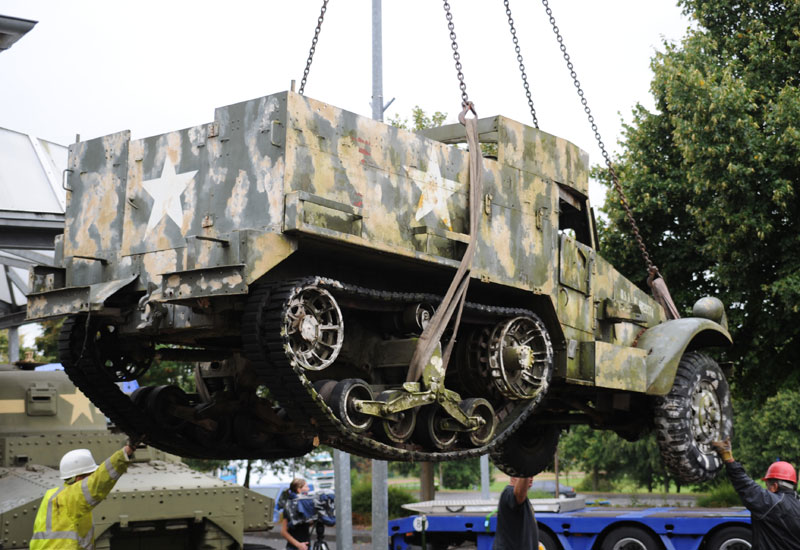
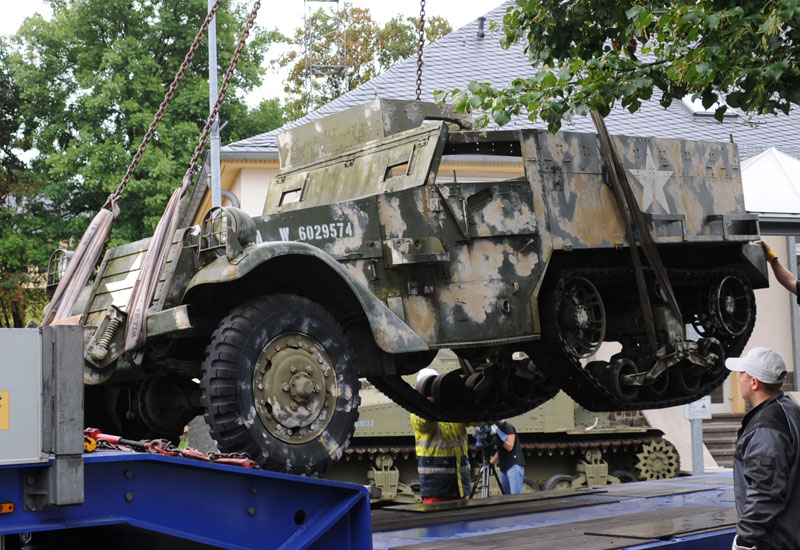
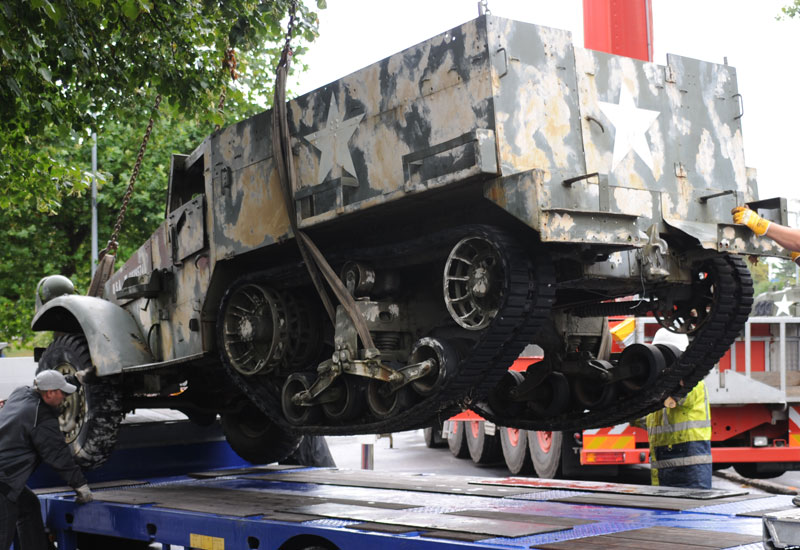
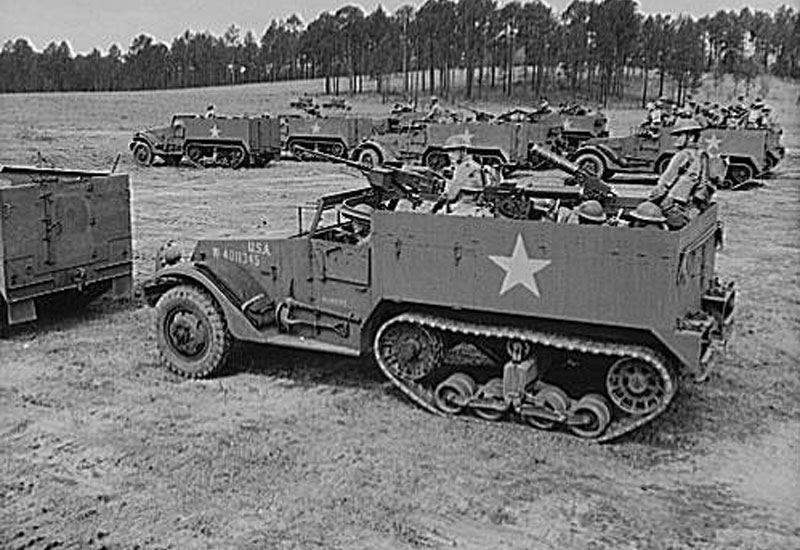
The M2 was a rear track-driven vehicle with a wheeled front axle. She was assigned a base 2-man crew made up of a driver and an assistant driver. A mount for an M2 Browning heavy machine gun was fixed above the forward cab and up to 1,000 rounds of ammunition was generally carried. Seats for seven passengers including applicable field gear could fit in the rear area. The M2 had up to 12mm of armor thickness protecting the crew and passenger areas and up to 6mm of armor around the engine block. The light armor coverage would only protect the crew and passengers from small arms fire and remained open-topped, exposing the passengers to plunging fire or hand thrown explosives. The 147hp engine was powerful enough to move the 9-ton vehicle with nine onboard personnel with supplies some 200 miles at 40mph.

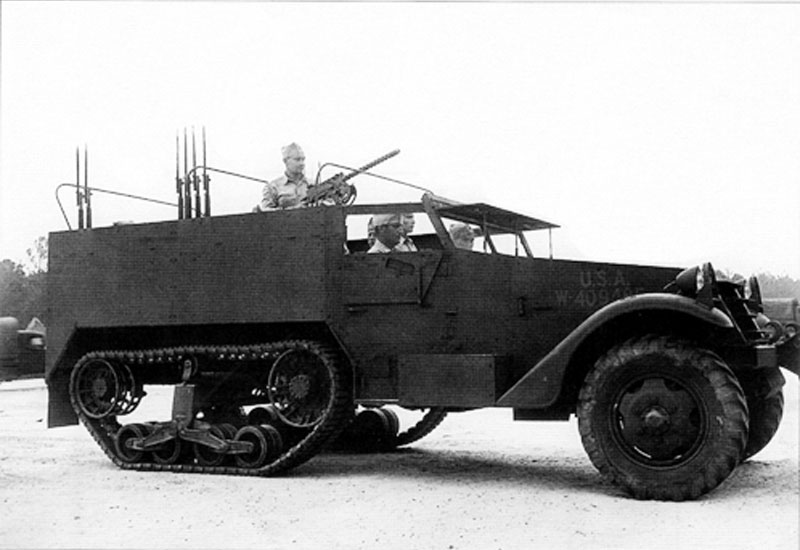
As soon as the M2 entered production and began shipping to US Army posts, the war in Europe had exploded. Requirements for the M2 skyrocketed (via Lend-Lease) to the point that the International Harvester Company received a contract to build the M9, an offshoot of the base M2. The White Company continued what production it could but was already hard at work in designing and developing a newer, larger, and heaver version of the M2 to become the more famous "M3" half-track. Unlike the M2, the M3 would be able to field an entire rifle squad into combat. As the war in Europe, North Africa and the Pacific progressed, there proved the need for a more mobile and adaptable force. As such, the M2 would receive a number of modifications to her armor protection, drive train, engine, and equipment stowage options. Some served as testbeds for anti-aircraft systems that ultimately evolved into production forms on the M3 chassis.

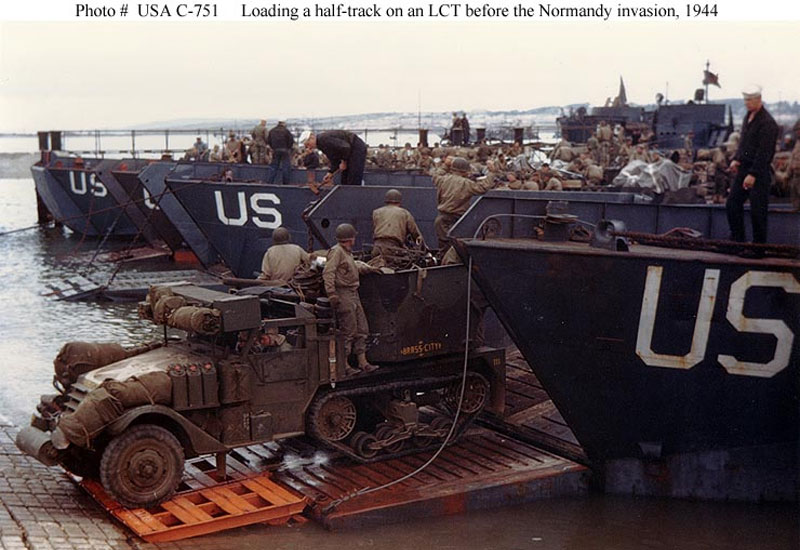
Though the initial M2 offering was a relatively limited one, she served the United States and her allies well throughout the World War 2 effort. The M2 saw combat action in North Africa, Europe and the East Front, supporting both offensives and retreats against a stellar German foe. Similarly, the US Marine Corps in the Pacific utilized the M2 to good effect in their island hopping campaigns, attempting to dislodge a stubborn Japanese defense. With some 13,500 M2’s delivered along with an additional 3,500 M9 copies produced, the vehicle showcased fifty years of dedicated service worldwide. Astoundingly, the series continued to receive modernization upgrades and see active service in Bolivia and other countries as recently as 2006.
Text ©2003-2013 www.MilitaryFactory.com • All Rights Reserved • No Reproduction Permitted
MilitaryFactory.com does NOT sell equipment/weaponry. Material presented throughout this website is for historical and entertainment value and should not to be construed as usable for hardware restoration, maintenance or general operation. Please consult manufacturers for such information. Our disclaimer. Email corrections / Comments to MilitaryFactory at Gmail dot com.
Picture of Half-Track Car M2 / M9
Pic of the Half-Track Car M2 / M9
Image of the Half-Track Car M2 / M9
View All Images (8)

Specifications for the
Half-Track Car M2 / M9
Half-Track Multi-Purpose Armored Personnel Carrier


Country of Origin: United States
Manufacturer: White Motor Company - USA
Initial Year of Service: 1940
Production: 17,000


Focus Model: Half-Track Car M2 / M9
Crew: 2 + 7


Overall Length: 19.55ft (5.96m)
Width: 7.22ft (2.20m)
Height: 7.41ft (2.26m)
Weight: 9.9 US Short Tons (9,000kg; 19,842lbs)


Powerplant: 1 x White 160AX engine delivering 147 horsepower.


Maximum Speed: 40mph (64.37 km/h)
Maximum Range: 199 miles (320 km)


NBC Protection: None
Nightvision: None


Armament:
OPTIONAL:
1 x 0.50 caliber (12.7mm) M2 Browning heavy machine gun.


Ammunition:
1,000 x 0.50 caliber (12.7mm) ammunition


Variants:
T14 - Prototype appearing in 1931; White Scout Car M3 hull with Kegresse half-track suspension system.


Half-Track Car M2 - Base series designation; fitted with White 160AX engine; 1 x M2HB .50 caliber machine gun.

M2A1 - M49 machine gun mounting; optional field 3 x firing pintle mounts (.30 cal).

Half-Track Personnel Carrier M9 (M2E5) - Lend-Lease M2 half-track produced by International Harvester; sans short hull and rear access door; revised interior layout.

Half-Track Personnel Carrier M9A1 - Fitted with M49 machine gun mounting; rear access door; similar to M2A1.

Half-Track M4 - Mortar Carrier for 81mm M1 mortar; based on M2 chassis; dismounted firing allowed.

Half-Track M4A1 - Mortar Carrier for 81mm M1 mortar; based on M2 chassis; vehicle firing allowed.

T1E1 - Anti-Aircraft Prototype; based on the M2 chassis; Bendix mounting with 2 x M2 12.7mm heavy machine guns; single prototype.

T1E2 - Anti-Aircraft Prototype; based on the M2 chassis; Maxson M33 mounting with 2 x M2 12.7mm machine guns.

T1E3 - Anti-Aircraft Prototype; based on the M2 chassis; Martin mounting as in B-17 bomber; single prototype.

T28 CGMC - M2 chassis mounted with M1A2 37mm autocannon and 2 x 12.7mm machine guns; never quantitatively produced.

T10 - Test Bed for Hispano-Suiza HS.404 series 20mm cannon with Maxson gun mount.


Operators: Argentina; Belgium; Bolivia; Cambodia; Chile; Czechoslovakia; France; Greece; Israel; Laos; Lebanon; Mexico; Netherlands; Nicaragua; Portugal; Poland; South Vietnam; Soviet Union; United Kingdom; United States

ALL LAND SYSTEMS CATEGORIES

By Decade:


1910 to 1919
1920 to 1929
1930 to 1939
1940 to 1949
1950 to 1959
1960 to 1969
1970 to 1979
1980 to 1989
1990 to 1999
2000 to 2009
2010 to 2019
VIEW ALL
Compare Tanks


By Type:


4x4 Military Vehicles
6x6 Military Vehicles
8x8 Military Vehicles
Artillery Gun Systems
Anti-Aircraft (AA) Guns
Anti-Aircraft (AA) Vehicles
Anti-Tank (AT) Guns
Anti-Tank (AT) Vehicles
Armored Cars
Armored Personnel Carriers (APC)
Battlefield Robots
Halftrack Vehicles
Heavy Tanks
Infantry Fighting Vehicles (IFV)
Light Tanks
Main Battle Tanks (MBT)
Modern Combat Tanks
Medium Tanks
Military Motorcycles
Multiple Launch Rocket Systems (MLRS)
Reconnaissance Vehicles
Special Purpose Vehicles
Self-Propelled Guns (SPG)
Tank Destroyers
General Purpose / Utility Vehicles


By Nation:


Afghanistan
Britain
China
France
Germany
Iran
Iraq
Israel / Israeli Army
Italy
Libyan Army
North Korea / North Korean Army
Pakistan
Russia
South Korea
Soviet Union
Syrian Army
United States
VIEW ALL

World War 2:


Artillery
Infantry Fighting Vehicles
Tank Destroyers (All)
Tanks (All)
Australian Tanks
British Tanks
Canadian Tanks
Cruiser Tanks (UK)
Czechoslovakian Tanks
French Tanks
German Tanks
German Tank Destroyers
German FlaK Guns
German Reconnaissance Vehicles
Hungarian Tanks
Italian Tanks
Japanese Tanks
Romanian Tanks
Soviet Tanks
Swedish Tanks
US Tanks
VIEW ALL


World War 1:


France WW1 Tanks
Germany WW1 Tanks
Britain WW1 Tanks
US WW1 Tanks
WW1 Artillery
WW1 Tanks (all)
VIEW ALL


Spanish Civil War:

VIEW ALL


Korean War:

Tanks
VIEW ALL


Vietnam War:

VIEW ALL


Cold War:

Cold War Tanks
Cold War American Tanks
Falklands War
Post-WW2 British Tanks
VIEW ALL


Gulf War (1991):

VIEW ALL


Miscellaneous:

Armored Vehicle Chassis Types

Site Disclaimer | Privacy Policy | Site Map | MF Origins


©2013 www.MilitaryFactory.com • Content ©2003-2013 MilitaryFactory.com • All Rights Reserved • Site Contact Email: militaryfactory at gmail dot com. The "Military Factory" name and MilitaryFactory.com logo are registered ® trademarks and protected by all applicable domestic and international intellectual property laws.


Top MF Stuff: 2013 Military Pay Scale | Military Ranks | WW2 Weapons | Sniper Rifles | Kts to Mph | WW1 Aircraft | Automatic Rifles | Aircraft Cockpits | Vietnam War Weapons | Main Battle Tanks | Submachine Guns | Shotguns | French Military Victories


Most photographic images appearing on this site are courtesy of the United States Department of Defense and are approved for public use. Other images acquired through the public domain. Digital art work courtesy of Dan Alex. Business Consulting by Kyle Williams. Material presented throughout this website is for historical and entertainment value and should not to be construed as usable for hardware restoration, maintenance or general operation. Please consult manufacturers for such information.


eXTReMe Tracker