Military Factory
Military Pay Chart
Global Firepower
Military Industrial Complex
Second World War
Home
Military Pay Scale
Military Ranks
Small Arms
Aircraft
Land Systems
Navy
Education
Military Factory Facebook Logo
flag of United States

M19 Gun Motor Carriage (M19 Twin 40mm) Self-Propelled Anti-Aircraft Artillery (1945)

Authored By Staff Writer | Last Updated: 12/11/2010

The M19 Twin 40mm was ready for action by April of 1945 but the end of the war limited its reach and production to just 300 systems.

The M19 Twin 40mm (M19 Gun Motor Carriage) self-propelled anti-aircraft system was developed towards the tail-end of World War 2 and made available in April of 1945. However, the war in Europe more-or-less ended the following month and the Empire of Japan capitulated in August of that same year, ending the war in the Pacific. As such, only three-hundred total M19 systems were delivered from the 904 that were initially ordered. The series would continue to serve in the post-war world and see service into the 1950s with the United States Army.

Design and Development

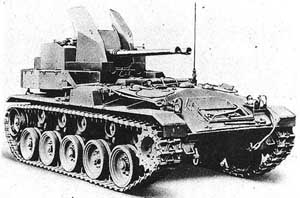
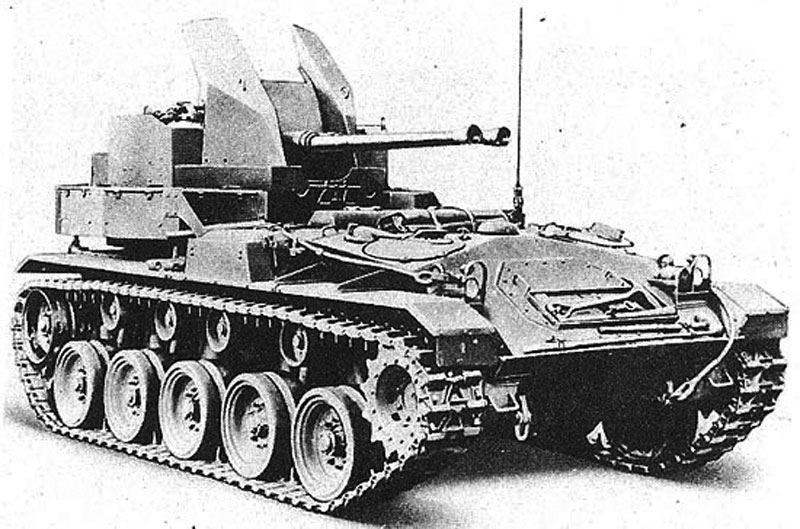
The M19 was developed to provide the US Army with a mobile, self-propelled, medium-class, anti-aircraft artillery system. The system in question would supply a defensive measure against low-flying enemy aircraft, protecting US Army motor columns in transit. The system was to be tracked in nature, allowing for some level of high mobility through those hard-to-traverse off road locales while still keeping up with motor columns on road. To speed along both development and production, the chassis of the M24 Chaffee light tank was selected as the starting point. The Chaffee hull was lengthened to an extent and had its engine placement relocated to the area behind the driver's position. Essentially, the engine compartment now divided the forward hull from the rear. The driver would control the vehicle via steering levers. In all, six personnel made up the crew complement of the M19 including the driver, an assistant driver (seated in the forward hull with the driver), two gunners seated side-by-side in the turret and two loaders seated side-by-side in the turret. Hull construction was of welded rolled homogenous steel offering armor protection levels up to 0.5-inches thick along the critical facings and less along the rear top. The turret was also of rolled homogenous steel with armor protection ranging from 0.25-inches thick along the sides of the gun shield to 0.5-inches along the front of the gun shield. The M19 was standardized in June of 1944 and orders for several hundred systems were placed by August of 1944 with production slated to begin in April of 1945. The M19 was intended to replace the Combination Gun Motor Carriage M15A1 series.

Armament

The rear of the hull was occupied by a power-operated, 360-degree traversing open-air turret system mounting a pair of 40mm M2 Dual Automatic Guns (essentially Bofors 40mm antiaircraft cannons in the US Army inventory) in an M4 mounting. The turret featured an elevation function of +85-degrees to -3-degrees using manual and hydraulic means (covering 40-degrees per second). The weapon systems were tied to the M13 or M13A1 fitting the M23 or M24 reflex sights. Each 40mm cannon was fed via a clip containing the 40mm ammunition and operated by way of an automatic loader. Each clip held four rounds while the automatic loader had room for seven. The barrels were rated to fire up to 120 rounds-per-minute. Three hundred fifty-two 40mm projectiles were carried aboard the M19 itself while a further 320 rounds could be accessed through use of a special towed M28 trailer.

Ammunition

The M2 made use of a 40mm AP (Armor-Piercing) or a 40mm HE (High-Explosive) shell with a muzzle velocity of 2,870 feet per second. The AP had a range out to 9,475 yards while the HE had a range out to 10,820 yards. Vertical range was limited to 7,625 yards.

Tracks and Suspension

The M19 sat on either the T72 or T85E1 series track with a width of 16- or 14-inches respectively. Suspension was of the torsion bar variety making use of five individually sprung road wheels to a track side. There was a drive sprocket fitted to the front with the idler at the rear. Four track return rollers were used. Shock absorbers were located along the first two and last two wheels on each respective track side.

Powerplant and Performance

Power was derived from a pair of Cadillac Series 44T4 16-cylinder, 4-cycle, 90-degree Vee gasoline engine delivering 110 horsepower at 3,400rpm. The powerplant was tied to a Twin Hydraulic transmission system featuring eight forward speeds and four reverse speeds. This provided for a road speed of 35 miles per hour with a road range of approximately 100 miles off of the internal 110-gallon fuel tank. Maximum grade traversing was rated at 60% while trenches up to 108-inches could be conquered. Maximum vertical obstacle height was 40-inches while fording depth was limited to 42-inches.

The Improved M19A1

The M19 was revised with the addition of a 200-amp auxiliary engine-driven generator (situated on the right fender) to become the M19A1. Additionally, some of the communications equipment was moved to blister positions along the turret. A visually differentiating feature between the M19 and M19A1 became her different exhaust pipes. The M19 featured these as two units running around each side of the front of the turret while the M19A1 sported both of these pipes along the left side of the vehicle. In all, however, the M19A1 differed only slightly in overall design when compared to her predecessor.

Cadillac Motor Car Division of General Motors Corporation headed up all production of the M19 series for the US Army.
Text ©2003-2013 www.MilitaryFactory.com • All Rights Reserved • No Reproduction Permitted
MilitaryFactory.com does NOT sell equipment/weaponry. Material presented throughout this website is for historical and entertainment value and should not to be construed as usable for hardware restoration, maintenance or general operation. Please consult manufacturers for such information. Our disclaimer. Email corrections / Comments to MilitaryFactory at Gmail dot com.
Picture of M19 Gun Motor Carriage (M19 Twin 40mm)
Pic of the M19 Gun Motor Carriage (M19 Twin 40mm)
View All Images (2)

Specifications for the
M19 Gun Motor Carriage (M19 Twin 40mm)
Self-Propelled Anti-Aircraft Artillery


Country of Origin: United States
Manufacturer: Cadillac Motor Car Division of General Motors Corporation - USA
Initial Year of Service: 1945
Production: 300


Focus Model: M19 Gun Motor Carriage (M19 Twin 40mm)
Crew: 6


Overall Length: 19.07ft (5.81m)
Width: 9.58ft (2.92m)
Height: 9.75ft (2.97m)
Weight: 19.8 US Short Tons (18,000kg; 39,683lbs)


Powerplant: 2 x Cadillac 44T24 V-9 90-degree engine delivering 110 horsepower @ 3,400rpm.


Maximum Speed: 35mph (56 km/h)
Maximum Range: 99 miles (160 km)


NBC Protection: None
Nightvision: None


Armament:
2 x 40mm M2 Dual Automatic Guns


Ammunition:
352 x 40mm projectiles internally
320 x 40mm projectiles via M28 trailer


Variants:
M19 - Base Production Model Designation


M19A1 - Relocated radio equipment to turret blisters; addition of a 200-amp auxiliary engine-driven generator.

M19 Gun Motor Carriage - Formal US Army Designation.


Operators:
United States

ALL LAND SYSTEMS CATEGORIES

By Decade:


1910 to 1919
1920 to 1929
1930 to 1939
1940 to 1949
1950 to 1959
1960 to 1969
1970 to 1979
1980 to 1989
1990 to 1999
2000 to 2009
2010 to 2019
VIEW ALL
Compare Tanks


By Type:


4x4 Military Vehicles
6x6 Military Vehicles
8x8 Military Vehicles
Artillery Gun Systems
Anti-Aircraft (AA) Guns
Anti-Aircraft (AA) Vehicles
Anti-Tank (AT) Guns
Anti-Tank (AT) Vehicles
Armored Cars
Armored Personnel Carriers (APC)
Battlefield Robots
Halftrack Vehicles
Heavy Tanks
Infantry Fighting Vehicles (IFV)
Light Tanks
Main Battle Tanks (MBT)
Modern Combat Tanks
Medium Tanks
Military Motorcycles
Multiple Launch Rocket Systems (MLRS)
Reconnaissance Vehicles
Special Purpose Vehicles
Self-Propelled Guns (SPG)
Tank Destroyers
General Purpose / Utility Vehicles


By Nation:


Afghanistan
Britain
China
France
Germany
Iran
Iraq
Israel / Israeli Army
Italy
Libyan Army
North Korea / North Korean Army
Pakistan
Russia
South Korea
Soviet Union
Syrian Army
United States
VIEW ALL

World War 2:


Artillery
Infantry Fighting Vehicles
Tank Destroyers (All)
Tanks (All)
Australian Tanks
British Tanks
Canadian Tanks
Cruiser Tanks (UK)
Czechoslovakian Tanks
French Tanks
German Tanks
German Tank Destroyers
German FlaK Guns
German Reconnaissance Vehicles
Hungarian Tanks
Italian Tanks
Japanese Tanks
Romanian Tanks
Soviet Tanks
Swedish Tanks
US Tanks
VIEW ALL


World War 1:


France WW1 Tanks
Germany WW1 Tanks
Britain WW1 Tanks
US WW1 Tanks
WW1 Artillery
WW1 Tanks (all)
VIEW ALL


Spanish Civil War:

VIEW ALL


Korean War:

Tanks
VIEW ALL


Vietnam War:

VIEW ALL


Cold War:

Cold War Tanks
Cold War American Tanks
Falklands War
Post-WW2 British Tanks
VIEW ALL


Gulf War (1991):

VIEW ALL


Miscellaneous:

Armored Vehicle Chassis Types

Site Disclaimer | Privacy Policy | Site Map | MF Origins


©2013 www.MilitaryFactory.com • Content ©2003-2013 MilitaryFactory.com • All Rights Reserved • Site Contact Email: militaryfactory at gmail dot com. The "Military Factory" name and MilitaryFactory.com logo are registered ® trademarks and protected by all applicable domestic and international intellectual property laws.


Top MF Stuff: 2013 Military Pay Scale | Military Ranks | WW2 Weapons | Sniper Rifles | Kts to Mph | WW1 Aircraft | Automatic Rifles | Aircraft Cockpits | Vietnam War Weapons | Main Battle Tanks | Submachine Guns | Shotguns | French Military Victories


Most photographic images appearing on this site are courtesy of the United States Department of Defense and are approved for public use. Other images acquired through the public domain. Digital art work courtesy of Dan Alex. Business Consulting by Kyle Williams. Material presented throughout this website is for historical and entertainment value and should not to be construed as usable for hardware restoration, maintenance or general operation. Please consult manufacturers for such information.


eXTReMe Tracker