The Dardo Infantry Fighting Vehicle (IFV) is part of the family of like-designed armored vehicles that include the tracked Ariete Main Battle Tank and the wheeled Centauro mobile tank killer. Like these systems, the Dardo is also a joint product by the Italian consortium involving IVECO and Oto Melara. Iveco handled the development of the hull and engine as well as related subsystems whereas Oto Melara was charged with the vehicle's armament and applicable subsystems. The Dardo entered service with the Italian Army in 1998 and has since seen combat service with Italian troops in both Iraq and Afghanistan as well as with the United Nations as part of the UNIFIL temporary contingent in Lebanon.
Development
Development of the Dardo was handled by Consorzio IVECO Oto. The system was developed in response to an Italian Army need for a capable Infantry Fighting Vehicle to replace their modernized though aging M113 series of armored personnel carriers (designated in Italian service as VCC). The contract was officially handed down to Otobreda and IVECO in 1992 to which three prototypes were developed and completed under the designation of VCC-80. Evaluation trials followed and it was then decided to further the VCC-80 chassis design into an improved armored infantry fighting vehicle with better offensive capabilities more in line with a standard main battle tank. In 1998, Consorzio IVECO Oto was given the contract for 200 production vehicles to be known as the Dardo IFV. Like other armored vehicles of this class, the Dardo chassis would also be converted for use as a battlefield ambulance, mobile command post and 120mm mortar carrier. Varying turret options could also be made available to aspiring customers that include a 30mm Bushmaster II series weapon system and a 60mm high-velocity gun weapon system.
Dardo Walk-Around
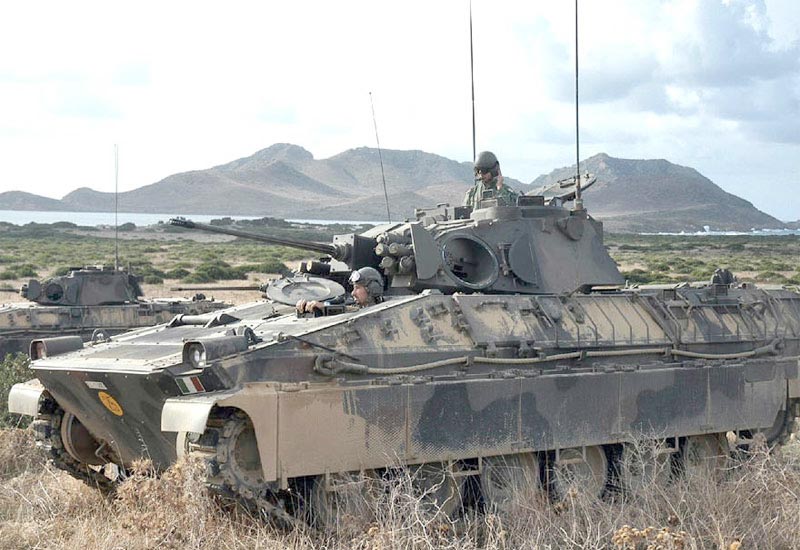
Externally, the Italian Dardo retains a very basic and utilitarian appearance, though still conventional in the field of infantry fighting vehicles to say the least. The hull supplies a low profile and sports angled armored surfaces as well as side skirts. The driver sits offset to the left, just ahead of the turret, with the powerpack to his right (noted by the exhaust screen along the right side of the hull). The glacis plate is broad and highly angled to promote excellent deflection capabilities as well as a sleek forward profile. Headlamps are situated at the extreme corners of the forward hull. The turret and the hull are both constructed with all-welded aluminum armor and furthered backed by bolt-on armor to the critical facings. Though allowing for an overall lighter operating weight, the use of aluminum armor in the design provides for a certain level of vulnerability on the battlefield - to both its delicate systems and crew alike. Suspension is of the hydropneumatic torsion bar type and assists the six rubber-tired dual road wheels to a track side. The drive sprocket is forward while the idler is to the rear while the track network is complimented by three return rollers to each track side.
The Dardo keeps a standard crew of three made up by a commander, driver and gunner. Available seating for passengers is six, all located in the rear hull. The passengers have access to six firing ports from which to train their personal weapons from - two along either hull side and one at the rear entry access ramp. The rear entry access ramp is fully-powered and provides the primary means for entry/exit the Dardo's combat ready troops. The rear ramp also maintains a manually-operated inset door for emergency exit. There is also a hatch above the rear crew compartment which serves the crew to load and reload the optional single-shot TOW missile launchers mounted externally. The crew has access to an air conditioning system, integrated NBC protection, passive night-vision (driver, gunner and commander) and an automated fire extinguisher system.
The powered two-man TC 25 series turret from Oto Breda rests in its ring just aft of the driver at about the middle of the hull. The commander and gunner both take their positions in this system with the commander seated left and the gunner to his immediate right. Main armament is an Oerlikon Contraves Type KBA 25mm dual-feed autocannon capable of up to 600 rounds per minute. Some 200 25mm projectiles are held in the turret. The cannon is stabilized along both axis and has elevation from -10 to +60 degrees. The main gun is assisted by the Galileo Avionic (originally known as Oficine Galileo) "HITFIST" fire control system developed from the VCC-80. A thermal imaging system and laser range finder also work in conjunction with the gunner's skill to help deliver accurate results and the cannon can attack both lightly-armored land vehicles and low-flying aircraft with equal lethality.
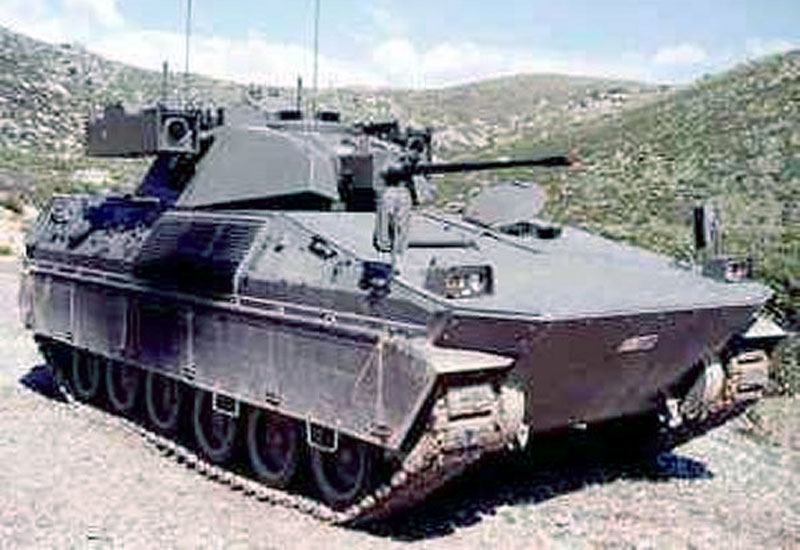
A co-axial MG 42/59 series 7.62mm machine gun is fitted to the left of the main gun and has 700 rounds available in its stores. An additional 7.62mm defensive machine gun can be added to an external weapon station fitting along the top of the turret. Rectangular single-shot Hughes TOW anti-tank missile launchers are optional and promote the Dardo's tank killer and battlefield self-preservation capabilities. These launchers are also positional from -7.5 to +30 degrees and independent of the main armament's current attack angle. Self-defense is complimented by 8 x 80mm smoke grenade dischargers mounted at the front of the turret (in a quad grouping) or straddling the sides of the turret (in line).
Powerpack
Power is supplied by a single Iveco-Fiat liquid-cooled V6 MYCA turbodiesel engine developing 512 horsepower tied to an automatic transmission system. The powerplant provides the Dardo with a top speed of 43.5 miles per hour and a range of 311 miles. Of note is that this Iveco-Fiat development is also the powerplant of choice for the Centauro 8x8 tank killer. Fording depth is listed at just under five feet and the Dardo is rated against gradients of 60 percent. Vertical obstacle crossing is 2 feet, 9 inches while trench crossings of 8 feet, 2 inches round out its performance capabilities.
Conclusion
As with most any new battlefield implement, only direct combat and active operations will prove the Dardo IFV a sound design or not. It has proven successful in its previous actions across Lebanon, Iraq and Afghanistan to this point.
Power & Performance Those special qualities that separate one land system design from another. Performance specifications presented assume optimal operating conditions for the CIO Dardo Infantry Fighting Vehicle (IFV).
1 x Iveco - Fiat 6V MTCA turbodiesel engine developing 512 horsepower driving conventional wheeled arrangement. Installed Power
43 mph 70 kph Road Speed
373 miles 600 km Range
Structure The physical qualities of the CIO Dardo Infantry Fighting Vehicle (IFV).
3 (MANNED) Crew
22.0 ft 6.7 meters O/A Length
9.8 ft 3 meters O/A Width
8.7 ft 2.64 meters O/A Height
51,588 lb 23,400 kg | 25.8 tons Weight
Armament & Ammunition Available supported armament, ammunition, and special-mission equipment featured in the design of the CIO Dardo Infantry Fighting Vehicle (IFV).
STANDARD:
1 x 25mm Oerlikon Contraves KBA dua-feed automatic cannon in front turret face.
1 x 7.62mm MG 42/59 co-axial machine gun in front turret face.
8 x Smoke Grenade Dischargers on turret sides.
OPTIONAL:
1 x 7.62mm MG 42/59 pintle-mounted external machine gun.
2 x Hughes TOW anti-tank single-shot missile launchers.
PROPOSED:
1 x 60mm High-Velocity Gun System
1 x 30mm Bushmaster II autocannon
1 x 150mm main gun (Light Tank)
1 x 120mm mortar (mortar carrier)
AMMUNITION: 200 x 25mm projectiles.
700 x 7.62mm ammunition.
Variants Notable series variants as part of the CIO Dardo family line.
VCC-80 IV - Developmental Designation
Dardo IFV - Base Infantry Fighting Vehicle
Dardo (120mm) - Proposed Variant
Dardo C3I - Proposed Command Vehicle
Dardo (LT) - Proposed Light Tank Variant; fitting a 105mm main gun.
Dardo (Ambulance) - Proposed Ambulance Variant
Operators Global customers who have evaluated and/or operated the CIO Dardo. Nations are displayed by flag, each linked to their respective national land systems listing.
Total Production: 200 Units Contractor(s): Iveco-Fiat-OTO-Melara Syndicated Company (CIO) - Italy
[ Italy ]
1 / 2
Front left side view of the Dardo IFV; note drivers position along upper hull and smoke grenade dischargers along front turret
2 / 2
Front right side view of the Dardo IFV; note single-shot TOW anti-tank missile launchers and side exhaust grill
The "Military Factory" name and MilitaryFactory.com logo are registered ® U.S. trademarks protected by all applicable domestic and international intellectual property laws. All written content, illustrations, and photography are unique to this website (unless where indicated) and not for reuse/reproduction in any form. Material presented throughout this website is for historical and entertainment value only and should not to be construed as usable for hardware restoration, maintenance, or general operation. We do not sell any of the items showcased on this site. Please direct all other inquiries to militaryfactory AT gmail.com. No A.I. was used in the generation of this content.