The Vickers 6-Ton (Mark E) was a light tank evaluated by the British Army but ultimately rejected. When the British Army passed on the system, the tank was marketed (with success) to operators around the globe. The system went on to serve its owners well and was even license-produced in the Soviet Union under the designation of "T-26" where it was produced in over 10,000 examples as well as undergoing series production in Poland (as the improved "7TP"). Behind the French-built Renault FT-17 light tank, the Vickers Mark E represented the second most quantitatively-produced tank system of the 1930s. Its reach was such that the little three-man tank saw combat in the Bolivia-Paraguay "Chaco War" of 1933, the 2nd Sino-Japanese War 1937, the Winter War between Finland and the Soviet Union and the French-Thai War of 1941. Approximately 158 examples were produced - not counting license production of the type by foreign operators, which raised the total into the thousands.
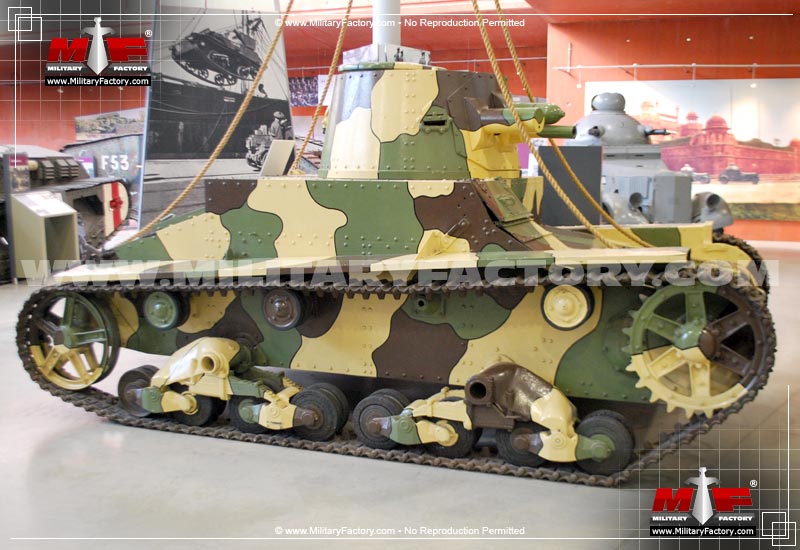
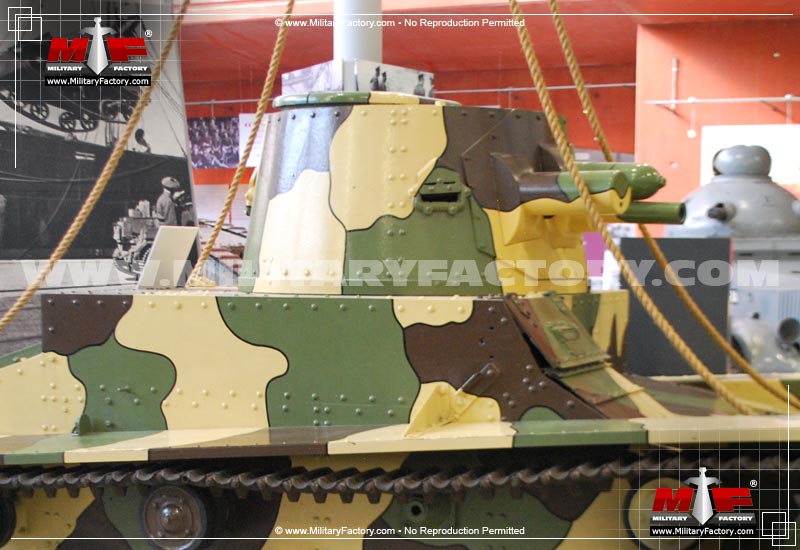
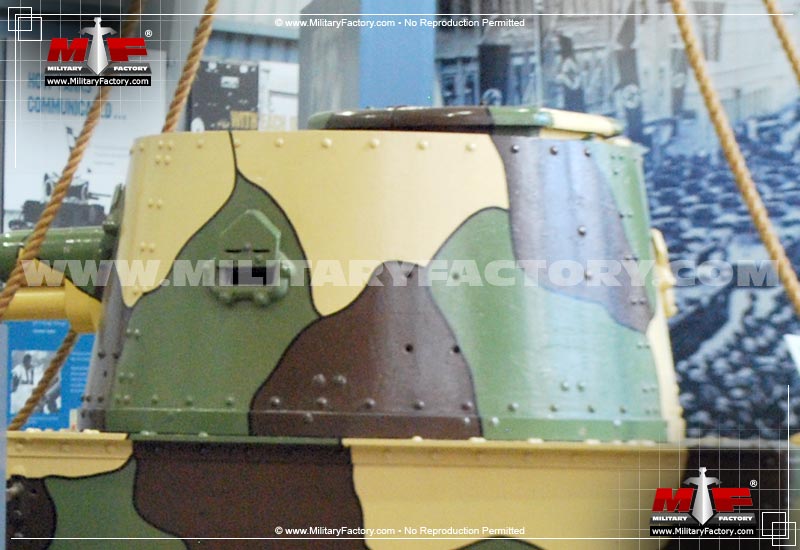
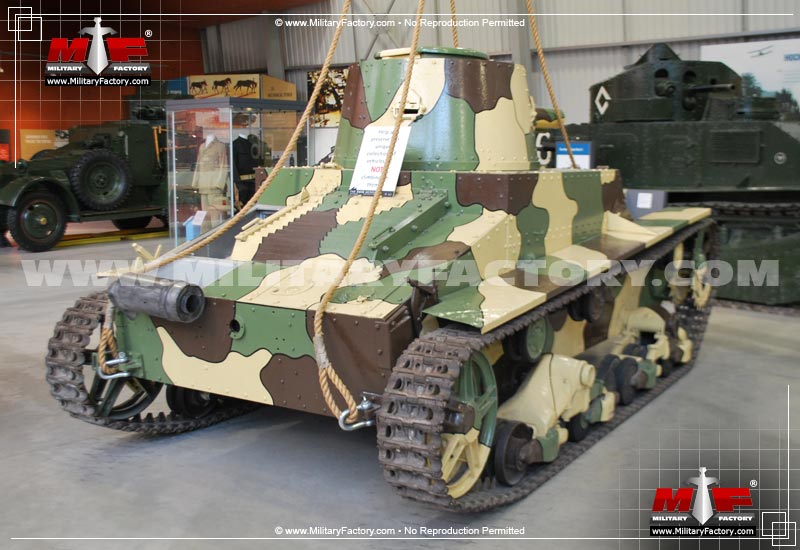
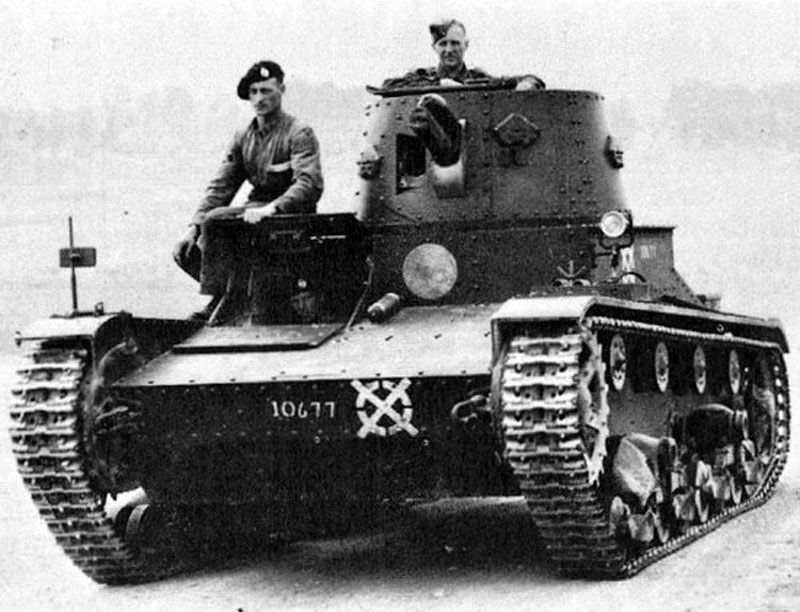
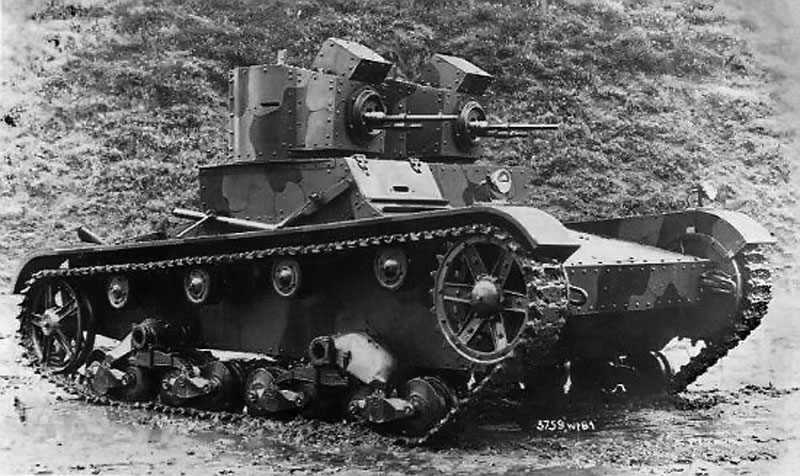
The Mark E began life as a private venture of the Vickers company, a firm which included engineers Vivian Loyd and John Valentine Carden (names prefacing the designation of the classic 1929 Carden-Loyd "tankette" series). The prototype was developed in 1928 and produced in two very distinct forms. The first, designated as "Type A", was interestingly fitted with two individual turrets each mounting a Vickers-brand 7.7mm machine gun. The second, designated as the "Type B", was of a more modern breed with a short-barreled 47mm main gun and a Vickers 7.7mm machine gun, both fixed into a single two-man turret system. This armament would become known as "duplex mounting" - quite a departure from past tank design approaches. Mounting both armament types into one centralized location allowed the crew to bring concentrated firepower to bear. The idea of designing a turret to contain more than one crew was also something of a departure from the norm. It allowed the turret crew greater ease of communication when engaging and firing on targets, directly producing a better rate-of-fire. The turret was mounted on a smallish superstructure protruding from the center of the upper hull. The crew was made up of three personnel, with two of these situated inside of the turret and the third acting as driver in the hull, offset to the right side of the superstructure. The driver controlled the tank via a clutch and brake system. Communications between the crewmembers was via a "Laryngophone" system.
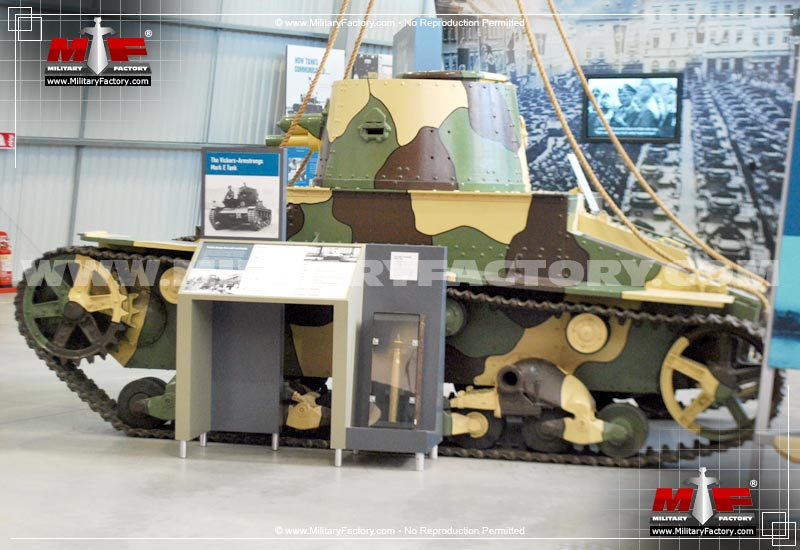
In either case, power was supplied to the tank via a single Armstrong Siddeley Puma gasoline engine of 80 to 95 horsepower (output differed based on tank version). The engine was separated from the crew compartment via a firewall and fitted to the rear of the hull. This allowed for a listed top speed of over 17 miles per hour with a 124 mile range. Armor thickness was impressive and ranged from 19mm at the rear to 25mm along the front facings. The hull was riveted and made of steel plates. Eight road wheels were fitted to a side in pairs and the track arrangement produced the distinct "hull-up" appearance common in early post-World War 1 tanks. The drive sprocket was fitted to the front of the hull. The suspension system was of a leaf spring bogie design which was itself another departure from the proven Christie form common to many preceding and current tank designs of the time.
The British Army took a close look at the Mark E. While the type offered up excellent range and good speed, the British Army was not sold on the unique suspension system which made use of two axles, double bogies and leaf springs. However, the Christie suspension system benefitted by offering up great cross-country mobility at speed while also promoting a lower profile. As it stood, the British Army passed on a production purchase of the homegrown Mark E, citing reliability concerns centering around its suspension system. It did, however, retain four examples for training purposes. The legacy of the Mark E - it would seem - was left for some other nation to write.
A Type F version of the Vickers 6-Ton existed. These were given an all-new turret that fitted the Marconi Type G2A radio system but was closely related to the Type B.
Vickers wasted little time in offering up their product for export. Recipients eventually became Bolivia, Bulgaria, Finland, Greece, Poland, Portugal, the Soviet Union, Spain, and the Republic of China (Taiwan). Chief among these was the Soviet Union, becoming the first owner of the new Vickers product (six systems were purchased in 1930) and ultimately locally-producing it under license as the T-26 beginning in 1931 - this essentially a direct copy of the British version. Thousands of this vehicle were ultimately produced in both the Type A and Type B forms with some sources numbering production past 12,000 examples. The T-26 chassis inspired other Red Army battlefield implements as needed and these would include a dedicated OT-26 flamethrower tank and engineering vehicles. Some Soviet T-26s went on to see combat action in the Spanish Civil War with the Republican Army.
The Polish took to the Vickers light tank as well, also eventually license-producing the type as the 7TP (Vickers Mk.E). The 7TP was fitted with Polish machine guns, enlarged engine intakes to help promote better cooling of their new diesel engines and a helpful 360-degree periscope. The 7TP saw action in the upcoming Second World War during the Invasion of Poland and was also made into the C7P artillery tractor. Some 140 examples of this tank were produced. Before production of the 7TP, however, Poland received delivery of both the Type A and Type B Vickers tanks in their original forms.
The Fins managed some very limited successes with their Mark E's (Type B) against Soviet armor in the Winter War (1939-1940) and Continuation War (1941-1944. The original 1930s order netted Finland unarmed Vickers 6-Ton tanks. They were eventually fitted with the 37mm Bofors main gun and a 7.92mm machine gun. Once in action, reliability problems and general inexperience doomed many of these early Finnish tank crews. Beginning in 1940, Finnish Mark E's were fitted with the Soviet-based 45mm main gun to which the designation of T-26E was applied. Of particular note was that both the British Vickers 6-Ton and Soviet T-26 types in Finnish service outlived the war, continuing to serve as training tanks up until 1959.
Bolivia used both the Type A and Type B versions of the Vickers 6-Ton in their 1933 war with Paraguay though this encompassed just two Type Bs and a single Type A model. These became the first tanks to see combat action anywhere in the Americas while at the same time signifying the beginning of the Vickers 6-Ton combat legend.
Power & Performance Those special qualities that separate one land system design from another. Performance specifications presented assume optimal operating conditions for the Vickers 6-Ton (Mark E) Light Tank.
1 x Armstrong Siddeley Puma gasoline-fueled engine developing 98 horsepower driving conventional track-and-wheel arrangement. Installed Power
17 mph 28 kph Road Speed
124 miles 200 km Range
Structure The physical qualities of the Vickers 6-Ton (Mark E) Light Tank.
3 (MANNED) Crew
15.7 ft 4.8 meters O/A Length
7.8 ft 2.39 meters O/A Width
7.6 ft 2.33 meters O/A Height
23,060 lb 10,460 kg | 11.5 tons Weight
Armament & Ammunition Available supported armament, ammunition, and special-mission equipment featured in the design of the Vickers 6-Ton (Mark E) Light Tank.
PRIMARY (TYPE A):
2 x 7.7mm Vickers machine guns in seperate turret installations.
PRIMARY (TYPE B):
1 x 47mm main gun in turret
1 x 7.7mm Vickers machine gun in turret
AMMUNITION: 50 x 47mm projectiles (Type B)
Variants Notable series variants as part of the Vickers 6-Ton (Mark E) family line.
Type A - 2 x 7.7mm Vickers machine guns in 2 x turrets.
Type B - 1 x 47mm short-barreled main gun and 1 x 7.7mm Vickers machine gun in single, two-man turret.
Operators Global customers who have evaluated and/or operated the Vickers 6-Ton (Mark E). Nations are displayed by flag, each linked to their respective national land systems listing.
Total Production: 158 Units Contractor(s): Vickers - UK
The "Military Factory" name and MilitaryFactory.com logo are registered ® U.S. trademarks protected by all applicable domestic and international intellectual property laws. All written content, illustrations, and photography are unique to this website (unless where indicated) and not for reuse/reproduction in any form. Material presented throughout this website is for historical and entertainment value only and should not to be construed as usable for hardware restoration, maintenance, or general operation. We do not sell any of the items showcased on this site. Please direct all other inquiries to militaryfactory AT gmail.com. No A.I. was used in the generation of this content.