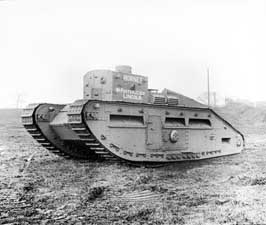
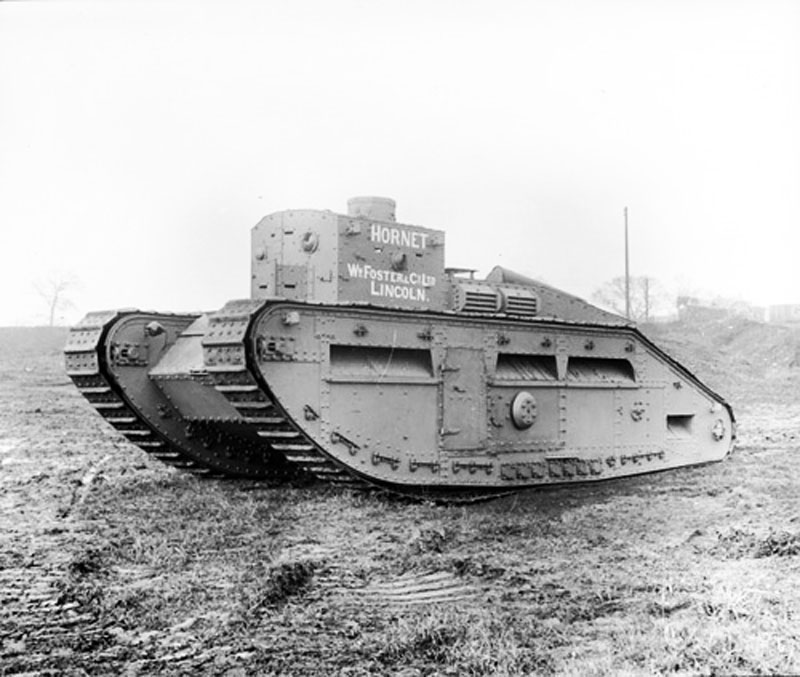
The Medium Mark C tank was a promising and notably agile armored system that arrived too late to see combat action in World War 1. Though categorized as a tank, the system was specifically an "armored fighting vehicle" (or "AFV") meant to support infantry movements and lead the charge in breaking stalemates common to World War 1 battlefields. Like many other tank systems of the First World War, the Medium Mark C led a relatively short operational life (1918 - 1925) and large wartime orders quickly evaporated with the armistice. Only some thirty-six unfinished systems were available at the end of the war - these eventually completed and placed into active service. The Medium Mark C was also known as the "Hornet" though this name was rarely used.
Origins of the Medium Mark C stemmed from a rivalry that developed between two former work mates - Sir William Tritton and Major Walter Gordon Wilson - both of whom were eventually awarded by the British government as co-inventors of the "tank". Tritton served with the William Foster & Company while Wilson, formerly of the Royal Naval Air Service, now served in the British Army. Tritton moved ahead without Wilson in the development of the Medium Mark A "Whippet" tank to which Wilson set about in generating an all-new tank design all his own, this becoming the Medium Mark B of 1917. In response, Tritton called upon his chief designer - William Rigby - to come up with a competing design to Wilsons. The new design was penciled and presented to the British Army for review. The British Army accepted the design on April 19th, 1918, to which the prototype was constructed and made available in August of 1918.
The Medium Mark C was slated to fill an initial production batch of 200 vehicles while the war was still in full swing. This was later amended to become a 600-strong order. However, the war officially ended in November of 1918 and all Medium Mark C wartime orders were cancelled. The thirty-six tanks that lay unfinished in the factory were completed delivered to the British Tank Corps, 2nd Tank Battalion. Of note became the four Medium Mark C's taking part in the 1919 victory parade that followed the armistice. This group was eventually given a further fourteen new-build Medium Mark C tanks to strengthen their ranks - many of these systems pieced together from available spare parts. The tanks capabilities and "newness" in design and construction ensured that Britain kept her close to home and, as such, the Medium Mark C was not deployed in actions outside of England.
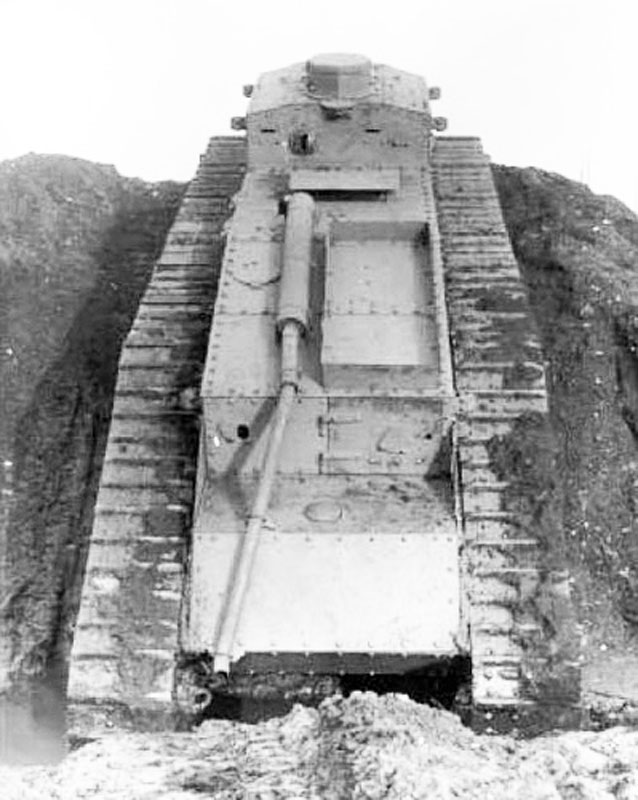
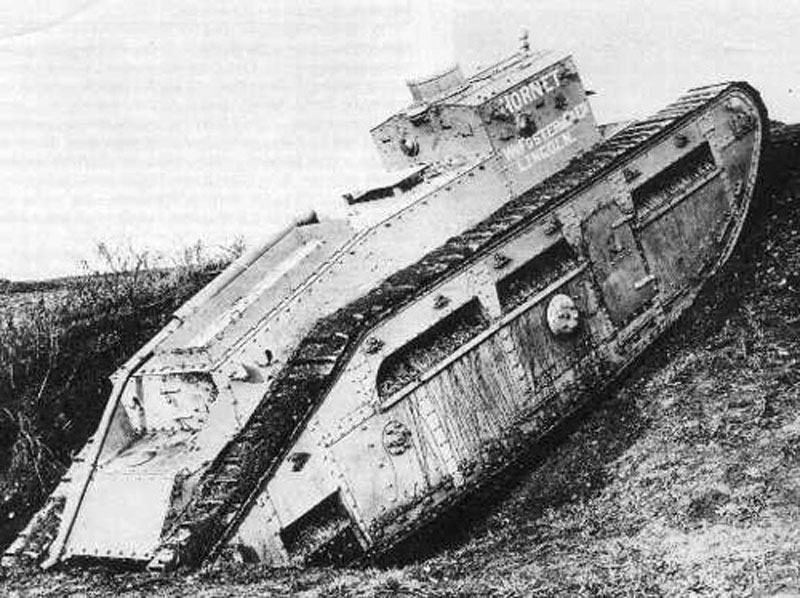
Design of the Medium Mark C was typical for the time. The tank sported a rhomboidal shape with two long-running unsprung track systems fitted to both sides of the hull. The forward portion of the tracks was raised to help tackle battlefield obstacles such as trenches and mounds. Each track system was fitted to a rudimentary hull design to which was affixed a static superstructure. The superstructure gave a taller profile but, the same time, improved visibility for the crew via vision slits and machine gun ports for engaging enemy infantry. The tank commander was given a rotating turret atop the superstructure. The Medium Mark C sported a long hull and its layout made it a relatively good cross country negotiator - considering the European countryside was littered with battlefield debris and trench networks - the latter of which the Medium Mark C could better navigate over than her predecessors. Armor thickness was a reported 14mm, providing protection against small arms fire. Entry and exit was via hinged doors along the track hull sides.
The Medium Mark C was powered by a single Ricardo 6-cylinder gasoline engine developing 150bhp at 1,200rpm and tied to an epicycle transmission system. Maximum speed was limited to 7.9 miles per hour while range topped out at 75 miles. The engine was fitted into a separated compartment at the rear of the hull and made accessible to the crew from within the vehicle. The crew was comprised of the tank commander, driver, machine gunner and mechanic. Communication for the crew was via speaking tubes - helpful in combating the onboard noises developed by the engine and structure. Armament was up to five Hotchkiss-type 7.7mm (.303 caliber) defensive machine guns fitted to the superstructure on ball mounts - two placed forward, two single fittings along the side panels and a single fitting facing to the rear.
World War 2 tanks generally came in two forms - "male" and "female". This terminology basically dictated the type of primary armament afforded to each. The male version was typically fitted with cannon armament while the female version was outfitted with defensive machine guns. The Medium Tank C was only produced in its female form though a male form was planned and designed but never put into production. It would have fitted a 6-pounder gun to its forward superstructure. A battlefield recovery version was also nixed though one existing Medium Mark C did serve to evaluate a new transmission system for a time.
After 1925, the Medium Mark C was replaced by the Vickers Medium Mark I and Mark II tanks. The last Medium Mark C was melted down as late as 1940.
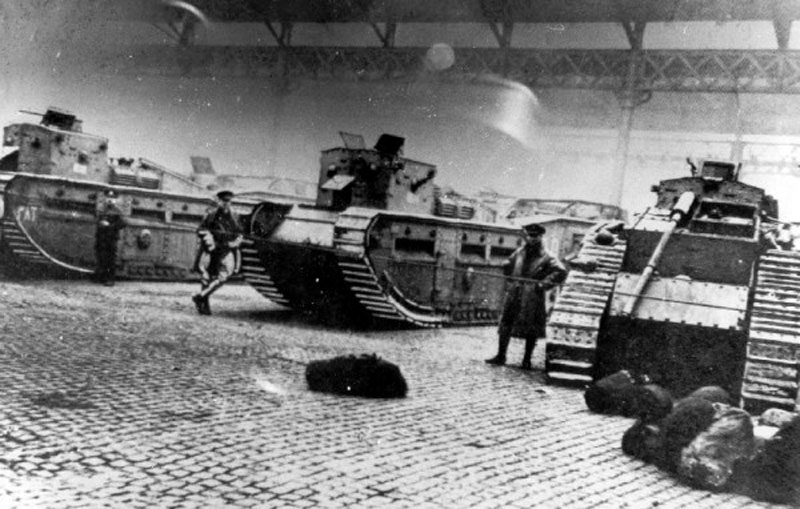
The Medium Mark C tank was deployed to Glasgow to help quell unrest in the 1921 strike. This effectively summarized the Medium Mark C's operational action history leaving the imagination to wonder of the tanks impact in the Great War should it have continued beyond November of 1918.
Power & Performance Those special qualities that separate one land system design from another. Performance specifications presented assume optimal operating conditions for the Medium Mark C (Hornet) Medium Tank.
1 x Ricardo 6-cylinder gasoline engine developing 150 horsepower at 1,200rpm. Installed Power
8 mph 13 kph Road Speed
75 miles 120 km Range
Structure The physical qualities of the Medium Mark C (Hornet) Medium Tank.
4 (MANNED) Crew
25.8 ft 7.85 meters O/A Length
8.9 ft 2.71 meters O/A Width
9.6 ft 2.94 meters O/A Height
44,798 lb 20,320 kg | 22.4 tons Weight
Armament & Ammunition Available supported armament, ammunition, and special-mission equipment featured in the design of the Medium Mark C (Hornet) Medium Tank.
4 OR 5 x 7.7mm Hotchkiss machine guns
AMMUNITION: Not available.
Variants Notable series variants as part of the Medium Mark C (Hornet) family line.
Medium Mark C - Base Series Designation
Medium Mark C (female) - 5 x machine guns
Medium Mark C (male) - Proposed cannon-armed variant; never produced; would have fitted a long-barrel 6-pdr main gun in forward superstructure.
Battlefield Recovery Vehicle - Proposed; never produced.
Operators Global customers who have evaluated and/or operated the Medium Mark C (Hornet). Nations are displayed by flag, each linked to their respective national land systems listing.
Total Production: 50 Units Contractor(s): Fosters - UK
[ United Kingdom ]
1 / 4
Front left side view of the Medium Mark C Hornet tank
2 / 4
High-angled rear view of the Medium Mark C Hornet tank
3 / 4
Top right side view of the Medium Mark C Hornet clearing a grade
4 / 4
Medium Mark Cs deployed to quell worker unrest in Glasgow circa early 1919
The "Military Factory" name and MilitaryFactory.com logo are registered ® U.S. trademarks protected by all applicable domestic and international intellectual property laws. All written content, illustrations, and photography are unique to this website (unless where indicated) and not for reuse/reproduction in any form. Material presented throughout this website is for historical and entertainment value only and should not to be construed as usable for hardware restoration, maintenance, or general operation. We do not sell any of the items showcased on this site. Please direct all other inquiries to militaryfactory AT gmail.com. No A.I. was used in the generation of this content.