After the close of hostilities in World War 2, the Japanese Empire was rightfully stripped of all war-making capabilities that included their heavy arms industries. Though Japanese tanks in World War 2 proved any but effective, all of Japan's facilities were scrutinized and disbanded from making war-related products for land, air or sea use. As such, any sort of tank development in the post-war years was essentially non-existent until the arrival of the Korean War just a few short years away.
With the onset of war on the Korean Peninsula, the governing Supreme Commander of Allied Powers overseeing Japan's reconstruction and containment allowed for limited military development that would eventually become the basis for the Japanese Self Defense Force charged with the defense of the island and nothing more. To help fill the ranks, the Allied powers brought with them American-made World War 2-era M24 Chaffee light tanks and M4A3E8 Sherman medium tanks. While the M24 was a good fit for the Japanese stature, its main gun armament proved inferior to anything it would have faced should the Korean War have spilled out of the peninsula. Conversely, the M4 Sherman provided for a heftier alternative but it was essentially nearing the end of its usefulness in terms of technology. To add insult to injury, the Shermans proved a bit too roomy for the Japanese, whose small-statured army soldiers didn't quite carry the length of their American tank brethren to be able to reach the driving control pedals at a comfortable angle. As such, the Japanese passed on purchasing any of the other newly available American tank systems and were allowed to pursue a home-grown alternative that fit the needs of the Japanese nation to a tee.
Development of this new Main Battle Tank began in 1955 with design undertaken at Mitsubishi Heavy Industries. The approach centered in on a relatively lightweight system with the portability to be carried via railway to designated hotspots. This provided something in the way of a challenge for providing a capable main battle tank system that was adequately armored at the expense of weight, which itself would have to fall under a certain value in order for the system to be wholly transportable as planned. Though an original limit of 25 tons was envisioned, the reality of it all was that the new tank would be somewhere closer to the vicinity of 35 tons. The armament was selected as a 90mm main gun. The entire tank system was designed and developed around the current Japanese soldier body build of the time.
Prototypes were soon made ready by the end of 1956 and continued throughout the rest of the decade. The initial system appeared as the STA-1 and was followed by the STA-2. This was further followed by the STA-3 and the STA-4 - the latter of which would go on to represent the production tank model. As it was already 1961, the new tank's designation was simply the initial year of active service. This resulted in the tank being called the "Type 61". Production began and slowly ramped up in the subsequent years. Production eventually ran from 1961 through 1975 to which 560 total examples appeared.
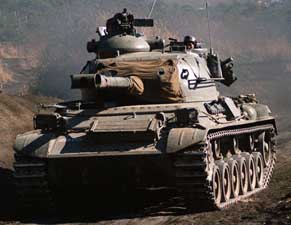
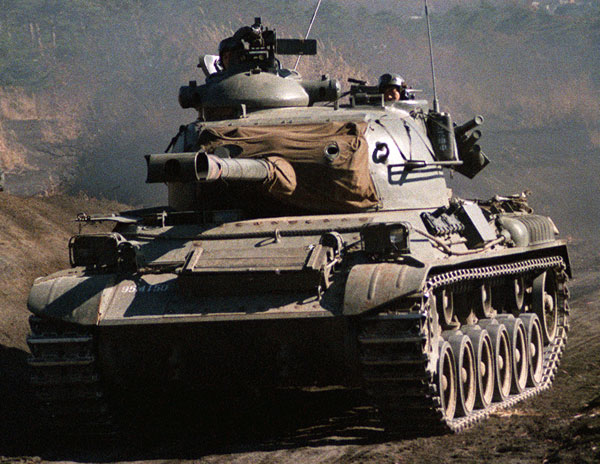
Outwardly, the Type 61 maintained a conventional appearance with sloping glacis plates on a welded steel hull and a rounded cast-steel turret. Armor was 64 millimeters at its thickest and the vehicle weighed in at 35 tons. Suspension was accomplished through a torsion bar system and six rubber road wheels to a track side allowing for speeds of up to 45 kilometers per hour on paved roadways. The turret was situated in the center of the design and housed three of the four crewmembers. Turret occupants included the tank commander, gunner and loader while the driver made his home in the front right side of the hull.
Main armament centered in on a Type 61 90mm rifled cannon with integrated muzzle brake. This was augmented by the 12.7mm M2 Browning heavy machine gun for anti-aircraft defense at the commander's cupola. A co-axial 7.62mm Browning M1919A4 anti-infantry machine gun was positioned in the turret alongside the main gun. Smoke grenade launchers were provided, three dischargers per turret side.
Power was derived from a Mitsubishi-brand HM21 WT V12 turbocharged diesel engine fitted to the rear of the hull and mated to a Mitsubishi-brand manually-controlled gearbox. Range totaled roughly 200 kilometers based on this arrangement. The Type 61 was not designed to be even remotely amphibious nor did it provide anything in the way of protection from nuclear, biological or chemical hazards so its tactical use - especially considering the volatile early years of the Cold War - was limited in those regards.
Type 61's served for nearly 40 years and were officially discontinued in 2000. Each preceding year brought the Type 61 total down substantially. The system was replaced by its successor in the Type 74 Main Battle Tank entering service in 1975 - another product of Mitsubishi Heavy Industries. Other variants derived from the Type 61 chassis included the Type 67 Armored Vehicle Launching Bridge and the Type 70 Armored Recovery Vehicle.
Power & Performance Those special qualities that separate one land system design from another. Performance specifications presented assume optimal operating conditions for the Type 61 Main Battle Tank (MBT).
1 x Mitsubishi 12HM21WT 4-stroke V-type 12-cylinder, vertical, air-cooled, diesel-fueled engine developing 570 horsepower at 2,100rpm and driving a conventional track-and-wheeled arrangement. Installed Power
28 mph 45 kph Road Speed
124 miles 200 km Range
Structure The physical qualities of the Type 61 Main Battle Tank (MBT).
4 (MANNED) Crew
26.9 ft 8.19 meters O/A Length
9.7 ft 2.95 meters O/A Width
8.2 ft 2.49 meters O/A Height
77,162 lb 35,000 kg | 38.6 tons Weight
Armament & Ammunition Available supported armament, ammunition, and special-mission equipment featured in the design of the Type 61 Main Battle Tank (MBT).
1 x 90mm Type 61 rifled main gun.
1 x 7.62mm Browning M1919A4 co-axial anti-infantry machine gun.
1 x 12.7mm M2 Browning Anti-Aircraft (AA) Heavy Machine Gun (HMG).
AMMUNITION: Not Available.
Variants Notable series variants as part of the Type 61 family line.
ST-A1 - Prototypes; 2 examples produced.
ST-A2 - Prototypes; 2 examples produced.
ST-A3 - Prototypes; 2 examples produced.
ST-A4 - Prototypes; 10 examples produced.
Type 61 - Main Battle Tank; 560 examples produced.
Type 61 Trainer - Training Tank
Type 67 AVLB - Armored Vehicle Launch Bridge
Type 70 ARV - Armored Recovery Vehicle
Operators Global customers who have evaluated and/or operated the Type 61. Nations are displayed by flag, each linked to their respective national land systems listing.
Total Production: 560 Units Contractor(s): Mitsubishi Heavy Industries - Japan
[ Japan (retired) ]
1 / 2
Forward left side view of the Type 61 main battle tank
2 / 2
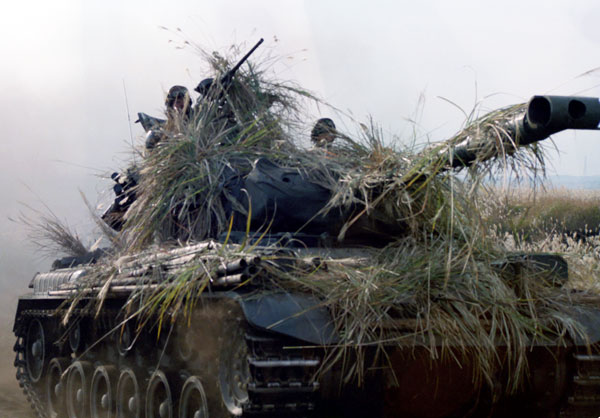
Forward right side view of a camoflauged Type 61 main battle tank
The "Military Factory" name and MilitaryFactory.com logo are registered ® U.S. trademarks protected by all applicable domestic and international intellectual property laws. All written content, illustrations, and photography are unique to this website (unless where indicated) and not for reuse/reproduction in any form. Material presented throughout this website is for historical and entertainment value only and should not to be construed as usable for hardware restoration, maintenance, or general operation. We do not sell any of the items showcased on this site. Please direct all other inquiries to militaryfactory AT gmail.com. No A.I. was used in the generation of this content.