Krupp Landkreuzer P.1000 Ratte (Rat)
If it was ever completed, the Landkreuzer P.1000 Ratte would have been the largest tank ever produced.
By Staff Writer
The Landkreuzer P.1000 "Ratte" (translating to "Rat") was a proposed super-heavy tank designed by the German firm Krupp in 1942. Hitler gave the project his blessing and the program set about to create the most powerful tank ever devised. It was an ambitious undertaking to say the least and - should it have been built - would also have become the largest tank ever produced. Albert Speer, the German Minister of Armaments and War Production for the Third Reich, saw the fruitlessness of such an endeavor and cancelled the P.1000 in early 1943. As such, the Ratte never made it off of the drawing boards.
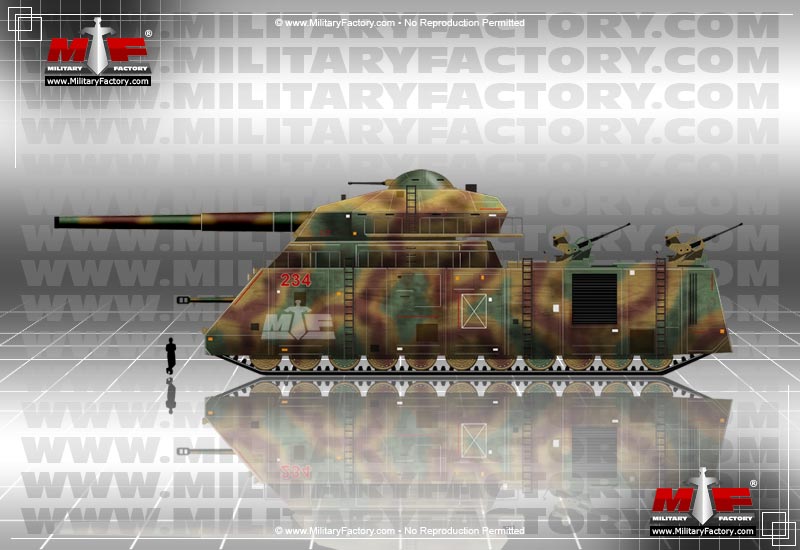
Externally, the P.1000 would have dwarfed any other tank in production by a mile. The immense size was something to behold with as many as 11 large road wheels affixed to either track side. The tracks themselves measured a near-four feet in width. The hull would have been conventional by 1942 standards, with straight faced skirted sides and an angled front and rear hull. Armor would have reached between 150mm and 360mm. Dimensions were pretty exact with the P.1000 sporting a height of 11 meters, a width of 14 meters and a length of 35 meters. The overall operational weight was expected to reach 1,000 tons (2,000,000 lbs).
The massive turret would have been positioned well forward in the hull. Primary armament was envisioned as 2 x 280mm 54.5 SK C/34 naval guns. As these guns had more in common with sea-based vessels, a custom turret was to be designed to house the twin artillery arrangement. Essentially, the turret would be a modified heavy cruiser emplacement (possibly from the Gneisenau-class) with full 360-degree traverse. Secondary armament became a 128mm KwK 44 L/55 anti-tank gun as well as 8 x 20mm Flak 38 anti-tank cannon systems. The 128mm system would have been mounted in the main turret in a smaller turret fitted to the rear of the hull (the exact location of this armament remains unknown). A further fitting of 2 x 15mm MG 151/15 autocannons would have also been part of the armaments package for the P.1000. A crew of 20 personnel would be required to man the various onboard systems.
To move such a behemoth, Krupp suggested the use of either 8 x Daimler-Benz MB501 20-cylinder marine diesel engines developing an estimated 16,000 horsepower or 4 x MAN V127Z32/44 24-cylinder marine diesel engines of 17,000 horsepower output. The former engine type was utilized in German E-Boat systems while the latter was prominent in U-Boat submarine designs. Though a top speed of 40 kilometers-per-hour was estimated, its durable operational range was not. It is assumed that the P.1000 would have been extremely limited in this area.
As it stood, the Landkreuzer P.1000 proved just another tangent for Hitler to commit resources and manpower too. On paper, the P.1000 was a true threat with armament and armor to destroy anything on the modern battlefield for the time but in reality, it is doubtful the system would have added much in the way of changing German fortune. The sheer size of the P.1000 would have extremely limited its use and effectiveness. Weight alone would have forced many-a-road to simply crumble while passing over the bridges of 1940's Europe would have been dangerous and downright impossible. Additionally, the use of multiple complex engines in one hull would prove a maintenance nightmare. If used at all, the P.1000's reach would have been severely limited by the design's inherent restrictions.
While the P.1000 project eventually foundered, the Panzerkampfwagen VIII Maus ("Mouse") went on to become the largest tank to be built in World War 2, though only reaching prototype form before the end of the war.
History text ©2003-2009 www.MilitaryFactory.com • All Rights Reserved •
No Reproduction Without Permission • Corrections / Comments to MilitaryFactory at Gmail dot com
Last Updated: 5/28/2009
|