Global Firepower | Military Industrial Complex | Second World War History
Home | Military Pay Scale Chart | Aircraft | Infantry Weapons | Military Vehicles | Navy Ships | Military Education | French Military Victories | Military Ranks | WW2 Weapons
Military Factory Latest from Military Factory
Thumbnail picture of the Dardo infantry fighting vehicle
Dardo IFV
Thumbnail picture of the Supermarine Scimitar fighter
Supermarine Scimitar
Thumbnail picture of the Centauro B1 8x8 tank killer
Centauro 8x8
Thumbnail picture of the Novi Avion fighter
Novi Avion
Thumbnail picture of the FR F2 bolt-action sniper rifle
FR F2
Thumbnail picture of the Lebel Model 1886 bolt-action rifle
Lebel Model 1886
2009 Military Pay Scale Chart - for Army, Navy, Air Force and Marines
  BY DECADE
    · 1910 to 1919
    · 1920 to 1929
    · 1930 to 1939
    · 1940 to 1949
    · 1950 to 1959
    · 1960 to 1969
    · 1970 to 1979
    · 1980 to 1989
    · 1990 to 1999
    · 2000 and Beyond
    · View All
  BY TYPE
    · 4-Wheeled
    · 6-Wheeled
    · 8-Wheeled
    · Anti-Aircraft
    · Anti-Tank
    · APCs
    · Halftracks
    · Heavy Tanks
    · IFVs
    · Light Tanks
    · Main Battle Tanks
    · Medium Tanks
    · Recon Vehicles
    · Special Purpose
    · SPGs
    · Towed Artillery
    · Utility Vehicles
  WORLD WAR 2
    · Full List
    · Tanks
    · IFVs
    · Tank Destroyers
    · Australia
    · Britain
    · Canada
    · France
    · Germany
    · Italy
    · Japan
    · Soviet Union
    · USA
  WORLD WAR 1
    · Full List
    · France
    · Imperial Germany
    · United Kingdom
    · United States
    · Tanks
  KOREAN WAR
    · Full List
  VIETNAM WAR
    · Full List

MilitaryFactory > Armored Vehicles > FCM Char 2C
 
 
More Pictures QuickGraphs Chassis Types CompareX2 Acronyms

FCM Char 2C

Development and mass production of the Char 2C was doomed after the Armistice following World War 1.
By Staff Writer

Bookmark and Share

The Char 2C was being planned and designed in the final year of the First World War. The system would become the largest tank of its kind to ever see operational service in any capacity and was ordered for mass production in an effort to bring some finality to the global war. In the end, the German capitulation and Armistice brought about cancellations of many systems in development including the Char 2C. The tank would still go on to see active service - albeit in a limited capacity - and amazingly fielded by French forces in the Battle of France some twenty years later.

As development began, the vehicle was to be originally produced in three weight classes as prototype models consisting of a 30, 40 and 62 ton variants. The Armistice stopped any development of these intended models along with the 300 or so of the 62 ton variant that was planned to be in production by 1919 under the order of Marshal Philippe Petain of the French General Staff. The only model to come out of post-war France was the Char 2C, a 69-ton prototype version that saw some 10 examples beginning service in 1921. Classified as a "super-heavy tank", the machine certainly fit the bill and was the largest tank to ever be produced. The system was heavily armored with the armor contributing to a good portion of the overall weight of the tank. Armament consisted of a single 75mm main gun along with 4 x Hotchkiss machine guns for anti-infantry defense. Machine guns were kept in a forward, rear and side gun positions for total covering fire.

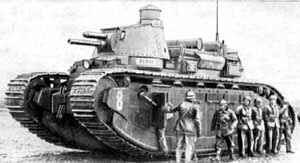
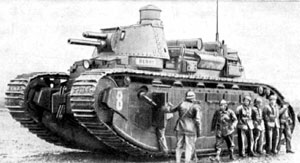
The Char 2C sported a large and high profile. Soldiers alongside the machine were seemingly dwarfed by the track system alone, mounted along the World War 1-style lozenge-type assembly with the tracks running over, under and around. The turret sat well-forward of the hull and mounted the primary armament. Two engines of 250 horsepower apiece drove the Char 2C for a grand operational total of 520 horsepower output. Engines were of either Daimler or Maybach brands and operated under 6-cylinders.

Despite development beginning in 1918 and deliveries accepted in 1921, the system was still under French service in 1940 and the eventual invasion of France by German forces beginning World War 2. The Char 2C was becoming outclassed with the steady rise of new tanks entering the fray. Where their armor was the thickest of any tank to be fielded in World War 1, by World War 2 standards, the Char 2C was extremely vulnerable to most types of anti-tank fire. 1939 saw the ten serviceable Char 2C pressed into "active" service with French forces in the Battle of France.

Though mounting a respectable 75mm main gun, the systems were held in reserve and served moreso in a propaganda-type role for the government to the point that each existing system was named after a region of ancient France and kept from enemy fire at all costs. Effectively never engaging the enemy or firing a single shot in anger against them, the reputation of the Char 2C was one of invincibility and power where the sheer sight of the machine sent the enemy running. In reality, of course, this was far from the truth. As the tide of the Battle of France continually turned against French favor, a last-ditch effort was made to reposition them further out of harms way in an effort to keep the French image alive. All ten tanks were purposely destroyed by French forces when the railway the tanks were transported on was found to be blocked by fire. With this mighty symbol of French military dominance all but gone, the German propaganda machine put to the airwaves in full force, stating that the tanks were directly destroyed by German forces in battle. A single example was recovered, however, and shipped to Berlin for show. The fate of this system is unknown. In any case, now real remnants of the tank officially exist.

The ten tanks were named by the following French regions: Alsace, Anjou, Berry, Bretagne, Champagne, Normandie, Poitou, Provence, Picardie and Touraine. Champagne would be the basis of a later developmental model in the form of the Char 2C bis featuring a powerful 155mm main gun, cast turret and new engines. Though perhaps a powerful force to reckoned with in the First World War, the Char 2C found itself highly outclassed in the Second World War and was mostly under-utilized for its military value - whatever that may have been some twenty years after its initial design. In any case, the Char 2C did play a role in the defense of France though mostly as a token in boosting morale across the lines. Perhaps in some ironic way the fate that the system incurred was justifiable considering its military value in 1940.

It should be noted that the origins of the Char 2C bring about much controversy in the historical sources. Apparently French Brigadier Estienne and his FT-17 light tank project with Renault faced off with French General Mouret and his super-heavy tank project the Char 2C. Estienne feared his light tank production would be curtailed due to the sheer amount of resources that would have to be dedicated to Mouret’s Char 2C project under full production and used his political power to work in his favor. Mouret is also accused of having accepted a bribe from the FCM Company for his involvement in furthering Char 2C production. Regardless, this type of behind-the-scenes turmoil certainly didn’t help in the development of the Char 2C in quantity thus explaining the limited production examples.

History text ©2003-2009 www.MilitaryFactory.com • All Rights Reserved • No Reproduction Without Permission • Corrections / Comments to MilitaryFactory at Gmail dot com

Last Updated: 11/5/2009


  Specifications for the FCM Char 2C
arrow downDimensions:
Length: 33.69ft (10.27m)
Width:9.68ft (2.95m)
Height: 13.12ft (4.00m)

arrow downStructure:
Accommodation: 12
Weight:76.1US Short Tons (69,000kg; 152,119lbs)

arrow downPerformance:
Speed: 7mph (12km/h)
Range: 62miles (100km)

arrow downSystems:
NBC Protection: None
Nightvision: None

arrow downPower:
Engine(s): 2 x Daimler OR Maybach 6-cylinder gasoline engine developing 520hp total.

arrow downArmament Suite:

1 x 75mm main gun
4 x 8mm Hotchkiss machine guns in forward, rear and side positions)

AMMUNITION:
Not Available


More Pictures QuickGraphs Chassis Types CompareX2 Acronyms

  Special Armored Vehicles Collections

By Nation:
Afghanistan Tanks
American Tanks
British Tanks
Iran Tanks
Iraq Tanks
Israeli Tanks
Russian Tanks

Miscellaneous:
Cold War Tanks
Modern Tanks


  Recent Armored Vehicle Additions
Thumbnail picture of the Dardo infantry fighting vehicle
Dardo IFV
Thumbnail picture of the Centauro B1 8x8 tank killer
Centauro 8x8
Thumbnail picture of the Vickers 6-Ton Mark E light tank
Vickers 6-Ton

  Contacting MilitaryFactory.com
We can only get better if you tell us how. You can contact MilitaryFactory.com at MilitaryFactory at gmail dot com (replace "at" with "@" and "dot with ".") with any questions, comments or corrections. We also accept related military imagery that you approve for us to use on our website. Keep in mind, however, that due to volume, we may not directly respond to your inquiry. Please add us to your list of non-blocked recipients!

Main Battle Tanks

  Armored Vehicle Quick Profile


Image Courtesy of the Public Domain.


flag of France
1921
Designation: FCM Char 2C
Classification Type: Heavy Tank / Super-Heavy Tank
Contractor: FCM Company - France

Country of Origin: France
Number Built: 11

Operators: France


  Variants
Char 2C - Base Model Designation

Char 2C bis - Developmental Model (Champagne) of 74 tons fitted with 155mm howitzer main gun armament; cast turret; new powerplant(s).

  Collections
  • Tanks of World War 2
  • Armor of the Persian Gulf War
  • Towed Artillery Reigns
  • Armor of the Vietnam War
  • Tanks of World War 1
  • Armor of the Korean War
  • World War 2 Tank Destroyers


Free GI Bill Guide

Top MF Stuff: Military Pay Scale Chart | Military Ranks | World War 2 Weapons | Sniper Rifles | Conversion Calculators


©2009 www.MilitaryFactory.com • Content ©2003-2009 MilitaryFactory.com • All Rights Reserved • Disclaimer Privacy Policy Site Map Origins
Most photographic images appearing on this site are courtesy of the United States Department of Defense and are approved for public use.
Other images acquired through the public domain. Digital art work courtesy of Dan Alex.
Business Consulting by Kyle Williams

Material presented throughout this website is for historical and entertainment value and should not to be construed as usable for
hardware restoration, maintenance or general operation. Please consult manufacturers for such information.

Site Contact: militaryfactory at gmail dot com (replace "at" with "@" and "dot" with ".") eXTReMe Tracker