Global Firepower | Military Industrial Complex | Second World War History
Home | Military Pay Scale Chart | Aircraft | Infantry Weapons | Military Vehicles | Navy Ships | Military Education | French Military Victories | Military Ranks | WW2 Weapons
Military Factory Latest from Military Factory
Thumbnail picture of the Dardo infantry fighting vehicle
Dardo IFV
Thumbnail picture of the Supermarine Scimitar fighter
Supermarine Scimitar
Thumbnail picture of the Centauro B1 8x8 tank killer
Centauro 8x8
Thumbnail picture of the Novi Avion fighter
Novi Avion
Thumbnail picture of the FR F2 bolt-action sniper rifle
FR F2
Thumbnail picture of the Lebel Model 1886 bolt-action rifle
Lebel Model 1886
2009 Military Pay Scale Chart - for Army, Navy, Air Force and Marines
  BY DECADE
    · 1910 to 1919
    · 1920 to 1929
    · 1930 to 1939
    · 1940 to 1949
    · 1950 to 1959
    · 1960 to 1969
    · 1970 to 1979
    · 1980 to 1989
    · 1990 to 1999
    · 2000 and Beyond
    · View All
  BY TYPE
    · 4-Wheeled
    · 6-Wheeled
    · 8-Wheeled
    · Anti-Aircraft
    · Anti-Tank
    · APCs
    · Halftracks
    · Heavy Tanks
    · IFVs
    · Light Tanks
    · Main Battle Tanks
    · Medium Tanks
    · Recon Vehicles
    · Special Purpose
    · SPGs
    · Towed Artillery
    · Utility Vehicles
  WORLD WAR 2
    · Full List
    · Tanks
    · IFVs
    · Tank Destroyers
    · Australia
    · Britain
    · Canada
    · France
    · Germany
    · Italy
    · Japan
    · Soviet Union
    · USA
  WORLD WAR 1
    · Full List
    · France
    · Imperial Germany
    · United Kingdom
    · United States
    · Tanks
  KOREAN WAR
    · Full List
  VIETNAM WAR
    · Full List

MilitaryFactory > Armored Vehicles > SdKfz 135 Marder I (Marten I)
 
 
More Pictures QuickGraphs Chassis Types CompareX2 Acronyms

SdKfz 135 Marder I (Marten I)

The Marder I was designed to meet the ever-growing power of Soviet armor in the form of the T-34 and Kliment Voroshilov tanks.
By Staff Writer

Bookmark and Share

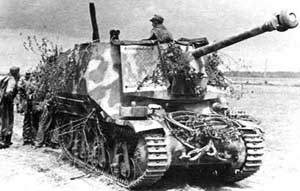
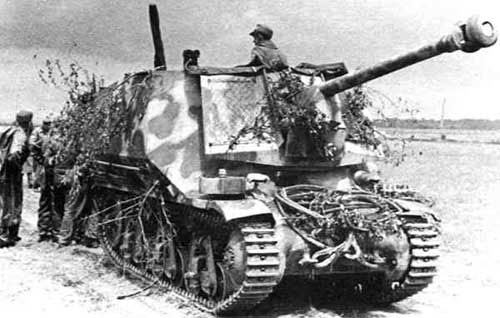
After the Fall of France, Germany confiscated several hundred Tractor Blinde 37L (commonly known as "Lorraine Tractors") which were general purpose chassis covering a variety of roles including armored personnel carrier and battlefield supply vehicles. Though these sat dormant for a time, interest in putting these systems back into action was heightened with the opening of the Eastern Front (Germany's invasion of former ally Russia). The new front presented a whole new set of problems for the German Army, chief among these was how to contend with the ever-growing presence of the stout T-34 takes of the Soviet Army - mobile machines with think frontal and side armor mounting an impressive main gun. The idea came about to fit a static superstructure to the existing supply of captured enemy tracked systems (like the Lorraine tractor) and make use of them as conversions to self-propelled anti-tank gun systems. The line of Marder tanks was now born and - before war's end - would see three distinct models of the family attached to three distinct chassis types (the latter two utilizing surplus Panzer II chassis systems).

The Marder I appeared in 1942 and was produced to the tune of 184 examples. In appearance, these combat systems were not unlike the self-propelled gun systems of today and featured a superstructure mounted to the rear with the engine in front. The superstructure was static in that the entire Marder I system would have to be pointed in the direction of fire. The superstructure was also opened at the top and the rear, making the gunnery crew exposed to battlefield fire and the elements in general. Nevertheless, with the turret mounting the powerful and proven PaK 40 anti-tank gun, the Marder I was a born killer ready to engage light to medium armored targets.

Production of the Marder I was split between 60 dedicated tank destroying elements and a further 100 as dedicated self-propelled artillery guns. The former would feature a version of the PaK 40 designated as the PaK 40/1 L/46 whilst the latter was armed with a 10.5-cm (4.1") OR a 15-cm (5.9") main gun. The Lorraine tractor design and arrangement proved to be quite acceptable to the task and was therefore a prime candidate for conversion. Other chassis under German control, such as the Hotchkiss H39, were also used in a few limited conversions falling under the same Marder I designation.

The engine was mounted in the front as it was in the original Lorraine tractor. This was of a DelaHaye 103TT in-line 6-cylinder engine developing 70 horsepower. The engine allowed for vehicle speeds of up to 24 miles per hour on ideal surfaces and an overall range of 93 miles. Armor protection surrounding the critical sides of the main gun was 12mm at its thickest and was sloped for added protection.

In combat, the Marder I was moderately successful. Most systems were kept within the borders of France and took part in the Invasion of Normandy to which many were lost in the fighting. The Marder II and Marder III systems would soon come online and feature many of the lessons learned from the Marder I conversion program. In any case, Marders would make up a strong arm of offensive power for the German Army through to the closing days of World War 2 though, by this time, the Marder I's were all but limited in their production quantity and surpassed by more purpose-built tank destroyer designs.

History text ©2003-2009 www.MilitaryFactory.com • All Rights Reserved • No Reproduction Without Permission • Corrections / Comments to MilitaryFactory at Gmail dot com

Last Updated: 9/21/2009


  Specifications for the SdKfz 135 Marder I (Marten I)
arrow downDimensions:
Length: 17.65ft (5.38m)
Width:6.17ft (1.88m)
Height: 6.56ft (2.00m)

arrow downStructure:
Accommodation: 4 to 5
Weight:11.0US Short Tons (10,000kg; 22,046lbs)

arrow downPerformance:
Speed: 24mph (38km/h)
Range: 87miles (140km)

arrow downSystems:
NBC Protection: None
Nightvision: None

arrow downPower:
Engine(s): 1 x DelaHaye 103TT in-line 6-cylinder engine developing 70hp.

arrow downArmament Suite:

1 x 7.5-cm PaK 40 main gun

AMMUNITION:
Not Available


More Pictures QuickGraphs Chassis Types CompareX2 Acronyms

  Special Armored Vehicles Collections

By Nation:
Afghanistan Tanks
American Tanks
British Tanks
Iran Tanks
Iraq Tanks
Israeli Tanks
Russian Tanks

Miscellaneous:
Cold War Tanks
Modern Tanks


  Recent Armored Vehicle Additions
Thumbnail picture of the Dardo infantry fighting vehicle
Dardo IFV
Thumbnail picture of the Centauro B1 8x8 tank killer
Centauro 8x8
Thumbnail picture of the Vickers 6-Ton Mark E light tank
Vickers 6-Ton

  Contacting MilitaryFactory.com
We can only get better if you tell us how. You can contact MilitaryFactory.com at MilitaryFactory at gmail dot com (replace "at" with "@" and "dot with ".") with any questions, comments or corrections. We also accept related military imagery that you approve for us to use on our website. Keep in mind, however, that due to volume, we may not directly respond to your inquiry. Please add us to your list of non-blocked recipients!

Main Battle Tanks

  Armored Vehicle Quick Profile


Image Courtesy of the Public Domain.


flag of Nazi Germany
1942
Designation: SdKfz 135 Marder I (Marten I)
Classification Type: Tank Destroyer / Self-Propelled Artillery
Contractor: Various - Germany

Country of Origin: Nazi Germany
Number Built: 184

Operators: Nazi Germany


  Variants
Marder I - Fitted to Lorraine tractor chassis and mounting 75mm anti-tank main gun; other chassis types included in production were from FCM 36 and Hotchkiss H39 tank series.

Marder II - Based on the Panzer II chassis.

Marder III - Based on the Panzer II chassis.

  Collections
  • Tanks of World War 2
  • Armor of the Persian Gulf War
  • Towed Artillery Reigns
  • Armor of the Vietnam War
  • Tanks of World War 1
  • Armor of the Korean War
  • World War 2 Tank Destroyers


Free GI Bill Guide

Top MF Stuff: Military Pay Scale Chart | Military Ranks | World War 2 Weapons | Sniper Rifles | Conversion Calculators


©2009 www.MilitaryFactory.com • Content ©2003-2009 MilitaryFactory.com • All Rights Reserved • Disclaimer Privacy Policy Site Map Origins
Most photographic images appearing on this site are courtesy of the United States Department of Defense and are approved for public use.
Other images acquired through the public domain. Digital art work courtesy of Dan Alex.
Business Consulting by Kyle Williams

Material presented throughout this website is for historical and entertainment value and should not to be construed as usable for
hardware restoration, maintenance or general operation. Please consult manufacturers for such information.

Site Contact: militaryfactory at gmail dot com (replace "at" with "@" and "dot" with ".") eXTReMe Tracker