Military Factory
Military Pay Chart
Global Firepower
Military Industrial Complex
Second World War
Home
Military Pay Scale
Military Ranks
Small Arms
Aircraft
Land Systems
Navy
Education
Military Factory Facebook Logo
flag of Nazi Germany

SdKfz 164 Hornisse / Nashorn Tank Destroyer (1943)

Authored By Staff Writer | Last Updated: 9/30/2011

Though mobility was a constant issue for the Nashorn design, her crews experienced a great level of success in taking on enemy tanks from long range.

Find a School Near You
Follow Military Factory on Facebook:
Trending on Military Factory:
Recent Articles:
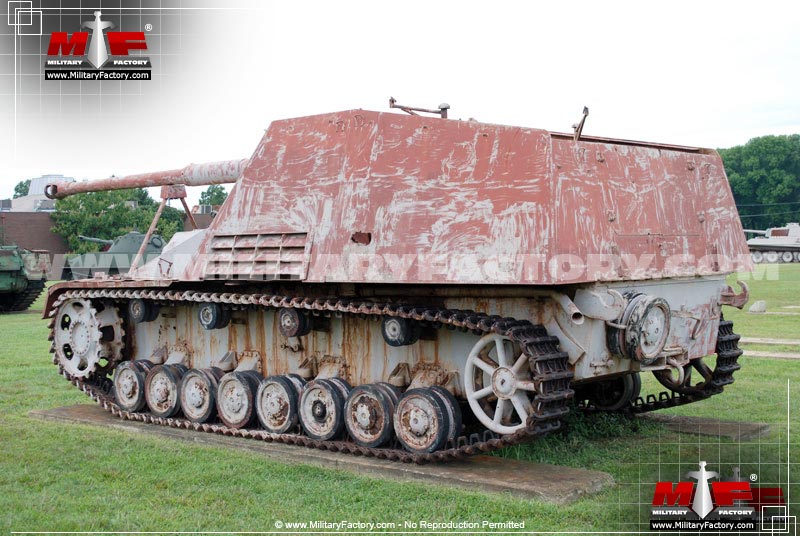
The SdKfz 164 came about from the existing weapon carrier vehicle designed to lug the sFH 18 artillery gun. This vehicle was itself a combination of Panzer III tank parts and the chassis of the Panzer IV tank, making it an efficient vehicle to produce from available stores. This system was designated as the Geschutzwagen III/IV and was selected as the chassis to field the powerful PaK 43 anti-tank gun in a new SdKfz 164 Panzerjager design - in essence an improvised design to fulfill a growing battlefield requirement.

The mammoth SdKfz 164 was an imposing tank destroying platform for Germany in the Second World War. With the obsolete Panzer III and Panzer IV chassis still in inventory or on production lines, it was decided to put them to better use by modifying them to become self-propelled guns mounting the powerful 88mm PaK 43 series. To accomplish this, the hull was lengthened to accommodate the new gun and the engine relocated while armor was removed in an effort to keep the vehicles weight at a respectable level.

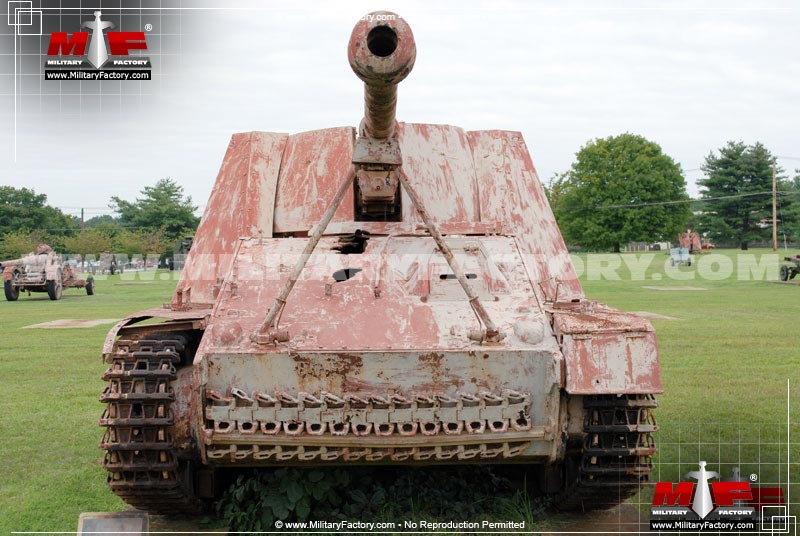
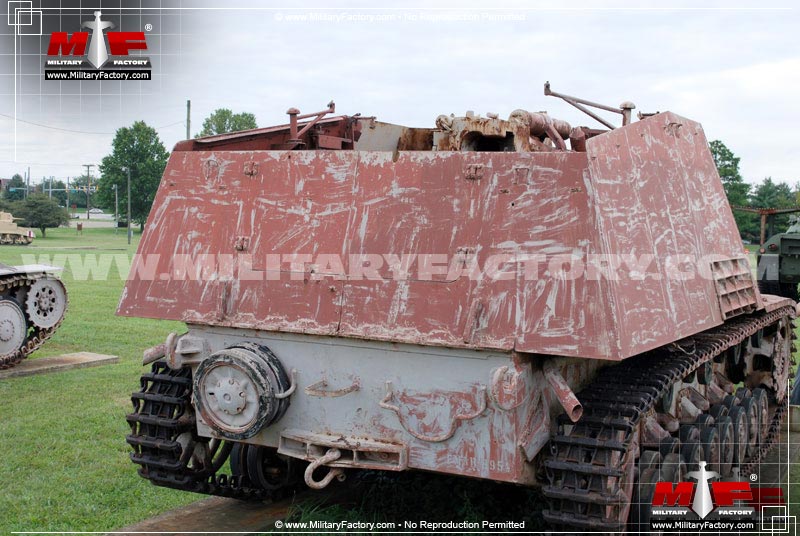
The main gun was fitted into a high superstructure which provided the vehicle with a tall profile and its turretless design meant that the entire vehicle would have to be turned in order to engage the enemy. The turret also offered no protection to the firing crew and commander from above or to the rear as it was an open-top design. As such, crews had to resort to battlefield modifications to keep the elements or shrapnel out and were issued small arms and a machine gun for self-defense work. Power was derived from a Maybach HL 12-cylinder engine producing some 300 horsepower and a crew of five personnel could man the system with the driver being the only one to benefit from any type of armor protection.

In its initial form, the SdKfz 164 appeared with the designation of "Hornisse" (meaning "Hornet") though this was later changed at Hitler's request with the name of "Nashorn" (meaning "Rhinoceros") as he required a more imposing name attached to the vehicle. Early Hornisse models were fitted with the standard PaK 43 L/71 main gun while later Nashorn models sported the new and improved PaK 43/1 L/71 occurring from 1944 onwards. Both vehicles were similarly designed and constructed apart from their main armament.

Once in combat, the SdKfz 164 proved its worth against Soviet armor of all classifications, engaging and defeating them some 2,000 to 4,000 meters away. After action reports dictated how the sheer velocity of the 88mm round could simply tear apart the Soviet T-34s like paper with a single direct hit. Mobility of the system did play a part in its usefulness however and the tank destroyer most always performed better when dug into a prepared position. The Hornisse/Nashorn series would later be superceded by the purpose-built Jagdpanther and Jagdpanzer tank-killing designs.
Text ©2003-2013 www.MilitaryFactory.com • All Rights Reserved • No Reproduction Permitted
MilitaryFactory.com does NOT sell equipment/weaponry. Material presented throughout this website is for historical and entertainment value and should not to be construed as usable for hardware restoration, maintenance or general operation. Please consult manufacturers for such information. Our disclaimer. Email corrections / Comments to MilitaryFactory at Gmail dot com.
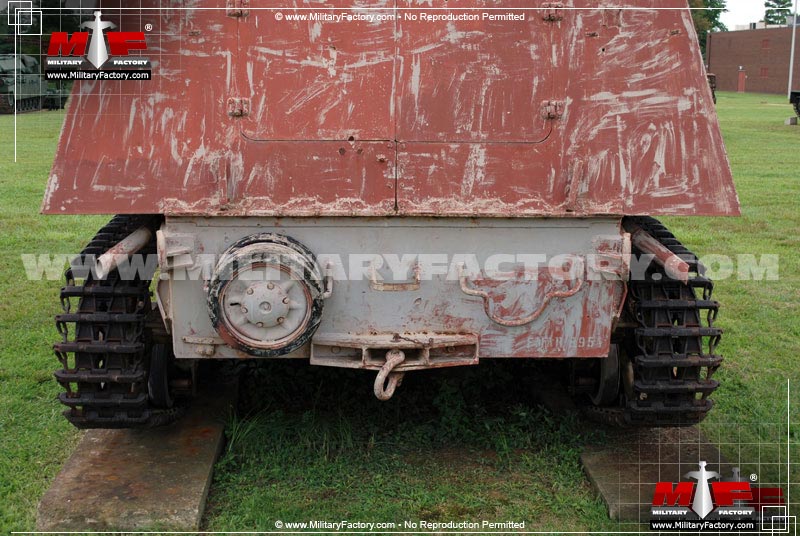
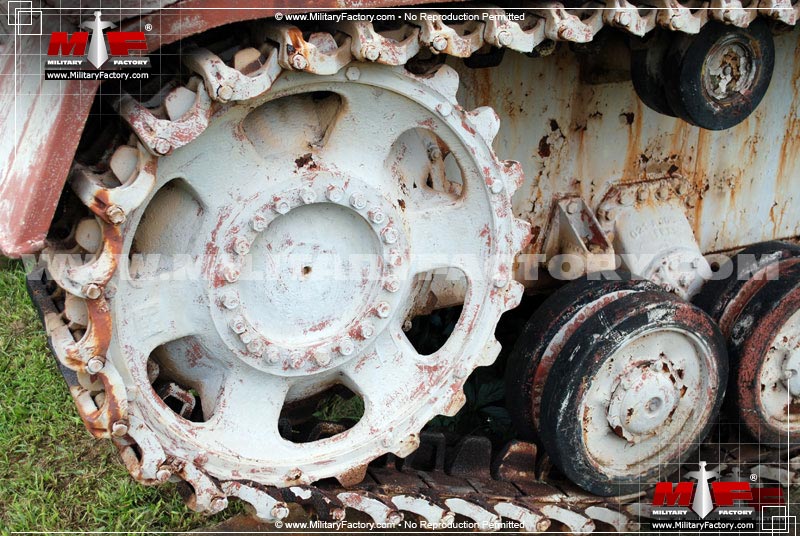
Picture of SdKfz 164 Hornisse / Nashorn
Pic of the SdKfz 164 Hornisse / Nashorn
Image of the SdKfz 164 Hornisse / Nashorn
View All Images (5)

Specifications for the
SdKfz 164 Hornisse / Nashorn
Tank Destroyer


Country of Origin: Nazi Germany
Manufacturer: Alkett / Deutsche Eisenwerke - Nazi Germany
Initial Year of Service: 1943
Production: 473


Focus Model: 8.8-cm PaK 43/1 (L/71) auf Geschutzwagen III und IV (Sf)
Crew: 4 or 5


Overall Length: 27.69ft (8.44m)
Width: 9.38ft (2.86m)
Height: 8.69ft (2.65m)
Weight: 26.9 US Short Tons (24,400kg; 53,793lbs)


Powerplant: 1 x Maybach HL 120 TRM V-12 water-cooled gasoline engine delivering 300hp.


Maximum Speed: 26mph (42 km/h)
Maximum Range: 162 miles (260 km)


NBC Protection: None
Nightvision: None


Armament:
Hornisse:
1 x 88mm PaK 43 L/71 main gun
1 x 7.92mm MG34 or MG42 machine gun

Nashorn:
1 x 88mm PaK43/1 L/71 main gun
1 x 7.92mm MG34 or MG42 machine gun


Ammunition:
24 x 88mm projectiles (Hornisse)
40 x 88mm projectiles (Nashorn)
600 x 7.92mm ammunition


Variants:
Panzerjager Hornisse (Hornet) - Fitted with 88mm PaK 43 L/71 main gun; based on the Geschutzwagen III/IV system.


Panzerjager Nashorn (Rhinoceros) - Fitted with newer 88mm PaK 43/1 L/71 main gun; overall model design very similar in many respects to the original Hornisse model.


Operators: Nazi Germany

ALL LAND SYSTEMS CATEGORIES

By Decade:


1910 to 1919
1920 to 1929
1930 to 1939
1940 to 1949
1950 to 1959
1960 to 1969
1970 to 1979
1980 to 1989
1990 to 1999
2000 to 2009
2010 to 2019
VIEW ALL
Compare Tanks


By Type:


4x4 Military Vehicles
6x6 Military Vehicles
8x8 Military Vehicles
Artillery Gun Systems
Anti-Aircraft (AA) Guns
Anti-Aircraft (AA) Vehicles
Anti-Tank (AT) Guns
Anti-Tank (AT) Vehicles
Armored Cars
Armored Personnel Carriers (APC)
Battlefield Robots
Halftrack Vehicles
Heavy Tanks
Infantry Fighting Vehicles (IFV)
Light Tanks
Main Battle Tanks (MBT)
Modern Combat Tanks
Medium Tanks
Military Motorcycles
Multiple Launch Rocket Systems (MLRS)
Reconnaissance Vehicles
Special Purpose Vehicles
Self-Propelled Guns (SPG)
Tank Destroyers
General Purpose / Utility Vehicles


By Nation:


Afghanistan
Britain
China
France
Germany
Iran
Iraq
Israel / Israeli Army
Italy
Libyan Army
North Korea / North Korean Army
Pakistan
Russia
South Korea
Soviet Union
Syrian Army
United States
VIEW ALL

World War 2:


Artillery
Infantry Fighting Vehicles
Tank Destroyers (All)
Tanks (All)
Australian Tanks
British Tanks
Canadian Tanks
Cruiser Tanks (UK)
Czechoslovakian Tanks
French Tanks
German Tanks
German Tank Destroyers
German FlaK Guns
German Reconnaissance Vehicles
Hungarian Tanks
Italian Tanks
Japanese Tanks
Romanian Tanks
Soviet Tanks
Swedish Tanks
US Tanks
VIEW ALL


World War 1:


France WW1 Tanks
Germany WW1 Tanks
Britain WW1 Tanks
US WW1 Tanks
WW1 Artillery
WW1 Tanks (all)
VIEW ALL


Spanish Civil War:

VIEW ALL


Korean War:

Tanks
VIEW ALL


Vietnam War:

VIEW ALL


Cold War:

Cold War Tanks
Cold War American Tanks
Falklands War
Post-WW2 British Tanks
VIEW ALL


Gulf War (1991):

VIEW ALL


Miscellaneous:

Armored Vehicle Chassis Types

Site Disclaimer | Privacy Policy | Site Map | MF Origins


©2013 www.MilitaryFactory.com • Content ©2003-2013 MilitaryFactory.com • All Rights Reserved • Site Contact Email: militaryfactory at gmail dot com. The "Military Factory" name and MilitaryFactory.com logo are registered ® trademarks and protected by all applicable domestic and international intellectual property laws.


Top MF Stuff: 2013 Military Pay Scale | Military Ranks | WW2 Weapons | Sniper Rifles | Kts to Mph | WW1 Aircraft | Automatic Rifles | Aircraft Cockpits | Vietnam War Weapons | Main Battle Tanks | Submachine Guns | Shotguns | French Military Victories


Most photographic images appearing on this site are courtesy of the United States Department of Defense and are approved for public use. Other images acquired through the public domain. Digital art work courtesy of Dan Alex. Business Consulting by Kyle Williams. Material presented throughout this website is for historical and entertainment value and should not to be construed as usable for hardware restoration, maintenance or general operation. Please consult manufacturers for such information.


eXTReMe Tracker