Military Factory
Military Pay Chart
Global Firepower
Military Industrial Complex
Second World War
Home
Military Pay Scale
Military Ranks
Small Arms
Aircraft
Land Systems
Navy
Education
Military Factory Facebook Logo
flag of France

Char D'Assault St. Chamond Assault Gun / Armored Fighting Vehicle (1916)

Authored By Staff Writer | Last Updated: 4/12/2012

The Char D Assault St. Chamond was essentially the forerunner to modern day self-propelled gun.

Find a School Near You
Follow Military Factory on Facebook:
Trending on Military Factory:
Recent Articles:
While traditionally categorized as one of the early combat "tanks" in history, the Char D'Assault St. Chamond featured qualities more akin to a tracked "assault gun" - today known properly as "self-propelled guns". The St. Chamond was of French origin and saw combat through most of World War 1, initially being introduced in 1916 with the French Army. Despite the potential that tanks held on the then-modern battlefield, the St. Chamond was a plodding and heavy instrument of war, never truly capable of traversing even the most modest of uneven battlefield terrains. Nevertheless, the vehicle sported a powerful and reliable 75mm main gun and any tracked "tank" of note during this time was of high value in the war effort.

Design of the St. Chamond tank was headed by Colonel Emile Rimailho who utilized the American Holt series of tractors as a starting point (similar to the competing Schneider CA tank before it). The chassis and track system were retained and a cumbersome armored hull superstructure was erected atop it to provide the requisite fighting and compartments. The engine was centrally located in the hull with suspension was via coil springs. There was a driving position at the front and the rear of the design allowing for backwards travel without having the tank turn completely around. Primary armament was a fixed, forward-firing 75mm main gun (with limited elevation) with up to 4 x 8mm Hotchkiss machine guns defending the vehicle from advancing enemy infantry attacking with grenades. One machine gun was set to the right-front of the hull with another at the rear hull facing. Each side of the hull were defensed by a machine gun - in effect providing all-around protection for the vehicle and crew. Armor protection for the crew maxed out at 11mm at its thickest.

Colonel Rimailho's participation in the design of the St. Chamond is of note here for his contributions to the French Army dated back to his time at the French state arsenal where he contributed to the development of the excellent Canon de 75mm modele 1897 field gun. When not properly compensated for his efforts, Rimailho left in protest and joined the team at Saint Chamond, designing its 75mm armament largely around the modele 1897. Thusly, the 75mm main gun featured in the original St. Chamond tank would follow the form and function of the French Army field gun to some extent - though being modified to suit the new role and cleared to fire existing French Army 75mm ordnance.

Power for the St. Chamond was supplied by through a single Panhard-Levassor 4-cylinder gasoline-fueled engine of 90 horsepower. This powerplant was then tied to an electrically-powered Crochat-Colardeau transmission system which, in turn, added unnecessary weight to the overall design. Electric generators were charged in supplying power to each individual track system allowing for 7.5mph speeds in ideal conditions. Range was limited to 37 miles.

The large St. Chamond tank required an operating crew of eight personnel to man the various onboard systems. The driver also served as the tank commander with vision out of a protruding upper hull fixture. He was seated at the front left of the vehicle. To his right was the main gun fitted centrally at the front hull. To the right of the main gun was a machine gunner who also doubled as the breech operator for the main gun. A second driver was positioned at the rear and called to action when the vehicle needed rearwards control. Additional machine gunners were stationed at the sides and rear of the design.

The initial St. Chamond prototype was made ready in September of 1916 with some 400 examples of the type already on order.

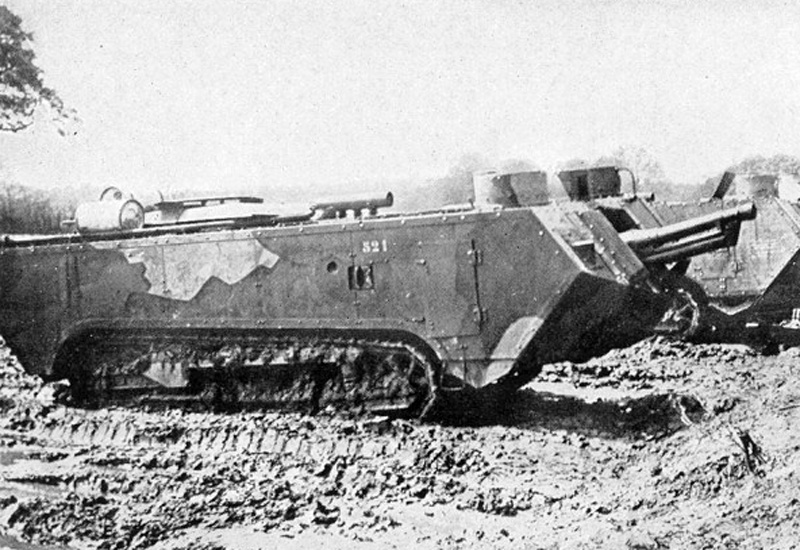
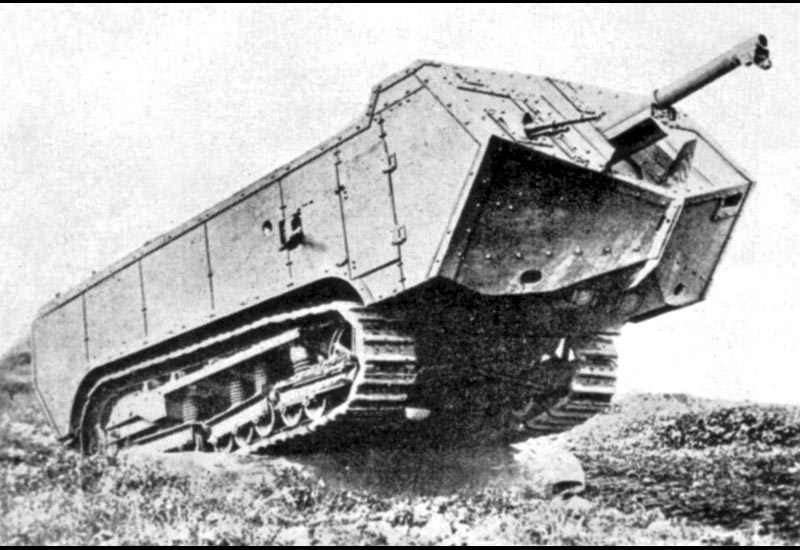
The most defining design characteristic of the St. Chamond was its oversized hull superstructure which spanned out over both the chassis front and rear. While this supplied the necessary internal volume needed for the gun, crew and engine, this naturally presented the tank with a very long hull that made crossing uneven terrain and trenches extremely difficult if not impossible. Once stuck, the St. Chamond would become nothing more than cannon fodder to German artillery or a sitting duck to grenade-toting German infantry. While the front hull sported some basic form of ballistics protection thanks to its angled face, the sides, rear and top of the vehicle were flat with little-to-no protection from artillery - the primary danger to tanks on the World War 1 battlefield. In addition to the detrimental hull design, the front-right machine gunner also managed the breech functions of the 75mm main gun which added unnecessary duties in the heat of battle (a dedicated gunner/loader managed the principle firing and elevation actions). The main gun, being fixed into its forward position, was limited in its elevation and therefore overall range and since the gun lacked any side-to-side traversal, the driver would have to turn the entire tank to face the target.

To make matters worse for the crew, the engine sat in an open-air fitting at the center of the design which divided the front and rear fighting compartments. Its open-air placement ensured that the fighting compartment would be noisy, smell of grease and oil and spew out fumes thusly making it a terrible work environment for the crew. Consider the fact that these were eight men required to spend hours on end in tight confines under the stress of battle. Walkways were set to either side of the engine to allow for crew allocation though these walkways were also home to the side machine gunners which complicated quick, effective internal maneuvering. One benefit of the open-air engine was easy access for make-shift repairs and maintenance in-the-field.

Once in service, the St. Chamond saw her armor increased from the original 11mm thickness to 19.5mm. The main gun designed by Rimailho was also dropped in favor of the standardized French Army modele 1897 series in 1917. A new roof design was implemented, intended to roll enemy grenades off of the tank while other protruding structures were eliminated for a much simpler, cleaner look. Early operational St. Chamond tanks had their armament removed and utilized for their hauling power in towing Schneider tanks.

The first "true" direct combat actions concerning St. Chamond tanks occurred on May 5th, 1917 to which three of the committed sixteen systems were lost in battle, others running aground over uneven terrain as expected. In limited operational service as a frontline combat tank, the St. Chamond failed to make an impression, ultimately given up in favor of the excellent French FT-17 two-man light tanks. Where the St. Chamond series did shine was in its assault prowess where her 75mm main gun could be brought to bear at distant targets. It was in this role that the St. Chamond would essentially become the assault gun that was never envisioned of her. The St. Chamond series would end the war as such while other chassis were relegated to supplementary roles, such as that of tracked supply carrier, until the armistice in November of 1918.

Some 377 St. Chamond tanks were completed during the war with only a single example remaining today - this on display at the Musee des Blindes in Saumur.
Text ©2003-2013 www.MilitaryFactory.com • All Rights Reserved • No Reproduction Permitted
MilitaryFactory.com does NOT sell equipment/weaponry. Material presented throughout this website is for historical and entertainment value and should not to be construed as usable for hardware restoration, maintenance or general operation. Please consult manufacturers for such information. Our disclaimer. Email corrections / Comments to MilitaryFactory at Gmail dot com.
Picture of Char D'Assault St. Chamond
Pic of the Char D'Assault St. Chamond
View All Images (2)

Specifications for the
Char D'Assault St. Chamond
Assault Gun / Armored Fighting Vehicle


Country of Origin: France
Manufacturer: St. Chamond - France
Initial Year of Service: 1916
Production: 377


Focus Model: Char D'Assault St. Chamond
Crew: 8


Overall Length: 28.97ft (8.83m)
Width: 8.76ft (2.67m)
Height: 7.74ft (2.36m)
Weight: 25.4 US Short Tons (23,000kg; 50,706lbs)


Powerplant: 1 x Panhard-Levassor 4-cylinder gasoline engine generating 90 horsepower with gasoline-electric drive.


Maximum Speed: 7mph (12 km/h)
Maximum Range: 37 miles (60 km)


NBC Protection: None
Nightvision: None


Armament:
1 x 75mm modele 1897 main gun
1 x 8mm Hotchkiss M1914 machine gun in front-right hull position.
1 x 8mm Hotchkiss M1914 machine gun in rear hull position.
1 x 8mm Hotchkiss M1914 machine gun in trainable left-hull side position.
1 x 8mm Hotchkiss M1914 machine gun in trainable right-hull side position.


Ammunition:
Not Available.


Variants:
Char D'Assault St. Chamond - Base Series Designation; ultimately saw her armor improved from 11mm to 19.5mm; original Rimailho 75mm gun replaced by modele 1897 series; redesigned roof to counter enemy grenades; some hulls converted to supply carriers sasns armament.


Operators: France

ALL LAND SYSTEMS CATEGORIES

By Decade:


1910 to 1919
1920 to 1929
1930 to 1939
1940 to 1949
1950 to 1959
1960 to 1969
1970 to 1979
1980 to 1989
1990 to 1999
2000 to 2009
2010 to 2019
VIEW ALL
Compare Tanks


By Type:


4x4 Military Vehicles
6x6 Military Vehicles
8x8 Military Vehicles
Artillery Gun Systems
Anti-Aircraft (AA) Guns
Anti-Aircraft (AA) Vehicles
Anti-Tank (AT) Guns
Anti-Tank (AT) Vehicles
Armored Cars
Armored Personnel Carriers (APC)
Battlefield Robots
Halftrack Vehicles
Heavy Tanks
Infantry Fighting Vehicles (IFV)
Light Tanks
Main Battle Tanks (MBT)
Modern Combat Tanks
Medium Tanks
Military Motorcycles
Multiple Launch Rocket Systems (MLRS)
Reconnaissance Vehicles
Special Purpose Vehicles
Self-Propelled Guns (SPG)
Tank Destroyers
General Purpose / Utility Vehicles


By Nation:


Afghanistan
Britain
China
France
Germany
Iran
Iraq
Israel / Israeli Army
Italy
Libyan Army
North Korea / North Korean Army
Pakistan
Russia
South Korea
Soviet Union
Syrian Army
United States
VIEW ALL

World War 2:


Artillery
Infantry Fighting Vehicles
Tank Destroyers (All)
Tanks (All)
Australian Tanks
British Tanks
Canadian Tanks
Cruiser Tanks (UK)
Czechoslovakian Tanks
French Tanks
German Tanks
German Tank Destroyers
German FlaK Guns
German Reconnaissance Vehicles
Hungarian Tanks
Italian Tanks
Japanese Tanks
Romanian Tanks
Soviet Tanks
Swedish Tanks
US Tanks
VIEW ALL


World War 1:


France WW1 Tanks
Germany WW1 Tanks
Britain WW1 Tanks
US WW1 Tanks
WW1 Artillery
WW1 Tanks (all)
VIEW ALL


Spanish Civil War:

VIEW ALL


Korean War:

Tanks
VIEW ALL


Vietnam War:

VIEW ALL


Cold War:

Cold War Tanks
Cold War American Tanks
Falklands War
Post-WW2 British Tanks
VIEW ALL


Gulf War (1991):

VIEW ALL


Miscellaneous:

Armored Vehicle Chassis Types

Site Disclaimer | Privacy Policy | Site Map | MF Origins


©2013 www.MilitaryFactory.com • Content ©2003-2013 MilitaryFactory.com • All Rights Reserved • Site Contact Email: militaryfactory at gmail dot com. The "Military Factory" name and MilitaryFactory.com logo are registered ® trademarks and protected by all applicable domestic and international intellectual property laws.


Top MF Stuff: 2013 Military Pay Scale | Military Ranks | WW2 Weapons | Sniper Rifles | Kts to Mph | WW1 Aircraft | Automatic Rifles | Aircraft Cockpits | Vietnam War Weapons | Main Battle Tanks | Submachine Guns | Shotguns | French Military Victories


Most photographic images appearing on this site are courtesy of the United States Department of Defense and are approved for public use. Other images acquired through the public domain. Digital art work courtesy of Dan Alex. Business Consulting by Kyle Williams. Material presented throughout this website is for historical and entertainment value and should not to be construed as usable for hardware restoration, maintenance or general operation. Please consult manufacturers for such information.


eXTReMe Tracker