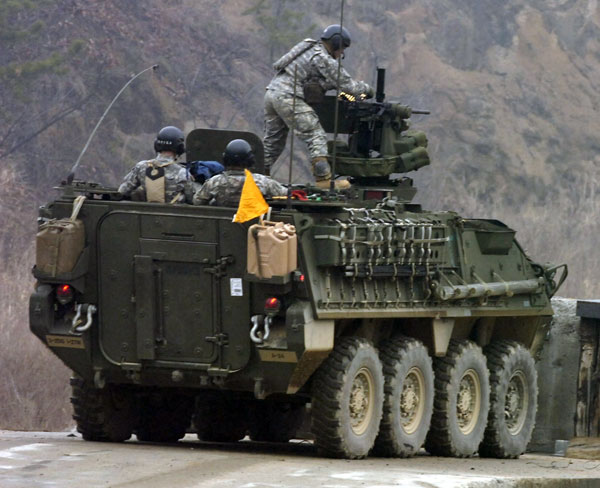
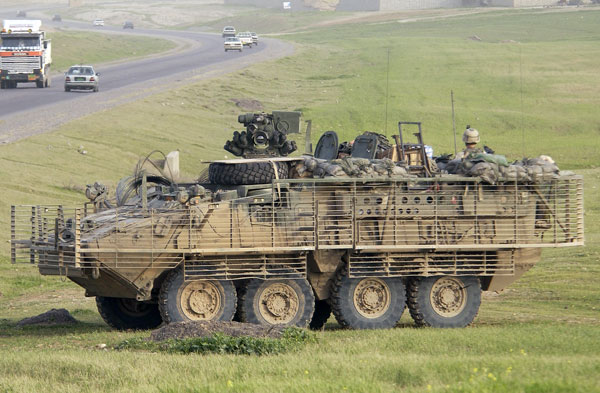
The M1126 Stryker is another 8x8 wheeled armored machine in the long line of Stryker vehicles. The primary operational role of the M1126 is as an armed armored personnel carrier that is able to ferry infantrymen and supplies to the front while providing a respectable level of firepower during the disembarking process. The weapons of the M1126 can be made specific to suit the role of the operator and a particular mission. The Stryker essentially shares the same basic chassis as the LAV family of "Generation III" wheeled vehicles.
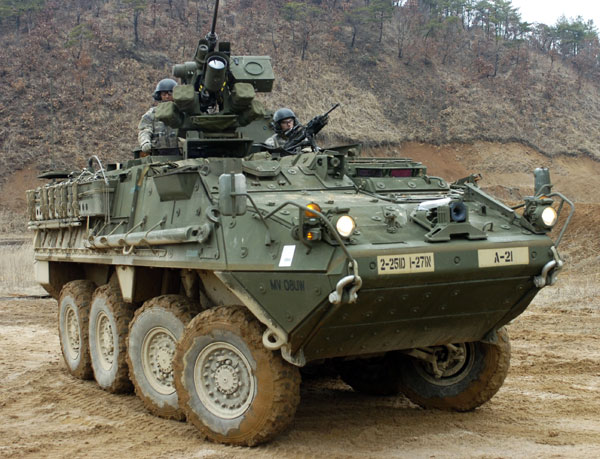
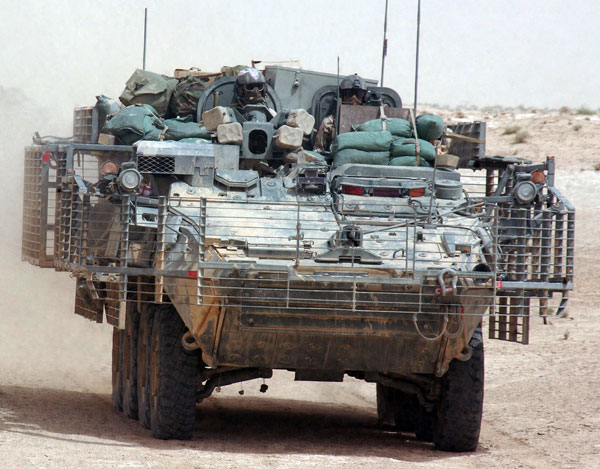
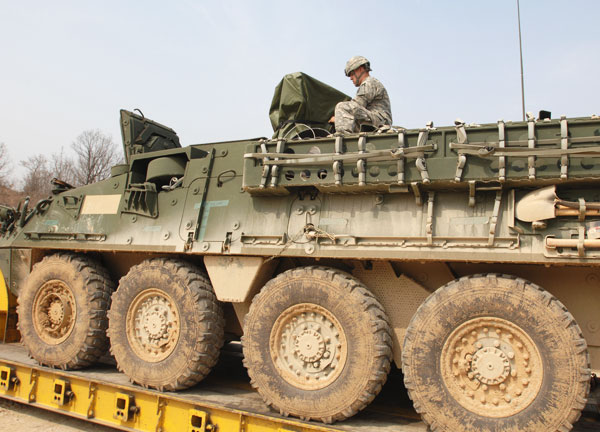
Design of the Stryker is characterized its eight large road wheels, fitted four to a side. The on-the-fly adjustable suspension system allows for 8x8 wheeled (full-time 4x4, selective 8x8) operation allowing the Stryker to operate effectively on both paved or unpaved road as needed. Armored surfaces are sharply angled at the front for increased protection to the crew and important internal systems alike while slab armor greets the side views. The Stryker features a broad glacis plate consistent with the Stryker family line of 8-wheeled vehicles. Seating is for two primary operators (driver and gunner) along with a litter of 9 combat-ready infantrymen and their applicable equipment. Infantry exit the vehicle through a large ramp at the rear of the hull. Multiple hatches atop the hull allow for crewmembers to achieve a stance position from within the Stryker body, though at the risk of exposing themselves to enemy fire. Hatch positions are located for the Squad Leader and VC along with two rear-guard positions as well as a power access hatch on the left hull side just rear of the drivers position and an additional escape hatch for passengers rear of that. The driver is afforded a dedicated hatch complete with vision blocks at the front left of the vehicle. The surface area of the Stryker upper hull is suitable for carrying various battlefield odds and ends.
A digital system onboard the Stryker allow for a fully-interactive battlefield map to be used in marking targets of note and their respective positions. This information can be utilized by other battlefield vehicles and commanders for more cohesive planning between units. Performance for the Stryker IVC comes from a single diesel powerplant developing 350 horsepower of output. The power to weight ratio is 15.8 kW/ton. A top speed of 62 miles-per-hour is listed though speeds reaching 70 miles-per-hour are indeed possible. Operational range for the Stryker system is reported at 300 miles.
Armament for the Stryker is made diverse and mission-specific thanks to the universal soft mount cradle atop the hull center. The cradle can accept the Remote Weapon Station that itself can fit a variety of weapons as needed by the operator. The RWS is a product of the Kongsberg Defense & Aerospace company of Norway and is represented on the Stryker by its US Army designation of PROTECTOR M151. The mounting can fit an M2 air-cooled, heavy caliber machine gun or the MK 19 series 40mm automatic grenade launcher. The turret system can also be fitted to fire up to 16 x M6-type smoke grenades. The M151 is a complete remote-controlled firing system meaning its occupants can engage enemy targets without exposing their upper bodies through a hatch to fire the weapon. All firing is handled from within the relative safety of the Stryker itself.
The Stryker's chassis makes up a wide range of mission-specific all-terrain armored vehicles. This includes the M1126 Infantry Carrier Vehicle, the M1127 Reconnaissance Vehicle, the M1128 Mobile Gun System, the M1129 Mortar Carrier, the M1130 Command Vehicle, the M1131 Fire Support Vehicle, the M1132 Engineer Support Vehicle, the M1133 Medical Evacuation Vehicle, the M1134 Anti-Tank Guided Missile vehicle, the M1135 Nuclear, Biological and Chemical Reconnaissance Vehicle and the prototype 105mm self-propelled howitzer system (development since cancelled).
" Stryker" is a US Army designation name for the LAV series and the name itself is derived from the names of two unrelated US Army Medal of Honor recipients (covering World War 2 and the Vietnam War) with the surname of "Stryker". The USMC utilizes the LAV family as the LAV-25, though a "Generation II" system.
The Iraqi National Police is due to receive some 400 M1126 Strykers, becoming the first export customer to do so.
October 2016 - The XM1296 ICV "Dragoon" was unveiled. The product, by General Dynamics, is an upgunned form of the base Stryker vehicle featuring a turreted 30mm autocannon for increased firepower. This effort is to bring the Stryker design more in line with Russian offerings which, historically, have always been very well-armed for infantry support and anti-armor operations. The U.S. Army received its first prototype Dragoon for evaluation on October 27th, 2016.
January 2023 - It is looking rather likely that Ukraine will be receiving a fleet of ex-American Stryker vehicles in the latest support package to the nation.
Power & Performance Those special qualities that separate one land system design from another. Performance specifications presented assume optimal operating conditions for the M1126 Stryker ICV (Infantry Combat Vehicle) 8x8 Wheeled Multirole Armored Fighting Vehicle (AFV).
1 x Caterpilla C7 diesel-fueled engine developing 350 horsepower. Installed Power
62 mph 100 kph Road Speed
311 miles 500 km Range
Structure The physical qualities of the M1126 Stryker ICV (Infantry Combat Vehicle) 8x8 Wheeled Multirole Armored Fighting Vehicle (AFV).
3 (MANNED) Crew
22.8 ft 6.95 meters O/A Length
8.9 ft 2.72 meters O/A Width
8.7 ft 2.64 meters O/A Height
36,240 lb 16,438 kg | 18.1 tons Weight
Armament & Ammunition Available supported armament, ammunition, and special-mission equipment featured in the design of the General Dynamics Stryker 8x8 Wheeled Multirole Armored Fighting Vehicle (AFV).
Primary armament fitted into M151 PROTECTOR Remote Weapon Station. Primary armament can include:
1 x 12.7mm Browning M2 air-cooled heavy machine gun
1 x 40mm SACO MK 19 Automatic Grenade Launcher (AGL).
4 x M6 smoke grenade dishargers
Secondary armament consists of:
1 x 12.7mm M2 air-cooled heavy machine gun
1 x 7.62mm M240 general purpose machine gun
"Dragoon" Variant:
1 x 30mm autocannon in turret.
1 x 7.62mm coaxial machine gun in turret.
1 x 12.7mm heavy machine gun over turret.
AMMUNITION: Dependent upon armament configuration.
Variants Notable series variants as part of the General Dynamics Stryker family line.
Stryker - Base Series Name.
M1126 ICV - Infantry Carrier Vehicle.
M1127 RV - Reconnaissance Vehicle.
M1128 MGS - Mobile Gun System.
M1129 MC - Mortar Carrier Vehicle.
M1130 CV - Command Vehicle.
M1131 FSV - Fire Support Vehicle.
M1132 ESV - Engineer Support Vehicle.
M1133 MEV - Medical Evacuation Vehicle.
M1134 ATGM - Anti-tank Missile System (TOW missile).
M1135 NBC RV - Nuclear, Biological, Chemical Reconnaissance Vehicle.
XM1296 "Dragoon" - Upgunned variant fitting turreted 30mm autocannon; first prototype in November 2016.
Operators Global customers who have evaluated and/or operated the General Dynamics Stryker. Nations are displayed by flag, each linked to their respective national land systems listing.
Total Production: 5,000 Units Contractor(s): General Dynamics Land Systems - USA
[ Iraq; Peru; Ukraine (ex-U.S. vehicles); United States ]
1 / 5
Image from the United States Department of Defense imagery database.
2 / 5
Image from the United States Department of Defense imagery database.
3 / 5
Image from the United States Department of Defense imagery database.
4 / 5
Image from the United States Department of Defense imagery database.
5 / 5
Image from the United States Department of Defense imagery database.
The "Military Factory" name and MilitaryFactory.com logo are registered ® U.S. trademarks protected by all applicable domestic and international intellectual property laws. All written content, illustrations, and photography are unique to this website (unless where indicated) and not for reuse/reproduction in any form. Material presented throughout this website is for historical and entertainment value only and should not to be construed as usable for hardware restoration, maintenance, or general operation. We do not sell any of the items showcased on this site. Please direct all other inquiries to militaryfactory AT gmail.com. No A.I. was used in the generation of this content.