Military Factory
Military Pay Chart
Global Firepower
Military Industrial Complex
Second World War
Home
Military Pay Scale
Military Ranks
Small Arms
Aircraft
Land Systems
Navy
Education
Military Factory Facebook Logo
flag of Italy

CANT Z.506 Airone (Heron) Maritime Reconnaissance / Bomber Floatplane (1936)

Authored By Staff Writer | Last Updated: 4/2/2013

The Italian CANT Z.506 series of floatplane aircraft was one of the few mounts to manage a useful existence before and after World War 2.

Find a School Near You
Follow Military Factory on Facebook:
Trending on Military Factory:
Recent Articles:
Cantieri Riuniti dell'Adriatico ("CANT") was responsible for the excellent Italian floatplane design that was the CANT Z.506 Airone ("Heron") series of the 1930s. The aircraft emerged from a commercial development which set about rewriting world aviation speed and distance records concerning aircraft of this class. The Z.506 began life as a commercial airliner shuttling persons over Italian Mediterranean routes before being adopted into service with the Italian Navy prior to and during World War 2 as a maritime patrol and bombing/torpedo platform. The aircraft managed an existence in the post-war world as well, her qualities proving useful in the at-sea rescue role.

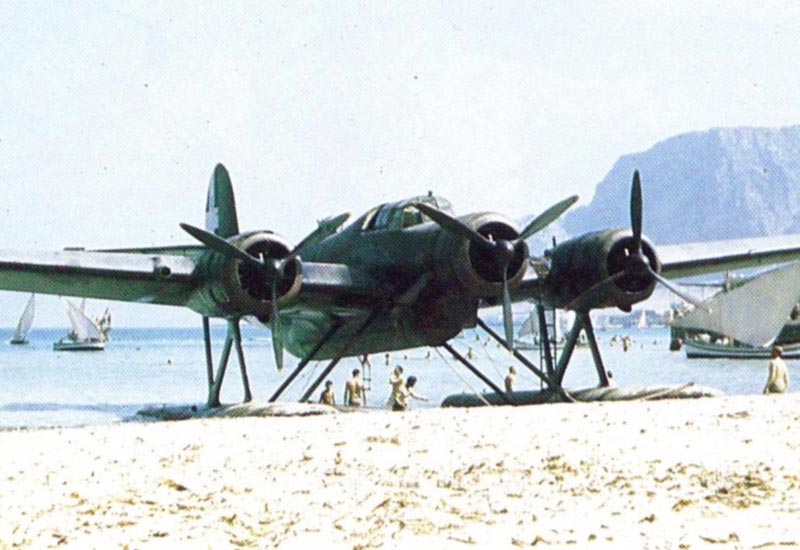
The CANT Z.506 offered up a very unique design appearance making her one of the more recognizable aircraft of the period. This was primarily due to her tri-motor configuration in which engine nacelles were affixed to both wing leading edges as well as the fuselage nose. The fuselage was well-streamlined from nose to tail, the latter capped by a conventional single-rudder tail unit. The fuselage sat atop a network of reinforced struts which attached it to a pair of long-running floats allowing for sea-based landings and take offs. The design was clean and well thought out for the period, combining a wooden understructure with canvas-and-wood skinning techniques which made it strong, light and cost-effective - only the floatplanes were actually constructed of more expensive metal. First flight was recorded on August 19th, 1935 with the prototype (powered by 3 x Piaggio P.IX radial piston engines of 610 horsepower each) giving rise to the original commercial model designated as the "Z.506A". The aircraft was formally introduced in 1936.

After the prototype proved the design highly sound, the Z.506A was ordered into serial production which begat an initial batch of 38 airframes in 1936. The first operating line of the type became Ala Littoria. The Italian Navy had taken notice of the record-setting aircraft and moved to adopt the tri-motor design in its military guise as the "Z.506B". This version was more-or-less a copy of the civilian-minded A-models though slightly reworked with a deeper fuselage to incorporate an observer's station/bomb bay and raised cockpit for improved outward visibility. Also in this version, the Alfa Romeo 126 series RC.34 radial piston engine of 750 horsepower was adopted for all three powerplant installations (2,250 horsepower combined) giving the airframe considerably more output power than previously designed. Crew accommodations amounted to five personnel. Fixed offensive/defensive armament was a network of machine guns - 1 x 12.7mm Breda-SAFAT heavy machine gun and 3 x 7.7mm Breda-SAFAT medium machine guns at various spots about the fuselage including dorsal and beam positions. The aircraft was cleared to haul up to 2,650lbs of stores (including a single 1,800lb torpedo in lieu of conventional drop bombs).

Initial Italian Navy units to receive the aircraft type became the 31st and 35th Naval Bomber Groups. With its steady powerplants in place, the Z.506B military model went on to raise even more aviation distance and ceiling records for her class including a nonstop jaunt from Cadiz, Spain to Caravelas, Brazil covering 4,362 miles during October of 1937. As the Italian Navy found increased usefulness in the Z.506 design, production was equally increased and ultimately involved Piaggio factories. The Regia Aeronautica (Italian Air Force) also adopted the type.

With its three-engine configuration, the Z.506B exhibited a maximum speed of 220 miles per hour and a range out to 1,200 miles. Her listed service ceiling was 23,000 feet. Dimensionally, the Z.506 aircraft was large with its 63 ft, 1.5 in running length, 24 ft, 5.3in resting height and 86 ft, 11.3 in wingspan. When empty, the airframe displaced at 19,300lbs and 28,000lbs when loaded.

With Italian interest now in the outcome of the Spanish Civil War (1936-1939), Italy supported the Nationalist movement alongside Nazi Germany and Portugal. This included a commitment of war goods that involved a few of its aircraft types such as the CANT Z.506. While not entirely engulfed in the regional bloodshed that followed, the Z.506 gave a good - though limited - account of itself in the conflict, taking flight to complete several recorded sorties. Its participation in the upcoming World War 2 would involve much more of the Z.506 series however.

World War 2 officially began in September of 1939 with the German invasion of Poland. The Polish Air Force had previously ordered six of the Z.506 aircraft though only one was ever delivered and this example destroyed during the German invasion of Poland. Italy joined on the side of the Axis powers in 1940 and, at this point, approximately 97 Z.506 series aircraft were still available for service through two Italian Navy bomber units. The type was used in anger as a sea-based bomber/torpedo bomber, maritime reconnaissance platform, convoy support aircraft and at-sea rescue platform (the latter under the designation of Z.506S "Soccorso"). As the war progressed, Z.506's became increasingly outclassed by smaller, more nimble intercepting fighter types fielded by the Allies which turned into mounting losses, proving the Z.506 a tactical liability in the direct bombing role. This relegated the series to more support-minded roles throughout the course of the war. Italy, as an Axis power, capitulated in September of 1943 and the war as a whole came to a close in August of 1945. The Z.506 managed to keep an existence through to the end fighting with elements of the Italian Co-Belligerent Air Force formed in southern Italy after the Italian Armistice of September. Some examples fell to the retreating Germans (to be operated by the Luftwaffe) in Italy and these were used against their former owners for a time and as made available. At least 70 examples fell to the Allies at the time of the Italian surrender.

After World War 2, remaining Z.506 systems were retained by the Italian Air Force and utilized as at-sea rescue aircraft where their good range, high endurance and floatplane landings could be used to perfection. The aircraft, therefore, managed a Cold War existence up to 1959-1960 when the final Herons were officially removed from service with the Italian Air Force.

Production spanned from 1935 to 1943, yielding 324 examples in all. A dimensionally larger version of the Z.506 was produced by CANT in 1937 for Ala Littoria and existed in three known examples as the Z.509.
Text ©2003-2013 www.MilitaryFactory.com • All Rights Reserved • No Reproduction Permitted
MilitaryFactory.com does NOT sell equipment/weaponry. Material presented throughout this website is for historical and entertainment value and should not to be construed as usable for hardware restoration, maintenance or general operation. Please consult manufacturers for such information. Our disclaimer. Email corrections / Comments to MilitaryFactory at Gmail dot com.
Picture of CANT Z.506 Airone (Heron)
View All Images (1)

Specifications for the
CANT Z.506 Airone (Heron)
Maritime Reconnaissance / Bomber Floatplane


Country of Origin: Italy
Manufacturer: CANT / Piaggio - Italy
Initial Year of Service: 1936
Production: 324


Focus Model: CANT Z.506 Airone (Heron)
Crew: 5


Length: 63.12ft (19.24m)
Width: 86.94ft (26.50m)
Height: 24.25ft (7.39m)
Weight (Empty): 19,290lbs (8,750kg)
Weight (MTOW): 28,010lbs (12,705kg)


Powerplant: 3 x Alfa Romeo 126 RC.34 9-cylinder air-cooled radial piston engine developing 750 horsepower each.


Maximum Speed: 226mph (364kmh; 197kts)
Maximum Range: 1,706miles (2,745km)
Service Ceiling: 26,247ft (8,000m; 5.0miles)
Rate-of-Climb: 0 feet per minute (0m/min)


Hardpoints: 1
Armament Suite:
STANDARD:
1 x 12.7mm Breda-SAFAT heavy machine gun in dorsal turret.
2 x 7.7mm Breda-SAFAT machine guns in beam fuselage positions.
1 x 7.7mm Breda-SAFAT machine gun in ventral position.

OPTIONAL:
Up to 2,600lbs of conventional drop bombs OR 1 x 1,800lb torpedo.


Variants:
Z.506 - Base Series Designation; original one-off prototype model.


Z.506A - Civilian variant

Z.506B - Military variant; deeper fuselage; provision for comventional drop bombs or single torpedo; raised cockpit deck.

Z.506S - Dedicated at-sea rescue variant

Z.506 (Landplane) - One-off seaplane converted to landbased role for endurance record.

Z.509 - Dimensionally larger variant of the Z.506 for Ala Littoria lines; three examples produced.


Operators: Italy; Nazi Germany; Poland; Spain; United Kingdom

ALL AIRCRAFT CATEGORIES

BY DECADE:


1900 to 1909
1910 to 1919
1920 to 1929
1930 to 1939
1940 to 1949
1950 to 1959
1960 to 1969
1970 to 1979
1980 to 1989
1990 to 1999
2000 to 2009
2010 to 2019
2020 to 2029
VIEW ALL
Compare Aircraft


BY TYPE:


Anti-Submarine Warfare (ASW)
Attack Helicopters
Bomber Aircraft
Medium Bombers
Heavy Bombers
Close-Air Support (CAS)
Commercial Aircraft
Dive Bombers
Electronic Warfare Aircraft (EWA)
Experimental / X-Planes
Fighter Aircraft
Floatplane Aircraft
Flying Boat Aircraft
Aerial Refueling Tankers
Helicopters (ALL)
Interceptor Aircraft
Multi-Role Aircraft
Navy Carrier Aircraft
Night Fighters
Reconnaissance / Scout
Search & Rescue (SAR)
Scout Helicopters
Special Purpose
Torpedo Bombers
Trainer Aircraft
Transport Aircraft
Transport Helicopters
Unmanned Aerial Vehicles (UAVs)
Unmanned Combat Air Vehicles (UCAVs)


COLLECTIONS:


4th Generation Fighter Aircraft
5th Generation Fighter Aircraft
US X-Planes
Classic US Warbirds
French Military Helicopters
Grumman "Cats"
Howard Hughes Aircraft
Indian Air Force
Israeli Air Force
Libyan Aircraft
Modern Chinese Aircraft
Modern Chinese Fighters
Modern Military Aircraft
Modern North Korean Aircraft
Modern Trainer Aircraft
Modern US Aircraft
Mikoyan Aircraft
Sukhoi Aircraft
Syrian Aircraft
Top 10 Fighter Aircraft of All Time


AIRCRAFT BY CONFLICT:


Arab-Israeli War (1948)
Cuban Missile Crisis (1959-1962)
Falklands War (1982)
Indo-Pak War (1965, 1971)
Iran-Iraq War (1980-1988)
Lebanon War (1982)
Operation Allied Force (1999)
Operation Desert Storm (1991)
Six Day War (1967)
Spanish Civil War (1936)
Soviet-Afghan War (1979-1989)
Yom Kippur War (1973)


MISCELLANEOUS:


Aircraft Cockpits
Aircraft Manufacturers List
Aircraft Timeline

WORLD WAR 2:


1939 Aircraft
1940 Aircraft
1941 Aircraft
1942 Aircraft
1943 Aircraft
1944 Aircraft
1945 Aircraft
1946 Aircraft
Australian Aircraft
Battle of Britain Aircraft
Bombers
Four-Engine Bombers
British Aircraft
British Bombers
British Transports
Dive Bombers
Canadian Aircraft
Fighters
Chinese Aircraft
French Aircraft
German Aircraft
German Fighters
German Flying Boats
German Jets
Secret Weapons of the Luftwaffe
Italian Aircraft
Imperial Japanese Aircraft
Imperial Japanese Fighters
Mitsubishi Bombers
Navy Aircraft
Pearl Harbor
Polish Aircraft
Romanian Aircraft
US Aircraft
US Bombers
US Navy Aircraft
Soviet Aircraft
Torpedo Bombers
Transport Aircraft
Tuskegee Airmen Aircraft
W.A.S.P. Aircraft
WW2 Aircraft Ranked by Speed
VIEW ALL


WORLD WAR 1:


1914 Aircraft
1915 Aircraft
1916 Aircraft
1917 Aircraft
1918 Aircraft
Aircraft Timeline
Austro-Hungarian Aircraft
Bomber Aircraft
British Aircraft
Fighters
Flying Boats
French Aircraft
Imperial German Aircraft
Italian Aircraft
Scout Aircraft
Russian Empire Aircraft
US Aircraft
WW1 Aircraft Ranked by Speed
VIEW ALL


KOREAN WAR:


Australian Aircraft
Korean War Aces
Korean War Jets
North Korean Aircraft
US Military Aircraft
VIEW ALL


VIETNAM WAR:


Helicopters
North Vietnam Air Force
US Airpower
VIEW ALL


COLD WAR:


1950s French Aircraft
British V-Bombers
Cold War Bombers
Soviet Aircraft
Soviet Bombers
Soviet Interceptors
Soviet Helicopters
Strategic Air Command
US Aircraft
US Bombers
US Interceptors
VIEW ALL

Site Disclaimer | Privacy Policy | Site Map | MF Origins


©2013 www.MilitaryFactory.com • Content ©2003-2013 MilitaryFactory.com • All Rights Reserved • Site Contact Email: militaryfactory at gmail dot com. The "Military Factory" name and MilitaryFactory.com logo are registered ® trademarks and protected by all applicable domestic and international intellectual property laws.


Top MF Stuff: 2013 Military Pay Scale | Military Ranks | WW2 Weapons | Sniper Rifles | Kts to Mph | WW1 Aircraft | Automatic Rifles | Aircraft Cockpits | Vietnam War Weapons | Main Battle Tanks | Submachine Guns | Shotguns | French Military Victories


Most photographic images appearing on this site are courtesy of the United States Department of Defense and are approved for public use. Other images acquired through the public domain. Digital art work courtesy of Dan Alex. Business Consulting by Kyle Williams. Material presented throughout this website is for historical and entertainment value and should not to be construed as usable for hardware restoration, maintenance or general operation. Please consult manufacturers for such information.


eXTReMe Tracker