Global Firepower | Military Industrial Complex | Second World War History
Home | Military Pay Scale Chart | Infantry Weapons | Military Aircraft | Vehicles | Navy Ships | Military Education | Military Ranks | WW2 Weapons | French Military Victories
Military Factory Latest from Military Factory
Thumbnail picture of the Arado Ar TEW 16/43-19
Arado TEW 16/43-19
Thumbnail picture of the Winchester Model 1866 Rifle
Winchester Model 1866
Thumbnail picture of the HMAS Brisbane destroyer
HMAS Brisbane
Thumbnail picture of the Henry Model 1860 Rifle
Henry Model 1860
Thumbnail picture of the USNS Henson survey ship
USNS Henson
Thumbnail picture of the FGS Schleswig-Holstein destroyer
Schleswig-Holstein
2010 Military Pay Scale Chart - for Army, Navy, Air Force and Marines
  BY DECADE
  · 1900 to 1909
  · 1910 to 1919
  · 1920 to 1929
  · 1930 to 1939
  · 1940 to 1949
  · 1950 to 1959
  · 1960 to 1969
  · 1970 to 1979
  · 1980 to 1989
  · 1990 to 1999
  · 2000 to 2009
  · 2010 to 2019
  · View All Aircraft
  BY TYPE
  · Attack Helicopters
  · Bombers
  · Close-Support
  · Commercial
  · Dive Bombers
  · Experimental
  · Fighters
  · Floatplanes
  · Flying Boats
  · Fuel Tankers
  · Helicopters
  · Interceptors
  · Multi-Role
  · Navy Aircraft
  · Night-Fighters
  · Recon Aircraft
  · Recon Helos
  · Special Purpose
  · Torpedo Bombers
  · Trainer Aircraft
  · Transport Aircraft
  · Transport Helos
  · UAVs
  WORLD WAR 2
  · Full List
  · 1939
  · 1940
  · 1941
  · 1942
  · 1943
  · 1944
  · 1945
  · Australia
  · Battle of Britain
  · Bombers
  · Britain
  · Dive Bombers
  · Canada
  · Fighters
  · China
  · France
  · Germany
  · German Fighters
  · German Flying Boats
  · German Jets
  · Italy
  · Japan
  · Mitsubishi Bombers
  · Poland
  · USA Aircraft
  · USA Bombers
  · Soviet Union
  · Torpedo Bombers
  WORLD WAR 1
  · Full List
  · 1914
  · 1915
  · 1916
  · 1917
  · 1918
  · Aces
  · Austria-Hungary
  · Bombers
  · Britain
  · Fighters
  · France
  · Germany
  · Italy
  · Recon Aircraft
  · Russia
  · USA
  KOREAN WAR
  · Full List
  · Aces
  · Australia
  · USA
  · North Korea
  VIETNAM WAR
  · Full List
  · United States
  · North Vietnam

Military Factory > Military Aircraft > Grumman F8F Bearcat
 
 
More Pictures Cockpit View 3 View Plan QuickGraphs StatsCentral

Grumman F8F Bearcat

The F8F Bearcat was one of the fastest piston-engine aircraft of its time, its performance on par with early jet-powered fighters.
By Staff Writer

Bookmark and Share

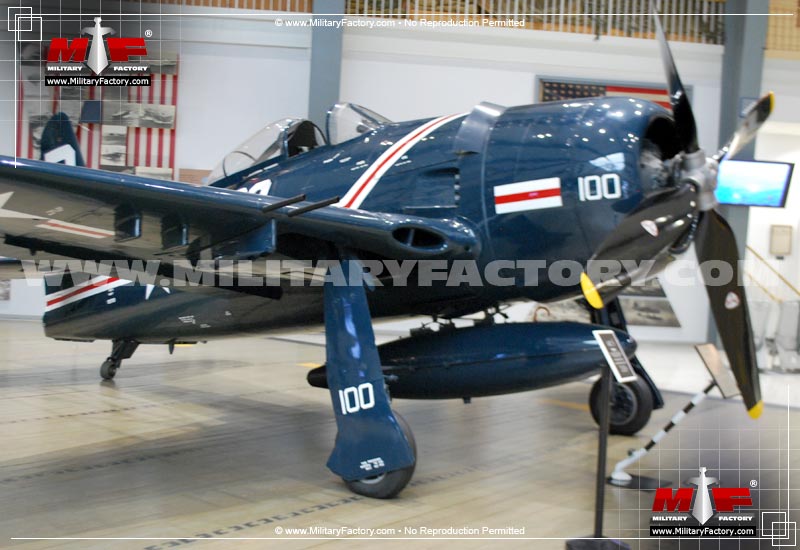
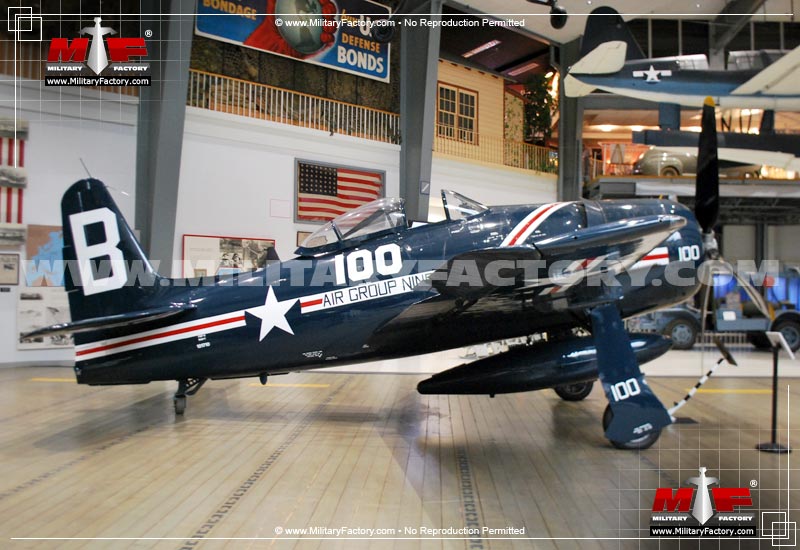
In many ways, the Grumman F8F Bearcat was the pinnacle of United States piston-engine fighter design. The aircraft arrived within the waning months of World War 2, missing combat action in all theaters altogether, but still managed to leave a legacy of power and performance even with the advent of the jet age. Its powerful Double Wasp radial piston engine and thoughtful design made for an excellent aircraft and one is left to his/his imagination as to the impact such a fighter would have had would it have shown up in time for combat in history's greatest airborne confrontations.

Grumman had a fighter aircraft history spanning back to the early 1930's. Grumman found success early in the war with its over-achieving F4F Wildcat fighter - the fighter that withstood the brunt of Japanese aggression surprisingly well until the formidable and classic Grumman F6F Hellcat was made ready in quantity. With this type of pedigree, Grumman's attempt to improve on their "cat" series was an inevitability and the F8F Bearcat would not disappoint except that when it was made ready, there was no more war to fight.

The Bearcat was born out of a specification requiring an interceptor aircraft designed around the powerful Pratt & Whitney R-2800 Double Wasp series radial piston engine (incidentally the same engine series powering the F6F Hellcat and the twin-engine F7F Tigercat). The aircraft would have to fit this engine into the smallest possible frame with every attention paid to the aircraft's overall weight. The resulting design succeeded in all fronts, culminating in an end-product proportionately better than the previous Grumman offerings.

The initial Grumman Company designation for the aircraft was G-58 (originating from Design 58, a report compiled by Grumman test pilot Bob Hall to Grumman President Leroy Grumman after his experiences in a captured German Focke-Wulf Fw 190) and was designed to succeed the F6F Hellcat series. Early forms of the Bearcat existed in this form and became two G-58A civilian-targeted systems, one for Major Alford Williams and owned by the Gulf Oil Company and the second owned by Grumman for demonstration purposes. The initial prototype became the XF8F-1, of which two were produced, and flew on August 21, 1944. Total design time for the Bearcat, from vision to air-worthy product, spanned just nine months.

When compared to the Hellcat, the Bearcat proved a much smaller design with better storage and use on the US Navy's aircraft and escort carriers. The Bearcat also exhibited better deck handling and performance far better than the Hellcat. The new design proved 20 percent lighter, about 50 miles per hour faster and had a 30% better rate-of-climb than its Hellcat brethren. Maneuverability and low-altitude performance were noted strong points of the aircrafts design.

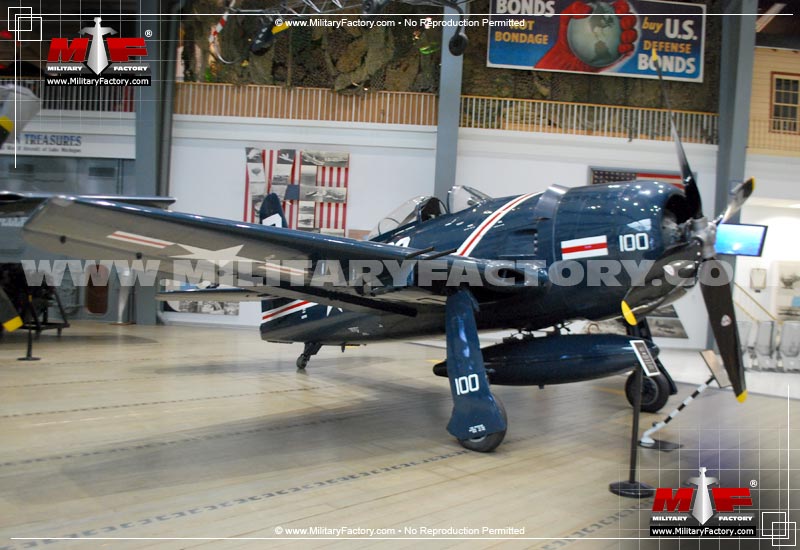
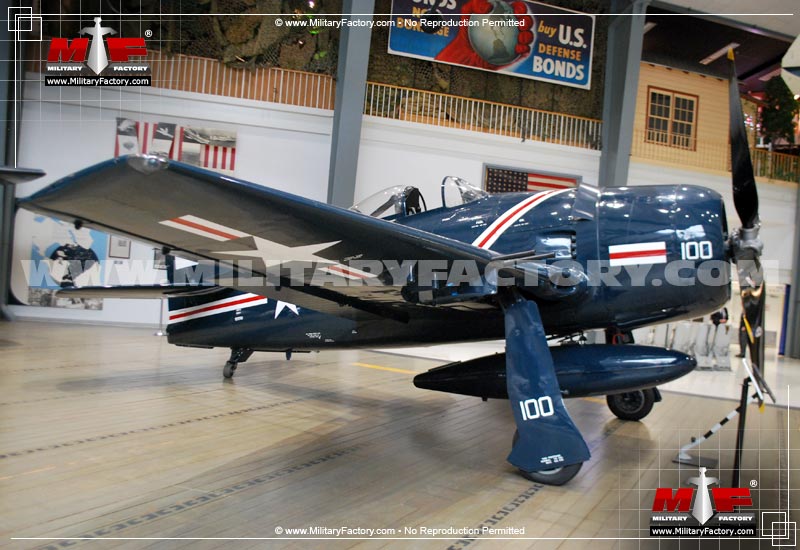
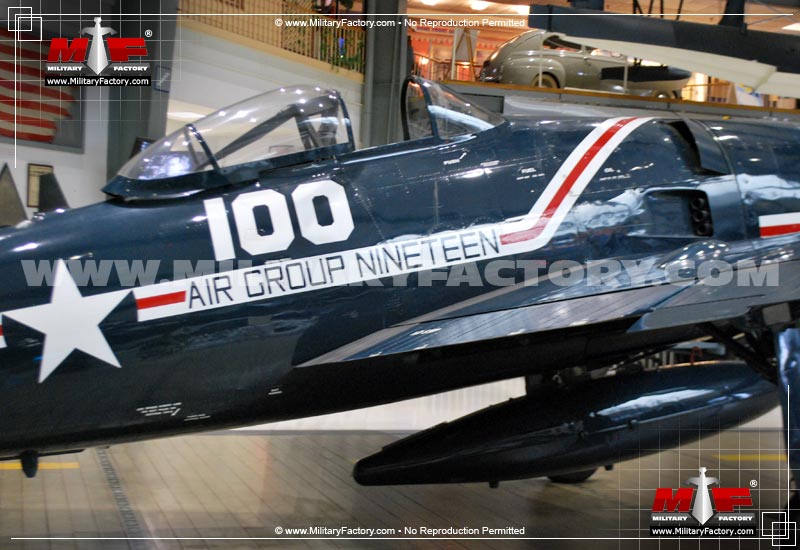
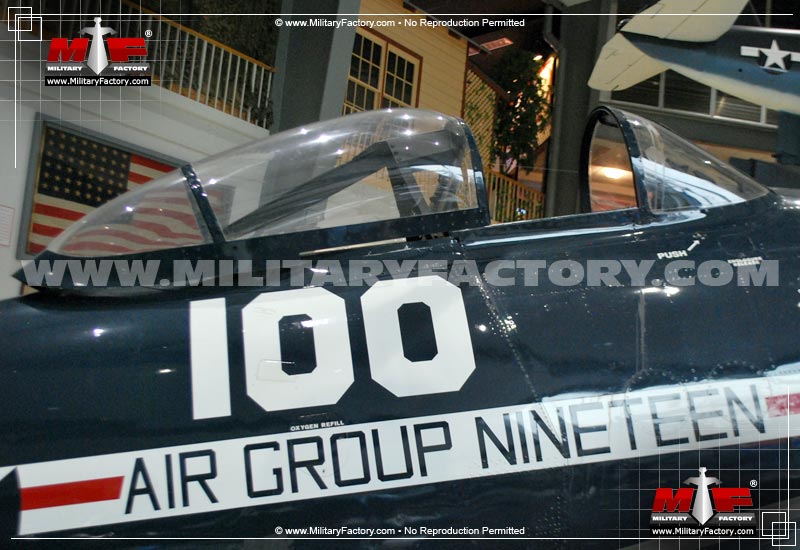
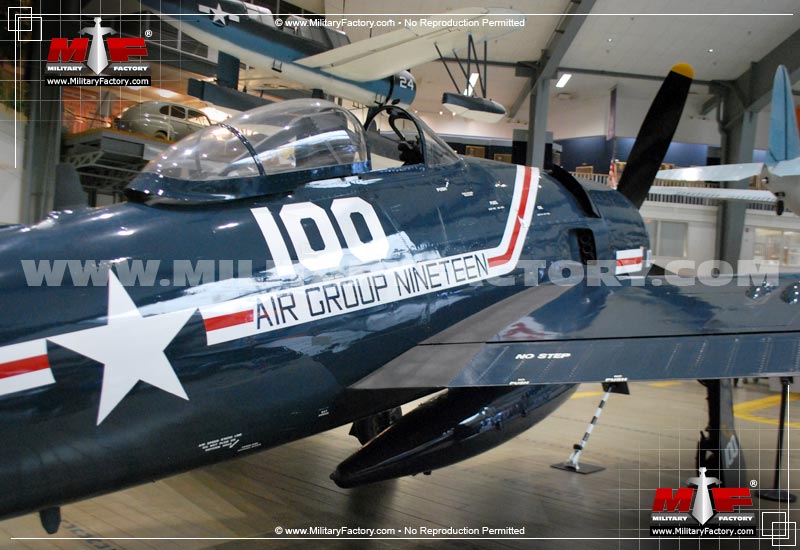
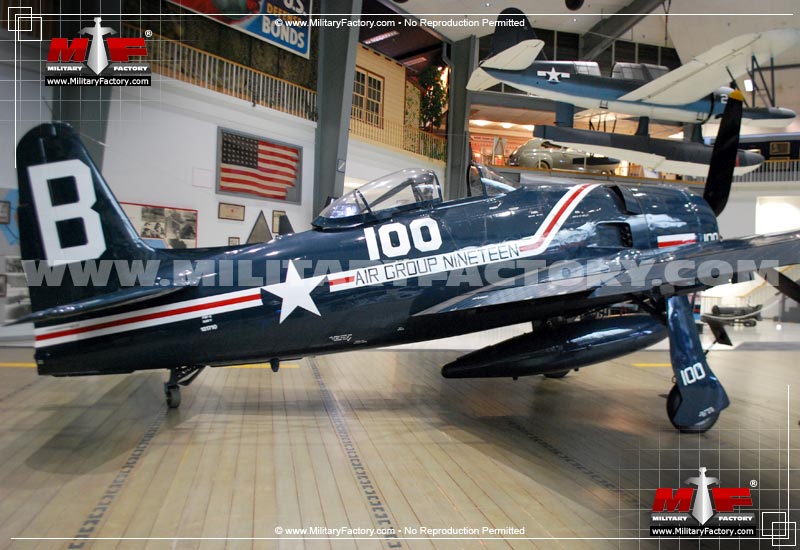
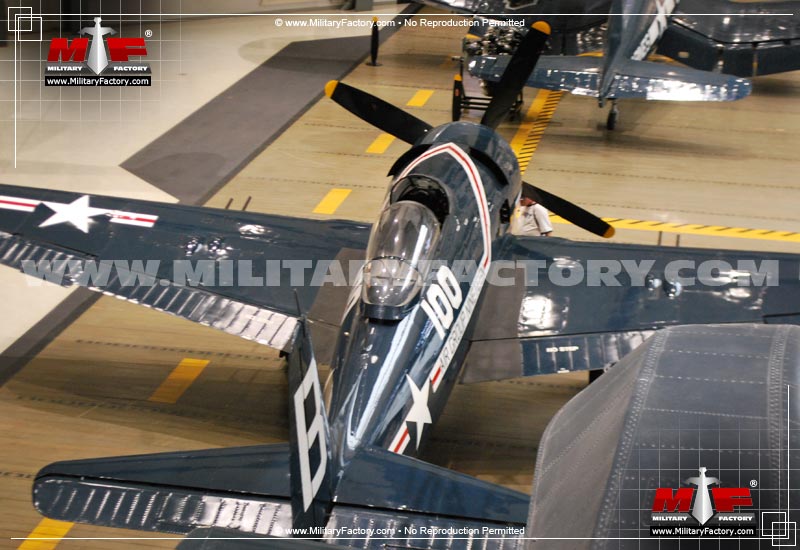
Design-wise, the Bearcat appeared quite the conventional piston-engine aircraft. Wings were low-wing monoplanes like the F6F before it. Unlike her predecessors, however, the F8F did away with the "razorback" raised rear fuselage styling and featured bubble canopy, affording the pilot unparalleled views in all directions - a vital part of the dogfighting success formula. The cockpit was situated well in the middle of the design and was armored as was the radial piston engine was encased in a sleek forward section, contoured into a slim fuselage shape. The empennage was conventional with a single vertical tail fin and horizontal planes. The undercarriage was fully retractable (including the tail wheel) with the main landing gears retracting towards the fuselage centerline in the wings. The main landing gears were of a purposeful length as the oversized propeller component necessitated this design element. Machine gun (and later) cannon armament and external stores were all located on the wings. One distinct design characteristic of the Bearcat series was in the selection of the Aero Products four-blade propeller of considerable size (over 12 feet!), adding to the menacing look that the aircraft exuded when at rest. Construction featured spot welding and flushed rivets.

The XF8F-1 prototypes gave birth to the first production Bearcat model designated as the F8F-1. This model featured folding wings - now a requirement of carrier-based aircraft the world over - self-sealing fuel tanks (another requirement of fighter aircraft) and a retractable tailwheel unit. Power was supplied by the Pratt & Whitney company and their outstanding R-2800-34W Double Wasp series of radial piston engines. This initial Bearcat was slightly slower than the wartime high-performance Vought F4U Corsairs but offered up excellent handling characteristics and a better rate-of-climb. Interestingly, armament was limited to only 4 x 12.7mm heavy machine guns but this was necessitated by the project design goals to cut weight at every corner. Bearcat F8F-1 models were also produced under the General Motors Company banner with these being designated as F8M-1's. F8F-1's became available in February of 1945 with the first squadron - VF-19 - made operational on May 21st of that year. Despite its late entry into the Second World War, a conflict it had arrived too late to see any service in, the Bearcat went on to provide many faithful years of service to the US Navy. In fact, no fewer than 24 Bearcat squadrons would see operational status during the Bearcat's reign.

The Bearcat was produced in a handful of conventional variants. The F8F-1 model spanned into a new production model known as the F8F-1B. These were essentially similar to their forerunners but were upgraded in the armaments department with a collection of 4 x 20mm, a vast improvement over the initial 4 x 12.7mm machine gun armament. The F8F-1 was later refurbished and exported to France (as 100 examples) and Thailand (from 100 to 150 examples depending on the source) under the F8F-1(D) designation and also appeared as a night-fighter in the XF8F-1N prototype (of which two were constructed) and the production F8F-1N, these being fitted with the APS-19 radar system.

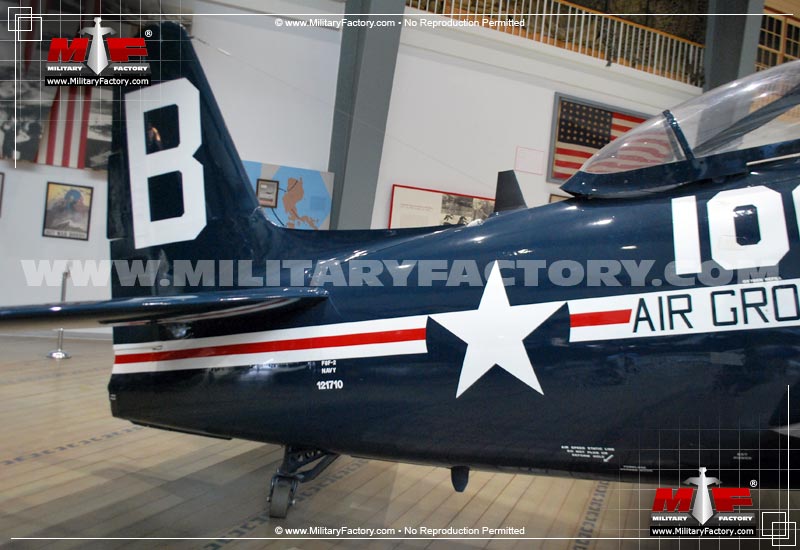
Inevitably, the initial design held more promise than it displayed and a new improved model was worked on in the XF8F-2 Bearcat prototype, a total of two aircraft being constructed. The XF8F-2 appeared in production form beginning in 1948 with a Pratt & Whitney R-2800-30W radial piston engine and 4 x 20mm cannon armament as standard. Changes in this new model also included a taller tail fin with associated enlarged rudder component and a revised engine cowling. At least 293 of the F8F-2 series would see production.

Like the Bearcats before it, the F8F-2 was spawned into a night-fighter platform in the F8F-2N. Like the F8F-1N before it, the F8F-2N also sported the APS-19 radar system. The F8F-2P became a photo-reconnaissance model outfitted with camera and associated equipment. Two 20mm cannons were retained from her fighter origins. The end of the Bearcat production line was in sight as the type was being phased out by 1952. As fate would have it, several became undistinguished drone control aircraft from converted F8F-1 and F8F-2 models designated as F8F-1D and F8F-2D respectively.

The F8F Bearcat proved no slouch in the performance department. A maximum speed of 421 miles per hour was possible along with a rate-of-climb topping 4,570 feet per minute. The aircraft's service ceiling maxed out at 38,700 feet while range was limited to 1,105 miles. In fact, Bearcats were noted for outperforming even the earliest of jet-powered designs, such was the designs success.

Beyond the original 4 x 12.7mm machine gun armament and the later 4 x 20mm cannon armament, the Bearcat featured provisions for 4 x 5" unguided rockets along with 1,000lbs of bombs. Its low-level performance and handling capabilities made the Bearcat a natural and lethal close-support aircraft.

The only operators of the Bearcat (along with the United States Navy) became France, Thailand and South Vietnam. Some 1,266 Bearcats would eventually be produced. Today, a handful of air-worthy Bearcats survive and are used in airshows and races. Bearcats were eventually replaced in USN service by the jet-powered McDonnell F2H Banshee and Grumman F9F Panther series. France utilized the Bearcat in its war in Indochina. Surviving French Bearcats were eventually passed on for service into the newly-formed Vietnamese Air Force beginning in 1955.

The F8F Bearcat became Grumman's last piston-engine fighter and its faster piston-powered product. Notable Bearcat pilots included Grumman test pilot Corky Meyer and future astronaut Neil Armstrong (the Bearcat reportedly being the latter's favorite aircraft to fly).

Text ©2003-2010 www.MilitaryFactory.com • All Rights Reserved • No Reproduction Without Permission • Corrections / Comments to MilitaryFactory at Gmail dot com

Last Revision: 10/8/2009


  Specifications for the Grumman F8F-1B Bearcat
arrow downDimensions:
Length: 28.25ft (8.61m)
Width:35.83ft (10.92m)
Height: 13.78ft (4.20m)

arrow downPerformance: About MACH
Max Speed: 421mph (677kmh; 366kts)
Max Range: 1,105miles (1,778km)
Rate-of-Climb: 4,570ft/min (1,393m/min)
Service Ceiling: 38,698ft (11,795m; 7.3miles)

arrow downStructure:
Accommodation: 1
Hardpoints: 2
Empty Weight: 7,068lbs (3,206kg)
MTOW: 12,948lbs (5,873kg)

arrow downPowerplant:
Engine(s): 1 x Pratt & Whitney 2,100hp R-2800-34W Double-Wasp 18-cylinder radial piston engine.
arrow downArmament Suite:
INITIAL:
4 x 12.7mm machine guns

STANDARD:
4 x 20mm cannons

OPTIONAL:
4 x 12.7cm rockets OR 1 x 1000lb bomb

  Pictures of the Grumman F8F Bearcat
     
Picture of Grumman F8F Bearcat
Picture of the Grumman F8F Bearcat
Image of the Grumman F8F Bearcat
     
arrow upView All 5 Images

CompareX2 CompareX4 Conversions Dictionary Acronyms

Compare and Contrast Military Aircraft Specifications

  Special Aircraft Collections
Aircraft by Conflict:
Falklands War
Indo-Pak War
Operation Allied Force
Operation Desert Storm
Six Day War
Yom Kippur War

Special Collections:
American X-Planes
Classic US Warbirds
Grumman "Cats"
Indian Air Force
Israeli Air Force
Mikoyan-Gurevich
British V-Bombers


Korean Air War:
Korean War Aircraft
Aces
Australia
United States
North Korea

Vietnam Air War:
Vietnam War Aircraft

Cold War
Cold War Aircraft
United States
Soviet Union
Soviet Bombers of the Cold War

Modern Aircraft
Modern Military Aircraft
United States

Miscellaneous
MiG-15 Versus Sabre
Top 10 Fighters of All Time
WW2 Aircraft Ranked by Speed
Aircraft Cockpits


  Recent Military Aircraft Additions
Thumbnail picture of the Arado Ar TEW 16/43-19
Arado TEW 16/43-19
Thumbnail picture of the Antonov An-2 Colt
Antonov An-2 Colt
Thumbnail picture of the Kyushu K11W Shiragiku bomber trainer
Kyushu Shiragiku

  Contacting MilitaryFactory.com
We can only get better if you tell us how. You can contact MilitaryFactory.com at MilitaryFactory at gmail dot com (replace "at" with "@" and "dot with ".") with any questions, comments or corrections. We also accept related military imagery that you approve for us to use on our website. Keep in mind, however, that due to volume, we may not directly respond to your inquiry. Please add us to your list of non-blocked recipients!

  Aircraft Quick Profile


Picture of the Grumman F8F Bearcat
Image courtesy of the United States Department of Defense.

View More Images

flag of United States
1945

Designation: Grumman F8F Bearcat
Classification Type: Carrier-Borne Fighter / Interceptor Aircarft
Contractor: Grumman - USA

Country of Origin: United States
Production Total: 1,266

Operators: France; North Vietnam; South Vietnam; Thailand; United States


  Variants
G-58 - Grumman Company Designation

G-58A - Civilian Model of which two were produced; second model was for demonstration purposes.

XF8F-1 - Two Prototype Models

F8F-1 - Initial Production Model; fitted with Pratt & Whitney R-2800-34W Double Wasp radial piston engine of 2,100 horsepower; folding wings; self-sealing fuel tanks; 4 x 12.7mm machine guns; retractable tailwheel.

F8M-1 - F8F-1 models produced by General Motors.

F8F-1B - Armament changed to 4 x 20mm cannons; 100 exmaples produced.

F8F-1(D) - Export Production Model for France (100 examples) and Thailand (~100 examples).

XF8-1N - Two Night-Fighter Prototype Models

F8F-1N - Night-fighter Production Model Designation; fitted with APS-19 series radar; 36 examples produced.

XF8F-2 - Two Prototypes of F8F-2 Production Models.

F8F-2 - Second Production Model; billed as "improved" Bearcat; fitted with Pratt & Whitney R-2800-30W radial piston engine; revised engine cowling; enlarged dorsal rudder and vertical tail fin; 4 x 20mm cannon armament; 239 produced.

F8F-2N - Night-Fighter Production Variant based on F8F-2 models; fitted with APS-19 radar; 12 examples produced.

F8F-2P - Photo-Reconnaissance Platform; outfitted with cameras and associated equipment; 2 x 20mm cannons retained for self-defense; 30 examples produced.

F8F-1D - F8F-1 Production Models converted to Drone Control Aircraft.

F8F-2D - F8F-2 Production Models converted tp Drone Control Aircraft.

  Collections
  • Sons of Empire - WW2 Aircraft of Japan
  • Aircraft of the Battle of Britain
  • X-Planes Throughout History
  • French Aircraft of World War 1
  • The German Luftwaffe in World War 2
  • Nightfighters - In a Class All Themselves
  • The Top Ten Fighters of All Time
  • Carrier "Born" Aircraft - Navy Mounts
  • If Boats Could Fly - Flying Boat Aircraft
  • World War 1 Aircraft Ranked by Speed
  • World War 2 Aircraft Ranked by Speed


Top MF Stuff: 2010 Military Pay Scale Chart | Military Ranks | World War 2 Weapons | Sniper Rifles | Conversion Calculators


Site Disclaimer | Privacy Policy | Site Map | MF Origins

©2010 www.MilitaryFactory.com • Content ©2003-2010 MilitaryFactory.com • All Rights Reserved • Site Contact Email: militaryfactory at gmail dot com (replace "at" with "@" and "dot" with ".")

eXTReMe Tracker

Most photographic images appearing on this site are courtesy of the United States Department of Defense and are approved for public use. Other images acquired through the public domain. Digital art work courtesy of Dan Alex. Business Consulting by Kyle Williams

Material presented throughout this website is for historical and entertainment value and should not to be construed as usable for hardware restoration, maintenance or general operation. Please consult manufacturers for such information.